Short answer
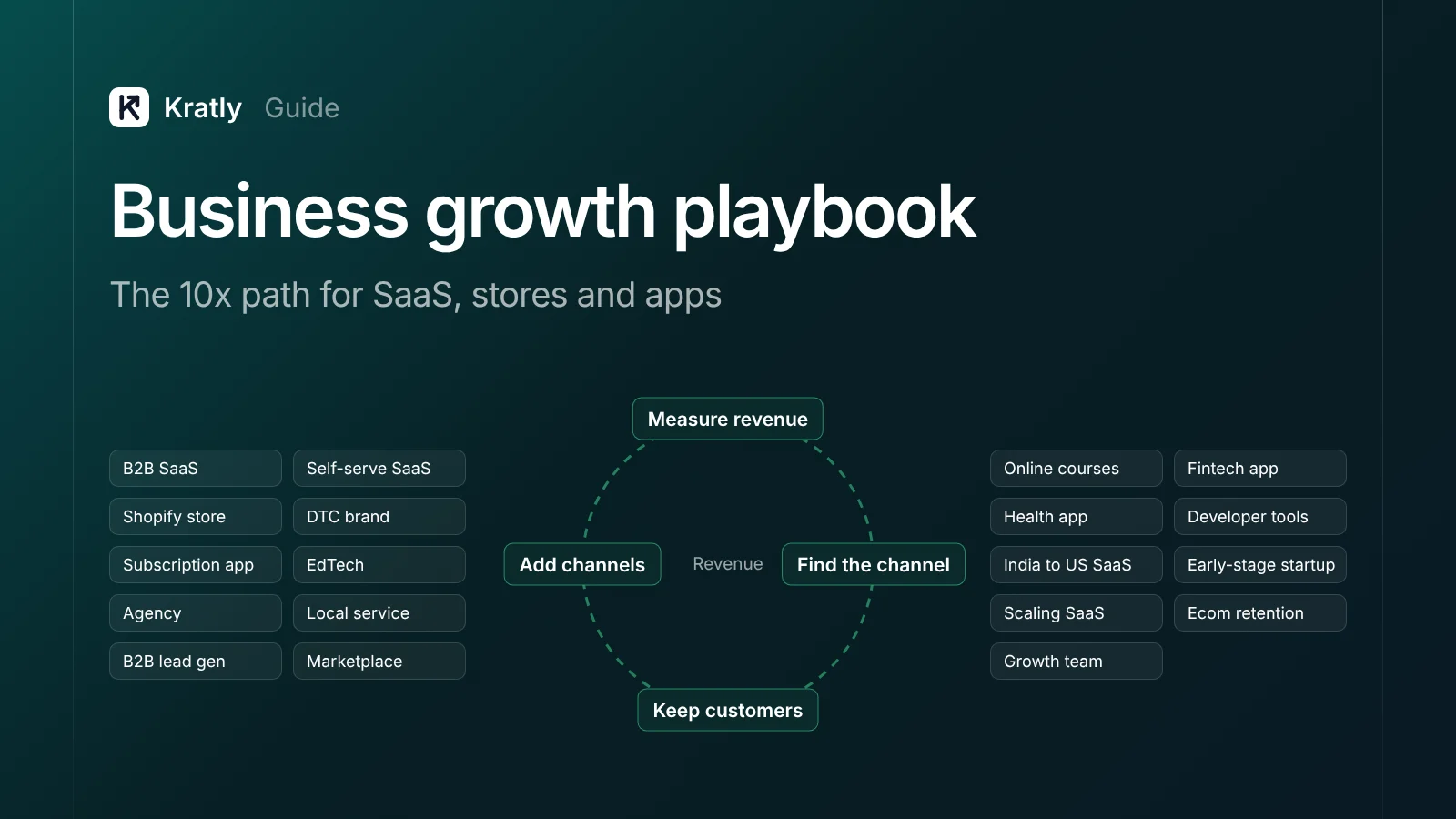
A business growth playbook is the short list of moves that grow revenue at your stage, for your type of business. The path to 10x is the same almost everywhere. Build one revenue scoreboard. Fix measurement before you scale spend. Find the one channel that pays. Keep the customers you win. Then add channels.
Of all US business establishments born in March 2013, 79.6% were still open a year later. After five years, 50.6% were left. After ten years, only 34.7% were still operating. That's Bureau of Labor Statistics data, published in January 2024.
People keep starting anyway. In December 2025 alone, Americans filed 497,046 business applications, seasonally adjusted, per the Census Bureau.
So how do the survivors grow? This business growth playbook is the hub for 19 guides, one per business type. This page shows what they share, and which one to read first.
What is a business growth playbook?#
A business growth playbook is a written plan of the few moves that will grow revenue next, chosen for your business type and stage. It names each move, what it costs, when it should pay, and the revenue number that proves it worked.
That last part is where most plans fail. A growth plan full of activity targets (posts, clicks, leads) can hit every goal while revenue stays flat. A playbook is judged only by money in Stripe, Shopify, the app stores or your CRM.
Why split playbooks by business type? A Shopify store sees revenue minutes after the click. A B2B SaaS company may wait three months for a contract. A local plumber's revenue arrives as a phone call. The steps are similar. The data, the delays and the first move are not.
All 19 playbooks by business type#
Find your row. If two fit, see how to pick.
| # | Business type | Who it's for | Stage | First move | Main revenue metric | Playbook |
|---|---|---|---|---|---|---|
| 51 | B2B SaaS | Sales-assisted SaaS selling to companies | First 100 customers to $1M ARR | Tie every paying account in Stripe or the CRM to its first campaign | New ARR by channel | B2B SaaS growth strategy: first 100 customers to $1M ARR |
| 52 | Self-serve SaaS | Product-led tools with a trial or free plan | Plenty of trials, too few paying | Find the first action that predicts payment | Trial-to-paid rate | Product-led growth strategy: trials that pay without a sales team |
| 53 | Shopify store | Owner-run stores | $10k to $100k a month | Match ad-reported sales to real Shopify orders | Profit after ad spend | How to grow a Shopify store from $10k to $100k a month |
| 54 | DTC brand | Brands scaling on Meta and Google | Ads work; scaling them is the problem | Set break-even ROAS from gross margin | New-customer revenue per ad dollar | DTC marketing strategy: Meta and Google at each revenue stage |
| 55 | Subscription app | iOS and Android apps sold by subscription | Installs rising, payers flat | Join web, ad and in-app data into one funnel | Download-to-paid rate | Subscription app growth strategy: installs that turn into payers |
| 56 | EdTech and exam prep | Course, tutoring and test-prep businesses | Revenue tied to exam seasons | Plan spend around the exam calendar | Paid enrollments per season | EdTech marketing strategy: exam prep, courses and seasonal demand |
| 57 | Marketing agency | Agencies running paid and SEO for clients | Client churn after month six | Report client revenue, not clicks | Client revenue tied to your work | How to prove marketing ROI to clients with revenue, not reports |
| 58 | Local service business | Trades, clinics, legal and home services | Leads come by phone and form | Track calls and forms to booked jobs | Cost per booked job | Local service business marketing: ads and SEO for booked jobs |
| 59 | B2B lead gen | Companies selling through demos and sales calls | Many form fills, thin pipeline | Send closed revenue back to the ad platforms | Closed revenue by channel | B2B lead generation strategy: measure pipeline, not form fills |
| 60 | Marketplace | Two-sided platforms | One side is short | Find which side limits completed transactions | Completed transactions (GMV) | Marketplace growth strategy: grow both sides without burning cash |
| 61 | Online course creator | Solo creators and small teams | Launch-driven revenue | Grow the email list that buys | Revenue per email subscriber | How to sell online courses: launches, evergreen funnels and email |
| 62 | Fintech app | Banking, investing and payments apps | Sign-ups that never fund | Optimize ads to funded accounts | Cost per funded account | Fintech marketing strategy: grow funded accounts, not installs |
| 63 | Health and wellness app | Fitness, mental health and care apps | Growth limited by privacy rules | Audit what your tracking sends to ad platforms | Paying subscribers | Healthcare app marketing: grow while respecting privacy rules |
| 64 | Developer tools | APIs, SDKs and dev platforms | Developers use it free; teams must pay | Write docs and pages for the jobs developers search | Paying teams | Developer marketing strategy: docs, SEO and communities that pay |
| 65 | SaaS from India to the US | Indian founders selling to US buyers | First US customers | Price in USD and test the US checkout | US revenue in USD | SaaS go-to-market in the USA from India: pricing and payments |
| 66 | Early-stage startup | Founders with about $5k a month to spend | Before a repeatable channel | Pick one channel and judge it by paying customers | CAC by channel | Startup marketing budget: where to spend your first $5k a month |
| 67 | Scaling SaaS | Companies between $1M and $10M ARR | Channels saturating, team growing | Make CAC payback the budget rule | CAC payback (months) | How to scale SaaS to $10M ARR: what changes after $1M |
| 68 | Ecommerce retention | Stores with a base of first-time buyers | Paying for the same customer twice | Build post-purchase email and SMS flows | Repeat purchase rate | Ecommerce retention strategy: email, SMS and repeat purchases |
| 69 | Growth team design | Any business deciding who to hire | Founder can't run growth alone | Hire for the bottleneck, not the title | Cost per paying customer after the hire | When to hire a growth marketer: agency, in-house or AI by stage |
Notice the "first move" column. Ten of the 19 are about measurement or tying spend to money. None say "launch a new channel." That's the pattern this page is about.
How do you grow a business 10x? The common path#
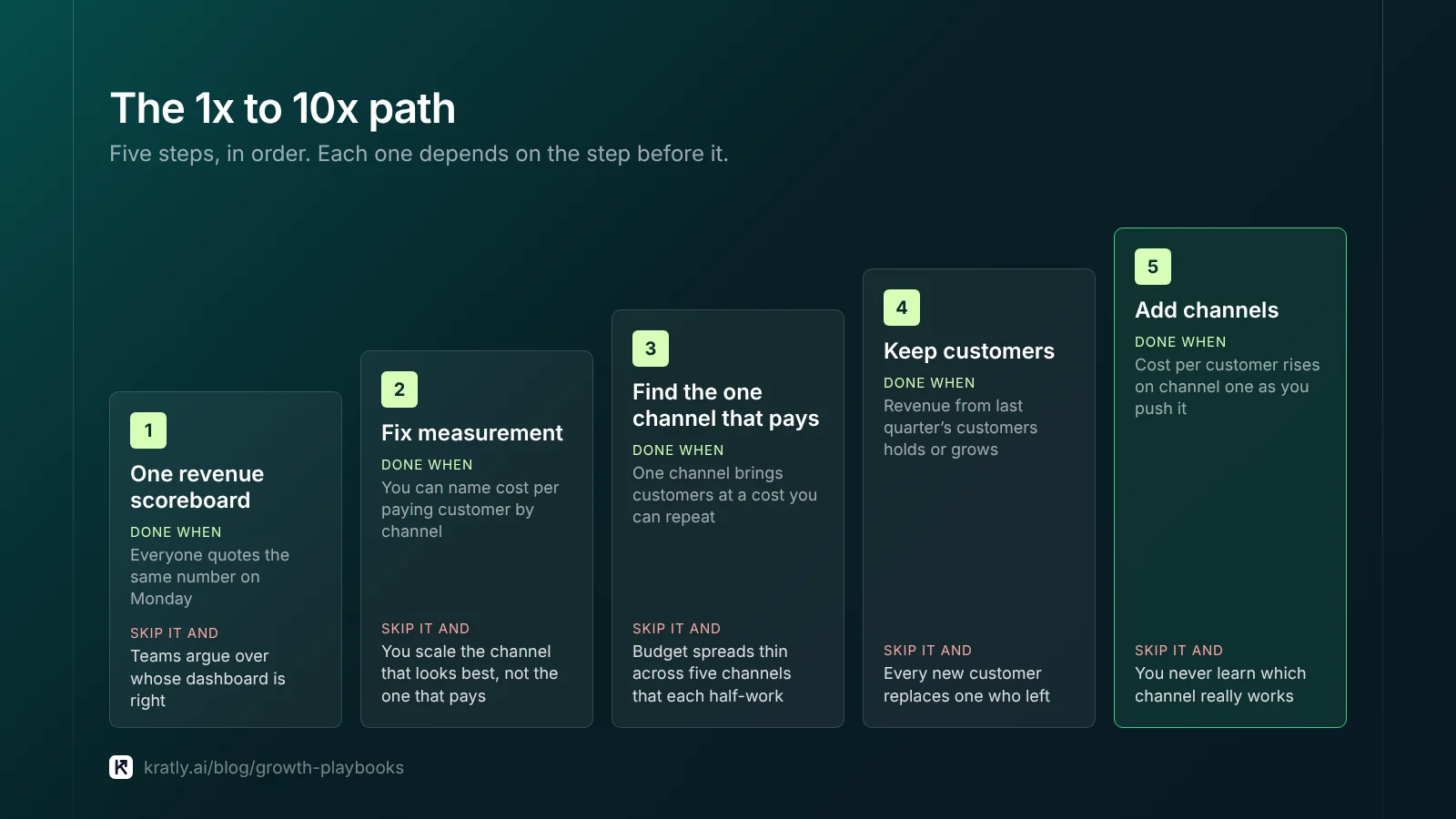
Strip away the industry details and the path from 1x to 10x has five steps. They run in order.
| Step | What you do | You know it's done when… | What breaks if you skip it |
|---|---|---|---|
| 1. One revenue scoreboard | Pick one revenue number and one source of truth | Everyone quotes the same number on Monday | Teams argue over whose dashboard is right |
| 2. Fix measurement | Tie each paying customer to the campaign, page or email that brought them | You can name cost per paying customer by channel | You scale the channel that looks best, not the one that pays |
| 3. Find the one channel that pays | Test a few channels; double down on one | One channel brings customers at a cost you can repeat | Budget spreads thin across five channels that each half-work |
| 4. Keep customers | Fix activation, repeat purchase and churn | Revenue from last quarter's customers holds or grows | Every new customer replaces one who left |
| 5. Add channels | Add a second channel only when the first saturates | Cost per customer rises on channel one as you push it | You never learn which channel really works |
Before step 1: is there a product people would miss?#
CB Insights studied 431 VC-backed companies that shut down since 2023. In its March 2026 analysis, 70% ran out of capital and 43% had poor product-market fit. CB Insights notes that running out of cash is usually the last cause, not the root one.
Superhuman's Rahul Vohra asked users how they'd feel if they could no longer use the product. Superhuman's share of "very disappointed" users started at 22% in summer 2017. He used Sean Ellis's benchmark: "the magic number was 40%." Within three quarters of product work, the score reached 58% (First Round Review).
His advice to investors also applies to founders: "avoid pushing for growth ahead of product-market fit."
Step 1: Build one revenue scoreboard#
Pick the number that pays the bills and the system that records it: MRR in Stripe, orders and margin in Shopify, or paying subscribers from the app stores.
Then make it the only number in the Monday meeting. Ad platforms, analytics and email tools each report their own "revenue," and they won't agree. The scoreboard picks the system where money actually lands.
What I'd put on it, at most: revenue, new paying customers, cost per paying customer, and revenue kept from last period's customers. Four numbers. Anything else is a drill-down.
Step 2: Fix measurement before you scale spend#
Most businesses skip this step because it feels like admin. Yet it decides whether more budget makes you money.
Ad platforms count conversions their own way. One Shopify merchant described Facebook reporting double the sales Shopify recorded. If you scale on the platform's number, you scale a guess.
The fix is to tie each payment back to the source that brought it. For SaaS that means passing campaign data into Stripe. For stores it means matching orders to clicks. The method is in our guide to SaaS marketing attribution tied to real revenue.
Then calculate cost per paying customer for each channel, using how to calculate CAC by channel from Stripe. Expect one to three weeks of setup. It's the cheapest growth work you'll do.
Step 3: Find the one channel that pays#
Most businesses that grow fast grow through one main channel first. Brian Balfour puts it bluntly: "Products are built to fit with channels. Channels do not mold to products" (Brian Balfour).
So ask which one channel fits how you sell, at your price. A $30 product can't afford a sales team. A $50,000 contract can't close from a Facebook ad alone.
Test two or three channels that fit your price, each with a fixed budget and end date. Judge them on cost per paying customer. Keep the winner and cut the rest.
For subscription businesses, judge the winner on payback too. Our guide to CAC payback period benchmarks shows how fast each channel should earn back its cost.
Step 4: Keep the customers you win#
Once a channel works, wait until retention holds before pouring money in.
Duolingo is the clearest public example. By mid-2018, its daily active users were growing only in the single digits. The team modeled where users came from and went. Retention of current users had about five times the impact on DAU of the next-best lever. They made it the team's North Star. That metric rose 21%, and daily churn among the best users fell by over 40%. DAU grew 4.5x over four years (Jorge Mazal on Lenny's Newsletter, Feb 2023).
Your version depends on the business type. For SaaS it's activation and churn. For stores it's the second order. For apps it's the first week. For services it's the repeat job or renewal.
Step 5: Add channels, one at a time#
Add a second channel when the first gets more expensive as you push it. That's the sign it's saturating. Test the new one the same way.
I'd treat adding channels before step 4 as the fastest way to burn a budget.
The loop: measure revenue, not activity#
The five steps aren't a one-time project. Once through them, you run the same weekly loop in every playbook.
- Observe. Pull revenue, new paying customers and cost per paying customer by channel from the scoreboard.
- Decide. Rank possible changes by money at stake: the campaign with spend and no buyers, the email that stopped converting, the page that lost rankings.
- Act. Make one or two changes. Write down what you expect.
- Measure. Next week, check whether revenue moved. Keep what worked. Undo what didn't.
This is the loop from autonomous growth: why 100 tools won't make customers pay. Revenue moves only when someone acts.
A 30-minute weekly meeting is enough to run it. Our guide to the weekly growth review meeting has the agenda.
What separates a revenue loop from an activity loop? The question it asks. Not "how many leads did we get?" but "how many became paying customers, and at what cost?"
How do you pick your playbook?#
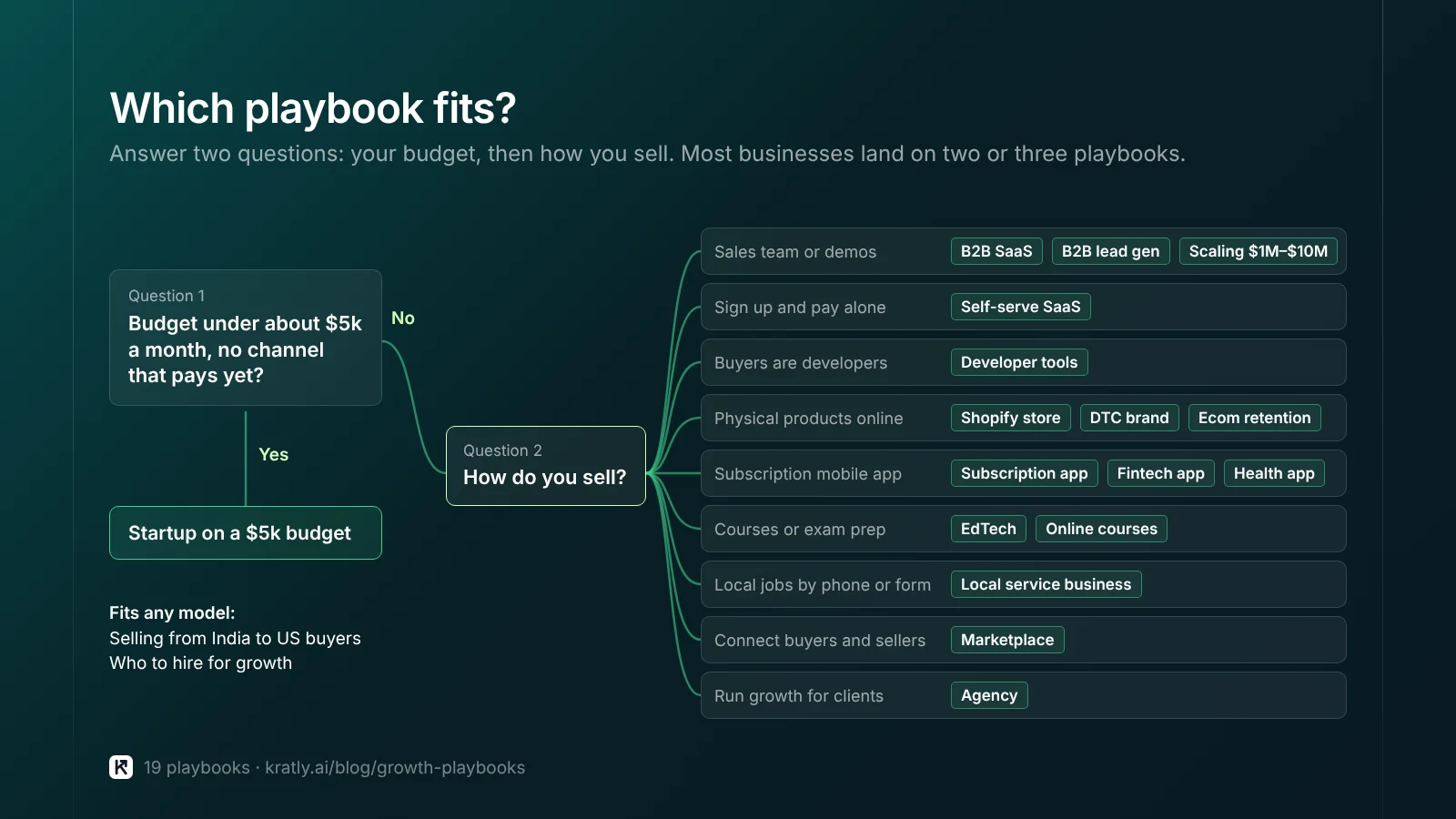
Answer in order. Stop at the first "yes".
| Question | If yes, read |
|---|---|
| Is your monthly marketing budget under about $5k, with no channel that reliably pays? | Startup marketing budget: where to spend your first $5k a month |
| Do you sell through a sales team or demos, with deals that take weeks? | B2B SaaS growth playbook, then B2B lead generation strategy: measure pipeline, not form fills |
| Do customers sign up and pay without talking to anyone? | Product-led growth strategy: trials that pay without a sales team |
| Are you past $1M ARR and adding people to growth? | Scaling from $1M to $10M ARR |
| Do you sell physical products online? | Shopify store growth playbook or DTC brand growth on Meta and Google |
| Are most of your store's orders from first-time buyers? | Ecommerce retention playbook |
| Is your product a mobile app sold by subscription? | Subscription app growth playbook |
| Does your app handle money or health data? | Fintech app growth or health app growth |
| Do you sell courses, tutoring or exam prep? | EdTech growth or online course growth |
| Do customers book a job by phone or form in a local area? | Local service business growth |
| Do you connect buyers and sellers? | Marketplace growth playbook |
| Are your buyers developers? | Developer tools growth |
| Are you an Indian team selling to US buyers? | SaaS go-to-market in the USA from India: pricing and payments |
| Do you run growth for clients? | Agency growth: prove client ROI |
| Are you deciding who should run growth? | Agency, in-house or AI growth team |
If more than one fits#
A DTC brand on Shopify fits 53, 54 and 68. When several fit, use two rules:
- Read the guide for where most revenue comes from today. If 80% of revenue is self-serve, start with the self-serve guide, even if sales gets the attention.
- Then read the guide for your biggest leak. If customers churn fast, the retention guide beats any acquisition guide.
Growth strategy by industry: what really changes#
The playbooks differ in four places. Knowing them helps you borrow from other rows.
| What differs | Fast-money businesses (stores, local services) | Slow-money businesses (B2B SaaS, lead gen, fintech) |
|---|---|---|
| Time from click to revenue | Minutes to days | Weeks to months |
| Where revenue is recorded | Shopify, booking system, call log | Stripe, CRM, funded-account data |
| Main risk in measurement | Platforms double-counting sales | Optimizing ads for sign-ups or leads that never pay |
| How fast you can judge a test | One to two weeks | One to three months |
What every business should stop doing#
These five habits show up in every business type.
Stop judging channels by platform-reported revenue#
Ad platforms grade their own homework, each with its own attribution window. Add them up and you'll often get more revenue than your bank received.
Cost of continuing: you shift budget toward the platform that claims the most credit. That's not always the one that brings buyers.
Stop adding channels to fix a weak one#
When one channel stalls, adding three more feels like progress. It splits your budget and your attention.
Cost of continuing: at $8k a month, four channels at $2k each rarely get enough data to judge. You spend months learning nothing.
Stop counting leads, sign-ups and installs as wins#
Optimizing ads for leads, sign-ups or installs teaches the platforms to find people who sign up, not people who pay. Our guide on B2B lead generation strategy: measure pipeline, not form fills covers the fix for sales-led businesses.
Cost of continuing: cost per lead falls while cost per paying customer rises. The dashboard looks better as the business gets worse.
Stop scaling spend while customers leave#
Pouring budget into acquisition while churn stays high means buying the same revenue twice. Fix the leak first.
Cost of continuing: every dollar spent on acquisition earns back less, because the customer leaves before they pay back.
Stop buying tools nobody acts on#
Before you buy another tool, ask what decision it will change and who will make it.
Cost of continuing: the license fee, the upkeep hours, and a false sense of progress.
How to do this in Kratly#
- Connect your ad accounts, site and revenue source. Kratly connects Google Ads, Meta Ads, website tracking, Search Console, and Stripe or Shopify. It ties each paying customer to the campaign, page or email that brought them. LinkedIn, TikTok and Reddit Ads are coming soon. Until then, tag that traffic with UTMs and upload its spend as a CSV.
- Get one revenue scoreboard. Kratly shows revenue and cost per paying customer by campaign, page and email, from billing data.
- Review ranked suggestions. Kratly lists changes by revenue at stake, such as search terms with spend and no buyers, or campaigns to grow or cut.
- Approve what you want changed. Kratly makes only the changes you approve. Each one is logged and can be reversed.
Not ready to connect anything? Try the free wasted-spend checker.
Every guide in this series#
- B2B SaaS growth strategy: first 100 customers to $1M ARR
- Product-led growth strategy: trials that pay without a sales team
- How to grow a Shopify store from $10k to $100k a month
- DTC marketing strategy: Meta and Google at each revenue stage
- Subscription app growth strategy: installs that turn into payers
- EdTech marketing strategy: exam prep, courses and seasonal demand
- How to prove marketing ROI to clients with revenue, not reports
- Local service business marketing: ads and SEO for booked jobs
- B2B lead generation strategy: measure pipeline, not form fills
- Marketplace growth strategy: grow both sides without burning cash
- How to sell online courses: launches, evergreen funnels and email
- Fintech marketing strategy: grow funded accounts, not installs
- Healthcare app marketing: grow while respecting privacy rules
- Developer marketing strategy: docs, SEO and communities that pay
- SaaS go-to-market in the USA from India: pricing and payments
- Startup marketing budget: where to spend your first $5k a month
- How to scale SaaS to $10M ARR: what changes after $1M
- Ecommerce retention strategy: email, SMS and repeat purchases
- When to hire a growth marketer: agency, in-house or AI by stage
Questions, answered
What is a business growth playbook?
A business growth playbook is a short plan of the moves that will grow revenue next, for your business type and stage. Each move has a cost, a time to pay off and a revenue number that shows whether it worked. It differs from a marketing plan because it's judged by money received, not by activity like posts, clicks or leads.
How do you grow a business 10x?
Grow a business 10x by following five steps in order. Build one revenue scoreboard. Fix measurement so each paying customer ties to a source. Find the one channel that pays at a repeatable cost. Improve retention so customers stay. Then add channels one at a time. Most stalled businesses skipped step two or four, not step three.
What is the best growth strategy by industry?
There's no single best one, but the differences are predictable. Fast-money businesses like stores and local services can test in a week or two. Slow-money businesses like B2B SaaS and fintech need weeks or months and must measure past the sign-up. Use the table in this guide to find your business type and its first move.
When should a business scale ad spend?
Scale spend when three things are true. You can tie paying customers to each campaign. One channel brings customers at a cost you can repeat. Customers stay long enough to pay back what you spent. If any of the three is missing, more spend usually buys more of the same problem.
How many marketing channels should a small business use?
Start with one main channel and test one or two others with a fixed budget and end date. At budgets under about $20k a month, spreading across many channels usually leaves each without enough data to judge. Add a second main channel when cost per customer on the first rises as you push it.
Written by
Priyansh Kumar
Priyansh Kumar has spent more than a decade in growth, scaling brands from 1 to 10 and from 10 to 100. He now builds Kratly, an autonomous growth team that ties every campaign, page and email to the revenue it brings.
Sources
- US Bureau of Labor Statistics: 34.7 percent of business establishments born in 2013 were still operating in 2023 (Jan 12, 2024) · Business Employment Dynamics
- US Census Bureau: Business Formation Statistics, December 2025 release (Jan 14, 2026)
- CB Insights: Why startups fail: top reasons (analysis of 431 shutdowns, Mar 2026)
- First Round Review: How Superhuman built an engine to find product-market fit
- Lenny's Newsletter: How Duolingo reignited user growth, by Jorge Mazal (Feb 28, 2023)
- Brian Balfour: Four Fits for $100M+ growth
- Shopify Community: Facebook reporting double the sales that Shopify reports
Was this article useful?