Short answer
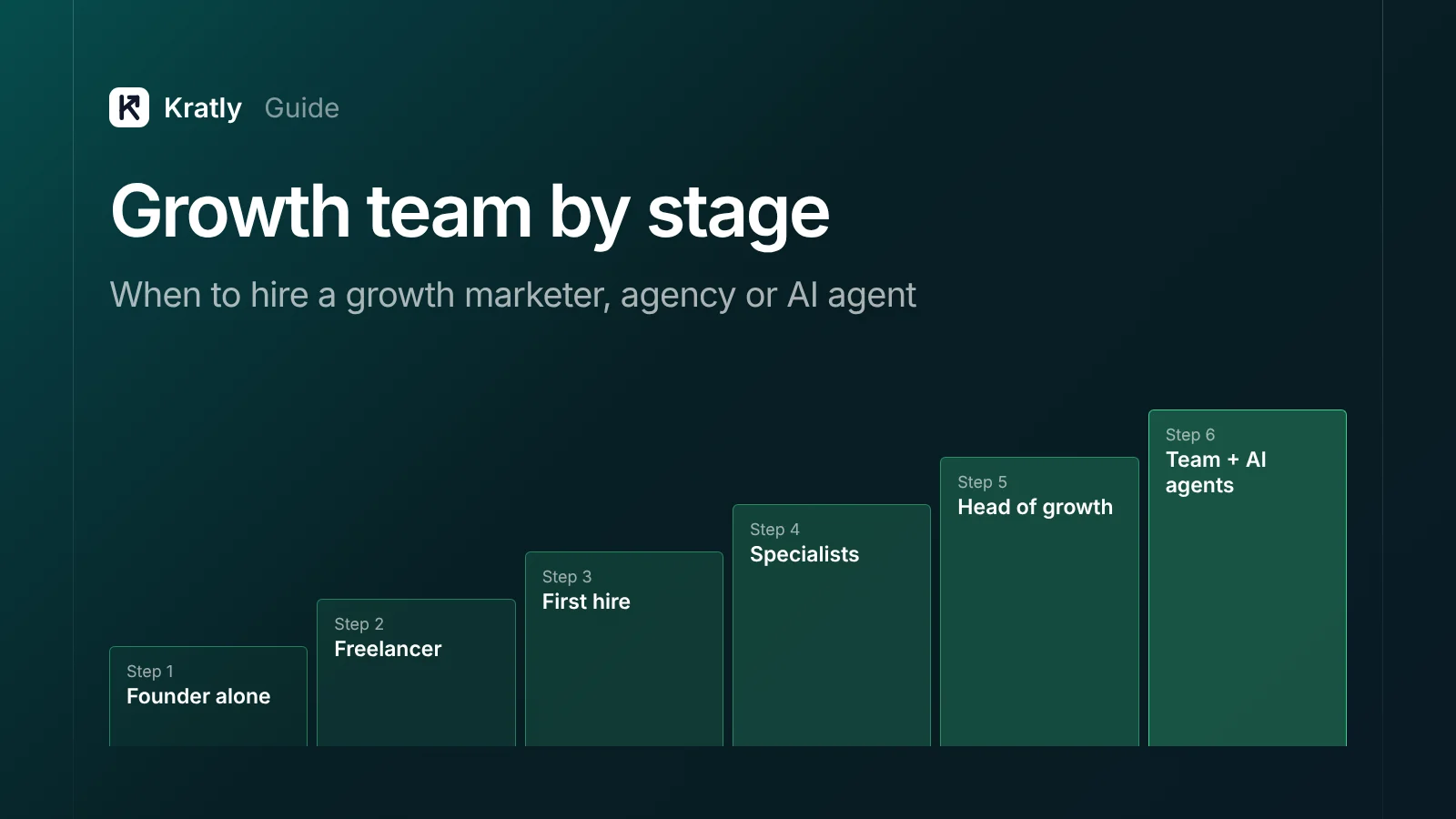
When to hire a growth marketer depends on stage. Run growth yourself until one channel brings paying customers. Then rent help by the hour. Hire a full-time generalist once that channel needs daily work. Add specialists or an agency per channel, then a head of growth who owns revenue, with AI agents doing account work.
Arielle Jackson is First Round's marketing expert in residence. While helping a startup called Rylo with its early messaging, she "wrote down the full list of everything that needed to happen before launch." The founders saw the list and said: "We've got to hire someone ASAP" (First Round Review, May 2019).
Jackson tells it as a case for hiring a marketer before launch. For a SaaS team still hunting for one working channel, I think it's usually too early. The real question is when to hire a growth marketer for your stage, and who comes before and after. This guide is part of our growth playbooks by business type.
What stage is your growth team at?#
A growth marketer is the person who finds, tests and scales the channels that bring paying customers, judged on revenue rather than activity.
The revenue bands are my illustrative cut-offs, not a benchmark.
| Stage | Revenue (illustrative) | Who does growth | What breaks next |
|---|---|---|---|
| 1. Founder-led | Under $10k MRR | A founder, part-time or full-time | Founder time runs out; product work slows. |
| 2. Rented help | $10k–$50k MRR | Founder plus freelancers or a fractional lead | Too many contractors, nobody owns the number. |
| 3. First hire | $50k–$150k MRR | One generalist growth marketer | One person can't go deep on every channel. |
| 4. Specialists | ~$2M–$5M ARR | Generalist plus a specialist or agency per channel | Channels compete for budget with no tie-breaker. |
| 5. Head of growth | ~$5M–$10M ARR | A head of growth who owns the revenue target | Account work swamps the team. |
| 6. Team + AI | $10M+ ARR | Small team, with AI agents doing daily account work | Agents need limits, approvals and an owner. |
Your go-to-market changes the timing. For consumer or marketing-led companies, Jackson suggests hiring "somewhere around the time you hit 10 people" (First Round Review). For enterprise SaaS, she says to get "a repeatable sales model in place first."
The five hiring moves, in order#
Costs come from our growth marketer vs AI agent cost comparison. Timelines are my estimates.
1. Keep growth founder-led until one channel works#
What to do: A founder runs small tests in two or three channels and talks to every early customer.
Why: Kathleen Estreich of MKT1 says "the founding team is the first marketing team" (TechCrunch, July 2021). A hire can scale a channel. A hire rarely finds product-market fit for you.
Cost: founder time, often 10–20 hours a week. Time to revenue: weeks for each test.
2. Rent expertise for scoped projects#
What to do: Bring in a freelancer or fractional growth lead for one job, such as fixing ad tracking or writing comparison pages.
Why: It's cheap to stop. Expert freelancers charge about $60–$120+ an hour (Upwork). Twenty hours a month is about $1,200–$2,400 (our arithmetic). Jackson suggests contractors for scoped, one-off projects.
Cost: $1,000–$3,000 a month for most early projects. Time to revenue: one to three months.
3. When to hire a growth marketer: once a channel needs daily work#
What to do: Hire a generalist strong in two areas, such as paid search and landing pages. Estreich calls this a "pi-shaped marketer" with "depth and competence in two areas" and warns against hiring "someone too senior who is not going to want to do the work" in an early team.
Jackson agrees the all-rounder is rare. Rank your needs and hire for the top one.
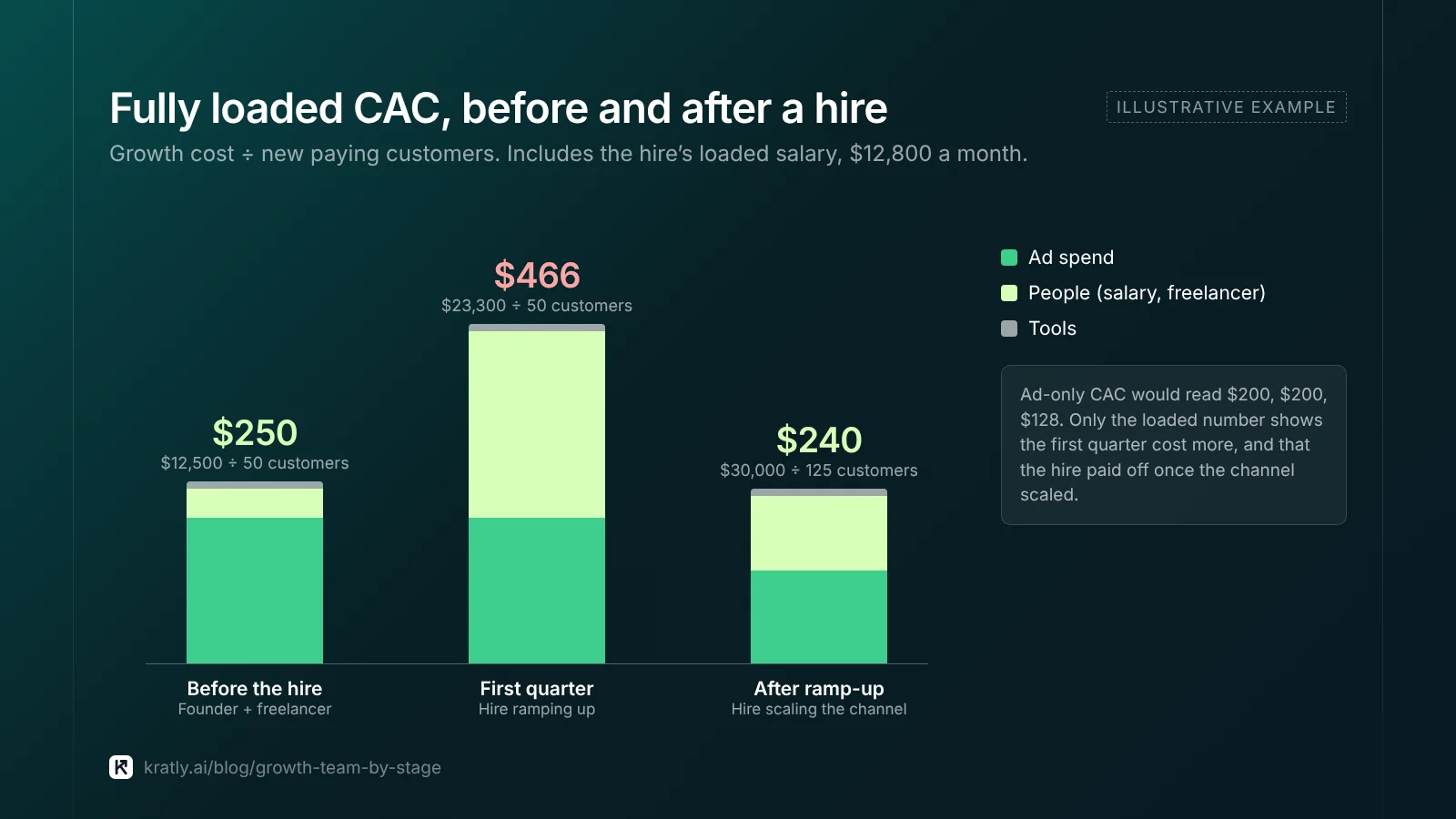
Cost: a growth marketing manager's median base is $105,000 (Payscale). Benefits are about 31.5% of total pay for professional roles (BLS ECEC, June 2026). That puts the loaded cost near $153,000 a year.
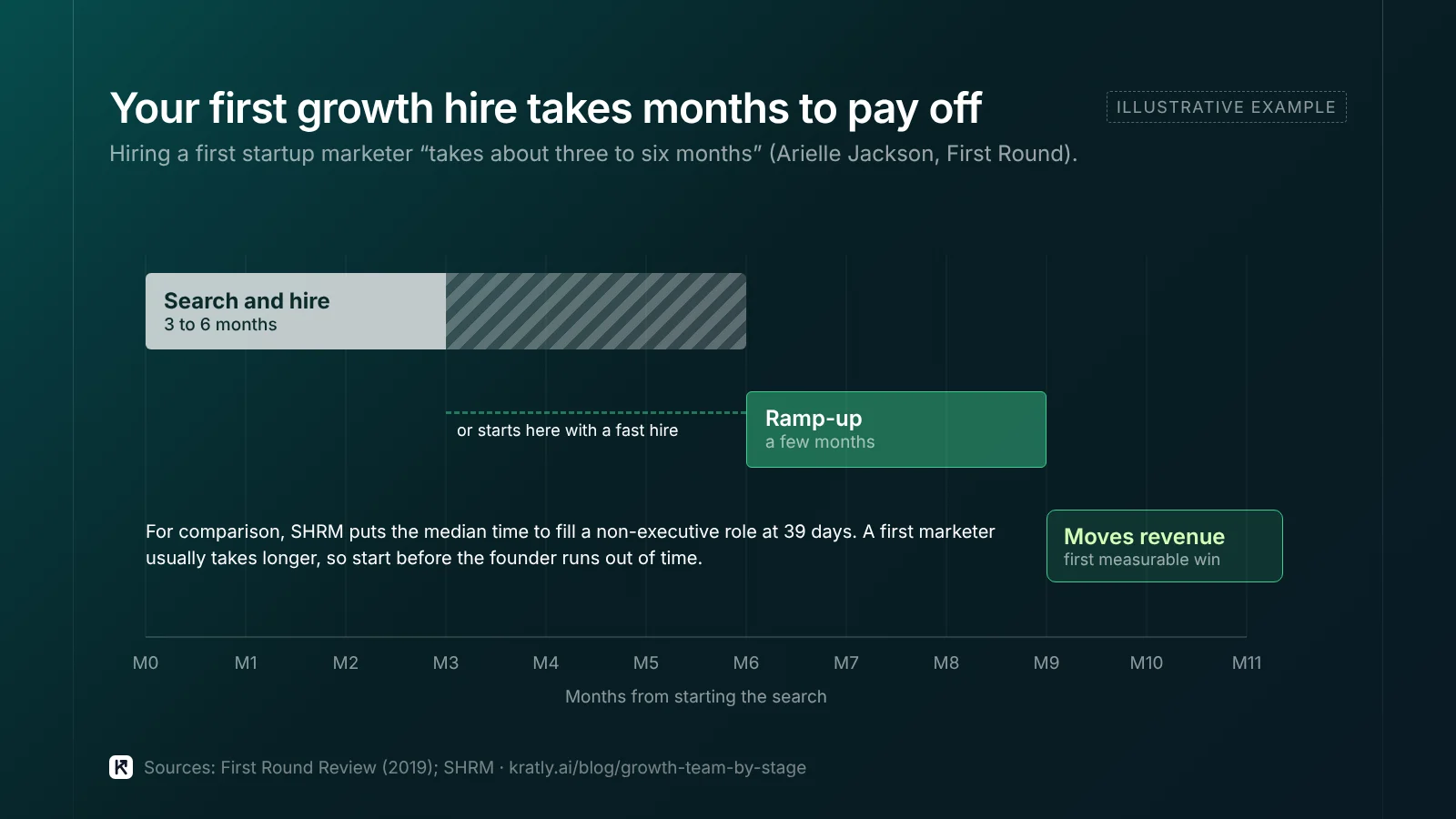
Time to revenue: slow. The median time to fill a non-executive role is 39 days (SHRM). For a first startup marketer, Jackson says it "takes about three to six months" to hire. Add a few months of ramp-up.
4. Add specialists or an agency per channel#
What to do: Keep your generalist as the owner. Add a specialist agency or freelancer for each channel that needs deep skill, like paid social creative.
Why: Emily Kramer of MKT1 names "PR, content and paid search" as common things to outsource. She warns that "the management overhead of a contractor agency is sometimes just as much as doing the work yourself" (TechCrunch). Keep an internal owner.
Cost: paid media agencies charge about 10–20% of ad spend, or $500–$2,000 a month flat for smaller accounts (AgencyAnalytics). Ask for reports on revenue, as in our guide to proving marketing ROI with revenue, not reports.
Time to revenue: four to eight weeks after onboarding.
5. Hire a head of growth, then add AI agents#
What to do: Once several channels run at once, hire one person to own the revenue target. Give them AI agents for search term reviews, budget pacing and reporting.
Why: Channels start fighting for budget, and someone needs the authority to cut one. Agents need an owner too. SaaStr found "AI agents require about as much management time as humans" (SaaStr).
Cost: a seed-to-Series A head of growth runs about $130K–$180K plus equity, per job-board data (Growth.Talent). Loaded, that's roughly $190K–$263K (our arithmetic, using BLS benefits). AI agents add a subscription and review time.
Time to revenue: one to two quarters for the hire. See scaling from $1M to $10M ARR.
Who should you hire now? A decision table#
| If this is true | Hire or buy | Rough monthly cost | They own |
|---|---|---|---|
| No channel brings paying customers yet | Nobody. Founder runs tests | Founder time | Learning what works |
| One channel works, founder is the bottleneck | Freelancer or fractional lead | $1K–$3K | One scoped project |
| A channel needs daily work, $10K+/month in ads | Generalist growth marketer | ~$12.8K loaded | One or two channels |
| A channel needs a skill your hire lacks | Specialist agency or freelancer | 10–20% of spend or $500–$2K | That channel only |
| Three or more channels compete for budget | Head of growth | ~$16K–$22K loaded | The revenue target |
| Account work eats your team's week | AI agents under a human owner | Subscription + review time | Daily account changes |
| You can't tie revenue to campaigns | Fix tracking before any hire | Varies | Clean data |
Monthly figures are our rounded arithmetic from the sourced costs. The rows are our judgment.
What should you measure in revenue?#
Judge every person, agency and agent on the same numbers, including their own cost.
| Metric | Formula | Where the data comes from | Healthy range (sourced) |
|---|---|---|---|
| Fully loaded CAC | (Ad spend + salaries + agency fees + tools) ÷ new paying customers | Payroll, invoices, Stripe or Shopify | No single benchmark; track your trend |
| CAC payback | Fully loaded CAC ÷ (new MRR per customer × gross margin) | Stripe + finance | Under 12 months for SMB SaaS (Bessemer) |
| Revenue per growth dollar | New revenue in the period ÷ total growth cost | Stripe or Shopify + finance | No sourced benchmark |
| Revenue tied to a source | Revenue with a known campaign, page or email ÷ all new revenue | Website tracking + Stripe or Shopify | Higher is better; set a baseline |
| Time to first win | Days from start date to first test that moved revenue | Your test log | No sourced benchmark |
What to stop doing#
Hiring a VP of marketing before anything works#
A senior leader needs a working engine to scale. Without one, you pay a loaded $200K+ for tests a founder could run.
Paying an agency on platform conversions#
An agency judged on platform conversions can look great while Stripe stays flat. Every month on that basis is fees spent without proof.
Stacking freelancers with no owner#
Five contractors with five reports means nobody owns the revenue number. Jackson notes that managing many freelancers can cost as much as a salary for an in-house hire.
Buying tools instead of deciding who owns growth#
A new tool without an owner rarely moves revenue. See what your marketing stack costs and what to cut.
Letting AI agents act without limits#
Agents need spend caps, approval steps and an undo log. One bad change can cost a week of budget.
How to do this in Kratly#
- Connect Google Ads, Meta Ads, your website and Stripe or Shopify. Kratly ties each campaign, page and email to revenue. LinkedIn, TikTok and Reddit Ads are coming soon; until then, use UTMs and upload their spend as a CSV.
- Run the free wasted-spend checker first. Upload a Google Ads search terms report and see which searches spend money without converting, before you hire anyone new.
- Set approval limits. A founder, freelancer or head of growth reviews Kratly's suggestions. You approve each change, and every change is logged and reversible.
- Review revenue by source weekly to judge hires and agencies on the same numbers.
Go deeper: Fractional CMO vs AI agent vs agency: cost and what you get
Questions, answered
When should a startup hire its first growth marketer?
When one channel already brings paying customers and needs daily work a founder can't give. Before that, founders learn faster by running tests themselves, with freelancers for scoped jobs. First Round's Arielle Jackson suggests around ten people for marketing-led companies. Enterprise SaaS should build a repeatable sales model first. Start the search early, since it can take three to six months.
Should my first marketing hire be a generalist or a specialist?
A generalist with depth in two areas. MKT1's Kathleen Estreich calls this a "pi-shaped marketer." Pick the two skills your best channel needs, such as paid search and landing pages. Avoid hunting for someone great at everything, since Jackson calls that person a rare sighting. Fill the gaps later with specialists or agencies for single channels.
Is a marketing agency or an in-house hire better?
In-house wins for the owner of your revenue number. Agencies win for narrow skills, like paid social creative, that don't justify a full-time salary. Paid media agencies typically charge 10–20% of ad spend. Keep someone inside who manages the agency, because MKT1's Emily Kramer warns the overhead can match doing the work yourself.
Can AI agents replace a growth team?
No. They can replace much of the daily account work, like search term reviews, budget pacing and reporting. They can't own a revenue target or decide what to stop. SaaStr found its AI agents needed about as much management time as people. Treat them as part of the team, under a human owner with clear limits.
Written by
Priyansh Kumar
Priyansh Kumar has spent more than a decade in growth, scaling brands from 1 to 10 and from 10 to 100. He now builds Kratly, an autonomous growth team that ties every campaign, page and email to the revenue it brings.
Sources
- First Round Review: So you think you're ready to hire a marketer? Read this first (Arielle Jackson, May 2019, updated Aug 2024)
- TechCrunch: The MKT1 interview: hiring versus outsourcing (July 28, 2021)
- Payscale: Growth Marketing Manager salary · Growth.Talent: Growth marketing salary guide
- US Bureau of Labor Statistics: Employer costs for employee compensation, June 2026
- SHRM: Recruiting benchmarks
- AgencyAnalytics: PPC pricing · Upwork: Hourly rates
- SaaStr: We built an AI VP of Marketing
- Bessemer Venture Partners: Scaling to $100M
Was this article useful?