Short answer
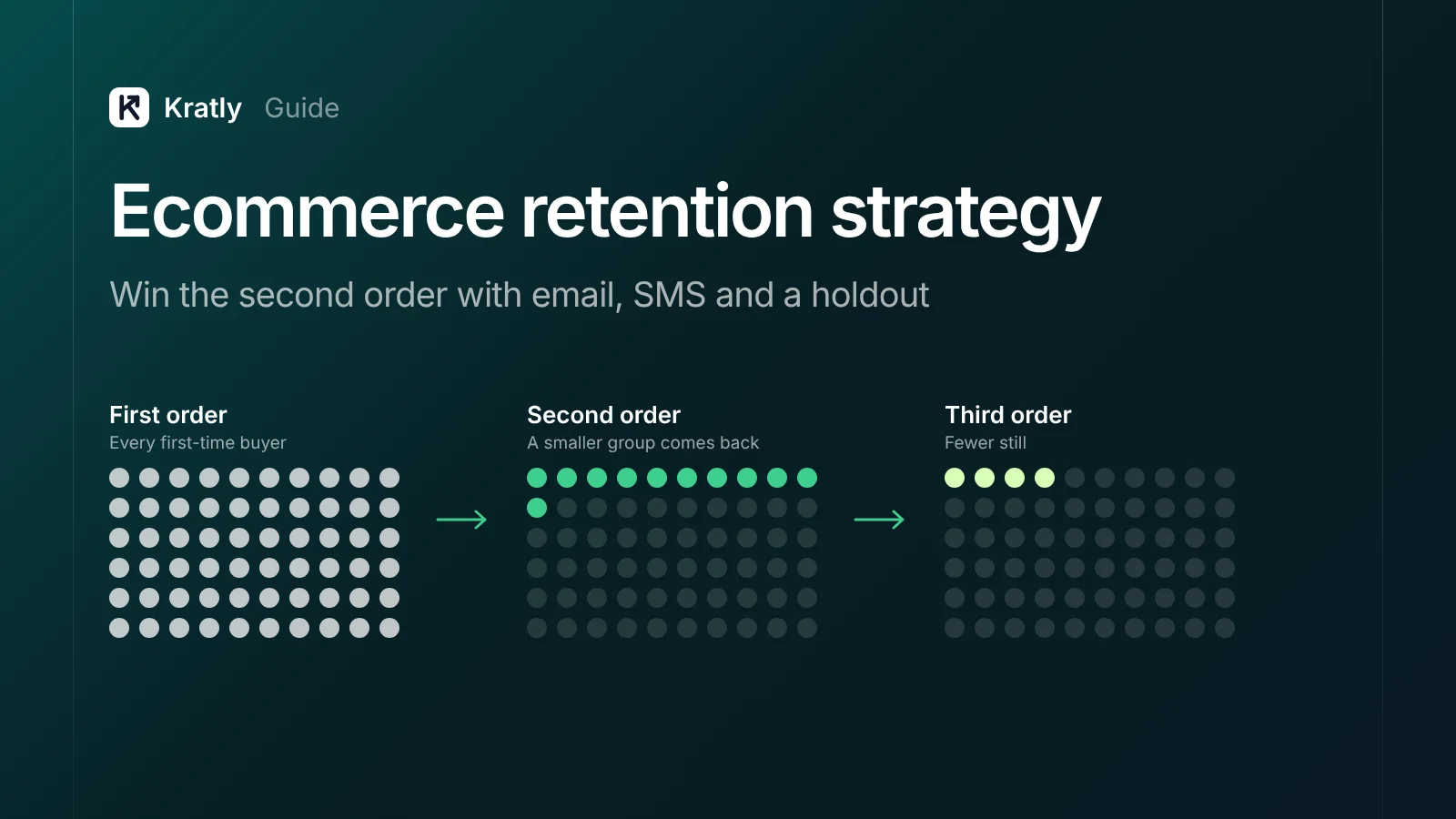
A good ecommerce retention strategy wins the second order. Set up welcome, abandoned-cart and post-purchase flows first. Time reorder reminders to when products run out. Add SMS only with written consent. Then add subscriptions or loyalty if buyers reorder. Judge everything by repeat purchase rate and incremental margin, measured against a holdout.
Brian Tate runs Oats Overnight, a DTC breakfast brand. In a May 2025 Modern Retail focus group (members only), he said the team watches month-one reorders and the share of buyers who order twice. "We try to get the earliest signal possible," he said. The brand even picks flavors by how well they retain: "We optimize our product mix by retention."
In the same piece, Knix's Nicole Tapscott said her team looks at "repeat purchase rate in a 90-day window." Neither shared a number. Both run the business on the second order. This playbook builds that ecommerce retention strategy, stage by stage, as part of our growth playbooks by business type.
What stage is your store's retention at?#
An ecommerce retention strategy is the plan that turns first-time buyers into repeat buyers, judged by the extra margin it brings.
| Customers who have bought | What's usually true | What breaks next |
|---|---|---|
| Under 1,000 | Few repeat orders yet. Email is a newsletter. No flows, or only the default abandoned checkout. | You can't tell if people reorder, because the cohorts are too small to read. |
| 1,000–10,000 | Flows exist. Repeat orders are a visible share of sales. Discounts creep into every email. | Flows get credit for orders that would have happened anyway. Margin leaks through codes. |
| 10,000+ | Email, SMS and maybe a subscription or loyalty program. A part-time retention owner. | Channels overlap. Nobody can say what each one adds. List fatigue raises complaints. |
These bands are my rule of thumb.
What's at stake? A study of more than 156,000 DTC customers by Beauchamp Sullivan & Co., cited by Shopify, found an average repeat purchase rate of 18.8% (Shopify). So about four in five buyers never order again.
The five moves of an ecommerce retention strategy#
1. Fix the flows that catch near-buyers (any stage)#
What to do: Set up a welcome flow and an abandoned cart or checkout flow, two or three emails each.
Why: These two flows do most of the automated selling. In Omnisend's 2026 report, abandoned cart and welcome emails drove 76% of automation-generated orders. Automations were about 2% of email sends but about 30% of email revenue. That's 2025 vendor data from 150,000 brands (Omnisend). Klaviyo's 2026 benchmarks put the average abandoned-cart email click rate at 6.0%, and text at 10.3% (Klaviyo).
Cost: Shopify Email covers basic flows. Expect 6–10 hours.
Time to revenue: Days. These flows reach people already close to buying.
The setup is in our Shopify store growth playbook. The same trigger-based logic for SaaS is in trial follow-up emails that turn sign-ups into paying customers.
2. Time the post-purchase flow to the reorder cycle (1,000+ customers)#
What to do: Find the median days between first and second order in Shopify. Send a how-to-use email after delivery. Then send a reorder reminder a few days before the typical reorder date. Add a winback email for buyers who pass twice that gap without ordering.
Why: A reminder sent after the customer already bought elsewhere is wasted.
Cost: 4–8 hours, plus the margin cost of any winback discount.
Time to revenue: One reorder cycle. For a 30-day product, about six weeks. For a 90-day product, a quarter.
3. Add SMS, with consent done right (1,000+ customers)#
What to do: Collect phone numbers with a separate, clear opt-in. Use SMS for abandoned carts, shipping updates and restocks. Keep promotions rare.
Why: Omnisend found automated SMS earned about $0.74 per send, versus $0.15 for SMS campaigns (Omnisend).
The rules are strict. Marketing texts sent by automated systems generally need prior express written consent under the TCPA. Since April 11, 2025, the FCC lets people revoke consent by "any reasonable means." Words like "stop," "quit," "cancel" and "unsubscribe" count. Businesses must honor the request within 10 business days (National Law Review). Carrier guidance from CTIA also expects a clear call to action with message frequency, rates and STOP instructions (Infobip summary). This is not legal advice; have counsel review your opt-in.
Cost: SMS tools charge per message. Plan 4–6 hours for setup and consent copy.
Time to revenue: Weeks, once the list grows past a few hundred subscribers.
4. Add subscriptions or loyalty only if people already reorder (10,000+ customers)#
What to do: If one product sells on a steady cycle, offer subscribe-and-save. If buyers spread across many products, try simple loyalty perks.
Why: Both lock in a habit; neither creates one. Hard-to-cancel plans also draw chargebacks and regulators. Recurly's 2026 data, cited by Shopify, puts ecommerce subscription churn at 4.25%. About a third of that, 1.38%, is involuntary churn (Shopify). So payment recovery matters as much as the offer. Shopify also cites a Deloitte 2025 survey: 72% of consumers say loyalty programs make them likelier to spend with a brand.
Make cancellation easy. In May 2026, Shutterstock agreed to pay $35 million to settle FTC allegations, including making it "difficult to cancel subscriptions" (FTC).
Cost: App fees, plus the discount, which comes straight out of contribution margin.
Time to revenue: Two to three reorder cycles before you can judge it.
5. Prove what retention adds with a holdout (1,000+ customers)#
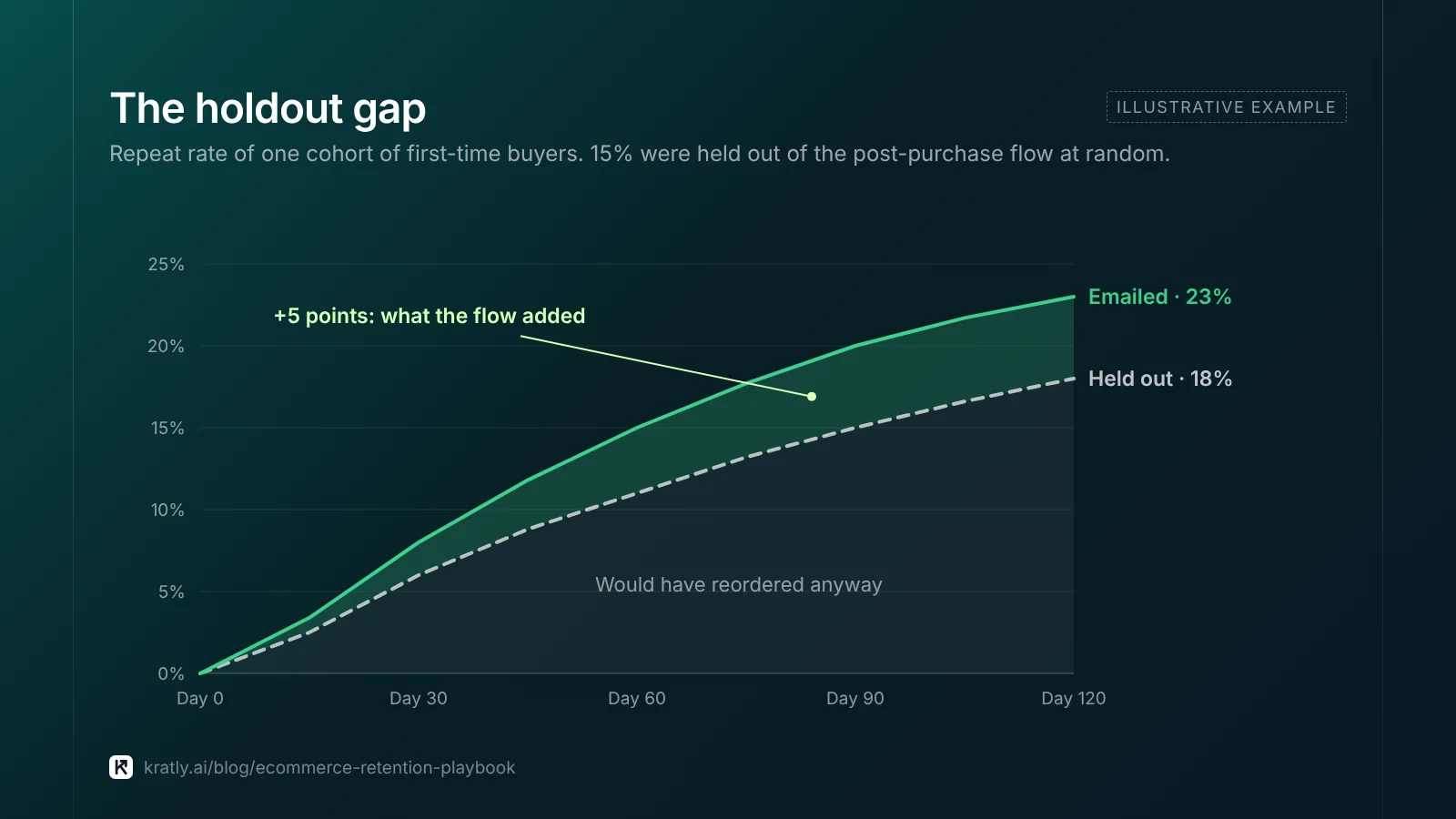
What to do: Hold back 10–20% of eligible customers from one flow at random. After one or two reorder cycles, compare repeat rate and margin per customer in Shopify.
Why: Email and SMS platforms credit orders placed within a window after a send. Many of those buyers would have reordered anyway. Our marketing incrementality test guide covers sizing and timing.
Cost: The revenue you give up from the held-out group, plus 2 hours to set it up.
Time to revenue: None directly. It shows where your next hour should go.
What to measure in revenue#
| Metric | Formula | Where the data comes from | Reference range |
|---|---|---|---|
| Repeat purchase rate | Customers with 2+ orders ÷ all customers in a cohort | Shopify customer cohort report | 18.8% average, 156,000+ DTC customers (Shopify) |
| 90-day repeat rate | First-time buyers who reorder within 90 days ÷ first-time buyers | Shopify orders export | No sourced range; Knix tracks this window |
| 12-month CLV (margin) | Average order value × orders per customer in 12 months × contribution margin % | Shopify orders + your costs | No sourced range; compare cohorts |
| Revenue per recipient | Attributed revenue ÷ people who got the flow | Email or SMS platform | Abandoned cart email $6.77, text $4.48 (Klaviyo) |
| Incremental margin per customer | Margin per customer, emailed minus held-out | Shopify, split by holdout list | No sourced range |
| Spam complaint rate | Spam reports ÷ delivered emails | Google Postmaster Tools, platform reports | Keep below 0.3% (Google, Yahoo) |
Use contribution margin for CLV, not revenue. A $60 order at 35% margin leaves $21 to repay acquisition. That sets what you can spend on ads, as covered in our DTC marketing strategy for Meta and Google.
What should you stop doing?#
Stop putting a discount in every flow. Buyers learn to wait for the code. A 15% code on a 35% margin order gives away well over a third of your margin. Cost: margin on orders that would have come at full price.
Stop blasting the whole list. Mailing people who stopped opening drives spam reports. Gmail asks bulk senders to keep complaints below 0.3%, and suggests under 0.1% (Google). Yahoo also requires one-click unsubscribe, honored "within 2 days" (Yahoo). Cost: more of your mail lands in spam, including the flows that pay.
Stop judging flows by platform-attributed revenue. It counts orders that would have happened anyway. Cost: more emails that add little margin.
Stop texting people who never opted in to texts. A delivery phone field is not marketing consent. Cost: legal exposure far larger than any SMS revenue.
How to do this in Kratly#
- Connect Shopify, Google Ads, Meta Ads and your site. Kratly ties each first order to the campaign or page behind it.
- Tag email and SMS links with UTMs. Kratly then credits the Shopify orders from each email or text.
- See revenue by campaign, page and email. Compare first-order revenue from ads with the repeat revenue those same customers bring later.
- Approve suggested changes. Kratly suggests budget shifts toward campaigns whose buyers come back. You approve them, and each change is logged and reversible.
Questions, answered
What is a good repeat purchase rate for ecommerce?
There's no single good number, because it depends on category and price. One widely cited study of 156,000+ DTC customers, by Beauchamp Sullivan & Co. via Shopify, found an 18.8% average. Compare your rate with your own last quarter first. Then compare it with brands that sell a similar product at a similar price.
How do you calculate customer lifetime value in ecommerce?
Multiply average order value by the orders a customer places in 12 months. Then multiply by your contribution margin percentage. A $60 average order, 1.5 orders a year and 35% margin give a 12-month CLV of $31.50. Use 12 months, not a guessed lifetime, and calculate it by cohort.
Which email flows should an online store build first?
Start with welcome and abandoned cart or checkout flows, because they reach people close to buying. In Omnisend's 2026 report, those two drove 76% of automation-generated orders. Next, build a post-purchase flow with a reorder reminder timed to your typical reorder gap. Add a winback flow last, for buyers who pass twice that gap without ordering.
Do I need consent to send marketing texts?
Yes. Marketing texts sent by automated systems generally need prior express written consent under the TCPA. People can opt out by any reasonable means, such as replying "stop" or "cancel." Since April 2025, you must honor that within 10 business days. Use a separate, clear SMS opt-in with frequency and rates stated. Have counsel review it, since this is not legal advice.
How do I know if my retention emails actually work?
Run a holdout. Leave 10–20% of eligible customers out of one flow at random. After one or two reorder cycles, compare repeat rate and margin per customer for both groups in Shopify. The gap is what the flow added. Platform-attributed revenue also counts buyers who would have reordered anyway, so it overstates the effect.
Written by
Priyansh Kumar
Priyansh Kumar has spent more than a decade in growth, scaling brands from 1 to 10 and from 10 to 100. He now builds Kratly, an autonomous growth team that ties every campaign, page and email to the revenue it brings.
Sources
- Modern Retail: Executive Action Items: How Dagne Dover, Knix and Oats Overnight think about retention (May 15, 2025, member exclusive)
- Shopify: How to improve ecommerce customer retention (updated Sep 23, 2026)
- Klaviyo: Abandoned cart benchmarks (Oct 2026, 110,000+ customers, vendor data)
- Omnisend: 2026 Ecommerce Marketing Report (2025 data, 150,000 brands, vendor data)
- National Law Review (Bradley Arant Boult Cummings): FCC's new consent revocation rule set to take effect in April 2025 (Mar 6, 2025)
- Infobip: US SMS compliance guide (CTIA summary)
- Federal Trade Commission: Shutterstock to pay $35 million (May 13, 2026)
- Google Workspace Admin Help: Email sender guidelines · Yahoo: Sender best practices
Was this article useful?