Short answer
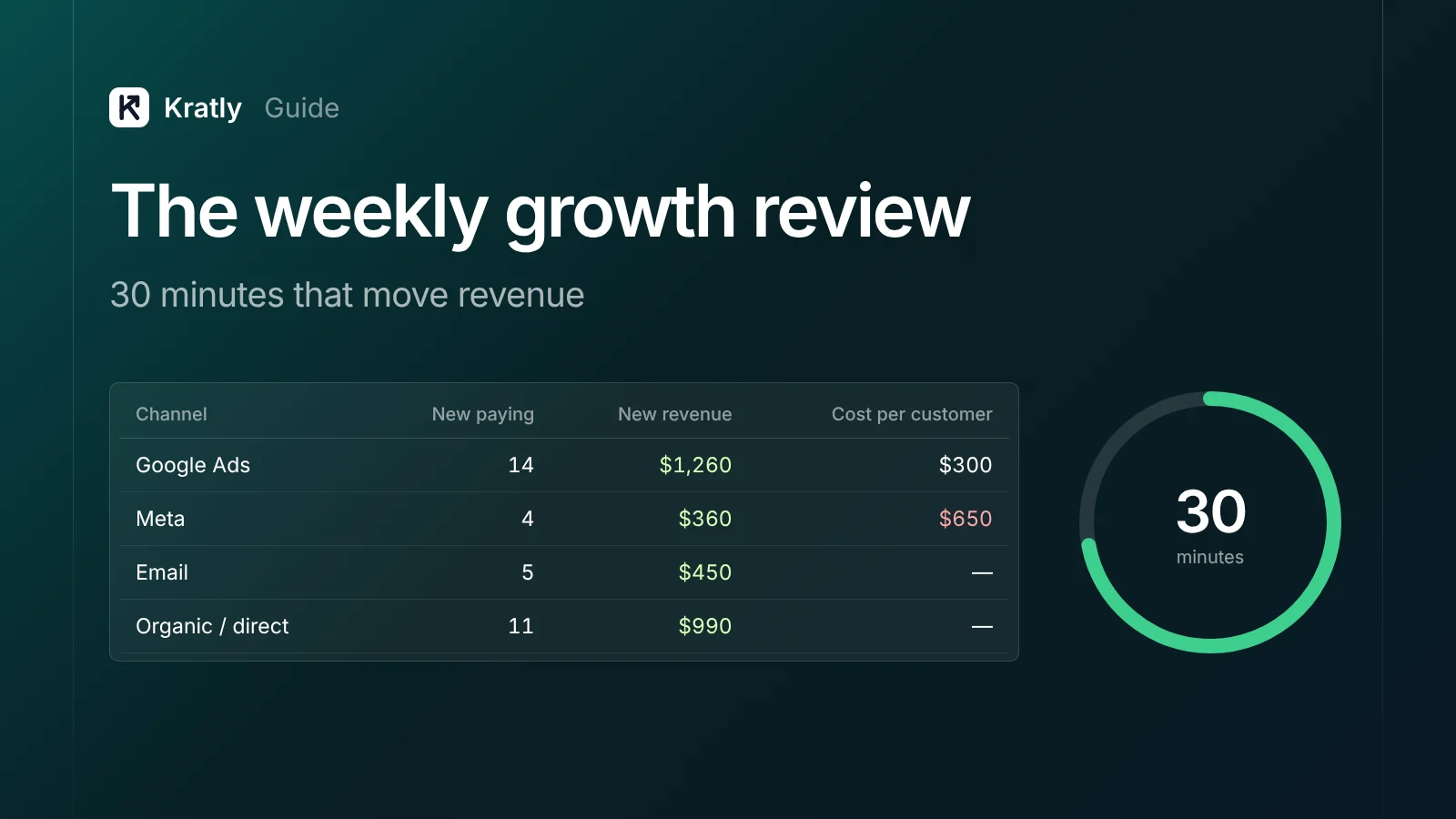
A good growth review meeting takes 30 minutes a week and has one job: decide what to change next. Start from one revenue scoreboard (new paying customers, revenue, cost per paying customer by channel, from Stripe or your store). Review last week's experiments, make decisions, then assign next week's experiments to named owners.
Executives now spend nearly 23 hours a week in meetings, up from less than 10 hours in the 1960s (Harvard Business Review). Brian Balfour, who led growth at HubSpot, put the bar simply: "If you have a weekly one hour team meeting, it better have high ROI" (Brian Balfour).
Most weekly marketing meetings miss that bar. Channel owners read out clicks and leads, and nobody asks who paid.
This article gives you a growth review meeting format and a template you can copy. To be clear: it's a recommended format, built from my opinion and from published practices at Amazon and from Balfour. It's not a study. Adapt it.
Why most weekly marketing meetings don't move revenue#
Three habits waste the hour.
Status updates instead of decisions. What people did belongs in a written note. Spend meeting time on choices.
Channel metrics instead of money. Google Ads reports conversions. Meta reports purchases. Email reports opens. Each number flatters its own channel. None tells you who paid. If the scoreboard isn't tied to Stripe or your store, the debate is about whose report to believe.
Too many tools, no shared view. When each person brings a screenshot from a different tool, half the meeting goes to reconciling. The cost of that sprawl is covered in marketing tool sprawl: what your stack costs and what to cut.
Andy Grove's High Output Management splits meetings into two kinds. Process-oriented meetings are regular and keep the business running. Mission-oriented meetings are called once to make a specific decision. A weekly growth review is the first kind. It should follow the same format every week, so people spend their energy on the numbers, not the agenda.
What Amazon and Balfour got right#
Two published practices shape this format.
Amazon's Weekly Business Review (WBR). Cedric Chin's write-up, based on former Amazon executive Colin Bryar, describes a 60-minute meeting covering 400 to 500 metrics (Commoncog). It works because it is exception-driven: "you really only discuss exceptional variation." Owners investigate odd numbers before the meeting. If they can't find the cause, they are expected to say "I don't know," and a follow-up is noted. Strategy is discussed in a separate meeting.
Balfour's weekly growth meeting. Balfour's meeting runs about 45 minutes, never more than an hour. Team members add learnings to a shared document before the meeting. Roughly 40 minutes go to questioning each learning, and the last 5 to 10 to metrics. His warning: "Don't let the conversation veer to debating priorities of experiments" (Brian Balfour).
| Idea | Amazon WBR | Balfour growth meeting | What I'd borrow |
|---|---|---|---|
| Length | 60 min (90 in holiday season) | ~45 min, max 60 | 30 min for a small team |
| Focus | Exceptions in a fixed metric deck | Learnings from experiments | Both, in that order |
| Prep | Owners explain exceptions in advance | Learnings written before Monday | Written pre-read, due the day before |
| Strategy | Separate meeting | Not debated in the meeting | Separate, monthly |
I cut it to 30 minutes for a smaller team. A team spending $5k to $100k a month on ads runs a handful of experiments a week, not dozens.
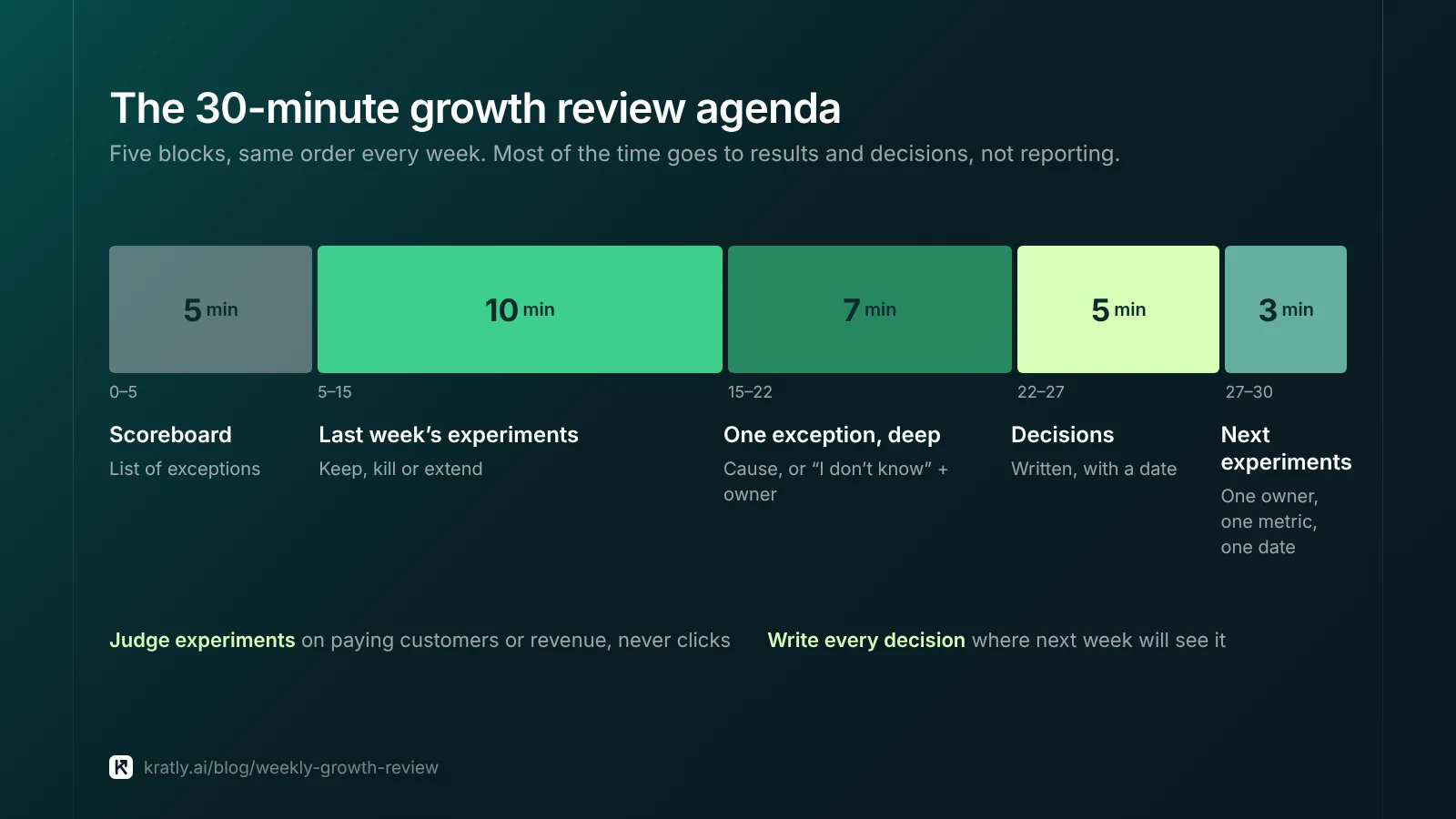
The 30-minute growth review meeting agenda#
| Minutes | Block | Output |
|---|---|---|
| 0–5 | Scoreboard. New paying customers, revenue, spend, cost per paying customer by channel vs last week and 4-week average | List of exceptions (anything outside normal range) |
| 5–15 | Last week's experiments. Each owner: what we changed, the result in paying customers or revenue, what we learned | Keep, kill or extend each one |
| 15–22 | One exception, deep. The biggest unexplained move on the scoreboard | Cause, or "I don't know" plus an owner to find out |
| 22–27 | Decisions. Budget moves, pauses, launches | Written decisions with a date |
| 27–30 | Next experiments. One owner, one metric, one review date each | Next week's list |
Two rules make this work. Judge experiments on paying customers or revenue, never on clicks. And write every decision down where next week's meeting will see it.
What I'd check first if your meetings run long: is the scoreboard ready before the meeting starts? If someone builds it live, the meeting is already lost.
Build one revenue scoreboard#
The scoreboard is the marketing KPI review in one table. Keep it to one screen. Pull revenue and new customers from Stripe or your store, not from ad platforms.
| Metric | Source | Why it's here |
|---|---|---|
| New paying customers (total and by channel) | Stripe / store, joined to UTM or click ID | The outcome you're paying for |
| New revenue (new MRR or order revenue) | Stripe / store | Size of what you bought |
| Spend by channel | Ad accounts | The cost side |
| Cost per paying customer by channel | Spend ÷ new paying customers | Compare channels on one number |
| CAC payback or ROAS vs break-even | Gross margin, revenue | Is the channel profitable? |
| Running experiments | Experiment log | What changed this week |
For the formulas, see customer acquisition cost by channel and CAC payback period. For stores, break-even ROAS is 1 ÷ gross margin (Amazon Ads).
Show each number against the last week and a 4-week average. Amazon's charts use a trailing six weeks plus a trailing twelve months for the same reason: one week alone is noise.
I'd leave out impressions, CTR, MQLs and open rates. They're useful to the person running the channel. In a growth review meeting they invite debate about activity, not money. The opposite case: a channel may have no paying customers yet because it's new. Then show its leading metric, but mark it as leading and give it a date to prove revenue.
Growth meeting template you can copy#
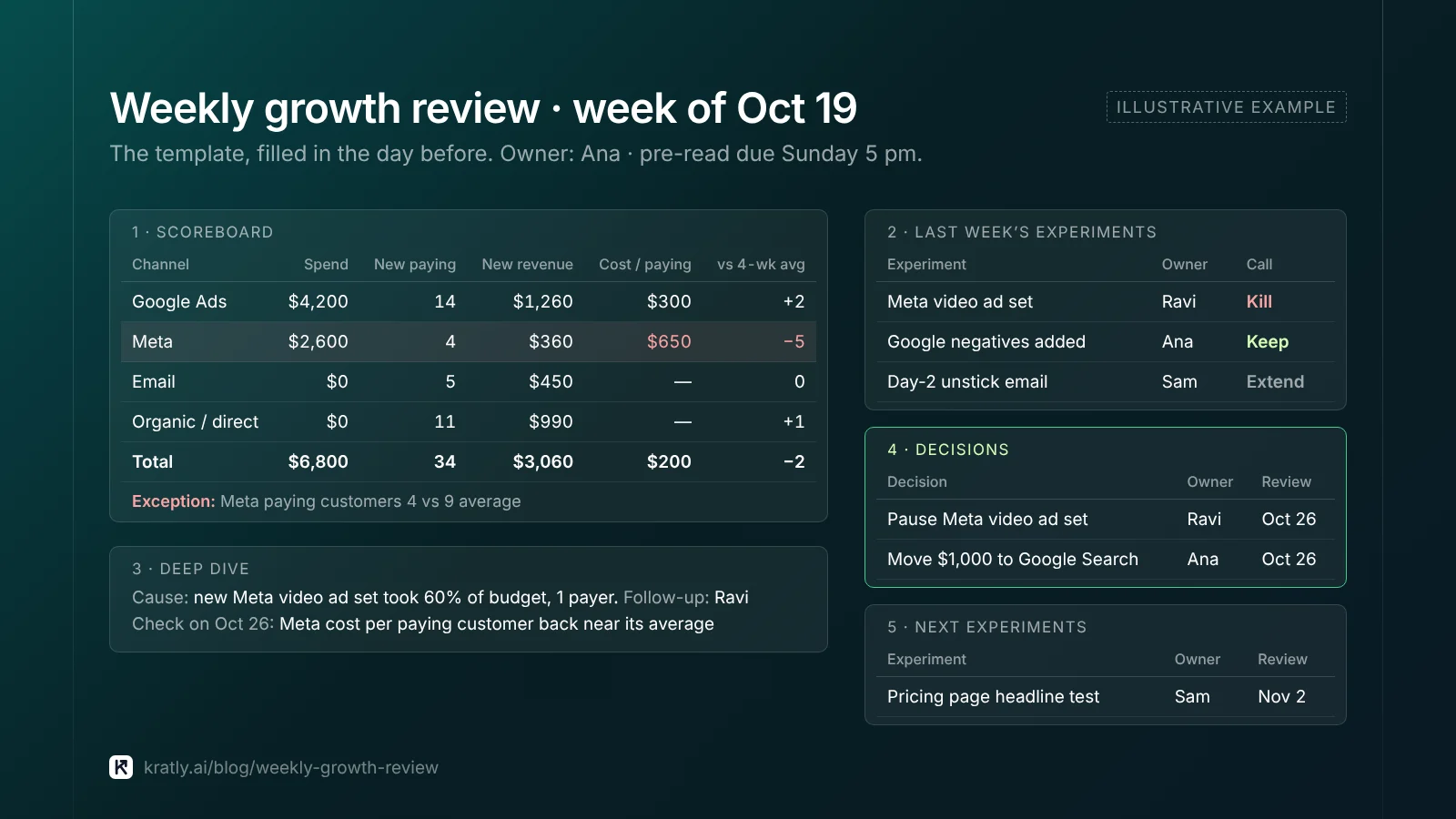
Paste this into your shared doc and fill it the day before.
WEEKLY GROWTH REVIEW — Week of {date}
Owner: {name}   Pre-read due: {day before, 5pm}

1. SCOREBOARD (5 min)
| Channel | Spend | New paying customers | New revenue | Cost per paying customer | vs 4-wk avg |
| Google Ads |  |  |  |  |  |
| Meta |  |  |  |  |  |
| Email |  |  |  |  |  |
| Organic / direct |  |  |  |  |  |
| Total |  |  |  |  |  |
Exceptions: {anything outside normal range}

2. LAST WEEK'S EXPERIMENTS (10 min)
| Experiment | Owner | Metric | Result | Keep / kill / extend |

3. DEEP DIVE (7 min)
Exception: {one}   Cause: {or "don't know"}   Follow-up owner: {name}

4. DECISIONS (5 min)
| Decision | Owner | Date | Review on |

5. NEXT EXPERIMENTS (3 min)
| Experiment | Owner | Success metric (paying customers or revenue) | Review date |
Rules that keep it to 30 minutes#
- Pre-read or cancel. If the scoreboard isn't ready an hour before, move the meeting.
- Exceptions only. Normal numbers get no discussion. "Nothing to see" is a complete answer.
- One owner per experiment. Shared ownership means nobody reports back.
- No priority debates. Ranking next month's ideas is a separate, monthly session.
- Decisions in writing. Each with an owner and a review date.
- Five people or fewer. Others read the notes.
The meeting has a real cost. Five people for 30 minutes is 2.5 hours a week, or about 125 hours a year. At an assumed $100 an hour fully loaded, that's about $12,500 a year. It pays for itself if it kills one losing campaign a quarter.
When I'd hold it less often: if you win fewer than about ten new paying customers a week, weekly channel numbers swing on luck. Keep the weekly slot for experiments and decisions, but judge channels on a 4-week rolling view. Tests that need more data are covered in did your marketing change really work?
This meeting is the human version of what an autonomous growth system does all week. More on that in autonomous growth: why connecting 100 tools won't make customers pay. For who should run the work, see growth marketer vs AI growth agent.
How to do this in Kratly#
- Connect ad accounts, site and Stripe or your store. Kratly shows revenue and cost per paying customer by campaign, page and email.
- Use it as the scoreboard. Open Kratly's channel view in the meeting instead of building a slide.
- Review suggested changes. Kratly flags campaigns and pages that moved, and suggests what to change.
- Approve and log. Changes you approve are logged and reversible, so next week's meeting starts from the log.
Questions, answered
What should a weekly growth meeting cover?
Four things: a revenue scoreboard by channel, results of last week's experiments, decisions, and next week's experiments with owners. Pull the scoreboard from Stripe or your store, not from ad platforms. Judge each experiment on paying customers or revenue, never on clicks. Leave status updates and idea ranking out of it. Those belong in a written note and a separate monthly session.
How long should a growth review meeting be?
Thirty minutes works for a small team running a few experiments a week. Balfour's meetings ran about 45 minutes, never more than an hour, and Amazon's WBR runs 60. Go longer only if the volume of experiments needs it. To stay on time, share the scoreboard as a pre-read the day before and discuss only exceptions.
Which marketing KPIs belong in the weekly review?
Track new paying customers, new revenue, spend, cost per paying customer by channel, and payback or ROAS against break-even. Pull revenue from Stripe or your store, not ad platforms. Show each number against last week and a 4-week average. Keep clicks, CTR, MQLs and open rates for channel owners, because they invite debate about activity, not money.
Who should attend the weekly growth review?
The people who own a channel or an experiment, plus one decision-maker. Five or fewer is a good limit, and everyone else reads the notes. Each experiment needs one named owner, because shared ownership means nobody reports back. Five people for 30 minutes is about 125 hours a year, so keep the list short.
Weekly or monthly growth review?
Weekly for experiments and decisions, so changes don't wait a month. If you win fewer than about ten paying customers a week, weekly channel numbers swing on luck. Then keep the weekly slot for experiments, but judge channels on a 4-week rolling view. Move strategy and idea ranking to a separate monthly session.
Written by
Priyansh Kumar
Priyansh Kumar has spent more than a decade in growth, scaling brands from 1 to 10 and from 10 to 100. He now builds Kratly, an autonomous growth team that ties every campaign, page and email to the revenue it brings.
Sources
- Harvard Business Review: Stop the Meeting Madness (Perlow, Hadley, Eun, July–Aug 2017)
- Brian Balfour: How to run a weekly growth meeting that gets results (2016)
- Commoncog (Cedric Chin): The Amazon Weekly Business Review
- Andrew S. Grove, High Output Management (book), chapter on meetings
- Amazon Ads: Ads math and break-even ROAS
Was this article useful?