Short answer
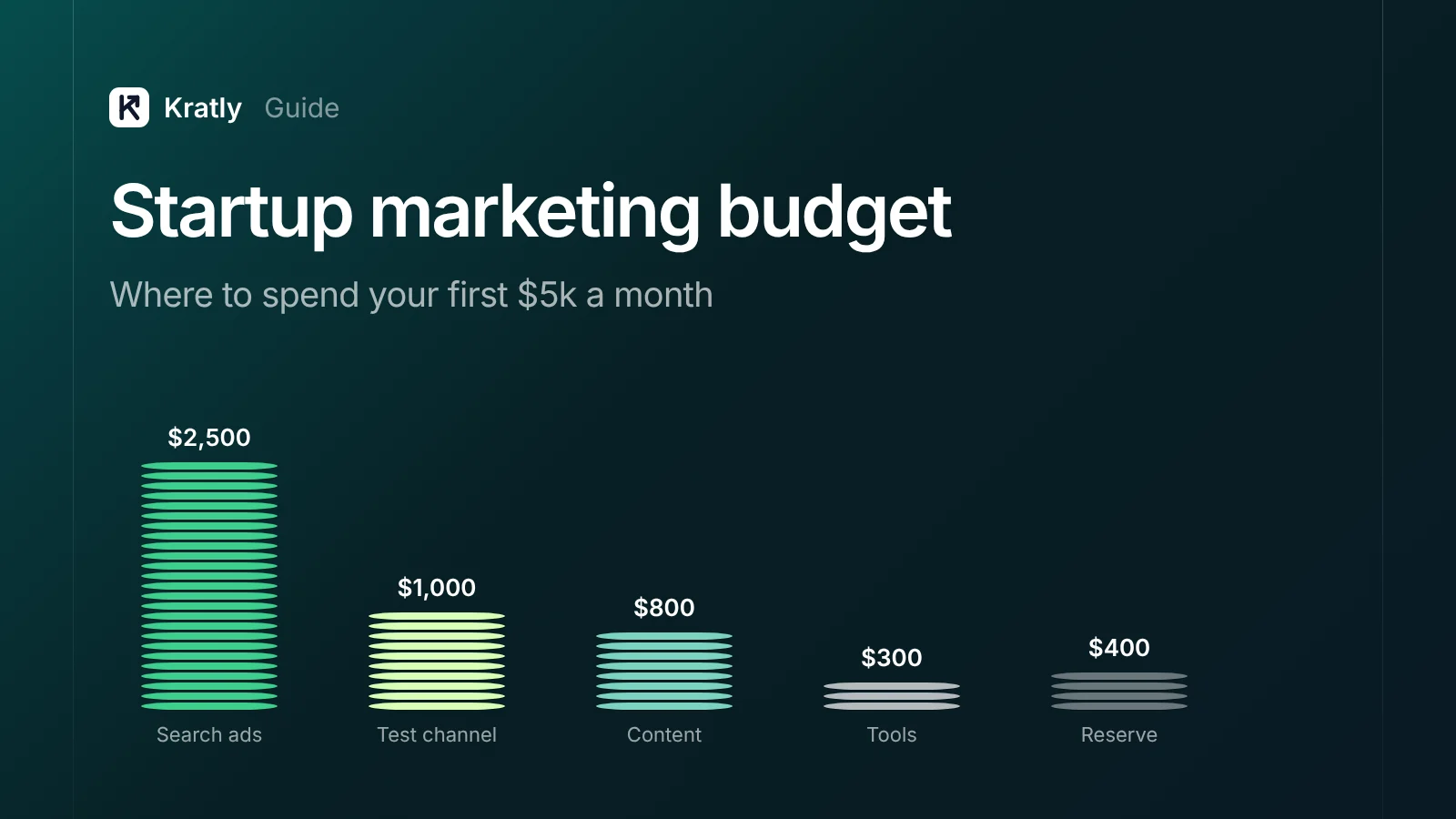
A good startup marketing budget is set by cash and payback, not a percentage of revenue. With $5k a month, put about half on one high-intent paid channel. Spend the rest on one or two cheap channel tests, content and tracking. Judge every dollar by paying customers in Stripe, not clicks or sign-ups.
In August 2023, an Indie Hackers founder answered a thread on marketing spend with the result of a small paid test: "I just spent $750 and got ~2,000 website clicks from which ~20 signed-up from which 0 subscribed (yet)" (Indie Hackers). Their advice below $500 a month in revenue: skip paid ads and put the effort into free channels.
At $5k a month, you can afford real tests, but not many. This playbook shows where the money goes. It's part of our growth playbooks by business type.
How much should a startup spend on marketing?#
A startup marketing budget is the monthly amount you can spend on finding customers and still survive the wait until they pay it back.
Benchmarks describe bigger companies:
- Large companies: Gartner's 2026 CMO Spend Survey put marketing budgets at 7.8% of company revenue, up from 7.7% in 2025. Most of the 401 respondents had revenue above $1 billion (Gartner, May 2026).
- Private B2B SaaS: SaaS Capital's 2026 survey of more than 1,000 companies found a median marketing spend of 8% of ARR. Selling costs were another 15% (SaaS Capital, June 2026).
At $300k ARR, 8% is just $2k a month. Early teams buying growth usually need more. That's fine if the spend pays back. The limit is your cash and your CAC payback period, not a ratio built from billion-dollar firms.
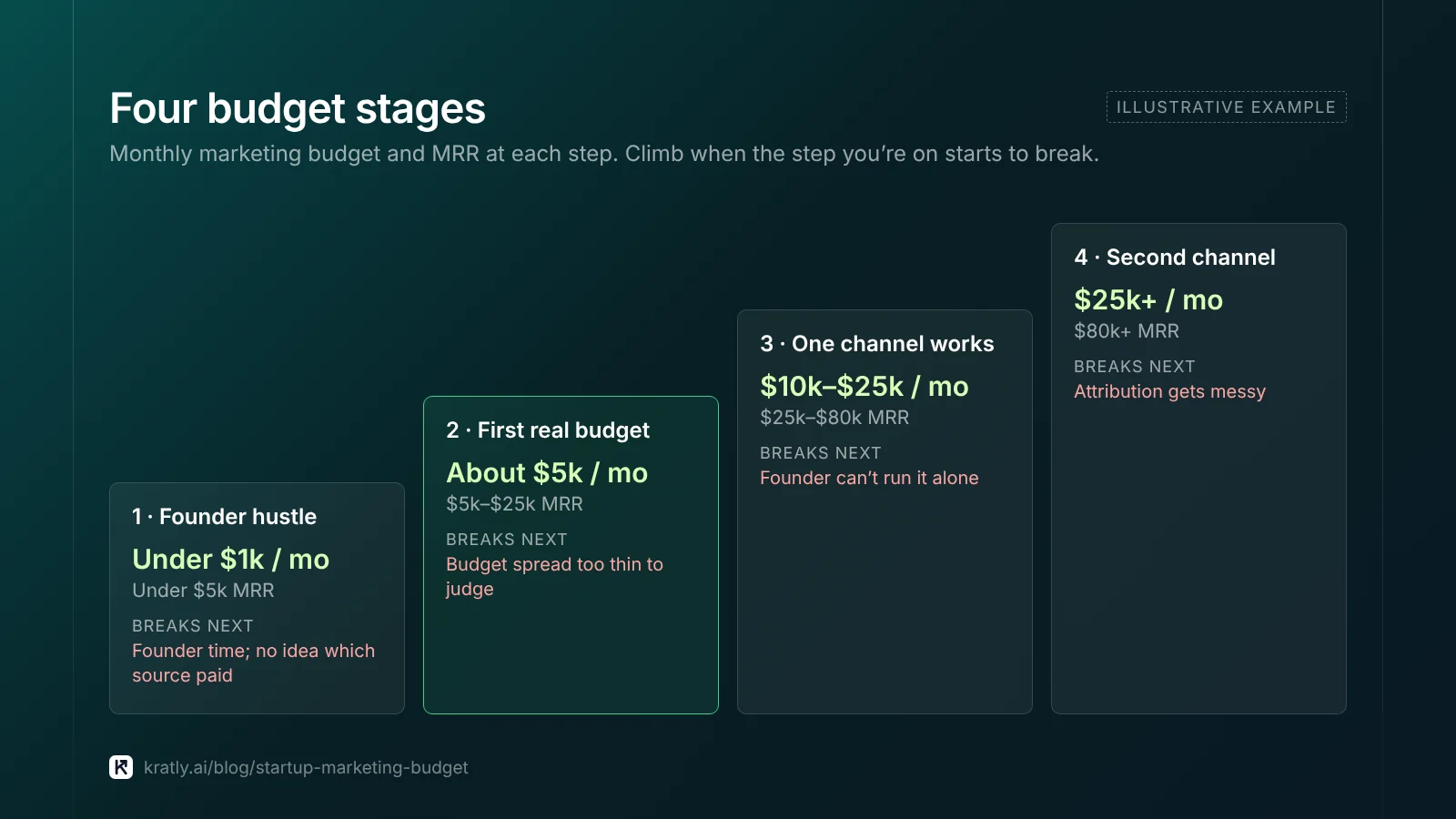
The stages below use monthly marketing budget and revenue. The bands are my illustration, not survey data.
| Stage | Monthly budget / MRR | What's true | What breaks next |
|---|---|---|---|
| 1. Founder hustle | Under $1k / under $5k MRR | The founder sells and posts. Ads are tiny tests. | Founder time. No idea which source brought which customer. |
| 2. First real budget | About $5k / $5k–$25k MRR | Two or three channels get tested. One may show promise. | Budget spread too thin to judge any channel. |
| 3. One channel works | $10k–$25k / $25k–$80k MRR | One channel brings paying customers at a cost you can repeat. | Founder can't run it alone. Time for the first hire. |
| 4. Add a second channel | $25k+ / $80k+ MRR | The first channel stops scaling at your payback target. | Attribution gets messy across channels. |
The five moves that matter most#
These are in the order I'd make them. Costs and timelines are my estimates, not benchmarks.
1. Set the budget from cash and payback#
Ask how many months of spend you can survive before customers pay it back. If CAC payback is 10 months and you spend $5k a month, roughly $50k is out before the first cohort breaks even. Your bank balance must cover that and payroll.
- Cost: two hours with a spreadsheet.
- Time to revenue: none directly. It prevents panic cuts.
2. Track paying customers by source before you spend#
Tag links with UTMs and store the source on each customer. Then judge channels by CAC by channel from Stripe, not ad reports. If you run Google Ads, send Stripe payments back to Google Ads so bidding learns from buyers.
- Cost: one to two days of developer time.
- Time to revenue: none directly. Every later decision gets cheaper.
3. Test three channels cheaply with the Bullseye method#
In Traction, Gabriel Weinberg and Justin Mares list 19 channels. Their Bullseye method has you brainstorm them all, then test "the three traction channels that seem most promising." Mares wrote that you can get "a rough idea of a channel's effectiveness with just a few hundred dollars" (Brian Balfour, guest post by Justin Mares, 2014).
His example: run four Facebook ads, not forty. You want a signal, not a verdict.
- Cost: $300–$1,000 per channel test, plus 5–10 founder hours.
- Time to revenue: two to six weeks for paid channels.
4. Back one high-intent paid channel with about half the budget#
For most B2B and SaaS startups, that's Google Search on buying-intent keywords. Start with exact and phrase match, a tight keyword list and manual or Maximize Clicks bidding.
Don't rush smart bidding. Google's target ROAS needs "at least 15 conversions in the past 30 days" for Search and Shopping (Google Ads Help). At a $250 CAC, $2,500 buys about 10 customers a month. So bid on a more frequent conversion, such as a qualified trial.
Judge each campaign on cost per paying customer after its conversion delay. See when to pause a Google Ads campaign.
- Cost: about $2,500 a month plus 2–3 hours a week.
- Time to revenue: two to six weeks, longer if you run a trial.
5. Make the first marketing hire when one channel works#
A first marketing hire costs far more than your budget. A US growth marketing manager earns a median base of about $105,000 (Payscale, 2026). Benefits make up about 31.5% of pay for professional roles (BLS, June 2026). That's roughly $12,800 a month loaded, more than twice a $5k budget.
So I'd hire only after one channel brings paying customers at a cost you can repeat. The full trade-off is in growth marketer vs AI growth agent: cost and results.
- Cost: about $150k a year, plus a 39-day median time to fill per SHRM.
- Time to revenue: usually a quarter or more while they learn your product.
How to split a $5k startup marketing budget#
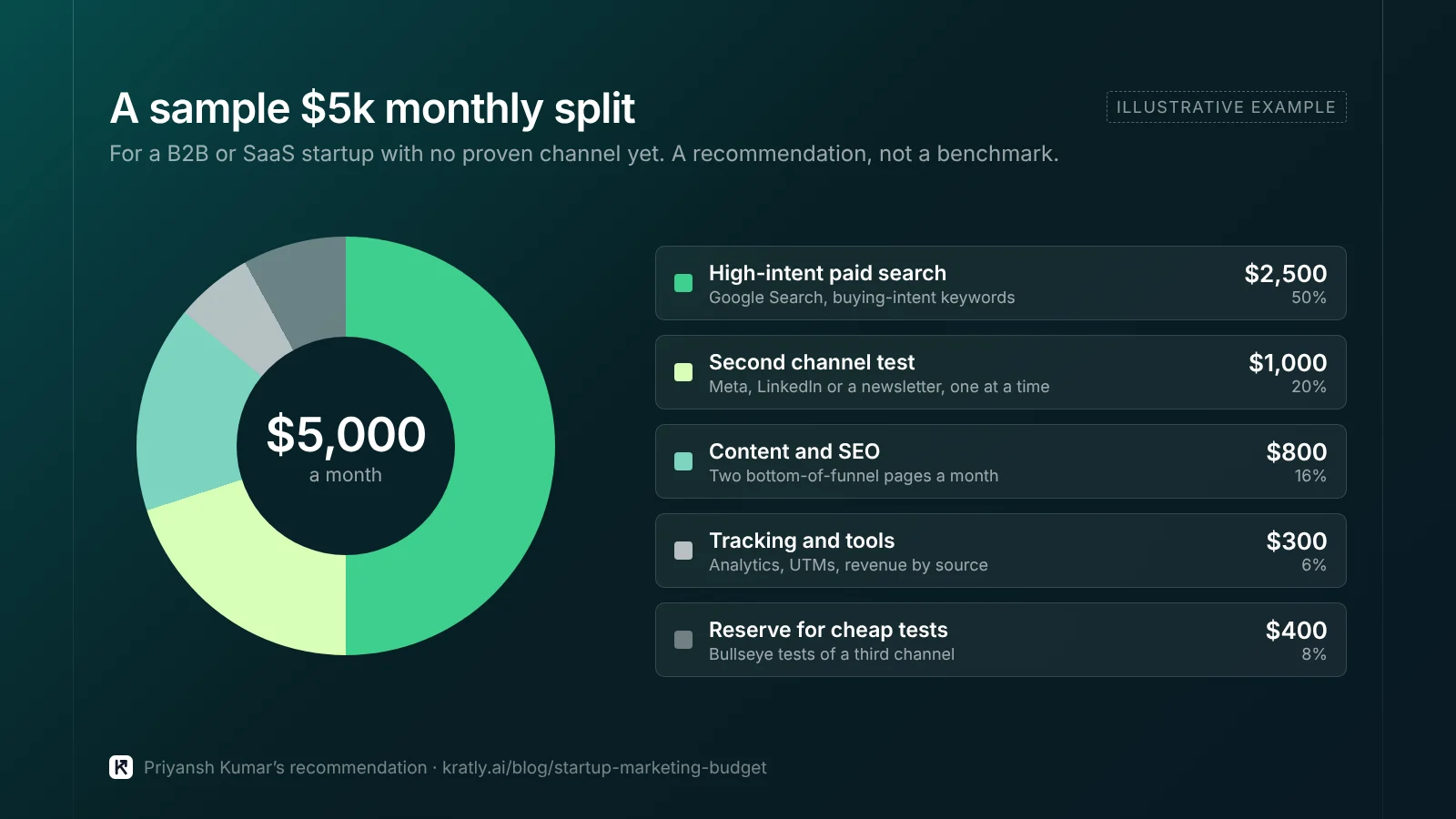
This is my recommendation for a B2B or SaaS startup with no proven channel yet. It's an opinion, not a benchmark.
| Line | Monthly $ | Share | What it buys |
|---|---|---|---|
| High-intent paid search | $2,500 | 50% | Google Search on buying-intent keywords |
| Second channel test | $1,000 | 20% | Meta, LinkedIn or a newsletter sponsorship, one at a time |
| Content and SEO | $800 | 16% | Two bottom-of-funnel pages a month from a freelance writer |
| Tracking and tools | $300 | 6% | Analytics, UTM discipline, a revenue view by source |
| Reserve for cheap tests | $400 | 8% | Bullseye tests of a third channel, a few hundred dollars each |
| Total | $5,000 | 100% |
Why so much on one channel? Small slices rarely give enough data to judge. The reserve keeps testing alive.
What should you measure in revenue?#
Pull revenue from Stripe and spend from the ad platforms.
| Metric | Formula | Where the data comes from | Healthy range (sourced) |
|---|---|---|---|
| Paying customers by source | New paying customers, grouped by first source | Stripe + UTMs | No benchmark; track the trend |
| CAC by channel | Channel spend ÷ new paying customers from it | Ad platforms + Stripe | Compare channels with each other |
| CAC payback | CAC ÷ (new MRR per customer × gross margin) | Stripe + finance | Under 12 months for SMB SaaS (Bessemer) |
| Marketing spend as % of ARR | Monthly marketing spend × 12 ÷ ARR | Accounting + Stripe | Median 8% at private B2B SaaS (SaaS Capital); expect higher early |
| Conversions per campaign | Conversions in the last 30 days | Google Ads | 15+ before target ROAS on Search (Google Ads Help) |
What to stop doing#
Spreading the budget across every channel#
Five channels at $1k each means five weak signals. None clearly fails, so all of them survive for months.
Paying agency minimums on a small budget#
Many paid media agencies have minimum retainers of $1,000 to $3,000 a month (Credo, 2019 data). At $5k of spend, that's 20–60% of your budget. Buy a few expert hours for a setup review instead.
Counting clicks and sign-ups as wins#
The Indie Hackers test above bought 2,000 clicks and no paying customers yet. A clicks report would have called it a win.
Turning on automated bidding without the data#
Target ROAS on five conversions a month gives the algorithm too little data. You pay for its guesses.
Hiring before a channel works#
A $150k-a-year hire who has to find the channel from scratch is your most expensive test.
How to do this in Kratly#
- Connect Stripe, your website and your ad accounts. Google Ads and Meta Ads connect today. LinkedIn Ads is coming soon. Until then, tag LinkedIn traffic with UTMs and upload its spend as a CSV.
- See cost per paying customer by channel. Kratly ties each paying customer to the campaign, page or email that brought them.
- Run the free wasted-spend checker. Upload a Google Ads search terms report. It runs in your browser and flags spend on searches that never convert, before you raise budget.
- Approve suggested budget shifts. Kratly suggests moving money toward channels that bring paying customers. You approve each change, and it's logged and reversible.
Go deeper: How much to spend on Google Ads: break-even CPC, budget by stage
Questions, answered
How much should a startup spend on marketing?
As much as your cash allows while you wait for payback. Benchmarks describe bigger firms: Gartner puts large-company marketing at 7.8% of revenue, and SaaS Capital finds a median 8% of ARR at private B2B SaaS. Early startups often spend more. Keep spending only on channels that pay back within about 12 months for SMB SaaS.
Is $5,000 a month enough for startup marketing?
Yes, if you focus it. $5k is enough to run one high-intent paid channel properly and test one or two more cheaply. It's not enough to run five channels well. Put about half on one channel, keep a small reserve for tests and judge every channel on paying customers, not clicks or sign-ups.
What percentage of revenue should go to marketing?
There's no single right number for a startup. SaaS Capital's 2026 survey found a median of 8% of ARR on marketing and 15% on sales at private B2B SaaS companies. Gartner's large-company figure is 7.8% of revenue. Early-stage startups usually spend a higher share, which is fine when CAC payback is short.
When should a startup make its first marketing hire?
After one channel brings paying customers at a cost you can repeat, and you have budget to scale it. A US growth marketing manager costs about $150,000 a year with benefits, more than twice a $5k monthly budget. Before that point, cheap channel tests run by the founder usually teach you more for less money.
Should a startup use an agency or run ads itself?
At around $5k a month, I'd run the first tests yourself. Many agencies charge minimum retainers of $1,000 to $3,000, which is 20–60% of a $5k budget. Buy a few hours of expert review instead. Consider an agency later, for a specific skill such as ad creative.
Written by
Priyansh Kumar
Priyansh Kumar has spent more than a decade in growth, scaling brands from 1 to 10 and from 10 to 100. He now builds Kratly, an autonomous growth team that ties every campaign, page and email to the revenue it brings.
Sources
- Gartner: 2026 CMO Spend Survey press release (May 11, 2026; 401 respondents, Jan–Mar 2026)
- SaaS Capital: 2026 Spending Benchmarks for Private B2B SaaS Companies (June 2026)
- Google Ads Help: About target ROAS bidding
- Brian Balfour: Traction: the Bullseye Framework, guest post by Justin Mares (Sept 2014)
- Bessemer Venture Partners: Scaling to $100M
- Payscale: Growth Marketing Manager salary (2026)
- US Bureau of Labor Statistics: Employer Costs for Employee Compensation (June 2026)
- SHRM: Recruiting benchmarking
- Credo: PPC pricing survey (2019 data)
- Indie Hackers: How much do you spend on marketing your SaaS? (thread, 2023)
Was this article useful?