Short answer
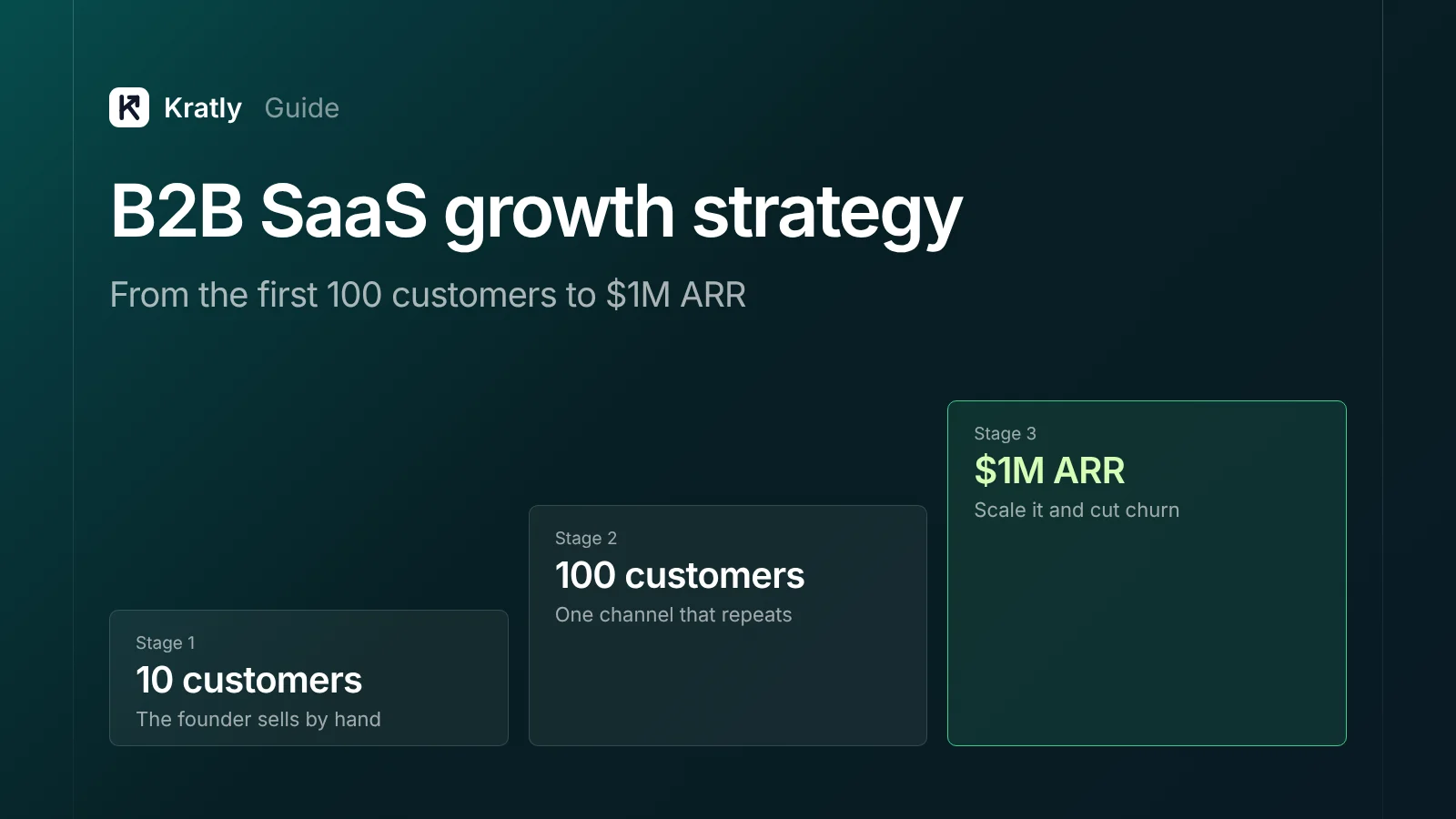
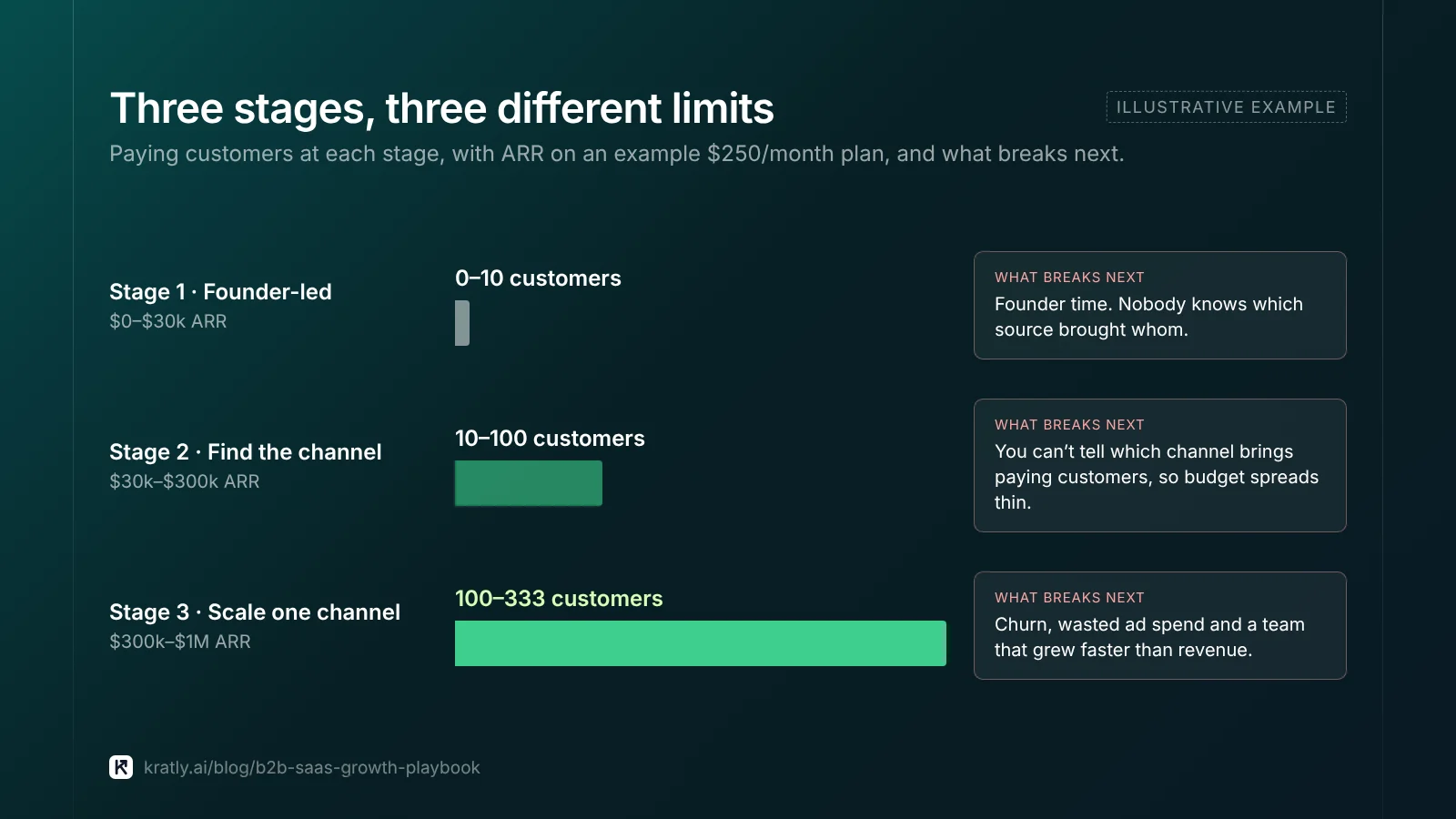
A good B2B SaaS growth strategy changes with your stage. From 0 to 10 customers, the founder sells by hand. From 10 to 100, you find one channel that brings paying customers at a cost you can repeat. From 100 customers to $1M ARR, you scale that channel and cut churn so revenue compounds.
In 2018, Guillaume Moubeche launched lemlist, a cold email tool, with his last $1,000. He didn't start with ads. He answered questions about prospecting in Facebook, Reddit and Slack groups. One post in a sales prospecting Facebook group, shared with the group creator's permission, brought almost 300 beta sign-ups (Growth Unhinged, Oct 2024).
About a year after launch, lemlist reached $200K ARR. It hit its first $1M ARR in 2020, with no outside funding, per the same write-up. Most companies take longer. ChartMogul's 2023 report puts the median time to $1M ARR at around 2 years and 9 months (ChartMogul).
This playbook is part of our growth playbooks by business type. Here's what to do, measure and stop at each stage.
What stage is your B2B SaaS at?#
A B2B SaaS growth strategy is the order in which you pick, test and scale channels, judged by paying customers and kept revenue, not sign-ups.
Count paying customers in Stripe, not trials. The revenue bands assume an illustrative $250/month plan, so scale them to your price.
| Stage | Paying customers (ARR at $250/mo) | What's true | What breaks next |
|---|---|---|---|
| 1. Founder-led | 0–10 ($0–$30k) | The founder sells. The product changes weekly. Every customer is a conversation. | Founder time. Nobody knows which source brought whom. |
| 2. Find the channel | 10–100 ($30k–$300k) | Two or three channels show signs of life. Onboarding is half manual. | You can't tell which channel brings paying customers, so budget spreads thin. |
| 3. Scale one channel | 100–333 ($300k–$1M) | One channel works. Churn starts to show in the monthly numbers. | Churn, wasted ad spend and a team that grew faster than revenue. |
The five moves that matter most#
These are in the order I'd make them. Each has a rough cost and a time to revenue. The costs are my estimates, not benchmarks.
1. Sell the first 10 customers yourself#
Paul Graham wrote that "the most common unscalable thing founders have to do at the start is to recruit users manually" (Paul Graham, "Do Things That Don't Scale", July 2013). For B2B that means cold emails, calls, demos and founder posts in the communities your buyers read.
Each sale teaches you who buys, what they pay and which words close the deal. You'll reuse those words in ads and pages later.
- Cost: 10–15 founder hours a week, under $100 a month in tools.
- Time to revenue: two to eight weeks per deal for small B2B plans.
Charge from the first customer. A pilot that never pays tells you nothing about price. Then watch what new customers do in week one, using a SaaS activation metric.
2. Tag every sign-up with its source from day one#
Do this before you spend a dollar on ads. Add UTM tags to every link and store the source on the customer record in Stripe. The method is in SaaS marketing attribution: tie every campaign to real revenue. Use a simple UTM naming convention so the data stays clean.
Without source data, you'll judge stage 2 channel tests by sign-ups or gut.
- Cost: one to two days of developer time.
- Time to revenue: none directly. It makes every later budget call cheaper.
3. Test channels and pick one that repeats#
At 10 to 100 customers, test two or three channels for 8–12 weeks each. Judge each one on cost per paying customer, not leads. Then put most of your time and money behind the one that wins.
Common first channels for B2B SaaS:
Bottom-of-funnel SEO. Comparison, alternatives and "best X for Y" pages. See SaaS SEO strategy: the bottom-of-funnel pages that bring revenue. Expect three to six months before steady sign-ups.
Google Ads on high-intent search. Fast feedback, but easy to waste. Start with the nine places Google Ads budgets leak.
Communities. Lemlist's early path. Read Reddit marketing for SaaS before you post.
LinkedIn Ads. Precise targeting, high cost per click. Judge it on paying customers, not leads.
Cost: $3k–$5k a month per paid channel during a test, or 20–40 hours a month for SEO and communities.
Time to revenue: two to six weeks for paid search, three months or more for SEO.
Use CAC by channel, calculated from Stripe, to pick the winner.
4. Fix retention before you scale spend#
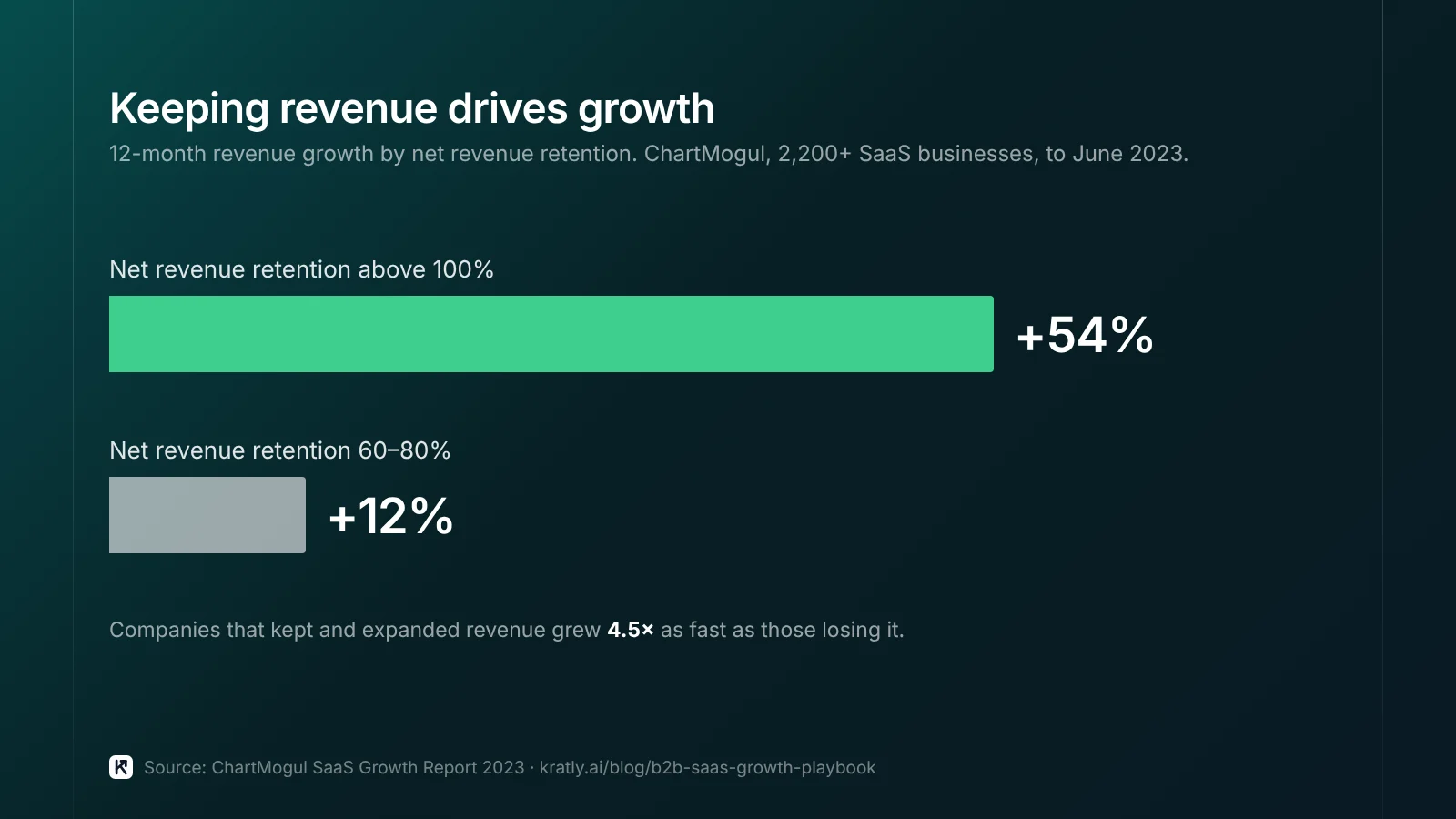
Churn quietly caps growth. ChartMogul found that companies with net revenue retention above 100% grew 54% over 12 months. Those at 60–80% grew 12% (ChartMogul, 2023).
Start with failed card payments, since that churn isn't a choice. Stripe's Smart Retries default is eight tries within two weeks (Stripe docs). See Stripe dunning emails. Then add a SaaS cancellation flow that asks why people leave.
- Cost: two to five days of setup.
- Time to revenue: the first recovered payments arrive within weeks.
5. Scale the winner with a weekly review#
At 100 customers, raise spend on the winning channel in steps of 20–30% a month. Check CAC payback after each step. Bessemer suggests under 12 months for SMB SaaS and under 18 for mid-market (Bessemer).
Hold a 30-minute weekly growth review on revenue by channel. Add a second channel only when the first stops scaling at your payback target.
- Cost: your channel budget plus about two hours a week.
- Time to revenue: each step shows results within one sales cycle.
What should you measure in revenue?#
Pull every number from Stripe or your billing system first. Ad platforms and your CRM come second.
| Metric | Formula | Where the data comes from | Healthy range (sourced) |
|---|---|---|---|
| New MRR | MRR from customers who paid for the first time this month | Stripe | No single benchmark; track the trend |
| Weekly revenue growth | (This week's revenue ÷ last week's) − 1 | Stripe | "5-7% a week" is good during YC (Paul Graham, 2012) |
| CAC by channel | Channel spend ÷ new paying customers from it | Ad platforms + Stripe | Compare channels with each other |
| CAC payback | CAC ÷ (new MRR per customer × gross margin) | Stripe + finance | Under 12 months SMB, under 18 mid-market (Bessemer) |
| Net revenue retention | (Starting MRR + expansion − contraction − churn) ÷ starting MRR, 12 months | Stripe | Median 101% in 2025 (SaaS Capital) |
| Gross revenue retention | (Starting MRR − contraction − churn) ÷ starting MRR, 12 months | Stripe | Median 91% in 2025 (SaaS Capital) |
Graham's weekly rate fits the earliest stage, when the base is tiny. He also says "the best thing to measure the growth rate of is revenue" (Paul Graham). The SaaS Capital figures exclude companies under $1M ARR, so treat them as the bar you're aiming for.
What to stop doing#
Running five channels at once#
Spread $5k a month across five channels and each gets $1k. That's rarely enough to judge any of them. Pick two, test properly, then cut one.
Counting sign-ups, leads and demos as wins#
A campaign can fill your CRM and bring zero paying customers. If your weekly report starts with leads, you'll fund the wrong channel for months.
Chasing short-term cash with lifetime deals#
Lemlist's AppSumo launch brought in $160,000 in two weeks. Moubeche said they kept about $60k, and those buyers wouldn't upgrade later (Failory, March 2020). He also said it paid for product work. So it can help once. But it's not a growth channel, and it fills support with users who'll never pay more.
Hiring sales or an agency before you can sell it yourself#
If the founder can't close deals, a new hire won't either. You'll pay a salary to learn what founder calls teach for free. Hire once you have a script that closes.
How to do this in Kratly#
- Connect Stripe, your website and your ad accounts. Google Ads and Meta Ads connect today. LinkedIn Ads is coming soon. Until then, tag that traffic with UTMs and upload its spend as a CSV.
- See revenue by source. Kratly ties each paying customer to the campaign, page or email that brought them. You see cost per paying customer by channel.
- Review the suggestions. Kratly flags spend that brings no paying customers and pages that bring revenue. It suggests what to change.
- Approve the changes you agree with. Kratly makes them. Every change is logged and reversible.
Questions, answered
What is the best B2B SaaS growth strategy for an early-stage startup?
Founder-led sales first. Win your first 10 paying customers through direct outreach, calls and communities your buyers already use. Then test two or three channels for 8–12 weeks each and keep the one with the lowest cost per paying customer. Scale that channel and fix churn before you add another. Track everything from Stripe, not ad platform reports.
How long does it take a SaaS company to reach $1M ARR?
ChartMogul's 2023 report puts the median at around 2 years and 9 months. The best companies in its data took about 9 months. Your timeline depends on price. At $250 a month you need about 333 customers. At $2,000 a month you need about 42, so fewer deals but longer sales cycles.
What is a good growth rate for an early B2B SaaS?
Paul Graham wrote that 5–7% a week is a good rate during Y Combinator, measured on revenue. That's for very early companies with a small base. Later, ChartMogul's 2023 data put median annual growth around 30%, with the top quartile at 60–70%. Compare yourself with companies at a similar revenue level.
What is a good net revenue retention for B2B SaaS?
SaaS Capital's 2025 survey of over 1,000 private B2B SaaS companies found a median net revenue retention of 101%. Median gross revenue retention was 91%. Companies with contracts under $12k a year had a lower median NRR, 98%. The survey excludes companies under $1M ARR, so early numbers will be noisier.
Should a B2B SaaS start with SEO or paid ads?
Start with paid search if you need fast feedback and can spend $3k–$5k a month for a test. Start with bottom-of-funnel SEO if cash is tight and you can wait three to six months. Many teams do both at a small scale. Judge both on paying customers in Stripe, never on traffic or sign-ups.
Written by
Priyansh Kumar
Priyansh Kumar has spent more than a decade in growth, scaling brands from 1 to 10 and from 10 to 100. He now builds Kratly, an autonomous growth team that ties every campaign, page and email to the revenue it brings.
Sources
- Paul Graham: Do Things That Don't Scale (July 2013) · Startup = Growth (Sept 2012)
- ChartMogul: SaaS Growth Report 2023 (2,200+ SaaS businesses, 12 months to June 2023)
- SaaS Capital: 2025 B2B SaaS Retention Benchmarks (PDF) · Summary page
- Bessemer Venture Partners: Scaling to $100M
- Stripe: Smart Retries
- Growth Unhinged (Charles Tenot): Lessons from bootstrapping lemlist (Oct 2024)
- Failory: Interview with Guillaume Moubeche of lemlist (March 2020)
Was this article useful?