Short answer
To sell online courses, build an email list first, then sell to it in a short launch with a deadline. Once a launch converts, turn the same sequence into an evergreen funnel and add paid traffic. Offer tiers and a payment plan. Judge everything on revenue per subscriber, net of refunds.
In November 2013, Nathan Barry emailed 6,467 subscribers about a new edition of his design book. In the first 24 hours, he sold 548 copies "for $36,297 in gross revenue" (Nathan Barry). He sold it in three packages. The $199 complete package was 31% of copies but 61% of revenue.
His launch shows how to sell online courses in miniature: a list, a date, a deadline and a premium tier. That's roughly $5.61 of first-day revenue per subscriber.
This guide is part of our growth playbooks by business type. Selling exam prep? See the edtech marketing strategy playbook for seasonal demand.
What stage is your course business at?#
The bands below are illustrative, not benchmarks. Count revenue from Stripe or Shopify, after refunds.
| Stage | Monthly revenue (illustrative) | What's true | What breaks next |
|---|---|---|---|
| 1. First course | $0–$5k | A small audience, under about 1,000 subscribers. One course, sold by hand or in one launch. | You build too much course before anyone pays. |
| 2. Launch-driven | $5k–$30k | Two to four launches a year. Revenue arrives in spikes. | Quiet months between launches. Every launch burns out the founder. |
| 3. Launches plus evergreen | $30k+ | An evergreen funnel sells daily. Paid ads feed it. Launches add peaks. | Ad spend grows faster than revenue. Refunds and payment plan failures hide in the totals. |
What I'd check first: what share of the last 12 months of revenue came in launch weeks? If it's over 70%, you're at stage 2.
The five moves that matter most#
These are in the order I'd make them. Costs and timings are my estimates.
1. Treat the email list as the business#
Social reach is rented. A list is yours.
Justin Welsh is a well-known case. Kajabi, the course platform he uses, says he earned over $5 million in revenue. It quotes his post: "I ran zero ads & operate at a 92% margin" (Kajabi case study). The figures are self-reported vendor marketing. But the model is clear: content builds the list, and email sells.
What to do:
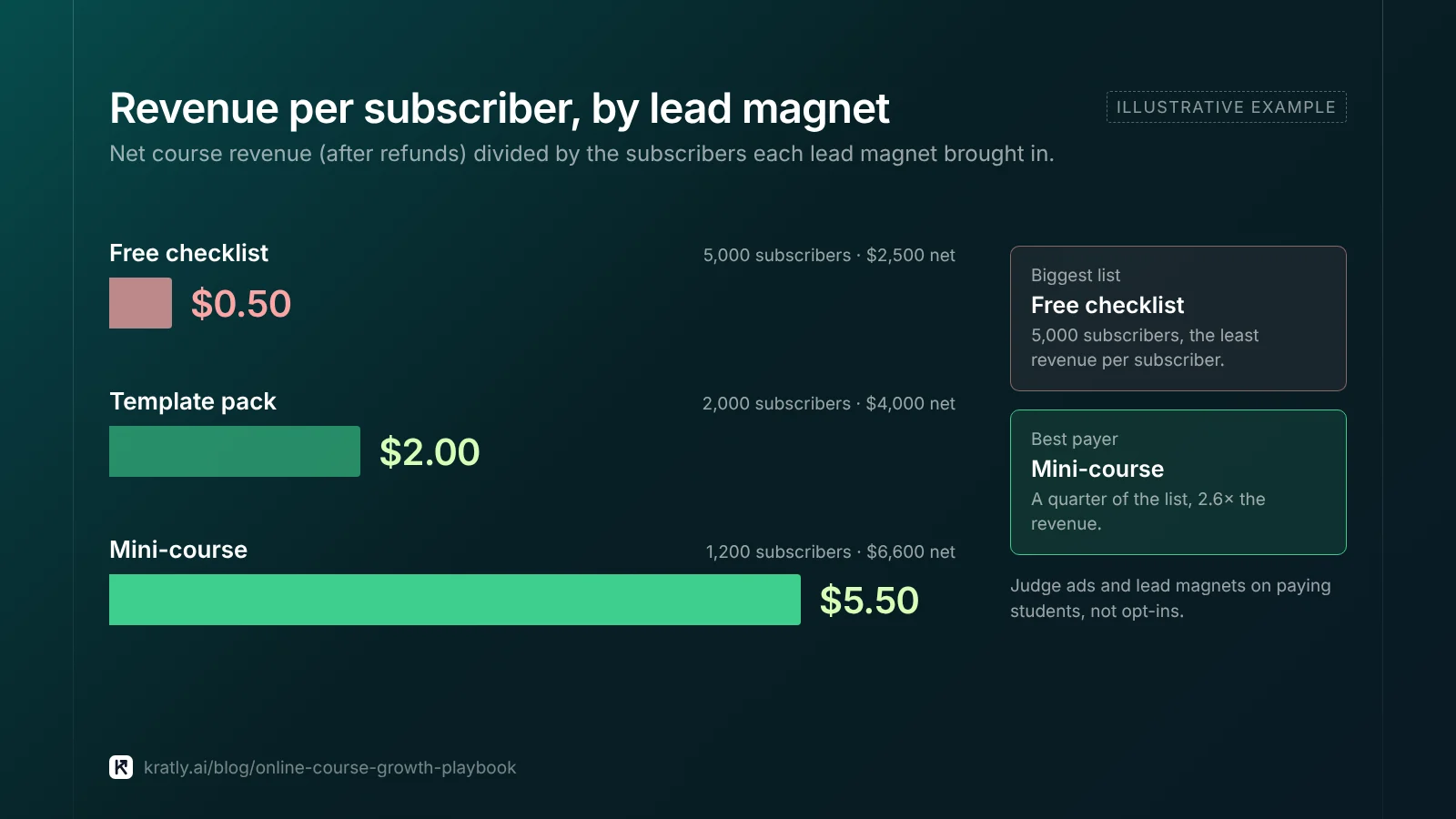
- Offer one lead magnet tied to the course: a checklist, a mini-course or a template.
- Tag every link in every email with UTMs, so sales trace back to the send.
Follow the FTC's CAN-SPAM rules: an unsubscribe link, a postal address and fast opt-outs.
- Cost: a few days to build the lead magnet. $0–$100 a month for an email tool at small list sizes.
- Time to revenue: your first launch, usually two to four months of list building away.
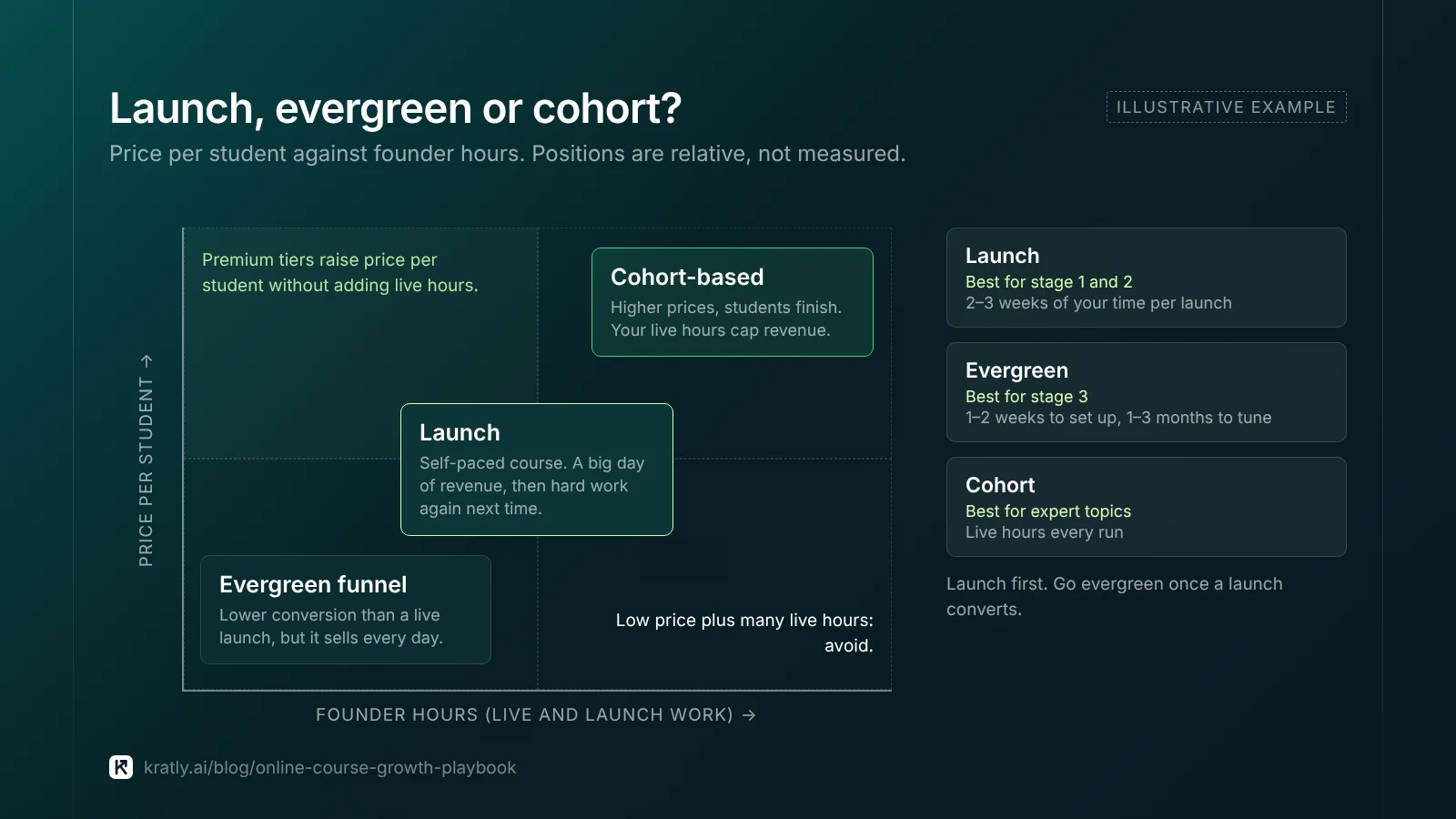
2. Pick launch, evergreen or cohort on purpose#
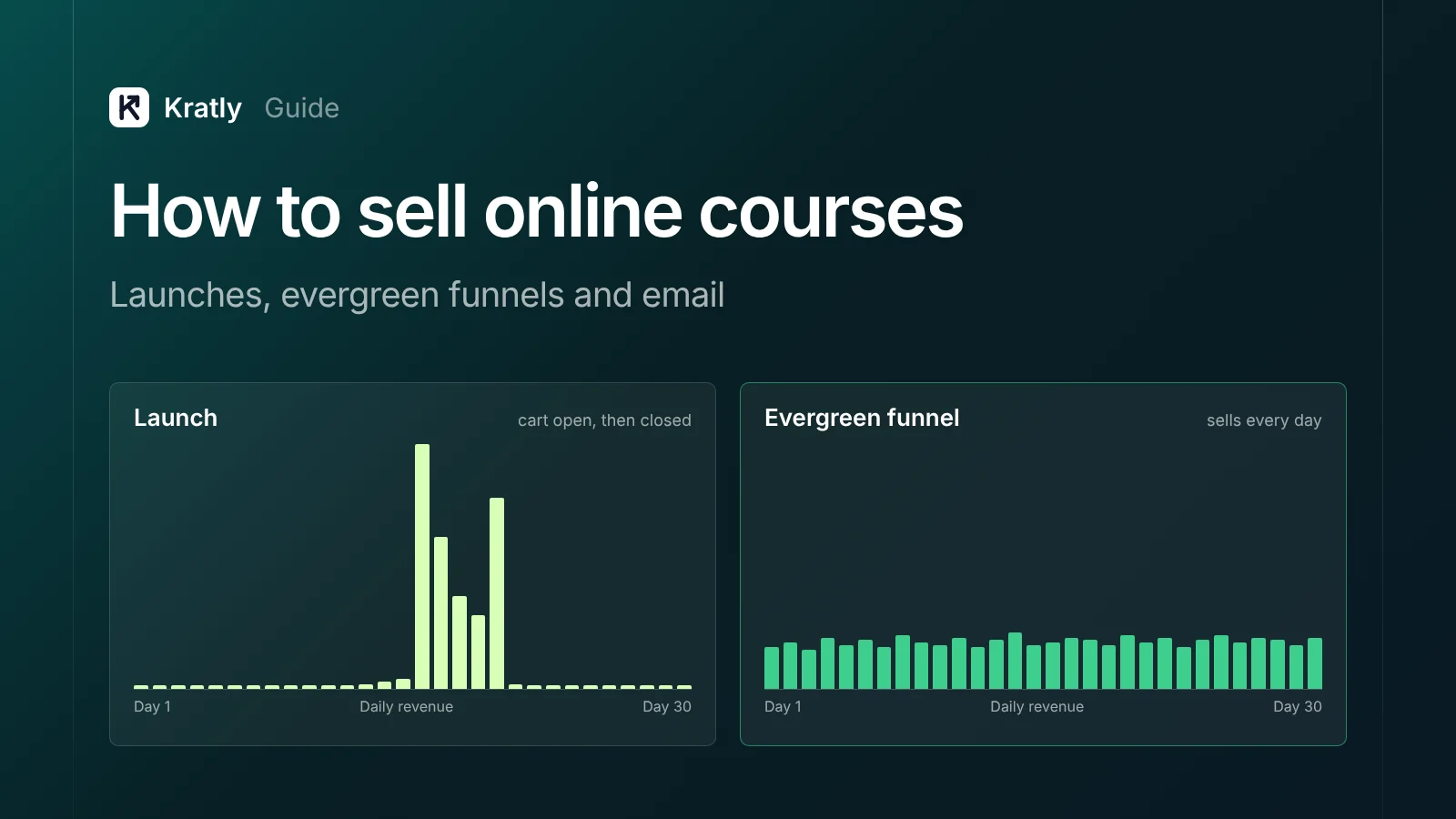
An evergreen funnel is a course sales sequence that runs for each new subscriber on their own timeline, every day of the year. A launch opens the cart to everyone at once, then closes it.
| Format | Pros | Cons | Best for |
|---|---|---|---|
| Launch (self-paced course) | Urgency is real. A big day of revenue. | Revenue is lumpy. Hard work each time. | Stage 1 and 2 |
| Evergreen funnel | Sells daily. Works with paid ads. | Deadlines must be honest. Conversion is usually lower than a live launch. | Stage 3 |
| Cohort-based course | Higher prices. Students finish. | Your live hours cap revenue. | Expert topics, high-touch outcomes |
Completion matters: students who finish buy again and refer friends. Justin Reich and José Ruipérez-Valiente studied edX courses from MIT and Harvard (Science, 2019). Only 3.13% of participants completed their courses in 2017–18 (Inside Higher Ed). Among verified learners, who paid for a certificate, 46% finished.
Paying changes behavior.
My view: launch first. A launch tells you if the offer sells, fast. Go evergreen only after one launch converts.
- Cost: a launch takes two to three weeks of your time. An evergreen setup takes one to two weeks.
- Time to revenue: launch week itself. Evergreen takes one to three months to tune.
3. Sell live before you automate#
A live workshop is the fastest way to learn objections. Those questions become your sales page and emails.
A simple sequence for a launch:
- Week 1: three teaching emails, no pitch.
- Day 0: a live workshop with a 10-minute offer at the end.
- Days 1–4: case studies, a FAQ email and a payment plan reminder.
- Last day: two short emails. Close the cart at the stated time.
Then reuse the recording and emails as your evergreen funnel, with an honest deadline per subscriber. The logic matches trial follow-up emails that turn sign-ups into paying customers: help first, then ask, then remind.
- Cost: one week to prepare. A webinar tool costs $0–$100 a month.
- Time to revenue: the launch week.
4. Price in tiers and offer a payment plan#
Barry's launch shows the power of a premium tier. He estimated that three packages earned 2.8 times what the book alone would have (Nathan Barry).
What to do:
- Offer two or three tiers: course only, course plus templates or community, and course plus live calls.
- Add a payment plan on courses above a few hundred dollars. Charge a little more in total than the pay-in-full price.
- Track payment plan completion. A plan that's 40% unpaid isn't revenue yet.
In Stripe, you can run an installment plan with a subscription schedule. You set a fixed number of iterations and an end_behavior of cancel (Stripe docs). That stops billing after the last payment.
The tests in SaaS pricing page best practices work for course pages too. Judge each on revenue, not clicks.
- Cost: a day to set up tiers and a plan.
- Time to revenue: the next launch.
5. Make honest claims and a clear refund policy#
Course marketing often leans on income screenshots. The FTC's Endorsement Guides apply to testimonials. If one student's result isn't typical, the ad "should clearly and conspicuously disclose the generally expected performance" (16 CFR 255.2).
Courses that teach people to make money face more scrutiny. In January 2025, the FTC proposed extending its Business Opportunity Rule to "money-making opportunities," including business coaching (FTC). Sellers would need proof for claims about likely earnings. Check the rule's current status with a lawyer.
For refunds, pick a window and write it in plain words. If you say "money-back guarantee," the FTC's guarantee guide expects a full refund on request, with conditions disclosed (16 CFR 239.3).
- Cost: a day to rewrite claims. Some lost sales from cut hype.
- Time to revenue: fewer refunds and chargebacks within a launch.
What should you measure in revenue?#
Pull revenue from Stripe or Shopify, after refunds. Use ad platforms for spend only.
| Metric | Formula | Where the data comes from | Healthy range (sourced) |
|---|---|---|---|
| Revenue per subscriber | Net launch revenue ÷ subscribers emailed | Stripe or Shopify + email tool | No public benchmark. Barry's 2013 launch: about $5.61 on day one |
| Launch conversion | Buyers ÷ subscribers emailed | Stripe + email tool | No public benchmark. Barry's day one: about 8.5% |
| Evergreen revenue per new subscriber | Revenue within 60 days ÷ new subscribers | Stripe + email tool | No public benchmark; track by lead magnet |
| Refund rate | Refunded orders ÷ orders, by source | Stripe or Shopify | No public benchmark |
| Payment plan completion | Plans fully paid ÷ plans started | Stripe | No public benchmark |
| CAC per student | Ad spend ÷ paying students from ads | Ad platforms + Stripe | Compare with revenue per student after refunds |
What to stop doing#
Building a 40-hour course before anyone pays#
Pre-sell a cohort or a beta first. If ten people won't pay, the full course won't save it.
Counting followers instead of subscribers#
Platforms decide who sees each post. Move people to email, then measure what each subscriber earns.
Running fake deadlines#
An evergreen "48 hours left" timer that resets on refresh breaks trust and may be deceptive. Use a real deadline per subscriber, or none.
Judging ads on opt-ins#
Cheap leads often never buy. Judge ad campaigns on paying students within 60 days, net of refunds.
How to do this in Kratly#
- Connect Google Ads, Meta Ads, your website and Stripe or Shopify. Kratly ties each course sale to the campaign, page or email that brought it.
- Tag your email links with UTMs. Kratly matches tagged email clicks to Stripe or Shopify revenue, so you see revenue by email and by launch.
- Compare lead magnets and ad campaigns on revenue. See which ones bring paying students, not just opt-ins.
- Approve budget changes. Kratly suggests cuts or shifts toward campaigns that bring paying students. You approve each one, and every change is logged and reversible.
Questions, answered
How do you sell online courses with no audience?
Start smaller than a course. Offer a paid workshop or beta cohort to the people you can reach: past clients, a community you help in, or your network. Their questions shape the course. Collect emails from every free resource you share. Run your first real launch once you have a few hundred engaged subscribers, and judge it on revenue per subscriber.
Is a launch or an evergreen funnel better for selling courses?
Launch first, then go evergreen. A launch has a real deadline and a big audience at once, so it tells you fast whether the offer sells. Once a launch converts, turn the same emails and recorded workshop into an evergreen funnel with honest deadlines. Then add paid traffic. Most mature course businesses run both.
Are cohort-based courses better than self-paced courses?
They finish better and sell at higher prices, but they cost your live hours. A study of MIT and Harvard courses on edX found 3.13% completion overall in 2017–18, and 46% among paying verified learners. Paying and live deadlines both lift completion. Choose cohorts when outcomes need feedback, and self-paced when the topic is simpler.
Should I offer a payment plan for my course?
Yes, for courses above a few hundred dollars. A plan lowers the barrier to buy. Charge slightly more in total than the pay-in-full price, to cover failed payments. Then track how many plans are fully paid. In Stripe, a subscription schedule with a fixed number of payments stops billing automatically after the last one.
Can I show student income results in my course ads?
Only with care. The FTC's Endorsement Guides say that if a result isn't typical, you should clearly disclose what people generally achieve. In January 2025, the FTC also proposed rules on earnings claims for business coaching and similar money-making offers. Keep proof for every claim, and get legal advice before using income figures.
Written by
Priyansh Kumar
Priyansh Kumar has spent more than a decade in growth, scaling brands from 1 to 10 and from 10 to 100. He now builds Kratly, an autonomous growth team that ties every campaign, page and email to the revenue it brings.
Sources
- Nathan Barry: The App Design Handbook iOS 7 Edition launch stats (Nov 11, 2013)
- Kajabi (vendor case study): Justin Welsh creator story
- MIT Teaching Systems Lab: Reich and Ruipérez-Valiente, "The MOOC pivot," Science, Jan 11, 2019
- Inside Higher Ed: Coverage of the MOOC pivot study (2019)
- Stripe: Subscription schedules, installment plans
- FTC: CAN-SPAM Act compliance guide · Proposed earnings claims rules (Jan 2025)
- eCFR: 16 CFR Part 255, Endorsement Guides · 16 CFR Part 239, Guarantees
Was this article useful?