Short answer
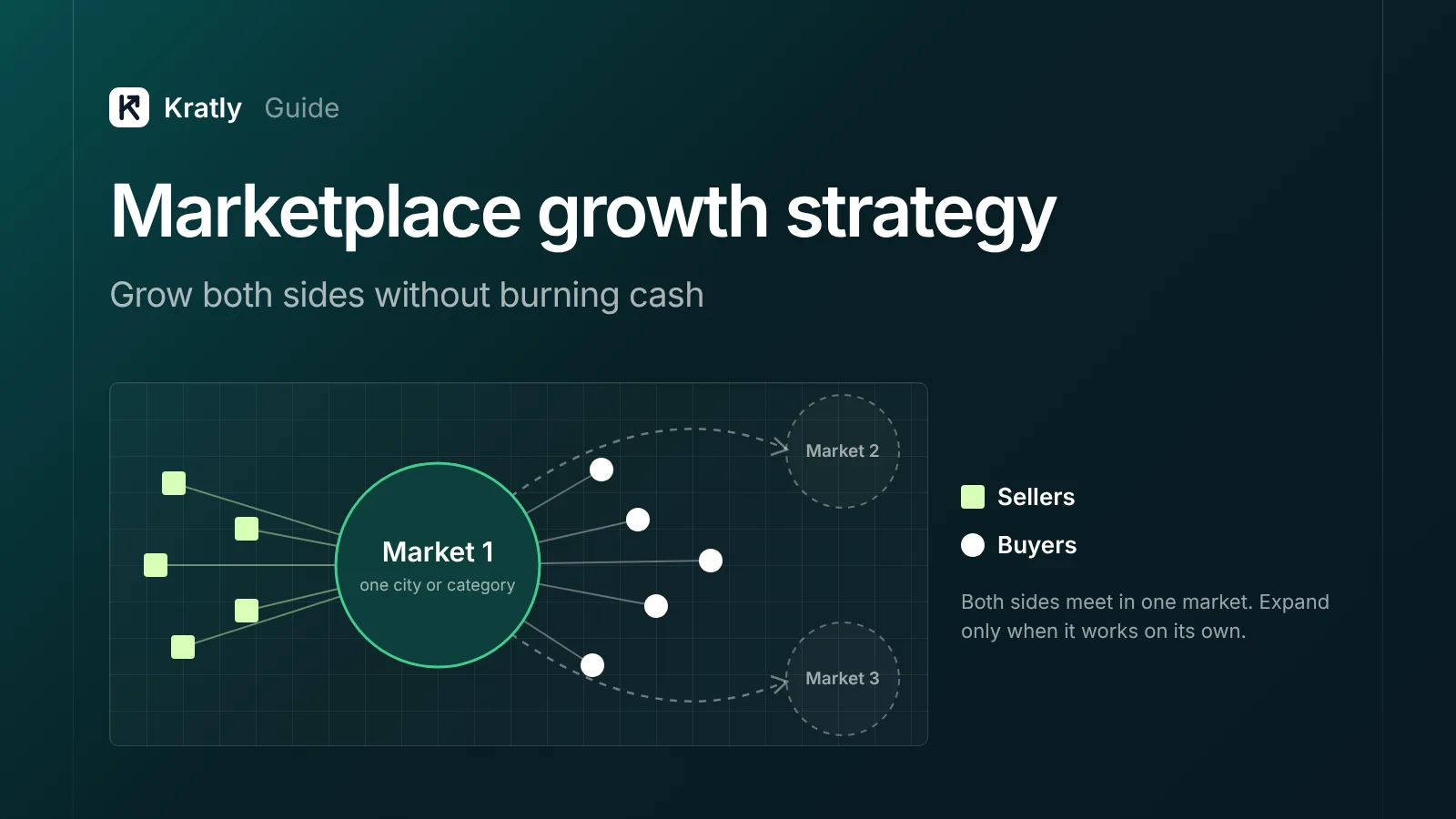
A marketplace growth strategy grows the side that limits completed transactions, which is usually supply. Start in one city or one category until buyers reliably find a match. Track match rate and time to match in each market. Count CAC separately for buyers and sellers. Expand only when a market works on its own.
Etsy didn't start by buying ads for shoppers. Its team recruited sellers in person at craft fairs. Later, "Etsy street teams" of community members spread the word (Lenny Rachitsky, Lenny's Newsletter). It also started with just three categories of items (Lenny's Newsletter).
That's the core of a marketplace growth strategy: get supply by hand, and keep the market small. This guide is part of our growth playbooks by business type.
What stage is your marketplace at?#
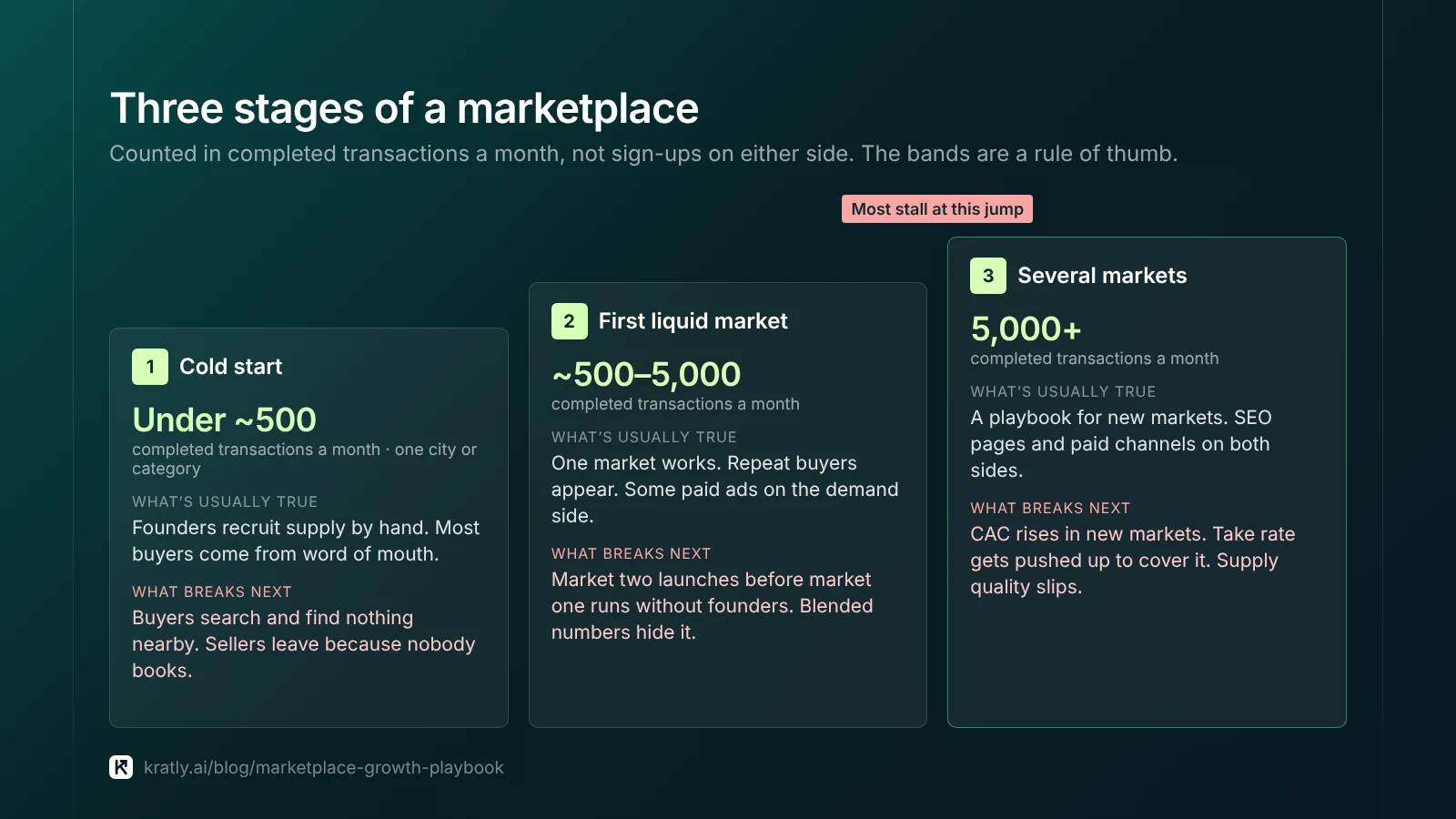
Count completed transactions, not sign-ups on either side.
| Stage | What's usually true | What breaks next |
|---|---|---|
| Cold start: one city or category, under ~500 completed transactions a month | Founders recruit supply by hand. Most buyers come from word of mouth. | Buyers search and find nothing nearby. Sellers leave because nobody books. |
| First liquid market: ~500–5,000 a month | One market works. Repeat buyers appear. Some paid ads on the demand side. | The team launches market two before market one runs without founders. Blended numbers hide that. |
| Several markets: 5,000+ a month | A playbook for launching new markets. SEO pages and paid channels on both sides. | CAC rises in new markets. Take rate gets pushed up to cover it. Supply quality slips. |
These bands are a rule of thumb. Pick your first move from "what breaks next."
The five moves of a marketplace growth strategy#
Marketplace liquidity is the chance that a buyer or seller who shows up finds a match fast enough to complete a transaction.
1. Grow the side that limits transactions, usually supply (cold start)#
What to do: When a transaction fails, which side was missing? If buyers search and leave, recruit supply. If sellers sit idle, find buyers. Start by hand: calls, visits, events.
Why: In Lenny Rachitsky's 2019 research, 14 of 17 marketplaces put early resources into supply (Lenny's Newsletter). DoorDash said restaurants were its biggest lever: "They bring the demand". He found "the vast majority of marketplaces start off supply-constrained". Direct sales was a key lever for about 60% of companies (Lenny's Newsletter).
The exceptions: Rover, TaskRabbit and Zillow found supply wasn't their problem.
Cost: Mostly founder hours. Plan 20–30 hours a week on supply in the first months.
Time to revenue: Weeks. Each new seller in a thin market can produce sales quickly.
2. Start in one city or one category (cold start)#
What to do: Pick one market where supply and demand sit close together. Constrain by geography if they meet in person, otherwise by category. Set a liquidity target first.
Why: Lenny found nearly every company he studied constrained its first market. Thumbtack was the one exception (Lenny's Newsletter). OpenTable aimed for "50-100 concentrated restaurants in a city". Uber's launch goal was over 30 drivers and an ETA under 15 minutes.
Andrew Chen calls this the atomic network: "the smallest network needed that can stand on its own". Make it "smaller and more specific than you think" (Andrew Chen on Lenny's Newsletter).
Cost: Saying no to buyers outside your market. That's cheaper than half-serving five cities.
Time to revenue: One to three months to see whether a market can hold liquidity.
3. Track liquidity in each market before you expand (first liquid market)#
What to do: Measure match rate and time to match for each city or category. Write down the level that means "this market works." Launch the next market only when the first holds it without founders.
Why: Andreessen Horowitz lists match rate first in its 13 marketplace metrics. It defines it as "the rate at which buyers can find sellers, and vice versa". It also lists time to match and retention by location (a16z).
Cost: Four to eight hours to define the metrics and build a weekly view.
Time to revenue: Indirect. It stops you from spending in markets that can't convert buyers.
4. Build search pages for real inventory, not empty ones (first liquid market and up)#
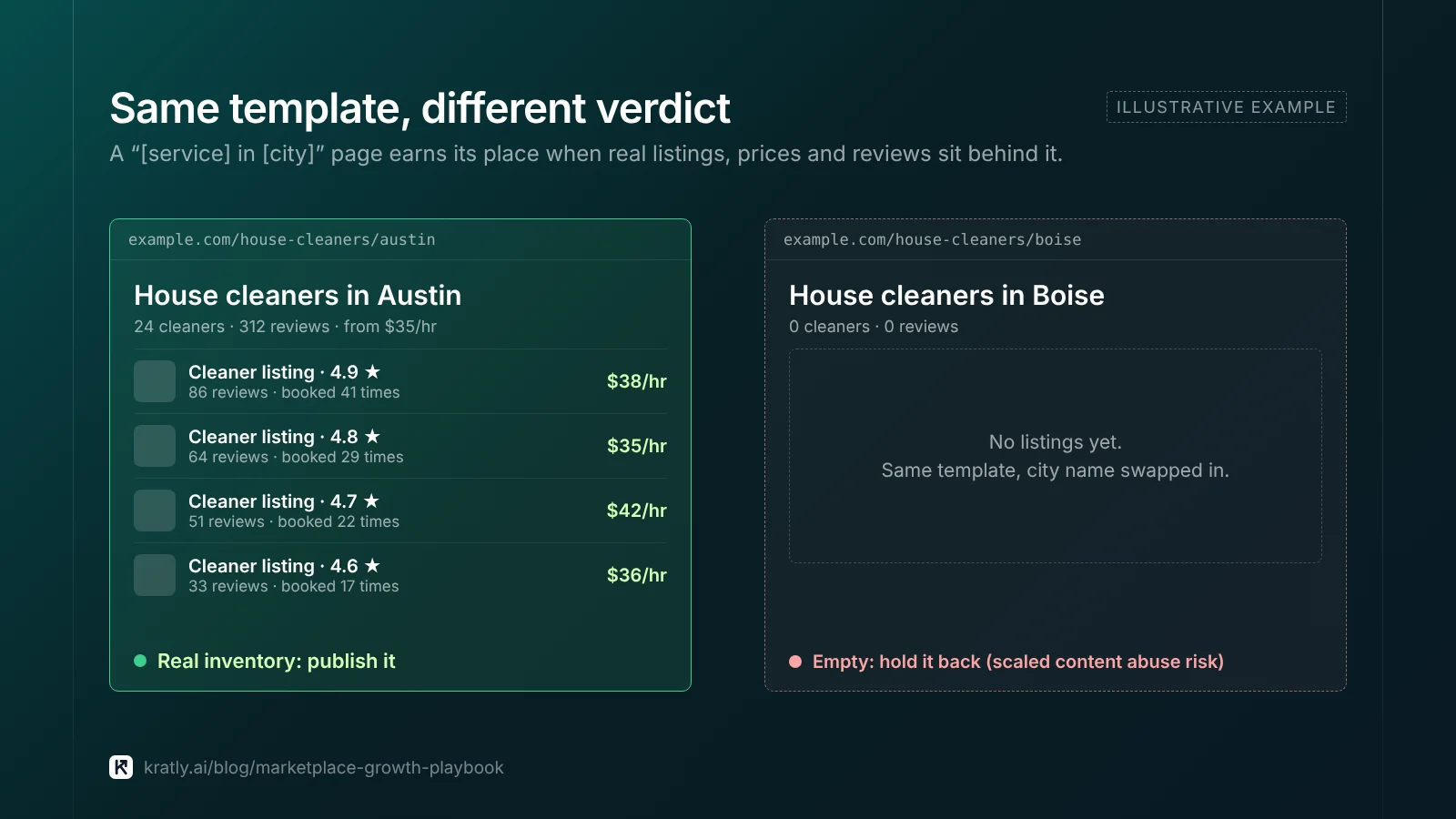
What to do: Create pages people search for, such as "[service] in [city]". Publish a page only when it has real listings, prices or reviews behind it. Check that Google indexes them.
Why: Thumbtack's Sander Daniels said SEO "ended up being 80-90% of our growth". GrubHub's Casey Winters said SEO brought 30% of all new users. At Etsy, millions of listings were indexed early (Lenny's Newsletter).
But Google's spam policies name scaled content abuse. That means many pages made mainly to rank, with little value for the reader (Google Search Central). The method is in programmatic SEO: what Google indexes and ignores.
Cost: Engineering time for templates, then a few hours a month on quality checks.
Time to revenue: Three to six months for organic traffic.
5. Count CAC for each side and pay only for completed transactions (all stages)#
What to do: Split marketing spend into supply and demand. Divide each by the new sellers or buyers who completed a first transaction. Judge campaigns on that, not sign-ups.
Why: A buyer sign-up in a market with no supply is worth nothing. In a given market, a16z says "CAC should decrease and the organic share of users should grow over time" (a16z). The method is in how to calculate CAC by channel.
Subsidies count as CAC too, like Uber's $40 an hour driver guarantee (Lenny's Newsletter).
Cost: Two to four hours to set up campaign naming by side, then 30 minutes a week.
Time to revenue: Two to four weeks, once you cut spend that brings no completed transactions.
What to measure in revenue#
Take rate is the share of transaction value that the marketplace keeps as revenue. a16z puts it simply: "GMV does not equal revenue" (a16z).
| Metric | Formula | Where the data comes from | Reference |
|---|---|---|---|
| GMV | Total value of completed transactions | Stripe or your payments ledger | No sourced range |
| Net revenue | GMV × take rate, after refunds | Stripe or your ledger | Etsy's transaction fee alone is 6.5% of the order (Etsy Help) |
| Match rate | Searches or requests that end in a transaction ÷ all searches or requests | Your database | No sourced range |
| Time to match | Median time from request or listing to transaction | Your database | No sourced range |
| CAC per side | Spend on one side ÷ new users on that side who completed a first transaction | Ad platforms + Stripe or ledger | No sourced range |
| Repeat rate by market | Buyers with 2+ transactions in 90 days ÷ all buyers | Stripe or ledger | No sourced range |
Etsy's fee is an example, not a target. Your take rate depends on the value you add. Bill Gurley: "Great marketplaces do not simply aggregate a market; they enhance it" (Above the Crowd, 2012). He adds that it's "much easier to extract reasonable economics when you are in the flow of payment."
What should you stop doing?#
Stop launching new markets before the first one is liquid. Cost: two half-working markets instead of one that grows on word of mouth.
Stop buying demand you can't serve. Cost: full CAC on a buyer you lose, plus a worse review or no review.
Stop reporting GMV as revenue. a16z warns the two are "frequently used interchangeably" (a16z). Cost: budgets and hiring set against money you never keep.
Stop mass-publishing empty location or category pages. They risk Google's scaled content abuse policy. Cost: pages that don't rank, and possible manual action.
Stop blending CAC across both sides. One number hides that you pay $40 for a buyer and $400 for a seller, or the reverse. Cost: you cut the wrong side's budget.
How to do this in Kratly#
- Connect Google Ads, Meta Ads, your website and Stripe. Kratly ties each paid transaction to the campaign, page or email that brought the buyer.
- Tag campaigns by side and market. Use UTM names such as
supply_austinordemand_austin. Then filter spend and revenue by those campaign names to compare sides and markets. - Connect Search Console. See which location and category pages bring visits and revenue, and which aren't indexed.
- Approve suggested changes. Kratly suggests budget shifts and pauses for campaigns that bring sign-ups but no revenue. You approve them, and each change is logged and reversible.
Questions, answered
Which side of a marketplace should you grow first?
Usually supply. In Lenny Rachitsky's research, 14 of 17 marketplaces focused early resources on supply, because supply was harder to get and often brought demand with it. Check your own data first. If sellers sit idle while buyers are scarce, you're demand-constrained, as Rover, TaskRabbit and Zillow were. Grow whichever side is missing when transactions fail.
How do you solve the chicken-and-egg problem?
Make the market small enough that one side can be won by hand. Pick one city or category. Recruit supply through direct sales, events and existing communities. Then bring buyers to that small market. Andrew Chen calls this the atomic network, the smallest network that can stand on its own. Expand only once it does.
What is a good take rate for a marketplace?
There's no single number, and it depends on the value you add. Bill Gurley argues great marketplaces enhance a market rather than just aggregate it. Being in the payment flow also makes fees easier to collect. As one example, Etsy charges a 6.5% transaction fee plus a $0.20 listing fee. Compare with direct rivals, not marketplaces in general.
How do you measure marketplace liquidity?
Track match rate: the share of searches or requests that end in a completed transaction. Add time to match: how long a request or listing waits before it transacts. Measure both per city or category, not blended. a16z lists both among its 13 marketplace metrics. Set your own target per market and track it weekly.
Does SEO work for marketplaces?
Yes, often better than for other businesses, because listings create pages people search for. Thumbtack said SEO drove 80-90% of its growth, and GrubHub said 30% of new users. Publish location and category pages only when they have real listings. Empty pages made at scale risk Google's scaled content abuse policy.
Written by
Priyansh Kumar
Priyansh Kumar has spent more than a decade in growth, scaling brands from 1 to 10 and from 10 to 100. He now builds Kratly, an autonomous growth team that ties every campaign, page and email to the revenue it brings.
Sources
- Lenny's Newsletter (Lenny Rachitsky, Nov–Dec 2019): Part 1, constrain the marketplace · Part 2, which side to focus on · Part 3, initial supply · Part 4, initial demand
- Andrew Chen on Lenny's Newsletter: The atomic network, excerpt from The Cold Start Problem (Dec 9, 2021)
- Andreessen Horowitz (Jeff Jordan, Li Jin, D'Arcy Coolican, Andrew Chen): 13 metrics for marketplace companies (Feb 2020)
- Bill Gurley, Above the Crowd: All Markets Are Not Created Equal: 10 Factors To Consider When Evaluating Digital Marketplaces (Nov 13, 2012)
- Google Search Central: Spam policies for Google web search
- Etsy Help: Etsy fee basics
Was this article useful?