Short answer
To get cited in Google AI Overviews, your page must be indexed and eligible for a snippet. Then rank on page one, answer each sub-question of the search under its own heading in 40 to 70 words, back claims with sources and original data, and earn mentions on sites Google already cites. Track citations weekly, query by query.
Your impressions are up and your clicks are down. A competitor's page is quoted in the AI box above you. And Search Console can't tell you how much of this is AI. When Google's AI Mode clicks briefly vanished from reports in May 2025, SEO consultant Lily Ray called it "Not Provided 2.0" (LinkedIn).
This guide sticks to what Google confirms and what the data shows, including where the studies disagree.
What Google says about AI Overviews and your site#
Start with the source. Google's "AI features and your website" page is short and clear. It was last updated December 10, 2025 (Google Search Central):
- "There are no additional requirements to appear in AI Overviews or AI Mode, nor other special optimizations necessary."
- To be eligible, "a page must be indexed and eligible to be shown in Google Search with a snippet."
- "All existing SEO fundamentals continue to be worthwhile."
- Traffic from AI features is counted in Search Console's Performance report under the Web search type.
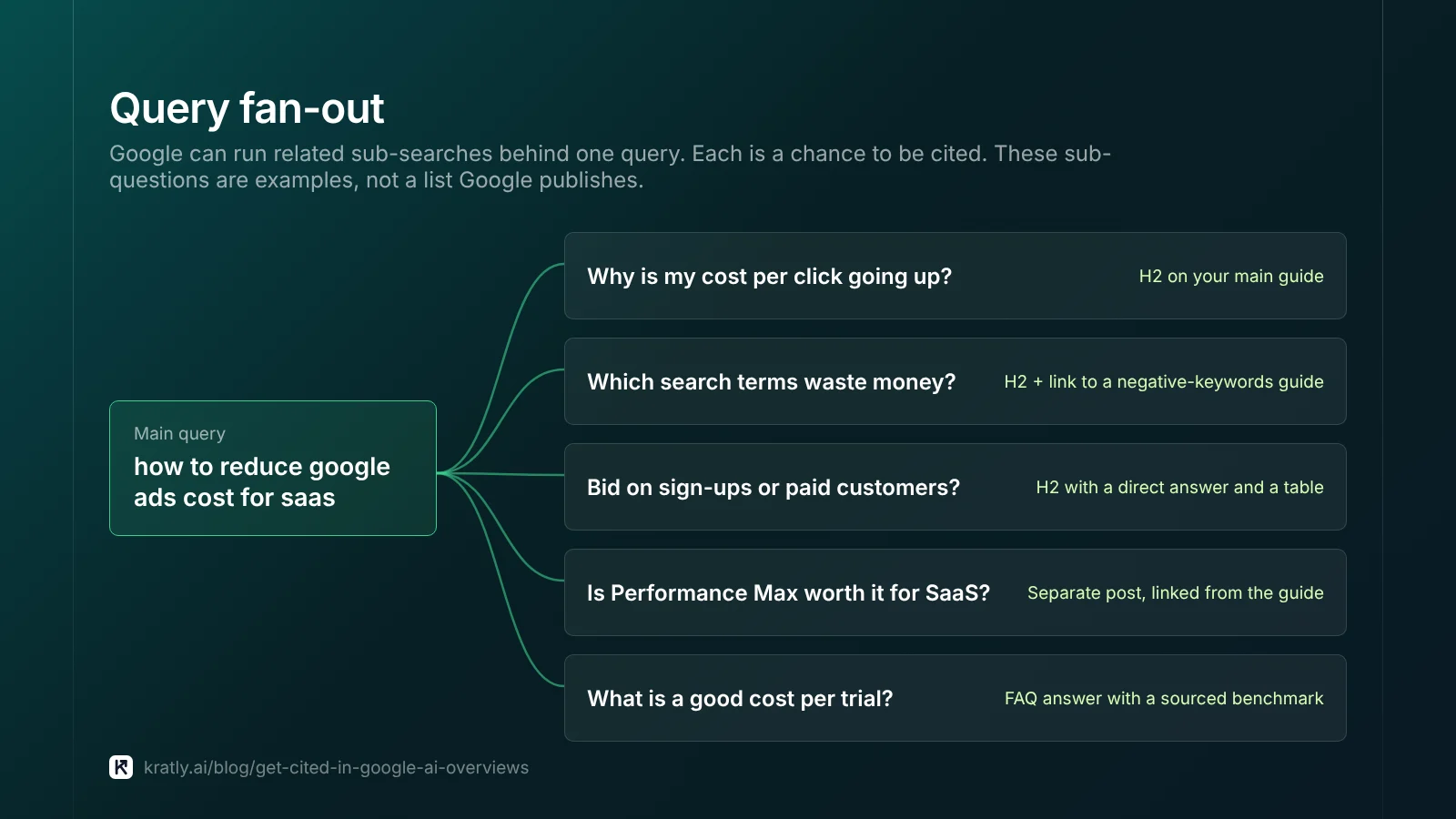
The same page explains query fan-out: AI Mode and AI Overviews may issue "multiple related searches across subtopics and data sources" to build an answer. Google's Liz Reid described it at I/O in May 2025 as breaking a question "into different subtopics" (Google I/O 2025).
Fan-out is the most useful idea in this guide. Your page doesn't have to rank for the main search. It has to be the best answer to one of the sub-searches Google runs behind it.
What this means for you: there's no secret AIO markup. If a page can't be indexed or shown with a snippet, nothing else matters. If it can, the work is ranking and answering well.
Controls that block citations by accident#
Google respects these, so check you aren't using them by mistake:
| Control | Effect |
|---|---|
noindex | Page is not in Search, so it can't be cited |
nosnippet | No snippet, so not eligible for AI features |
data-nosnippet on an element | That text can't be quoted |
max-snippet:[n] | Limits how much text can be shown |
A page that loads its main text only through JavaScript that fails to render can look empty to Google too.
How much traffic do AI Overviews take?#
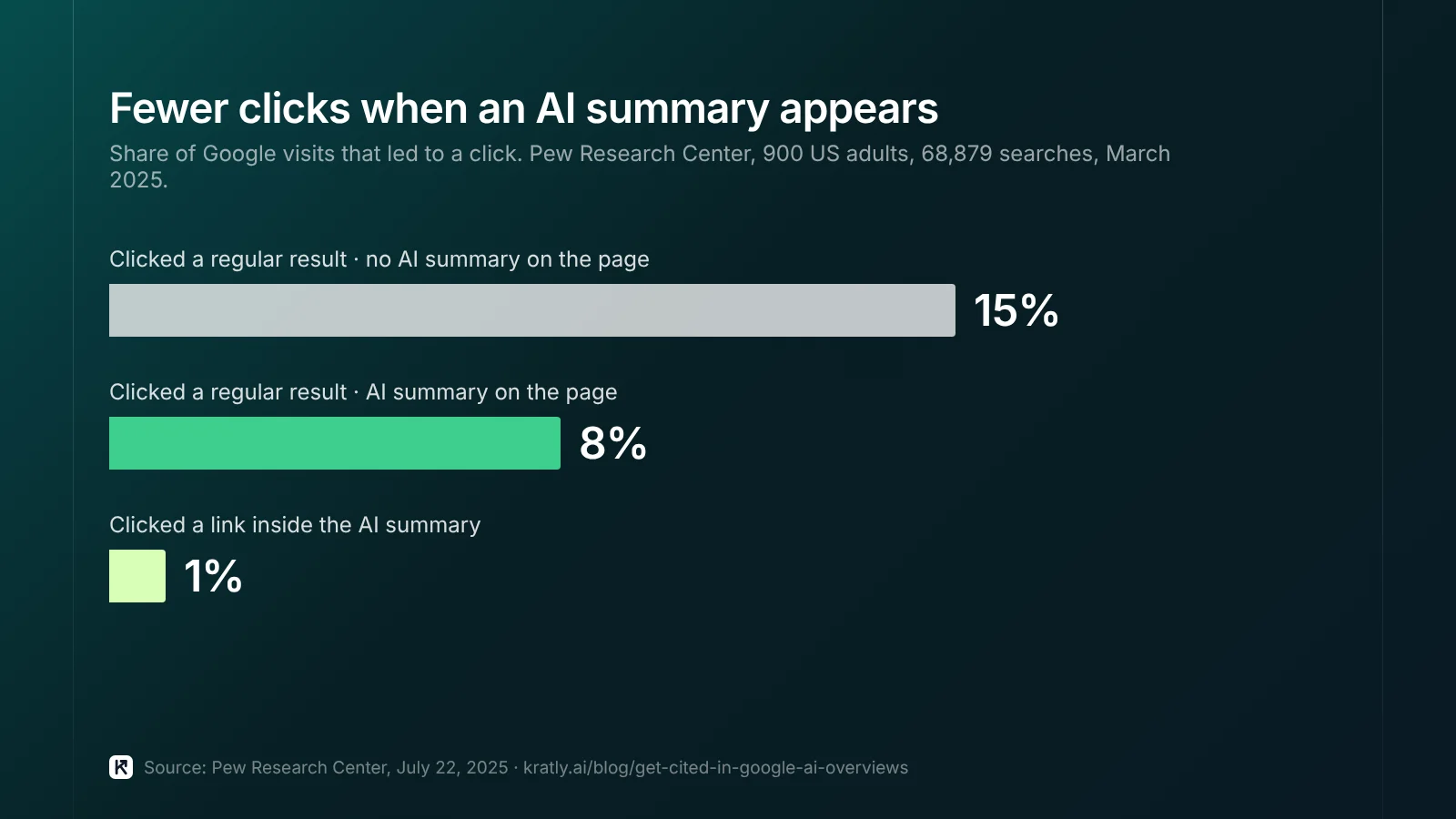
They take a lot of clicks from the pages they summarise. Being cited gets some of that back.
| Study | Date | Finding |
|---|---|---|
| Pew Research, 900 US adults, 68,879 searches | July 2025 | Users clicked a regular result on 8% of visits with an AI summary vs 15% without. Only 1% clicked a link inside the summary (Pew) |
| Ahrefs, 300K keywords | February 2026 | AI Overviews cut clicks to the #1 result by 58% (Ahrefs) |
| Seer Interactive, 3,119 queries, 42 clients | November 2025 | Organic CTR on queries with an AI Overview fell 61% from June 2024 to September 2025. Cited pages got 35% more organic clicks than uncited ones (Seer) |
Google disputes the overall picture. In August 2025, Liz Reid wrote that total organic clicks were "relatively stable year-over-year" with "slightly more quality clicks" (Google).
Both can be true. Total clicks can hold steady while clicks on informational queries, the ones AI answers, fall. Ahrefs calls this "the great decoupling": impressions up, clicks down (Ahrefs).
The reach is large. In July 2026, Google said AI Mode had passed 1 billion monthly users (Alphabet Q2 2026).
The takeaway: if an AI Overview appears for your search, the citation is the new position one. Seer's data shows cited pages still win clicks.
Do you need to rank in the top 10 to be cited?#
It helps a lot. But it's less required than it was, and the studies disagree on how much.
| Study | Date | Dataset | Citations from the organic top 10 |
|---|---|---|---|
| Ahrefs | July 2025 | 1.9M citations | 76.1% |
| BrightEdge | September 2025 | 9 industries | 16.7% from top 10 (54.5% overlap with organic results overall) |
| seoClarity | October 2025 | 5.1M citations | ~32% overlap; 90% of AIOs include at least one top-10 URL |
| Ahrefs (update) | ~March 2026 | 4M URLs | 37.9%; 31% from beyond position 100 |
| Conductor | September 2026 | 168M citations | 43%; position 1 cited 24.9% of the time vs 10.2% at position 10 |
Sources: Ahrefs, BrightEdge, seoClarity, Conductor.
Why the spread? Different methods, different keyword sets, and in Ahrefs' case better detection of citations. Ahrefs says part of its drop from 76% to 38% comes from that, so the two numbers aren't a clean before-and-after.
What holds across all of them:
- Ranking well still raises your odds. Conductor found position 1 cited about 2.5 times as often as position 10.
- Many citations come from outside the top 10. That's query fan-out at work: Google searches sub-topics and cites pages that rank for those.
So you have two routes to a citation: rank high for the main query, or be the best page for a sub-question.
AI Overviews vs AI Mode: what's different#
Google now has two AI answer surfaces, and Google's guidance covers both (Google Search Central).
| AI Overviews | AI Mode | |
|---|---|---|
| Where it shows | At the top of normal search results, for some queries | A separate AI tab or mode in Search |
| What the user does | Reads a summary, may scroll to results | Asks a question, then follow-ups, in a conversation |
| Fan-out | Uses query fan-out | Uses query fan-out; Google describes it as running many related searches |
| Reported in Search Console | Inside "Web" | Inside "Web" |
| How to get cited | Same eligibility and fundamentals | Same eligibility and fundamentals |
The practical difference is the follow-up question. In AI Mode, a user who asks "how do I reduce Google Ads cost" may then ask "what about Performance Max?" Pages that answer the next question as well as the first one have more chances to be cited across the conversation.
That makes the fan-out map in step 3 below even more useful. Think in question chains, not single queries.
A fan-out map, worked through#
Here's how you might map one money query. These sub-questions are examples of what to check, not a list Google has published.
Main query: "how to reduce google ads cost for saas"
| Likely sub-question | Where to answer it |
|---|---|
| Why is my Google Ads cost per click going up? | H2 on your main guide |
| Which search terms waste money? | H2 plus a link to a deeper negative-keywords guide |
| Should SaaS bid on sign-ups or paid customers? | H2 with a direct answer and a table |
| Is Performance Max worth it for SaaS? | Separate post, linked from the guide |
| What is a good cost per trial for SaaS? | FAQ answer, with a sourced benchmark if one exists |
Each row becomes a heading with a 40 to 70 word answer underneath. If you only answer the main query, you only compete for one slot.
How to get cited in Google AI Overviews: 7 steps#
Step 1: Make sure the page is eligible#
Run the page through Search Console's URL Inspection. Confirm it is indexed, the canonical is the URL you expect, and the rendered HTML contains your main text. Remove any stray nosnippet or tight max-snippet.
If pages aren't being indexed at all, fix that first. Our guide on why Google isn't indexing your pages covers the common causes.
Step 2: Rank on page one for the main query, or a sub-query#
Classic SEO still drives most citations. Build the page that deserves to rank: match the intent, cover what the top results cover, and add what they miss. For product-led companies, start with the bottom-of-funnel pages in our SaaS SEO guide.
Step 3: Map the fan-out#
List the questions Google is likely to ask behind your main query. Sources:
- "People also ask" boxes and their follow-ups
- Related searches at the bottom of the results
- The headings of the pages already cited in the AI Overview
- Questions your sales and support teams hear
For "how to reduce google ads cost", the fan-out might include "why is my cost per click going up", "should I use broad match", and "what is a good conversion rate". Each one is a heading on your page.
Step 4: Write an answer Google can lift#
Under each heading, put a direct answer of about 40 to 70 words first, then the detail. This range is a pattern seen across cited pages, not a Google rule.
Write sentences that stand alone. "Wasted spend is ad spend on clicks that never lead to a sale" can be quoted. "As mentioned above, this is the main issue" can't.
Use tables for comparisons and numbered lists for steps. AI answers often lift them whole.
Step 5: Add evidence nobody else has#
Research on generative engines found that adding statistics, quotations and citations to sources raised a page's visibility in AI answers (see GEO research below). Give AI something worth citing:
- Original numbers from your own data, with the method
- Real screenshots and worked examples
- Named experts with their credentials
- Links to the primary source for every claim
Step 6: Be present where Google already looks#
AI Overviews cite a mean of 11.4 sources per query, and Reddit took 20.4% of first-citation slots in Seer's May 2026 sample of 8,500 US keywords (Seer). That was a one-week snapshot, but the pattern is clear: forums, YouTube, reviews and comparison pages get cited.
Show up there honestly. Answer real questions in communities where your buyers ask them. Get listed on the comparison pages that already rank. Never post fake reviews or sock-puppet answers: it breaks platform rules and it backfires.
Step 7: Keep it fresh, for real#
Update pages when facts change: new screenshots, new data, new rules. Show the updated date, and only change it when the content really changed.
Then re-check the AI Overview. If a competitor is cited for a sub-question, read their answer and rewrite yours to be clearer and better supported.
Generative engine optimization: what the research says#
Generative engine optimization (GEO) is the practice of shaping content so AI answer engines cite it. The term comes from a Princeton-led paper first published in November 2023 and presented at KDD 2024 (Aggarwal et al., arXiv).
Interest has grown fast. Exploding Topics puts searches for "generative engine optimization" at 14.8K a month, with 6,400% growth over two years (Exploding Topics).
What the paper found:
- GEO methods raised visibility in AI answers by up to 40%.
- Adding quotations, statistics and citations to sources worked best.
- Keyword stuffing performed worse than doing nothing.
- Results varied by subject.
One caution: the tests used a research benchmark and AI engines in general, not Google AI Overviews specifically. Treat it as direction, not a guarantee.
AI overview SEO, GEO and AEO (answer engine optimization) are mostly the same work under different names. All three reward clear answers, real evidence and pages that are easy to quote.
What doesn't work (or isn't proven)#
Plenty of advice in this space is repeated without evidence.
- "Add FAQ schema to get cited." Seer's May 2026 study found pages with high FAQ-schema coverage underperformed (Seer). Schema helps Google understand a page. It doesn't win citations by itself.
- "Make every page longer." In the same study, winning pages were either under 250 words or between 1,000 and 2,000. Length should match the question.
- "Special AI markup or an llms.txt file gets you into AI Overviews." Google says no special optimizations are needed for its AI features (Google Search Central).
- Keyword stuffing. It lowered visibility in the GEO research.
- Paying for placements to fake authority. Some guides end by selling guest posts. Paid links break Google's spam policies.
How to track AI Overview citations#
Search Console counts AI Overview and AI Mode traffic inside "Web" but doesn't break it out. Google's John Mueller confirmed there would be no separate AI Mode report (Search Engine Land). So you track it yourself.
- Pick 50 to 200 priority queries. Mix your money queries with the questions in your fan-out map.
- Log them weekly. For each query, record: does an AI Overview appear, are you cited, which competitors are cited, and what AI Mode shows.
- Watch impressions vs CTR in Search Console for those queries. Rising impressions with falling CTR usually means an AI answer appeared.
- Track indirect signals. Branded searches and direct visits often rise when you're cited often.
- Act on losses. When a competitor takes a citation, compare answers and rewrite yours.
To check ChatGPT, Perplexity and Gemini as well as Google, see our guide to AI search visibility.
How to do this in Kratly#
Kratly's AI search audit does the tracking for you.
- Enter your site and your priority queries. Start with the 10 to 20 searches that bring you customers, not just visitors.
- See where you're cited. For each query, the audit shows whether an AI Overview appears, who is cited and whether you are.
- Find the gaps. Kratly flags the queries where a competitor is cited and you rank but aren't, which are the fastest wins.
- Fix and re-check. Rewrite the section the AI quotes, then re-run the audit four weeks later.
Go deeper: How to rank in ChatGPT: generative engine optimization for SaaS
Questions, answered
How does Google choose sources for AI Overviews?
Google hasn't published a formula. It says pages must be indexed and snippet-eligible, and that normal SEO fundamentals apply. AI Overviews also use query fan-out, running related sub-searches. So pages that rank well for the main query or a sub-question are the most likely to be cited.
Can a small website get cited in AI Overviews?
Yes. Studies from 2025 and 2026 found a large share of citations come from pages outside the top 10, partly because of query fan-out. A small site with the clearest, best-supported answer to a specific sub-question can be cited alongside large brands.
Does FAQ schema help you get cited in AI Overviews?
Not on its own. Google says no special markup is needed for AI features, and Seer's 2026 study found pages with heavy FAQ-schema use underperformed. Use schema to describe your page accurately, but put the effort into clear answers and evidence.
How long does it take to get cited in AI Overviews?
There's no fixed time. A page must be indexed first, which can take days to weeks. After that, citations tend to follow rankings, so a page that reaches page one for a query or sub-query can start being cited soon after. Track weekly to see changes.
Do AI Overviews replace SEO?
No. Google says SEO fundamentals still apply, and ranking well remains the strongest predictor of being cited. What changes is the goal: being the quoted source matters more than position alone, and answers need to be clear enough to lift.
Can I see AI Overview traffic in Google Search Console?
Only combined. AI Overview and AI Mode clicks and impressions are counted inside the "Web" search type, with no separate filter. To know when you're cited, track your priority queries directly with a manual log or an AI search audit tool.
Written by
Priyansh Kumar
Priyansh Kumar has spent more than a decade in growth, scaling brands from 1 to 10 and from 10 to 100. He now builds Kratly, an autonomous growth team that ties every campaign, page and email to the revenue it brings.
Sources
- Google Search Central: AI features and your website
- Google: AI search driving more queries and higher quality clicks (Aug 2025) · Alphabet Q2 2026 earnings · Google I/O 2025 keynote
- Pew Research Center: Google users less likely to click when an AI summary appears (2025)
- Ahrefs: AI Overviews reduce clicks (2026 update) · AI Overview citations and the top 10 · The great decoupling
- Seer Interactive: AIO impact on CTR (Sept 2025 update) · What it takes to rank in AI Overviews in 2026
- BrightEdge: Rank overlap after 16 months of AIO
- seoClarity: AIO rankings overlap
- Conductor: AIO vs organic rankings
- Aggarwal et al.: GEO: Generative Engine Optimization (arXiv)
- Search Engine Land: Search Console AI Mode reporting
Was this article useful?