Short answer
A fintech marketing strategy should be judged on funded accounts, not installs or sign-ups. Fix identity checks and the first deposit before you buy traffic. Clear Google, Meta and app store finance rules early. Pay referral bonuses only after funding. Then compare channels on cost per funded account and 90-day activity.
PayPal needed users fast. In Zero to One, Peter Thiel says ads cost too much, so PayPal paid new customers $10 to join and $10 more for each friend they referred (Zero to One excerpt, Goodreads). He also names the catch: paying people to become customers means your costs grow as fast as your users.
Sign-ups are cheap to buy. Accounts that hold money are not. This playbook is part of our growth playbooks by business type.
What stage is your fintech app at?#
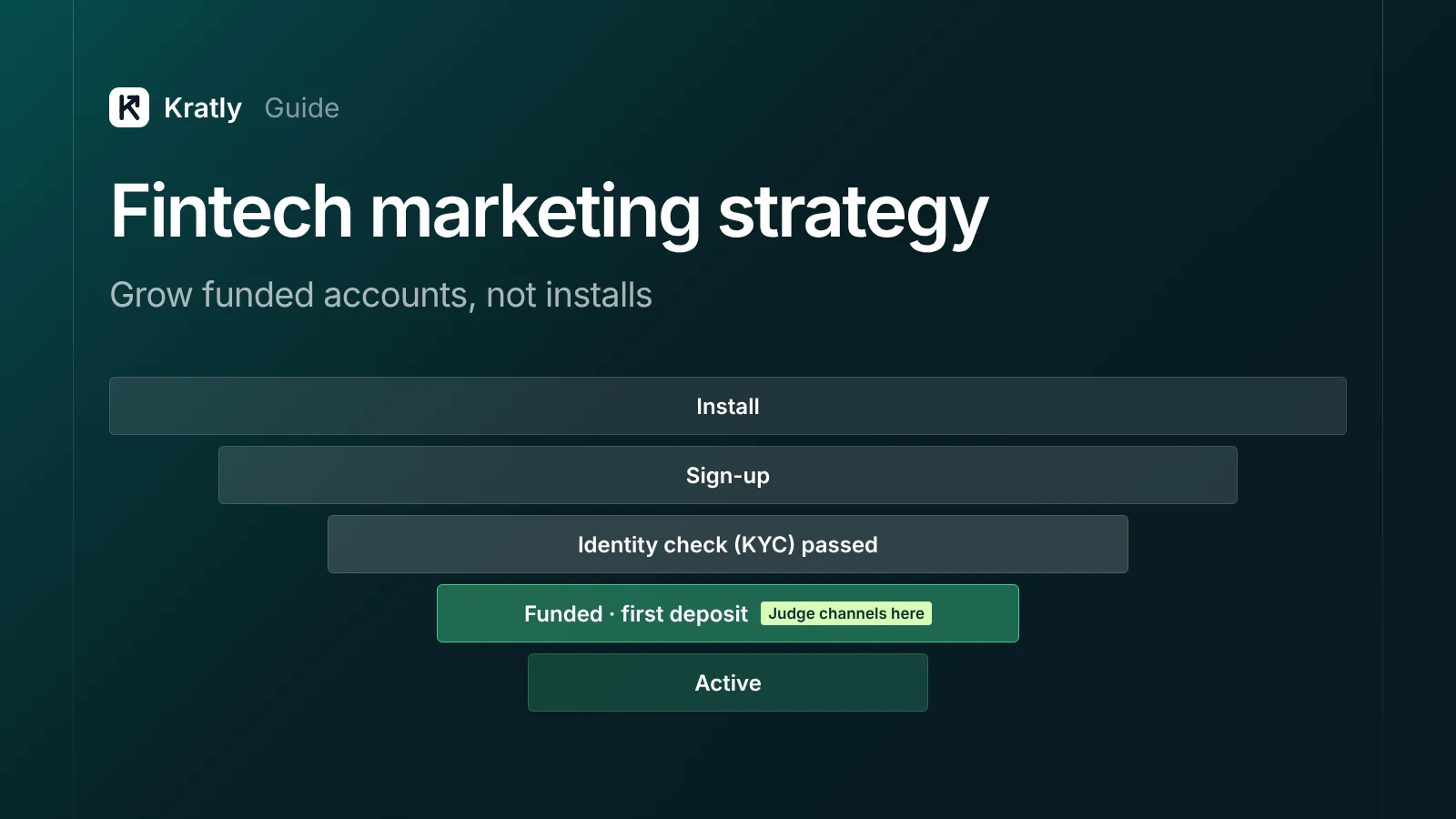
The funnel for a bank, card, payments or investing app has five steps: install, sign-up, identity check (KYC) passed, funded, active. A funded account is an account that has passed identity checks and received its first deposit, transfer or card load.
The bands below are my rule of thumb, not an industry standard.
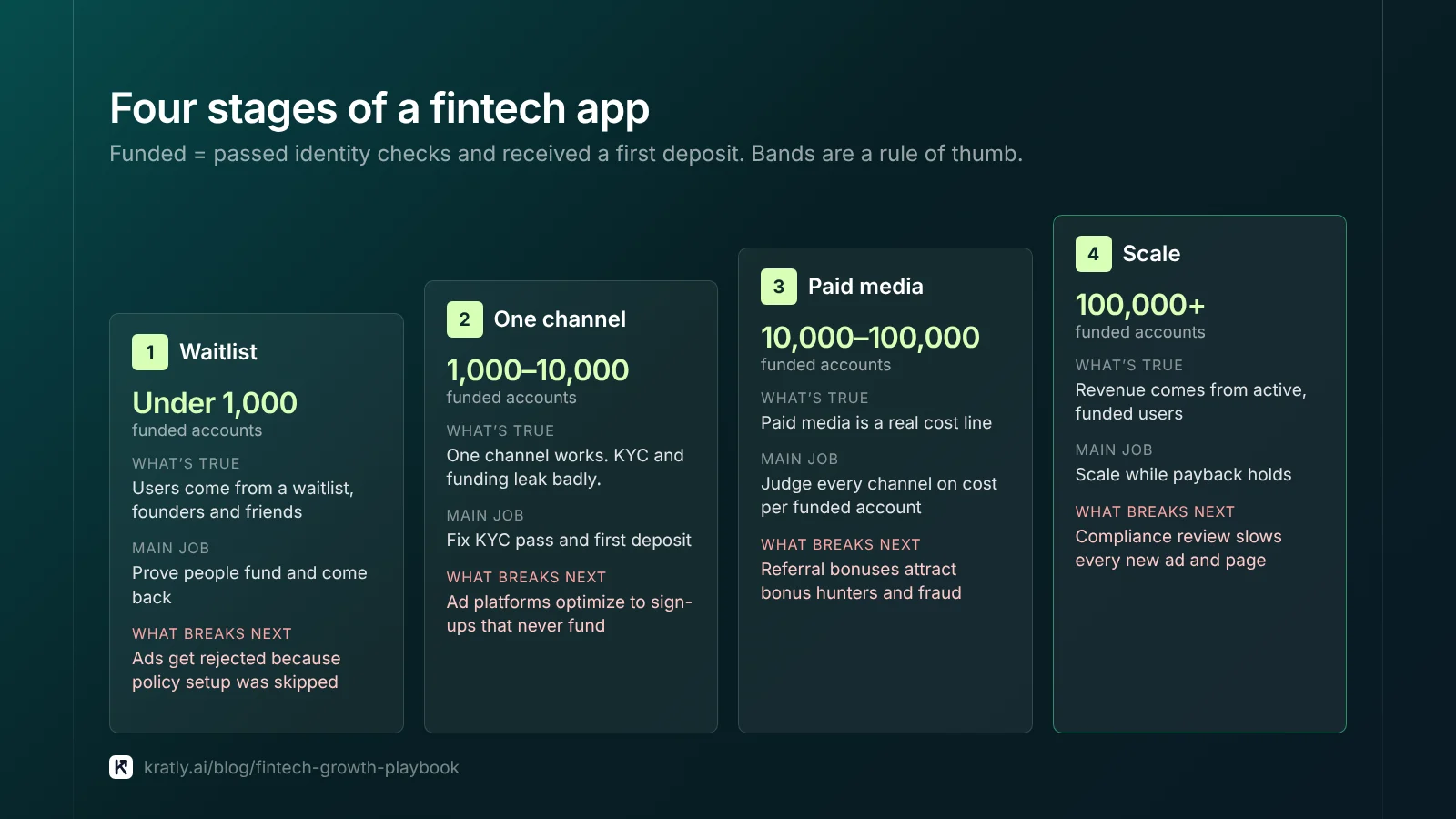
| Funded accounts | What's true | Main job | What breaks next |
|---|---|---|---|
| Under 1,000 | Users come from a waitlist, founders and friends | Prove people fund and come back | Ads get rejected because policy setup was skipped |
| 1,000–10,000 | One channel works. KYC and funding leak badly. | Fix KYC pass and first deposit | Ad platforms optimize to sign-ups that never fund |
| 10,000–100,000 | Paid media is a real cost line | Judge every channel on cost per funded account | Referral bonuses attract bonus hunters and fraud |
| 100,000+ | Revenue comes from active, funded users | Scale while payback holds | Compliance review slows every new ad and page |
The five moves that matter most#
Do these roughly in order.
1. Fix KYC and the first deposit before buying traffic#
What to do: Count how many people reach each screen from sign-up to first deposit. Then cut steps. Prefill what you can, and offer instant bank linking for the first deposit. Nudge anyone who stalls.
Why: Identity checks lose a lot of people. A 2020 report by PIF, a UK payments trade body, and HooYu, a KYC vendor, found only 74% of applicants were onboarded on average. Some lost "as much as a third of all applicants." Half named ID document upload as the worst step (The Fintech Times). It's UK vendor data from 2020, so treat it as a rough guide.
Cost: 2–6 weeks of product and engineering time, plus your KYC vendor's per-check fee. Time to revenue: as soon as it ships, because every existing ad dollar converts better. To pick the step that predicts long-term use, see how to find your activation metric.
2. Clear ad and app store rules before launch#
What to do: Read each platform's finance policy before the first campaign. Have a lawyer review your ads, landing pages and bonus terms.
Why: Fintech ads get rejected or limited more than most. The main platform rules:
| Platform | Rule for finance |
|---|---|
| Google Ads | Landing pages must show your physical address and all fees. US personal loan ads with an APR of 36% or more are not allowed (Google Ads Help). Some locations also require financial services verification. |
| Meta | Ads for financial products and services must use a special ad category. Age is fixed at 18–65+, gender and zip codes can't be targeted, and lookalikes are off (Meta for Developers). |
| Apple App Store | Banking and financial apps "should be submitted by a legal entity that provides the services." Loan apps can't charge over 36% APR (App Review Guidelines, 5.1.1(ix) and 3.2.2(ix)). |
| Google Play | Financial apps must complete a Financial features declaration. You must show licenses on request (Play Console Help). |
US marketing law matters just as much. Check these with counsel:
- UDAAP. CFPB exam procedures cover "advertisements, and other promotional material in all forms of media." Fine print may not cure a misleading claim. Affiliates are in scope too (CFPB).
- FINRA Rule 2210. Brokerages today need a principal to approve retail communications before use. A July 2026 proposal would switch to risk-based review and flags "finfluencers." It isn't adopted yet (FINRA Regulatory Notice 26-14).
- Referral and bonus terms. State the conditions next to the offer, not only in linked terms. Anyone paid to promote you may need to disclose it. The FTC's guidance gives sample wording for paid links (FTC).
Cost: legal review, plus 1–3 weeks of setup. Time to revenue: none directly; it keeps launch on track.
3. Measure cost per funded account by channel#
What to do: Store the campaign, keyword or referrer against each user ID at sign-up. Record the first deposit against that ID. Divide each channel's spend by its funded accounts.
Why: Cost per install hides the four steps after it. Here's an illustrative example with made-up numbers, not real company data:
| Step | Channel A | Channel B |
|---|---|---|
| Spend | $30,000 | $30,000 |
| Installs (CPI) | 10,000 ($3) | 3,750 ($8) |
| Sign-ups | 4,000 (40%) | 2,250 (60%) |
| KYC passed | 2,800 (70%) | 1,800 (80%) |
| Funded | 560 (20%) | 810 (45%) |
| Cost per funded account | $53.57 | $37.04 |
Channel A looks far cheaper on installs, yet costs about 45% more per funded account. The method is in how to calculate CAC by channel. Joining app and web data on one ID is covered in web to app attribution.
Cost: 1–3 weeks of data work. Time to revenue: 4–8 weeks, once funding has had time to happen.
4. Send funded events back to the ad platforms#
What to do: Send a "funded" event to Google and Meta, not just "install" or "sign-up." Optimize campaigns toward it once you have enough volume.
Why: Ad platforms find more of whatever event you send. Meta's app campaigns support app event and value goals (Meta for Developers). Google App campaigns support target cost per action and target ROAS (Google Ads Help). The app setup matches the subscription app growth playbook.
Cost: a few days of engineering. Time to revenue: 2–6 weeks as bidding relearns.
5. Pay referral bonuses on funding, not sign-up#
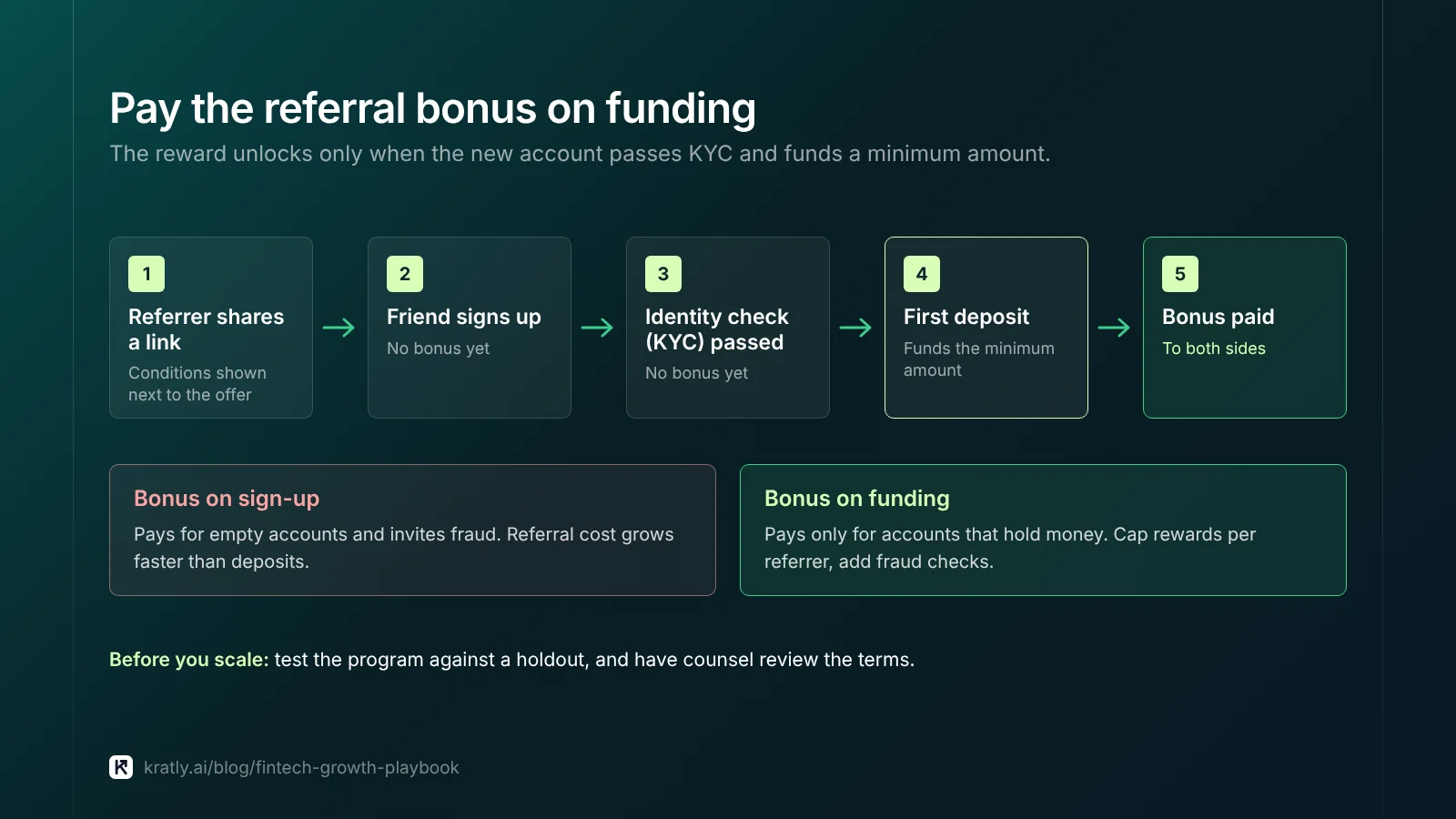
What to do: Give both sides a reward only when the new account passes KYC and funds a minimum amount. Cap rewards per referrer. Put the conditions next to the offer.
Why: Referrals are the classic fintech channel, but Thiel's warning applies. A sign-up bonus pays for accounts that never hold money. A funding bonus pays only for the result you want.
Cost: the bonus itself, plus fraud checks. Time to revenue: 2–4 weeks. Test it against a holdout before you scale it.
What should a fintech measure in revenue?#
| Metric | Formula | Data source | Healthy range |
|---|---|---|---|
| KYC pass rate | KYC passed ÷ sign-ups | KYC vendor, your database | 74% average onboarded in a 2020 UK survey (The Fintech Times) |
| Funded rate | Funded ÷ KYC passed | Core banking or ledger | Set your own baseline |
| Cost per funded account | Channel spend ÷ funded accounts from it | Ad accounts + your database | Set from revenue per funded account |
| 90-day active rate | Accounts with a transaction in days 61–90 ÷ funded | Ledger or card processor | Set your own baseline |
| Revenue per funded account | Interchange + interest + fees − rewards, per account | Ledger, card processor, Stripe if you bill | Set your own baseline |
I haven't found a public benchmark for funded rate I'd trust. Your own weekly cohort trend matters more. Payback is cost per funded account ÷ monthly revenue per active account.
What to stop doing#
Stop judging campaigns on cost per install or per sign-up. Both stop short of money. You'll scale channels full of people who never fund.
Stop paying bonuses on sign-up. You pay for empty accounts and invite fraud. Your referral cost grows faster than deposits.
Stop launching ads before compliance review. A misleading ad costs more than the review, and fine print added later may not fix it.
Stop planning Meta audiences you can't use. Lookalikes, zip codes and gender targeting are off for financial products. Plan on broad targeting and strong creative.
How to do this in Kratly#
- Connect Google Ads, Meta Ads and your website. Kratly reads spend and tracks which campaign brought each sign-up visitor.
- Send a funded-account event. Fire it from your website tracking or the Kratly app SDK when an account is first funded, with no balances or personal details. If you bill fees through Stripe, connect Stripe too.
- See cost per funded account by campaign. Once that event comes in, Kratly shows it next to what each ad platform reports, so sign-up-heavy campaigns stand out.
- Approve changes. Kratly suggests budget moves toward campaigns that bring funded accounts. You approve each one, and every change is logged and reversible.
Not ready for that? Run the free app store audit on your listing first.
Questions, answered
What is a good fintech marketing strategy?
Judge everything on funded accounts. Fix KYC and the first deposit before you buy traffic. Clear ad and app store finance rules early, with legal review. Then track cost per funded account by channel. Send funded events to the ad platforms, and pay referral bonuses only after funding.
Why is cost per funded account better than cost per install?
Because an install earns nothing. Money starts only after sign-up, identity checks and a first deposit. Cheap installs can lose most people before funding. Cost per funded account counts the whole path, so it shows which channel actually brings customers who hold money.
Do fintech ads need special approval on Google and Meta?
Often, yes. Google requires financial services verification in some locations and sets landing page disclosure rules everywhere. In the US it bars personal loan ads at 36% APR or more. Meta requires the financial products and services special ad category, which limits age, gender, zip code and lookalike targeting.
How much KYC drop-off is normal?
There's no reliable US benchmark. A 2020 UK report by PIF and HooYu found only 74% of applicants were onboarded on average. Some fintechs lost up to a third. Half said ID document upload was the biggest drop-off point. Measure your own rate at each screen and fix the worst one first.
Should fintech referral bonuses pay on sign-up?
No. Pay when the new account passes KYC and funds a minimum amount. A sign-up bonus pays for empty accounts and invites fraud. Show the conditions next to the offer, cap rewards per person and have counsel review the terms. Test against a holdout first.
Written by
Priyansh Kumar
Priyansh Kumar has spent more than a decade in growth, scaling brands from 1 to 10 and from 10 to 100. He now builds Kratly, an autonomous growth team that ties every campaign, page and email to the revenue it brings.
Sources
- Peter Thiel with Blake Masters, Zero to One (Crown, 2014): PayPal passage, community-posted excerpt on Goodreads
- Google Ads Help: Financial products and services policy · Financial services verification · App campaign bid strategies
- Meta for Developers: Special ad categories · Advantage+ app campaigns
- Apple: App Review Guidelines
- Google Play: Financial Services policy
- CFPB: UDAAP examination procedures (PDF)
- FINRA: Regulatory Notice 26-14, proposed changes to Rule 2210 (Jul 2026)
- FTC: Endorsement Guides: What People Are Asking
- The Fintech Times: PIF and HooYu report on onboarding failures (Oct 2020, vendor data)
Was this article useful?