Short answer
A good subscription app growth strategy is judged on payers, not installs. Show a paywall during onboarding, test a longer trial and lead with an annual plan. Fix your store listing before you buy traffic. Then buy search intent on Apple Ads and scale Meta and Google app campaigns that optimize for trials or purchases.
Greg, a plant care app, used to show its paywall only after a user added a fifth plant. The team moved the paywall into onboarding for everyone. At the same time, they switched from usage-based to feature-based pricing. Trial sign-ups rose about 400%. Sign-up-to-trial conversion went from 3% to 15% (RevenueCat). CEO Alex Ross was clear about the caveat: "We changed two things at once."
That's one app, and two changes. But it shows where most subscription app growth strategy goes wrong. Teams buy more installs when the leak is between install and payment.
This playbook is part of our growth playbooks by business type.
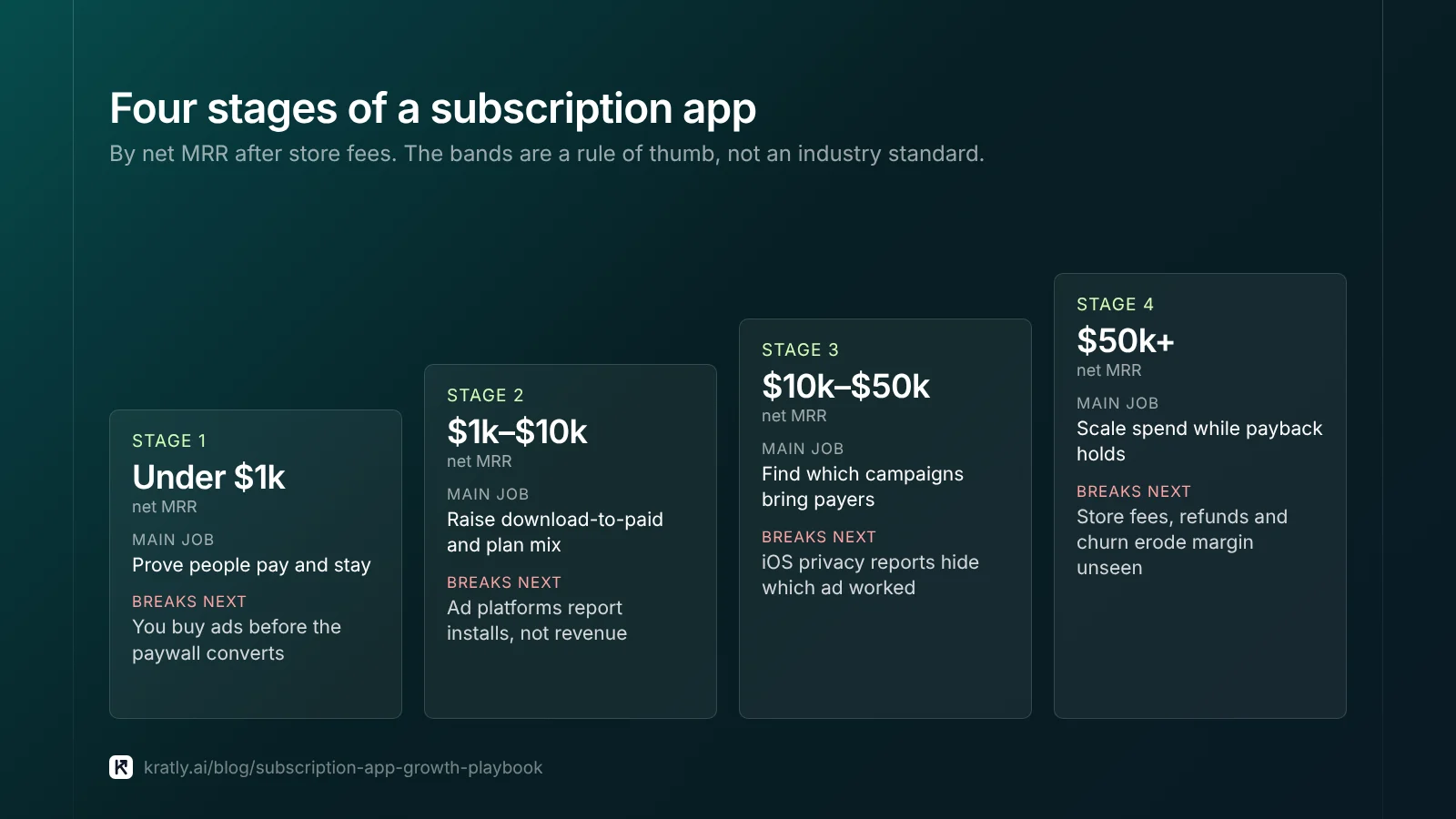
What stage is your subscription app at?#
Stages are by monthly recurring revenue (MRR) after store fees. The bands are my rule of thumb, not an industry standard.
| Net MRR | What's true | Main job | What breaks next |
|---|---|---|---|
| Under $1k | Installs come from launches, friends and search. Few people pay. | Prove people pay and stay | You buy ads before the paywall converts |
| $1k–$10k | A paywall works. Search brings steady installs. | Raise download-to-paid and plan mix | Ad platforms report installs, not revenue |
| $10k–$50k | Paid installs are a real cost line | Find which campaigns bring payers | iOS privacy reports hide which ad worked |
| $50k+ | Renewals are a large share of revenue | Scale spend while payback holds | Store fees, refunds and churn erode margin unseen |
The five moves that matter most#
Do these roughly in order.
1. Put the paywall in onboarding#
What to do: Show a paywall at the end of onboarding, after one moment of value. PhotoRoom, for example, lets new users remove a photo background, then shows the paywall (RevenueCat). Test a hard paywall, with no free tier, against your current flow.
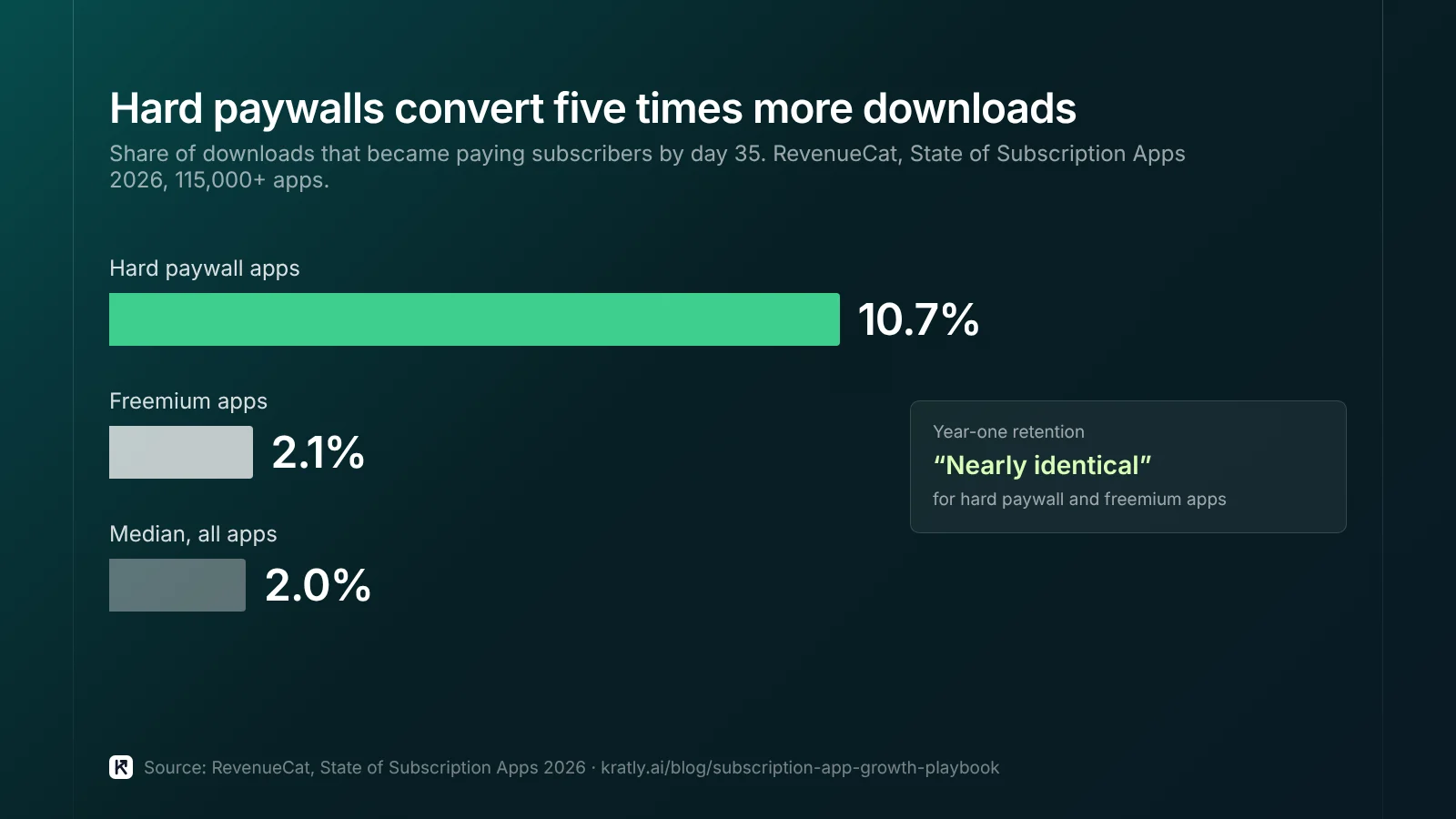
Why: RevenueCat's 2026 report covers over 115,000 apps. Hard paywall apps converted 10.7% of downloads to paid by day 35, against 2.1% for freemium. Year-one retention was "nearly identical" for both (RevenueCat). In Health & Fitness, 82.1% of trial starts happen on day 0. If your paywall appears on day 3, most people never see it.
Cost: a few days of design and build. Time to revenue: 2–4 weeks, once a test reaches enough trials. The free trial vs freemium trade-off is laid out in free trial vs freemium: which brings more paying customers?
2. Test trial length and lead with the annual plan#
What to do: Run one test of a longer trial against your current one. Put the annual plan first on the paywall, with the monthly price per month next to it.
Why: In RevenueCat's data, trials of 17–32 days had a median trial-to-paid rate of 42.5%. Trials of four days or less had 25.5%. Yet short trials grew from 42.1% to 46.5% of all trials. Apps that sell mostly yearly plans earned a median $0.36 per install by day 14, against $0.18 for monthly-led apps (RevenueCat).
The trade-off: a longer trial delays cash, and annual discounts cut price per month. I'd still test both before buying more installs. Annual prepay also shortens cash payback, as shown in CAC payback period benchmarks.
Cost: a few hours in your paywall tool. Time to revenue: one trial length plus two weeks.
3. Fix your store listing before you buy installs#
What to do: Rewrite the title, subtitle and keyword field around the problem your app solves. Test screenshots. Add custom product pages for your main ad themes.
Why: Apple says about 65% of downloads happen after a search on the App Store, based on 2022 data (Apple Ads). Apple now allows up to 70 custom product pages, which can appear in keyword search (Apple Developer). A better listing lowers the cost of every paid install too.
Cost: 10–20 hours. Time to revenue: 2–6 weeks as rankings move. Work through the full app store optimization checklist for 2026.
4. Buy search intent on Apple Ads, judged on payers#
What to do: Start with exact-match keywords on your brand, your category and competitors. Tie each keyword to subscriptions, not installs. Cut keywords whose cost per paying subscriber stays well above target.
Why: A cheap install that never pays is still expensive. The setup is in Apple Search Ads for subscription apps.
Cost: start with a test budget you can lose, plus 2–3 hours a week. Time to revenue: your trial length plus a week before judging any keyword.
5. Scale Meta and Google app campaigns on purchase events#
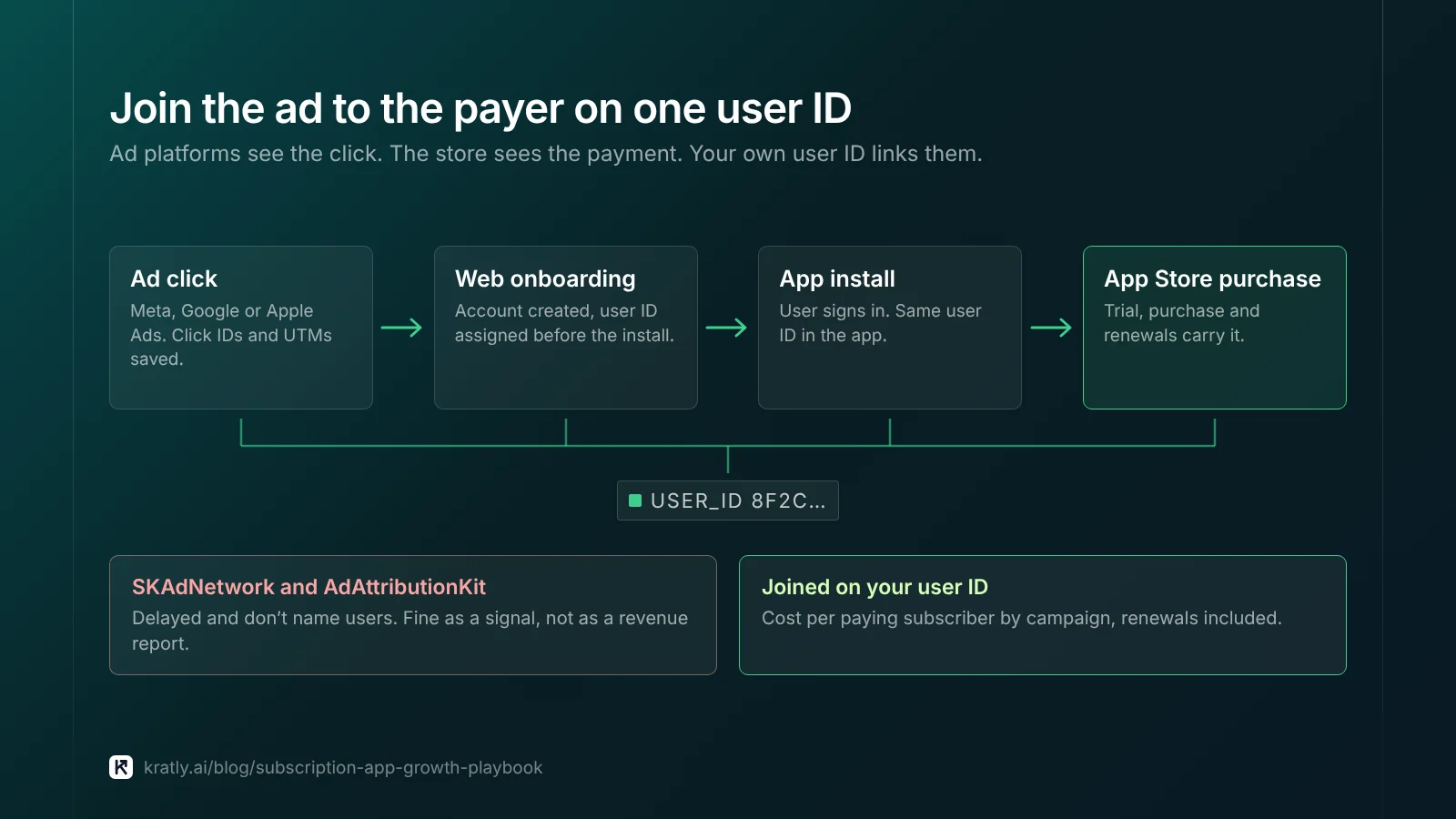
What to do: Run Meta Advantage+ app campaigns and Google App campaigns that optimize for trials or purchases, not installs. Meta offers install, app event and value goals (Meta for Developers). Google offers target cost per action and target ROAS for App campaigns (Google Ads Help). Consider a web onboarding funnel, so the ad click and the account are tied before the install.
Why: Send installs and you'll get installers. On iOS, Apple's SKAdNetwork and AdAttributionKit reports are delayed and don't name users (Apple WWDC25). So join store revenue to your own user ID, as covered in web to app attribution.
Cost: media budget plus a deep-linking or attribution tool. Time to revenue: 4–8 weeks for a fair read.
What should a subscription app measure in revenue?#
Download-to-paid rate is the share of new installs that become paying subscribers within a set window, often 35 days. It's the one number that tells you whether installs turn into payers.
| Metric | Formula | Data source | Healthy range |
|---|---|---|---|
| Download-to-paid (day 35) | Paying subscribers ÷ installs in the cohort | App Store Connect, Play Console, RevenueCat | Median 2.0%; hard paywall 10.7% (RevenueCat) |
| Trial-to-paid | Trials that convert ÷ trials started | App store or RevenueCat | North America median 34.2% (RevenueCat) |
| Revenue per install (day 14) | Revenue from cohort ÷ installs | App store + ad accounts | Median $0.23 (RevenueCat) |
| Cost per paying subscriber | Ad spend ÷ new payers from that campaign | Ad accounts + store revenue joined on user ID | Set from your net revenue per payer |
| Net revenue per payer | Price − store fee − refunds | App store, Stripe for web checkout | Fee is 15% or 30% on Apple, 15% on Play subscriptions (RevenueCat) |
Mind the store fee. Apple charges 30% as standard. It drops to 15% after a subscriber completes a year of paid service. Developers who earned up to $1 million in proceeds the prior year can join the Small Business Program for 15% (Apple Newsroom). Google Play charges 15% on subscriptions from day one, per RevenueCat's fee guide (January 2026).
US apps may now link to web checkout after Epic v. Apple. Whether Apple can charge a commission is still in court as of October 2026 (IPWatchdog). In one test, Dipsea's web-only checkout earned about 6% less per customer than in-app (RevenueCat).
What to stop doing#
Stop judging campaigns on cost per install. An install is a cost, not a result. Keep going and you'll scale the campaigns that bring the cheapest non-payers. The cost is your whole paid budget aimed at the wrong people.
Stop hiding the paywall behind days of free use. Most trials start on day 0. A late paywall means most users leave before they ever see a price. The cost is the payers you never asked.
Stop paying 30% when you qualify for 15%. If your proceeds were up to $1 million last year, enroll in Apple's Small Business Program. Every month you wait, you hand Apple an extra 15 points of your App Store revenue.
Stop treating SKAdNetwork as your revenue report. It's delayed and has no user IDs. Trust it alone and you'll cut good campaigns while keeping weak ones.
How to do this in Kratly#
- Connect Meta Ads, Google Ads and your website. Kratly reads spend by campaign and tracks web onboarding visits. Apple Ads isn't connected yet; tag its traffic and upload spend as a CSV.
- Bring in app revenue. Add the Kratly SDK to your iOS or Android app. Kratly verifies App Store and Google Play purchases, renewals and refunds, and joins them to web checkout payments in Stripe on one user ID.
- See cost per paying subscriber by campaign. Kratly shows revenue next to what each ad platform reports, so install-heavy campaigns stand out.
- Approve changes. Kratly suggests budget moves toward campaigns that bring payers. You approve each one, and every change is logged and reversible.
Not ready for that? Run the free app store audit on your listing first.
Questions, answered
What is the best subscription app growth strategy?
Fix conversion before you buy traffic. Put the paywall in onboarding, test a longer trial and lead with the annual plan. Then improve your store listing and buy search intent on Apple Ads. Scale Meta and Google app campaigns last. Judge every step on paying subscribers, not installs.
What is a good download-to-paid rate for a subscription app?
RevenueCat's 2026 report puts the median at 2.0% of downloads paying by day 35. Hard paywall apps reached 10.7%, while freemium apps reached 2.1%. Rates vary by category and region, so track your own rate by weekly cohort.
Should a subscription app use a hard paywall or freemium?
Test a hard paywall first if your app shows value fast. In RevenueCat's 2026 data, hard paywall apps converted about five times more downloads to paid. Year-one retention was nearly identical. Freemium can still make sense when free users bring growth, such as shared content or invites.
How long should a free trial be for an app?
Longer than most apps use. In RevenueCat's 2026 data, trials of 17 to 32 days had a median trial-to-paid rate of 42.5%. Trials of four days or less had 25.5%. A longer trial delays cash, so test one longer option against your current trial and compare revenue per install.
How much does Apple take from app subscriptions?
Apple's standard rate is 30%. It drops to 15% after a subscriber completes a year of paid service. Developers with up to $1 million in yearly proceeds can join the Small Business Program and pay 15% from the start. Google Play charges 15% on subscriptions. Check current terms, since US web checkout rules are still in court.
Written by
Priyansh Kumar
Priyansh Kumar has spent more than a decade in growth, scaling brands from 1 to 10 and from 10 to 100. He now builds Kratly, an autonomous growth team that ties every campaign, page and email to the revenue it brings.
Sources
- RevenueCat: State of Subscription Apps 2026 · Optimizing paywall placement (Nov 2023) · App store fees (Jan 2026) · IAP vs web purchases test
- Apple: Small Business Program announcement (Nov 2020) · Custom product pages update (Oct 2025) · WWDC25: AdAttributionKit · Apple Ads: Advanced overview
- Meta for Developers: Advantage+ app campaigns
- Google Ads Help: Choose a bid strategy for your App campaign
- IPWatchdog: Supreme Court grants cert in Apple's App Store appeal (Jun 2026)
Was this article useful?