Short answer
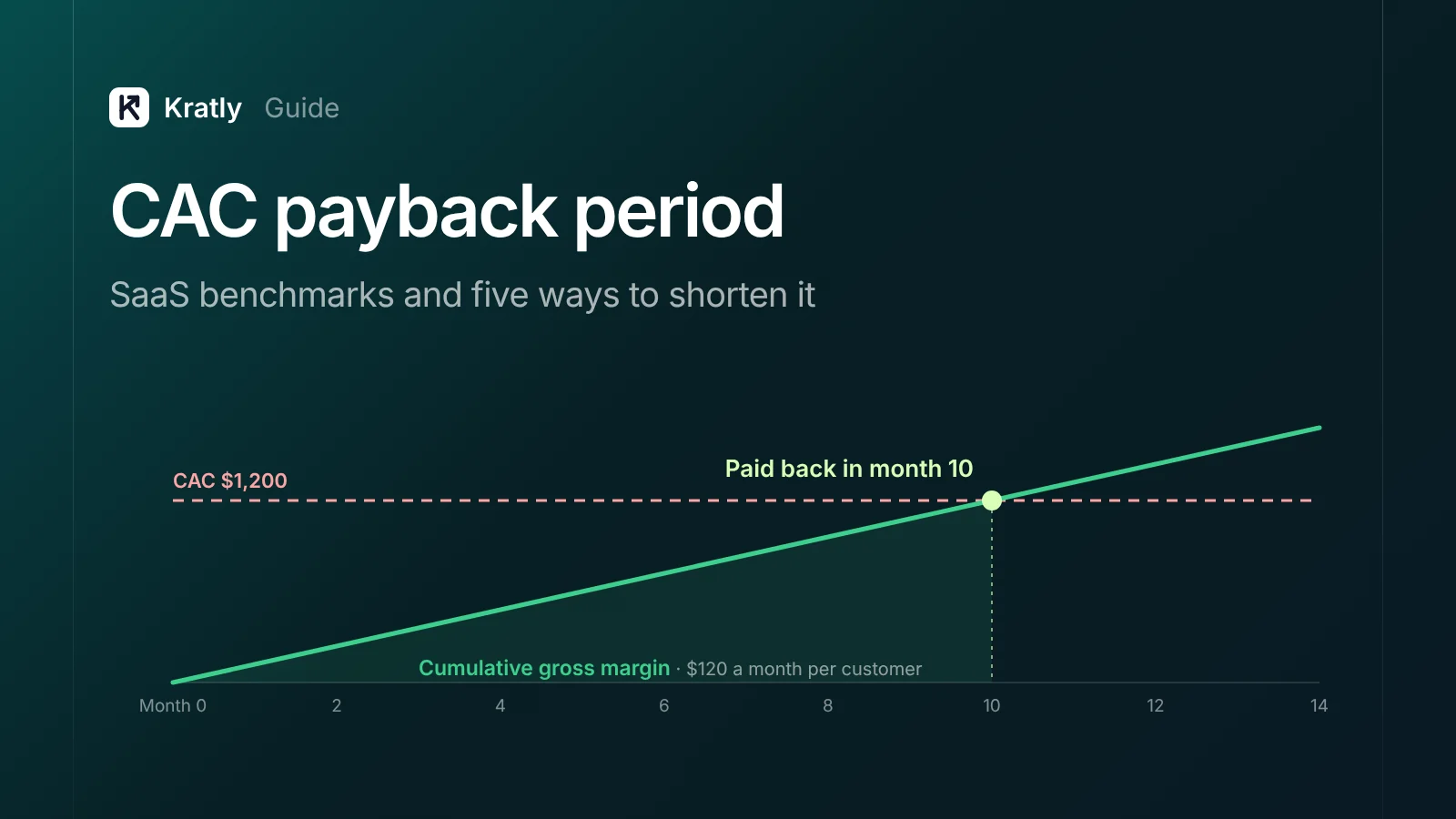
CAC payback period is the number of months a new customer takes to repay what you spent to win them. Formula: CAC ÷ (new monthly revenue per customer × gross margin). Common targets are under 12 months for SMB SaaS and under 18–24 for mid-market and enterprise. A 2026 benchmark puts the 2025 median at 16 months.
On an Indie Hackers thread about paid ads, one founder shared the math behind a channel. A 0.1% conversion to paid meant "CAC = 1000$; pricey." Their rule of thumb: "You want your CAC Payback Period to be less than 12 months" (Indie Hackers).
That rule is a good start. But your CAC payback period depends on how you count CAC, which revenue you include and whether you use gross margin. This guide covers the formula, current benchmarks and five ways to shorten it, with the cost of each.
What is the CAC payback period formula?#
CAC payback (months) = CAC ÷ (new MRR per customer × gross margin %)
- CAC is the full cost to win one new paying customer: media, agency, tools, people. If you haven't calculated it yet, start with how to calculate CAC by channel. It relies on SaaS marketing attribution tied to Stripe revenue.
- New MRR per customer is the monthly recurring revenue a new customer brings at the start. Use the price after discounts.
- Gross margin is revenue minus hosting, payment fees, support and other costs to serve. For many SaaS companies it's 70–85%.
David Skok says the months-to-recover-CAC figure "should include a Gross Margin adjustment" to be accurate. He suggests it "should be less than 12 months" (For Entrepreneurs).
Why gross margin? Revenue isn't yours to spend. If a $100 plan costs $25 to serve, only $75 a month repays acquisition. Skip the margin and your payback looks a quarter shorter than it is.
What I'd check first: is your benchmark on the same basis as your number? Some reports use revenue, some gross margin. A 12-month revenue payback at 75% margin is a 16-month gross-margin payback.
What's a good CAC payback benchmark for SaaS?#
| Source (year) | Benchmark |
|---|---|
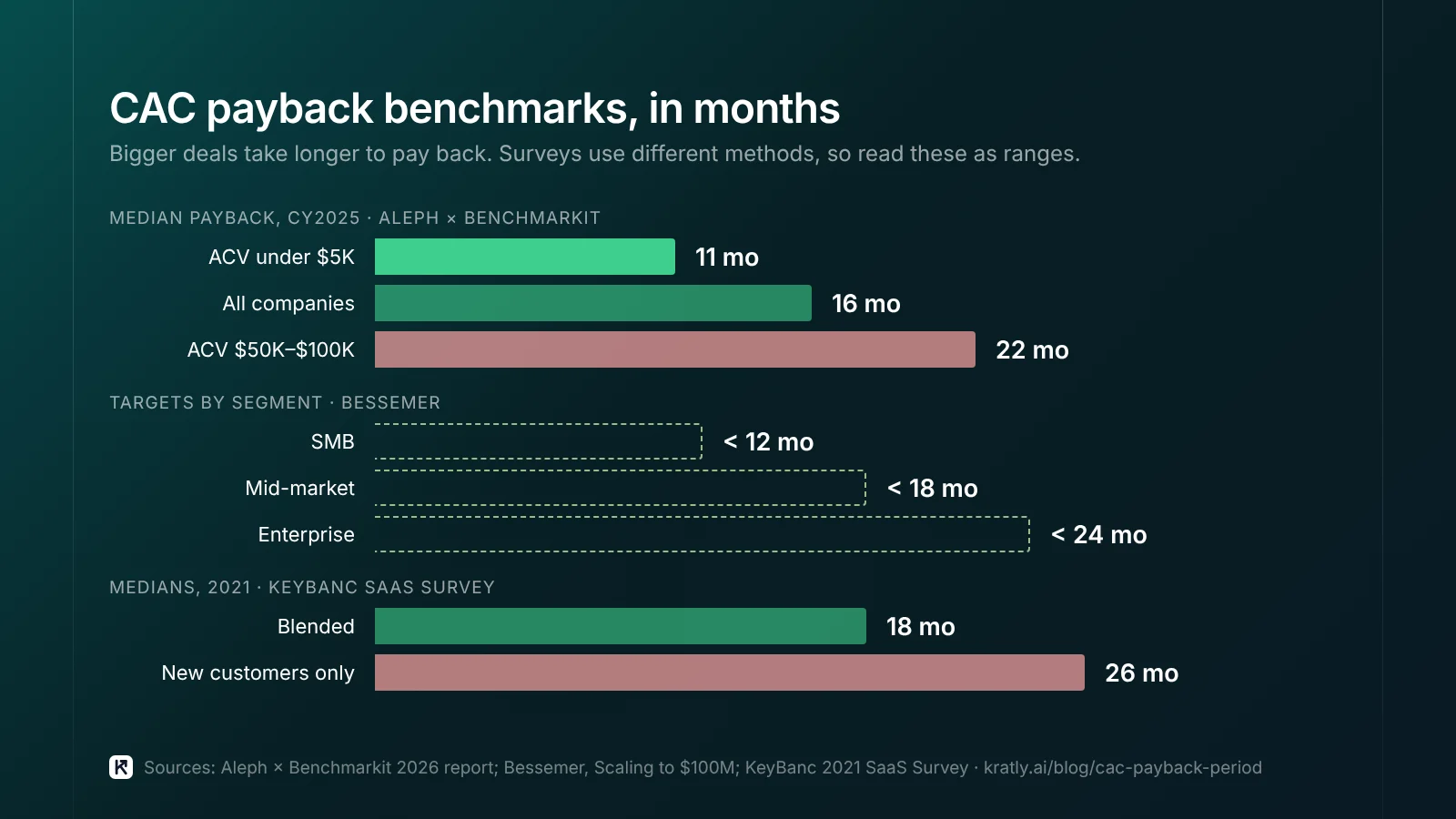
| Aleph × Benchmarkit, 2026 report on CY2025 data | Median 16 months (2024: 18). Top quartile 6 months or less; bottom quartile 24+ (Aleph) |
| Same report, by deal size | Under $5K ACV: 11 months median. $50K–$100K ACV: 22 months (Aleph) |
| Bessemer, State of the Cloud 2023 | 0–6 months best, 6–12 better, 12–18 good (Bessemer) |
| Bessemer, Scaling to $100M | Under 12 months SMB, under 18 mid-market, under 24 enterprise. Companies at $1–10M ARR averaged 15 months (Bessemer) |
| KeyBanc SaaS Survey 2021 | Median 18 months blended, 26 months for new customers, gross-margin basis (KeyBanc via For Entrepreneurs) |
| David Skok | Under 12 months; around 20 months can work in land-and-expand enterprise (For Entrepreneurs) |
The Aleph × Benchmarkit figures cover 198 of the 342 companies in their sample, per Aleph's summary. The surveys differ in method, so compare your number with the range, not a single figure.
Notice the KeyBanc gap. Blended payback (18 months) includes expansion revenue from existing customers. Payback on new customers alone was 26 months. If you quote the blended number to yourself, you're flattering your acquisition.
Here's the side I take: for a self-serve SaaS spending $5k–$100k a month on ads, I'd aim for under 12 months on paid channels. That's your most measurable, most cuttable spend. I'd accept 18–24 months only where deals are large, contracts are annual and net revenue retention is above 100%.
LTV to CAC: useful, but easy to fool yourself with#
LTV to CAC compares lifetime value with acquisition cost. Skok's guideline is above 3 (For Entrepreneurs). Greg Head of Practical Founders argues for at least 5 (Practical Founders).
The problems:
- No single formula. An a16z piece notes "there are several ways to calculate LTV:CAC" (a16z). Two companies can both claim 3x and mean different things.
- Hidden assumptions. Skok's 3x assumes a simple LTV with no gross-margin adjustment, and a gross margin of 80% or more. At 60% margin, the same ratio means less profit.
- Lifetime is a guess. With 2% monthly churn, the formula implies a 50-month life. A two-year-old company hasn't seen month 50.
- It ignores cash timing. A 4x LTV to CAC that takes 30 months to pay back can still drain your bank account.
That's why I'd run the business on CAC payback first and use LTV to CAC as a sanity check. Payback uses numbers you've already seen: what you spent, and what customers pay now.
A worked example (illustrative numbers)#
These numbers are made up to show the method. They are not from a real company.
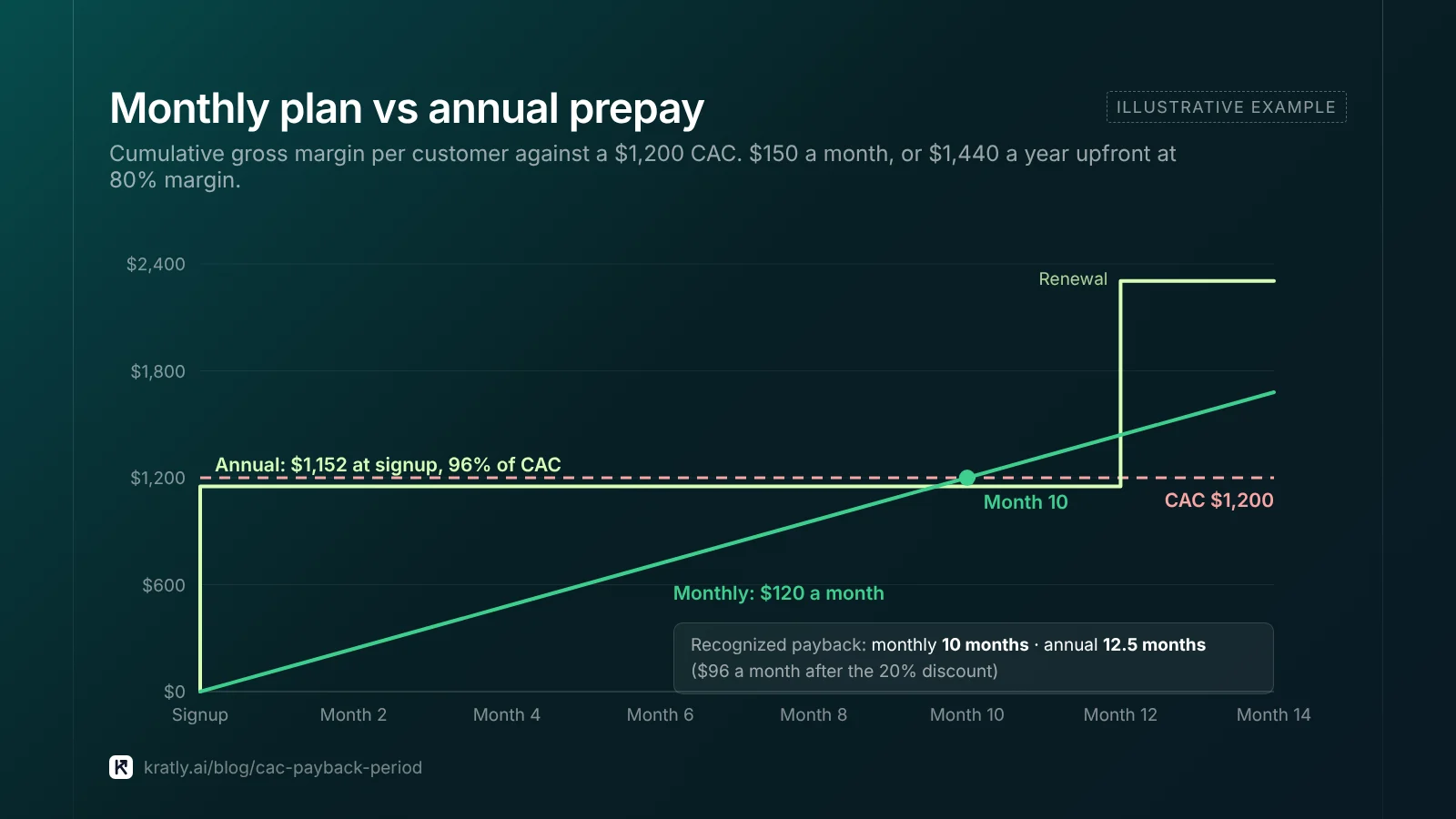
A SaaS company sells a $150/month plan. Gross margin is 80%. Paid channels cost $36,000 in a quarter, including agency and a share of salaries, and brought 30 new paying customers in Stripe.
- CAC = $36,000 ÷ 30 = $1,200
- Monthly gross margin per customer = $150 × 0.80 = $120
- CAC payback = $1,200 ÷ $120 = 10 months
Now the same company offers an annual plan at 20% off: $1,440 a year, paid upfront. Gross margin on that is $1,152. On a cash basis, the customer repays almost all of the $1,200 CAC on day one. On a monthly-recognized basis, payback stretches to about 12.5 months, because the discount cuts monthly margin to $96.
Both views matter. Cash payback decides how fast you can reinvest. Recognized payback tells you whether the price still works.
| Plan | Monthly gross margin | Payback (recognized) | Cash recovered at signup |
|---|---|---|---|
| Monthly, $150 | $120 | 10 months | $120 |
| Annual, $1,440 upfront | $96 | 12.5 months | $1,152 |
Five ways to shorten CAC payback#
Each lever moves either the top of the formula (CAC) or the bottom (margin earned per month). Here they are in the order I'd try them.
1. Cut spend that brings no paying customers#
This is the cheapest lever. It costs hours, not revenue. Look at every campaign's cost per paying customer, not per sign-up. Pause or cut the ones well above your target after their conversion delay has passed. The method is in when to pause a Google Ads campaign.
The trade-off: cutting too fast kills campaigns that were about to pay. Wait out your trial length plus a week before judging.
2. Improve trial-to-paid conversion#
If CAC is $1,200 and you double trial-to-paid, CAC halves with no extra spend. A February 2026 Growth Unhinged and ChartMogul study of 200 B2B products found a median free-to-paid rate of 8% (Growth Unhinged). First Page Sage, an agency, reports 17.3% for opt-in trials and 49.1% for card-required trials (First Page Sage). Card-required trials convert better but start fewer trials, so check paying customers per visitor, not the rate alone.
The trade-off is in free trial vs freemium: which brings more paying customers? Expect four to eight weeks of onboarding and email work.
3. Push annual prepay#
Annual upfront payments shorten cash payback dramatically, as the example shows. One Indie Hackers commenter put it this way: annual upfront can have "such a huge impact on your CAC payback period" (Indie Hackers). Another suggested annual plans "usually 20-30% discounted."
The cost is the discount. At 20% off, you give up $360 a year per $150/month customer. I'd do it when cash is your constraint. I'd skip deep discounts if you're well funded and churn is already low.
4. Raise price or ACV#
Payback falls in direct proportion to price, if conversion holds. A 20% price rise on a $150 plan cuts a 10-month payback to about 8.3 months. Test it on new customers only, and watch trial-to-paid for two to three months.
The opposite case: in the Aleph × Benchmarkit data, larger deals had longer payback, not shorter (Aleph). Moving upmarket usually brings a sales team and a longer cycle. Raising price on the same buyers is a different move from chasing bigger buyers.
5. Expand within accounts#
Seats, usage tiers and add-ons raise revenue per customer after the sale. Strong net revenue retention, meaning revenue from a cohort grows after churn, shortens real payback even when the starting MRR stays flat.
Be careful how you report it. The standard formula uses starting MRR. If you include expected expansion, say so, and show the new-customer figure too. That's the KeyBanc lesson: 18 months blended, 26 on new customers alone.
How to do this in Kratly#
- Connect ad accounts, your site and Stripe. Kratly ties each paying customer to the campaign, page or email that brought them.
- See cost per paying customer by channel and campaign. Apply your gross margin to turn it into payback months, using the formula above.
- Review flagged campaigns. Kratly flags campaigns whose payback runs well above your target once they have enough data.
- Approve changes. Kratly suggests budget cuts or shifts. You approve them, and each change is logged and reversible.
Go deeper: LTV to CAC ratio: calculate it from real revenue, not estimates
Questions, answered
What is a good CAC payback period for SaaS?
Under 12 months is the common target for SMB and self-serve SaaS. Mid-market can run to 18 months and enterprise to 24. A 2026 Aleph × Benchmarkit report put the 2025 median at 16 months, with the top quartile at 6 months or less.
How do you calculate CAC payback period?
Divide CAC by the monthly gross margin a new customer brings. Monthly gross margin is new MRR per customer times your gross margin percentage. A $1,200 CAC on a $150 plan at 80% margin pays back in 10 months. Use fully loaded CAC, counted from paying customers in Stripe.
Should CAC payback use revenue or gross margin?
Gross margin. Revenue includes money you spend serving the customer, such as hosting, payment fees and support. Using revenue shortens payback on paper by roughly the share that goes to costs. A 12-month revenue payback at 75% margin is a 16-month gross-margin payback. If you compare with a benchmark, check which basis it uses.
Is LTV to CAC better than CAC payback?
No, they answer different questions. LTV to CAC estimates total return and depends on a guessed customer lifetime. It also has no single formula. CAC payback tells you how fast cash comes back, using numbers you've already seen. Run the business on payback and check LTV to CAC quarterly as a sanity check.
Does an annual plan shorten CAC payback?
On a cash basis, yes, often to the first month. On a recognized basis, the discount can make it slightly longer. In our example, 20% off moved recognized payback from 10 to 12.5 months. Track both, and price the discount knowing what it costs you per customer.
Written by
Priyansh Kumar
Priyansh Kumar has spent more than a decade in growth, scaling brands from 1 to 10 and from 10 to 100. He now builds Kratly, an autonomous growth team that ties every campaign, page and email to the revenue it brings.
Sources
- Aleph × Benchmarkit: CAC payback period benchmarks, 2026 report on CY2025 data · Report page
- Bessemer Venture Partners: State of the Cloud 2023 · Scaling to $100M
- KeyBanc Capital Markets: 2021 SaaS Survey (PDF)
- For Entrepreneurs (David Skok): SaaS Metrics 2.0
- Andreessen Horowitz: Why Do Investors Care So Much About LTV:CAC? (Aug 2023)
- Practical Founders: 8 Common Mistakes Startup Founders Make About CAC
- Growth Unhinged: Free-to-paid conversion report (Feb 2026)
- First Page Sage: Trial conversion benchmarks (Oct 2026, agency data)
- Indie Hackers: Paid ads experience thread · Monthly vs annual subscriptions
Was this article useful?