Short answer
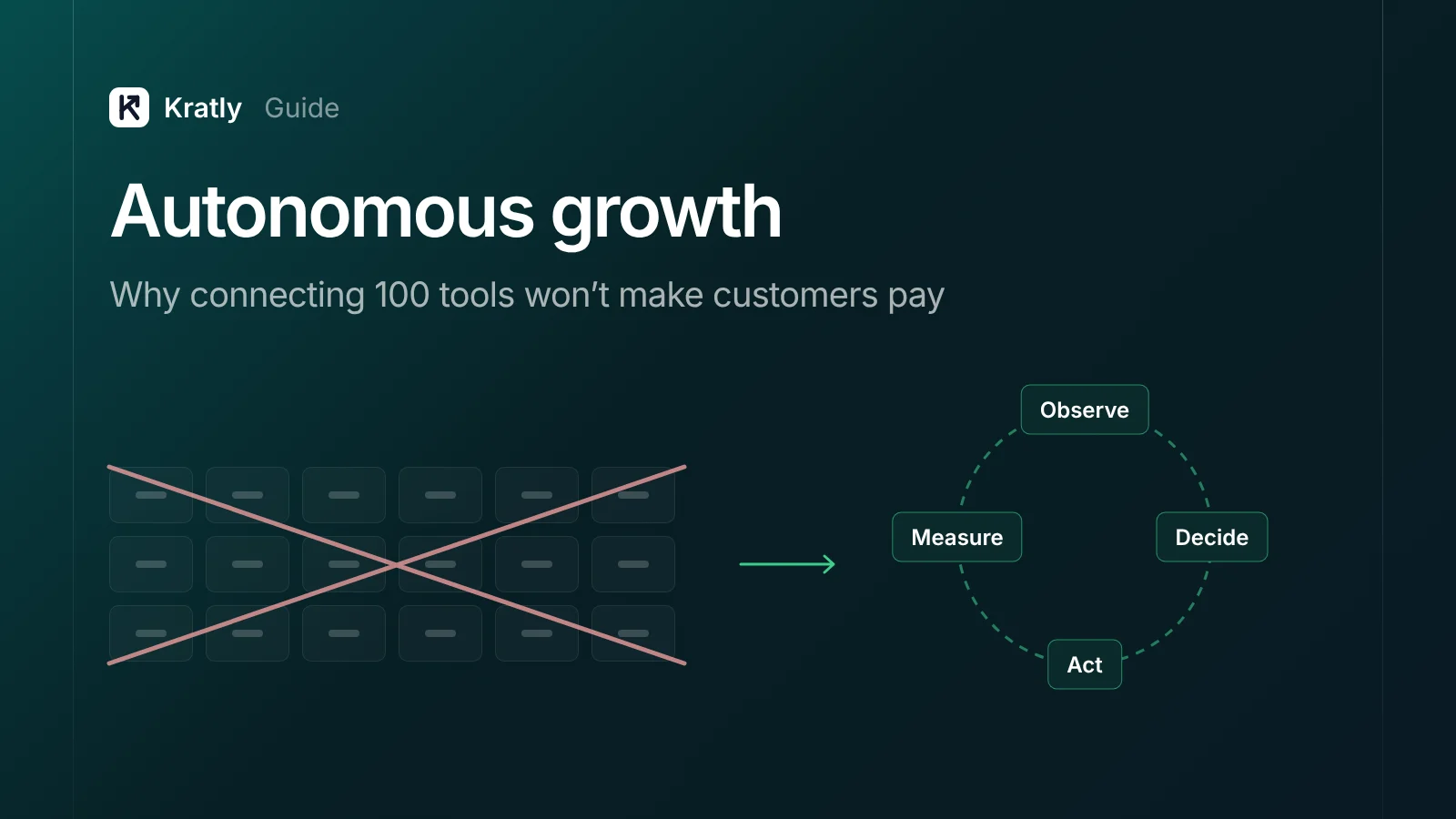
Autonomous growth is a closed loop in which an AI growth agent reads your revenue data, decides which growth action to take, carries it out in your ad, SEO and email tools within limits you set, and judges each action by revenue against a control. More tools don't make customers pay. Acting on revenue data does.
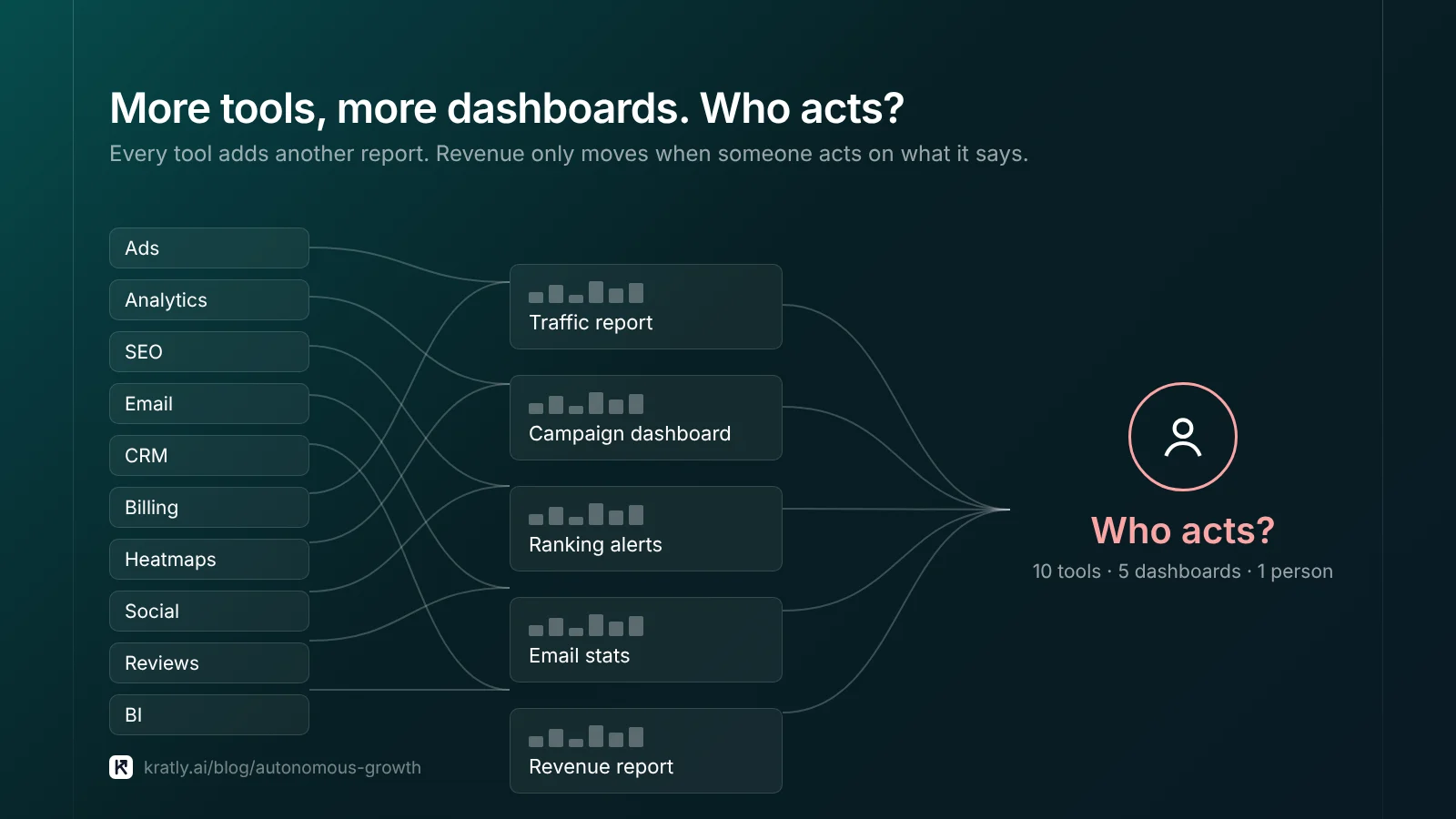
You have the analytics tool, the ad accounts, the email platform, the SEO suite, the dashboards and the Zaps that glue them together. You also have the same revenue as last quarter.
One founder on Indie Hackers counted: "I had 14 paid subscriptions before my first paying customer… $400 a month. Zero revenue" (Indie Hackers). The problem was never a missing integration. It was missing work.
What is autonomous growth?#
Autonomous growth is a way of running marketing in which software does the full cycle of growth work, not just the reporting. It reads revenue data, decides what to change, makes the change in your tools, and checks whether revenue moved.
Three words in that definition do the work:
- Revenue. The input and the scorecard are paid customers and money, from Stripe, Shopify or your app store. Not clicks, not sign-ups, not "engagement".
- Acts. The system makes the change: adds the negative keyword, shifts the budget, fixes the page, sends the email. A dashboard that tells you what to do isn't autonomous.
- Control. Each change is checked against what would have happened anyway. Otherwise you can't tell growth from noise.
Autonomous doesn't mean unsupervised. You set the goals, the budget limits and which actions need your approval. The agent does the repetitive analysis and execution in between.
The term is new and nobody owns it yet. Most pages that rank for it are lists of AI tools. That's part of the problem we're describing.
Why more marketing tools don't make customers pay#
Marketing tool sprawl is what happens when a team adds tools faster than it uses them. Each tool promises an insight. Nobody has time to act on all of them.
The numbers are consistent:
| Finding | Source |
|---|---|
| Marketers used only 33% of their martech stack's capabilities in 2023, down from 58% in 2020 | Gartner, 2023 |
| Gartner's 2025 survey put martech utilization at 49% | Gartner, 2025 |
| The martech landscape grew to 15,384 products in 2025, up 9% in a year | chiefmartec, 2025 |
| Organisations use 54% of their SaaS licenses; the rest go unused | Zylo SaaS Management Index, 2026 |
| 57% of marketers feel overwhelmed by the number of martech platforms | Clevertouch via MarTech, 2024 |
Read the first two rows together: even in the better year, about half of what teams pay for goes unused.
Tools produce information. Revenue needs action.#
Every tool you add creates more information: another report, another alert, another dashboard. One Reddit user, quoted by Coupler.io, described the result: "We have a beautiful dashboard nobody looks at" (Coupler.io).
The gap between "knowing" and "doing" is where revenue leaks. You know some search terms waste money. You haven't added the negatives. You know the trial emails are weak. You haven't rewritten them. The tool did its job. The work didn't happen.
Integrations add maintenance, not outcomes#
Connecting tools creates its own work. Zaps break. Fields stop syncing. Someone has to notice. As one writer on tool overload put it: "We've got too many tools and not enough traction" (Remotely Led).
If you want to know what your stack costs and what to cut, our guide to marketing tool sprawl walks through the audit.
AI growth agent vs AI marketing agent vs growth automation#
These terms get used as if they mean the same thing. They don't.
| Growth automation | AI marketing agent | AI growth agent | |
|---|---|---|---|
| What it does | Runs fixed rules you wrote ("if X, send Y") | Creates or runs marketing tasks: copy, posts, campaigns | Reads revenue data, decides what to change across channels, acts, and measures |
| Decides? | No | Within one task | Yes, across the funnel |
| Judged by | Did the rule fire? | Output: assets, speed, MQLs | Incremental revenue |
| Data it needs | Event triggers | Brand and content inputs | Ad, site and billing data joined together |
| Example | Zapier sends a Slack alert on a new sign-up | A tool writes ten ad variations | An agent finds search terms with spend and no paying customers, adds negatives, and checks cost per customer two weeks later |
All three are useful. But only the last one is aimed at the question your board asks: did revenue grow, and why?
Most AI marketing agents today measure their own output. Few connect to billing data, and fewer test against a control. When you compare tools, ask what number they promise to move.
Thinking about hiring instead? Our comparison of a growth marketer vs an AI growth agent covers cost and results side by side.
The autonomous growth loop: observe, decide, act, measure#
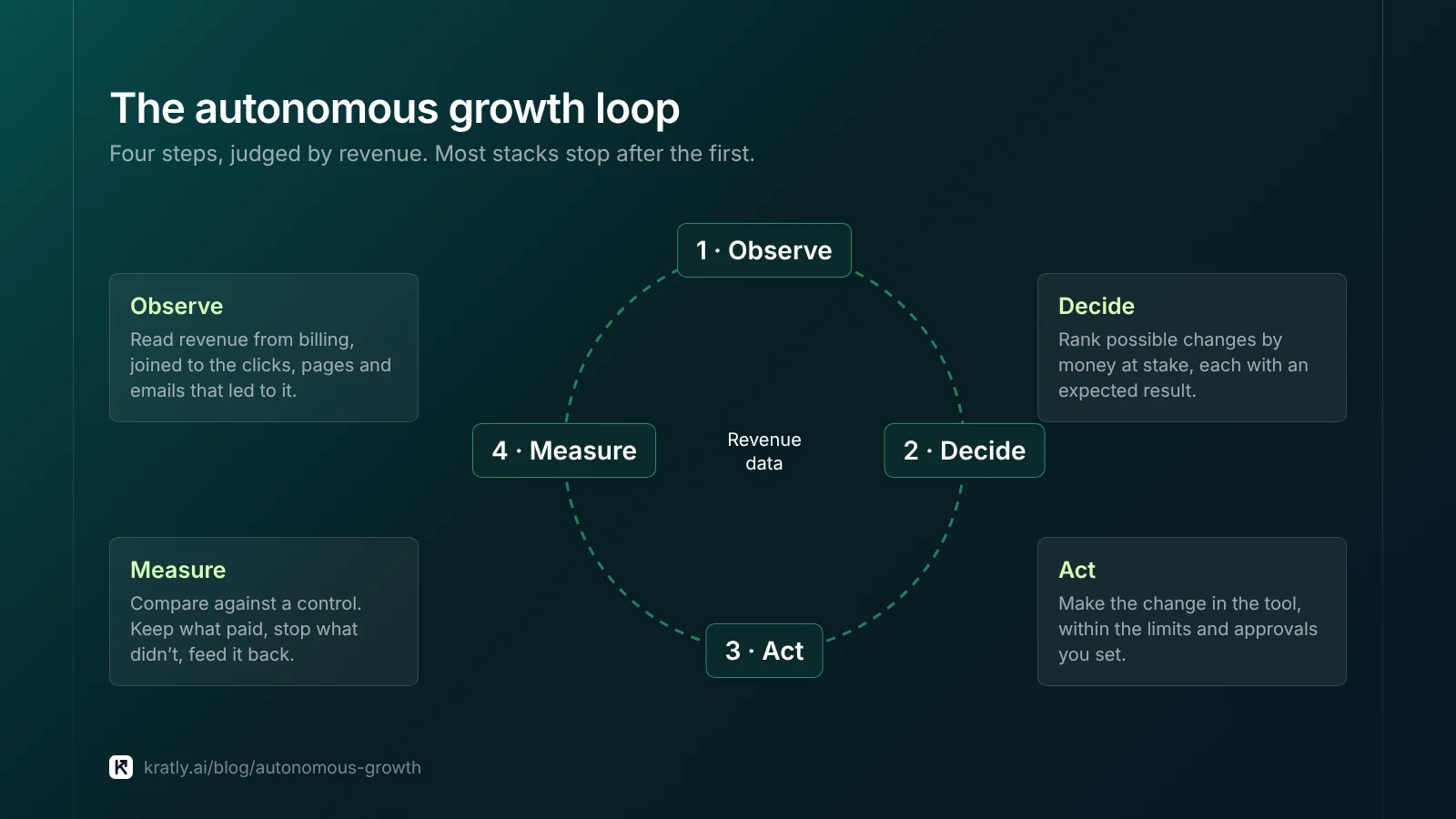
The loop has four steps. Most teams do the first one well, the second one sometimes, and the last two rarely.
1. Observe: start from revenue, not clicks#
Join three kinds of data:
- Spend and clicks from Google Ads, Meta, Microsoft Ads
- Behaviour from your site and app: sign-ups, activation, key events
- Money from Stripe, Shopify or the app stores: payments, refunds, renewals
Ad-platform ROAS is an input, not the truth. Your billing system is the truth. If you can't yet tie a payment back to a campaign, fix that first. Our SaaS marketing attribution guide shows how.
2. Decide: rank the changes by money at stake#
From that data, list possible changes and rank them by expected revenue impact. For example:
- "These 40 search terms spent $3,100 last quarter with no paying customer. Add as negatives."
- "Campaign B brings customers at half the cost of Campaign A. Move 15% of A's budget to B."
- "Trial users who don't connect a data source in three days rarely pay. Send a setup email on day two."
Each decision should state what it expects to happen and how confident it is.
3. Act: make the change in the tool#
This is the step dashboards skip. The agent writes the negative keywords into Google Ads, changes the budget, edits the page, or schedules the email, within the limits you set.
4. Measure: compare against a control#
Did the change work, or did revenue move for another reason? Compare against a holdout group, a matched time period or a matched region. Keep what worked. Roll back what didn't. Feed the result back into step one.
Our guide to testing whether a marketing change worked explains simple control groups for small teams.
How much should an AI agent be allowed to do?#
Handing an AI the keys to your ad budget sounds risky because it is. Agentic AI has a mixed record so far.
- Gartner predicts over 40% of agentic AI projects will be cancelled by the end of 2027, citing "escalating costs, unclear business value or inadequate risk controls" (Gartner, June 2025).
- In an October 2025 Gartner survey, 45% of martech leaders said vendor AI agents fail to meet expected business performance (Gartner, October 2025).
- McKinsey's 2025 State of AI found only 39% of organisations report any EBIT impact from AI (McKinsey, 2025).
Practitioners say the same. SaaStr's Jason Lemkin wrote that "AI agents require about as much management time as humans," and described an agent that ran an unauthorised test that "gave away free tickets" (SaaStr). On Reddit's r/AI_Agents, one user said marketing agents often turn "into guided semi automation" (r/AI_Agents).
The answer isn't to avoid agents. It's to give them autonomy in steps, with hard limits.
| Level | The agent can… | Use it for |
|---|---|---|
| 1. Read | Analyse data and report findings | Week one with any new tool |
| 2. Draft | Propose changes with evidence; you approve each one | New campaigns, pricing, creative, anything customer-facing |
| 3. Act with limits | Make set types of change inside caps; you review a log | Negative keywords, bid and budget shifts within ±20%, pausing clear losers |
| 4. Act and report | Run a proven loop end to end; alerts on exceptions | Only loops that have worked at level 3 for weeks |
The ±20% figure is an example, not a rule. Set your own caps.
Guardrails every autonomous setup needs:
- A daily spend cap and a per-change budget limit
- A ceiling on cost per paying customer that triggers a pause
- Automatic rollback when a change breaks its threshold
- A full log of every action, who or what made it, and why
- A kill switch anyone on the team can use
Start with one narrow loop. Gartner's cancellation reasons, cost, unclear value and weak risk controls, are all easier to manage when the scope is small.
Where to start: three loops that pay back fastest#
You don't need to automate everything. Start where money leaks today and the fix is clear.
Loop 1: Stop paying for searches that never buy#
Wasted ad spend is the easiest place to show results, because the saving is immediate and measurable. The agent reads search terms, matches them to paying customers, and adds negatives for terms that spend and never convert. See Google Ads wasted spend: the 9 places your budget leaks.
Loop 2: Turn trial sign-ups into paying customers#
Many teams spend heavily to get trials and lightly on converting them. An agent can watch which trial users stall, and send the right follow-up at the right moment. See trial follow-up emails that turn sign-ups into paying customers.
Loop 3: Get cited where buyers now search#
Buyers increasingly read AI answers before they click. An agent can check whether Google AI Overviews and ChatGPT mention you, and flag the pages to fix. See how to get cited in Google AI Overviews.
Autonomous growth for SaaS, online stores and apps#
The loop is the same everywhere. What changes is where revenue lives and how long it takes to show up.
| SaaS | Online store | Mobile app | |
|---|---|---|---|
| Revenue source | Stripe or your billing system | Shopify or your store platform | App Store and Google Play, plus web payments |
| Time from click to money | Days to months (trial, then subscription) | Minutes to days | Install, then in-app purchase or subscription |
| The leak to fix first | Ads optimised for sign-ups, not payers | Performance Max spend on brand searches and low-margin products | Installs that never purchase |
| What "act" looks like | Upload paid conversions, cut campaigns with no paying customers, trigger trial emails | Negatives, product exclusions, budget shifts by margin | Shift spend to sources that bring paying users, fix the store listing |
| Control to use | Holdout of trial users, or a matched period | Geo or time split | Matched period or a holdout audience |
SaaS: the trial is where the loop breaks#
For SaaS, the sale happens weeks after the click and in a different system. Unless the loop can join the click to the Stripe payment, it ends up optimising for sign-ups. That's why attribution comes before automation.
Online stores: margin, not revenue#
For stores, money arrives quickly, so the loop can move faster. But revenue isn't profit. An agent that shifts budget toward high-revenue, low-margin products can grow sales and shrink profit. Feed it margin, not just order value.
Apps: two funnels that must become one#
For apps, a user may click an ad on the web, install later and pay inside the app. If the loop can't see both, it credits the wrong channel. Our guide to web-to-app attribution covers how to connect them into one funnel.
How to judge an AI growth agent before you buy#
Gartner warns of "agent washing": many vendors relabel chatbots and automations as agents. It estimated only about 130 of thousands of agentic AI vendors are real (Gartner, June 2025).
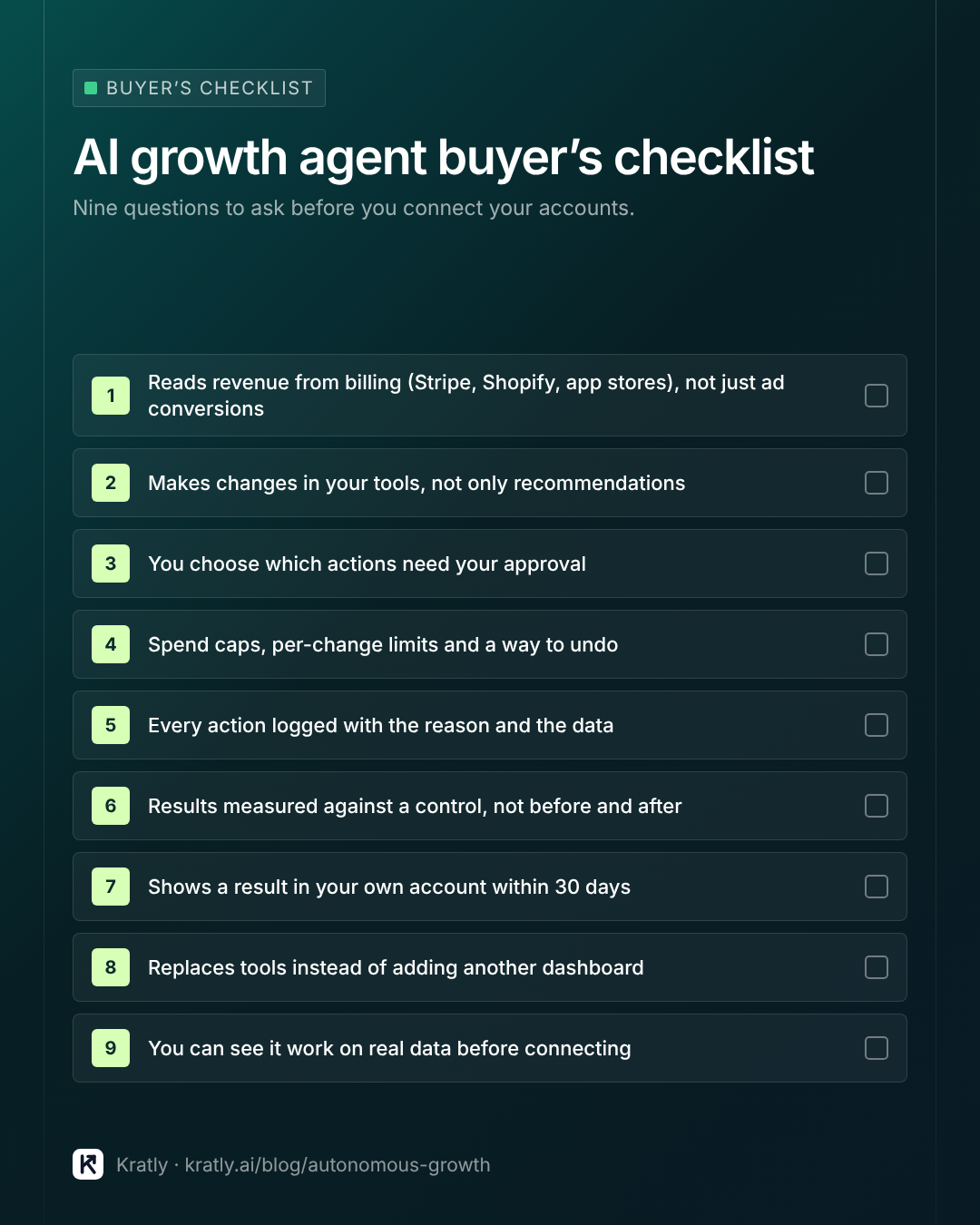
Ask these questions in any demo:
If the answers are mostly "no", you're buying another tool, not autonomous growth.
How to do this in Kratly#
Kratly is built to run the loop above on your own data. It starts from paid revenue and acts within the limits you set.
- Connect your ad accounts, site and revenue source. Kratly joins clicks and campaigns to Stripe payments, so every action is judged by paying customers.
- Review what Kratly finds. It ranks changes by money at stake: wasted search terms, campaigns to cut or grow, pages missing from AI answers.
- Choose what Kratly can do alone. Approve each change at first. Allow set changes within caps once you trust them.
- See the result against a control. Kratly reports what each change did to revenue, so you keep what paid and stop what didn't.
You can see all of this in the demo workspace before you connect anything.
Questions, answered
What is an AI growth agent?
An AI growth agent is software that reads your marketing and revenue data and decides which growth actions to take. It makes those changes in your ad, SEO and email tools, then measures the effect on revenue. Unlike a dashboard, it acts. Unlike simple automation, it decides which rule to apply and checks if it worked.
Is autonomous growth safe for my ad budget?
It can be, with guardrails. Start with read-only access, then approve each change, then allow small changes inside caps. Set a daily spend cap, a per-change limit, a cost-per-customer ceiling and automatic rollback. Keep a full action log and a kill switch.
What's the difference between an AI agent and marketing automation?
Marketing automation follows fixed rules you write, such as "send email two when a user signs up." An AI agent chooses what to do based on data: which users to email, which budget to move, which search terms to block. Then it checks the result.
Will an AI growth agent replace my marketing team?
Not the judgement. An agent takes over repetitive analysis and execution: search-term reviews, budget shifts, routine tests. Your team still sets strategy, positioning, creative and the limits the agent works within. Practitioners report agents still need regular management time.
How do I reduce marketing tool sprawl?
List every tool, its cost and the last decision it led to. Cut tools nobody has acted on in 90 days. Merge tools that do the same job. Then judge what remains by one question: does it change revenue, or just report it? Our tool sprawl guide has a full audit.
How do I measure whether autonomous growth is working?
Measure revenue against a control, not activity. Compare paying customers and revenue from changed campaigns or users against a holdout or a matched period. Track cost per paying customer and payback time. If the agent reports only its own output, ask for the revenue view.
Written by
Priyansh Kumar
Priyansh Kumar has spent more than a decade in growth, scaling brands from 1 to 10 and from 10 to 100. He now builds Kratly, an autonomous growth team that ties every campaign, page and email to the revenue it brings.
Sources
- Gartner: Marketing technology survey, 2023 · Technology and emerging trends (2025 utilization) · Over 40% of agentic AI projects will be cancelled by 2027 · 45% of martech leaders say vendor AI agents underdeliver
- chiefmartec: 2025 Marketing Technology Landscape
- Zylo: How much is wasted on SaaS spend (2026 index)
- MarTech: Marketers keep adding tech despite feeling overwhelmed (2024)
- McKinsey: The state of AI 2025
- SaaStr: We built an AI VP of Marketing
Was this article useful?