Short answer
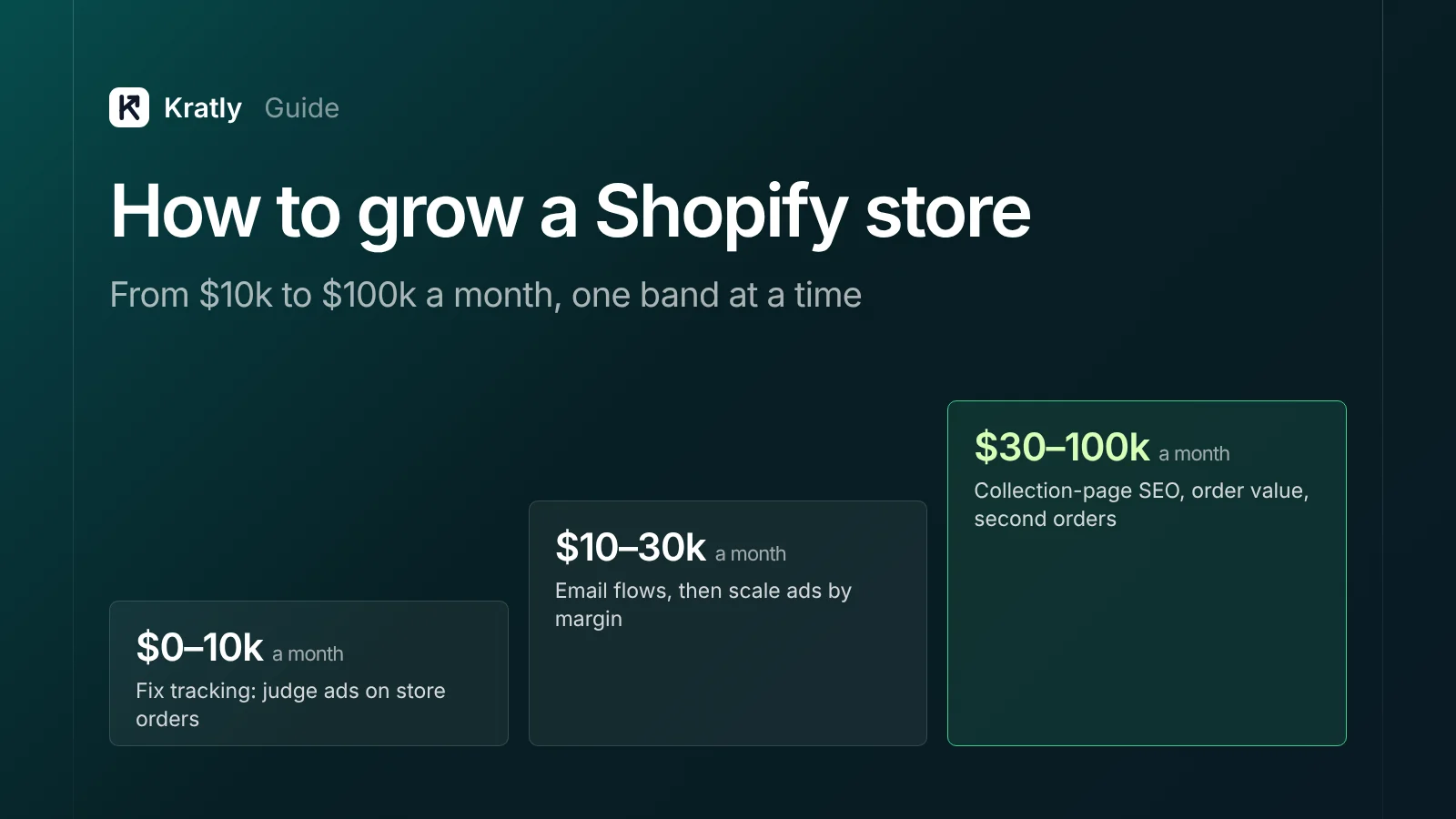
How to grow a Shopify store from $10k to $100k a month: first, fix tracking so ads are judged on Shopify orders against your break-even ROAS. Then build email flows for abandoned checkouts and repeat buyers. Scale Meta and Google only while contribution margin stays positive. Add SEO for collection pages. Measure profit per order, not traffic.
In January 2016, Jonah, a 17-year-old swimmer from Denver, launched a watch store on Shopify called Watch Outfitters. In his first year, he was making more than $13,500 a month, according to a Shopify blog interview (August 2016; figures self-reported).
He ran three to five Facebook campaigns at a time, cut the losers and repeated the winners. A weekly "Watch of the Week" email brought in about $500 per send. His rule: "Knowing your customers equals testing."
That gets you to $10k a month. It won't get you to $100k. This guide shows how to grow a Shopify store past that point, stage by stage. It is part of our growth playbooks by business type.
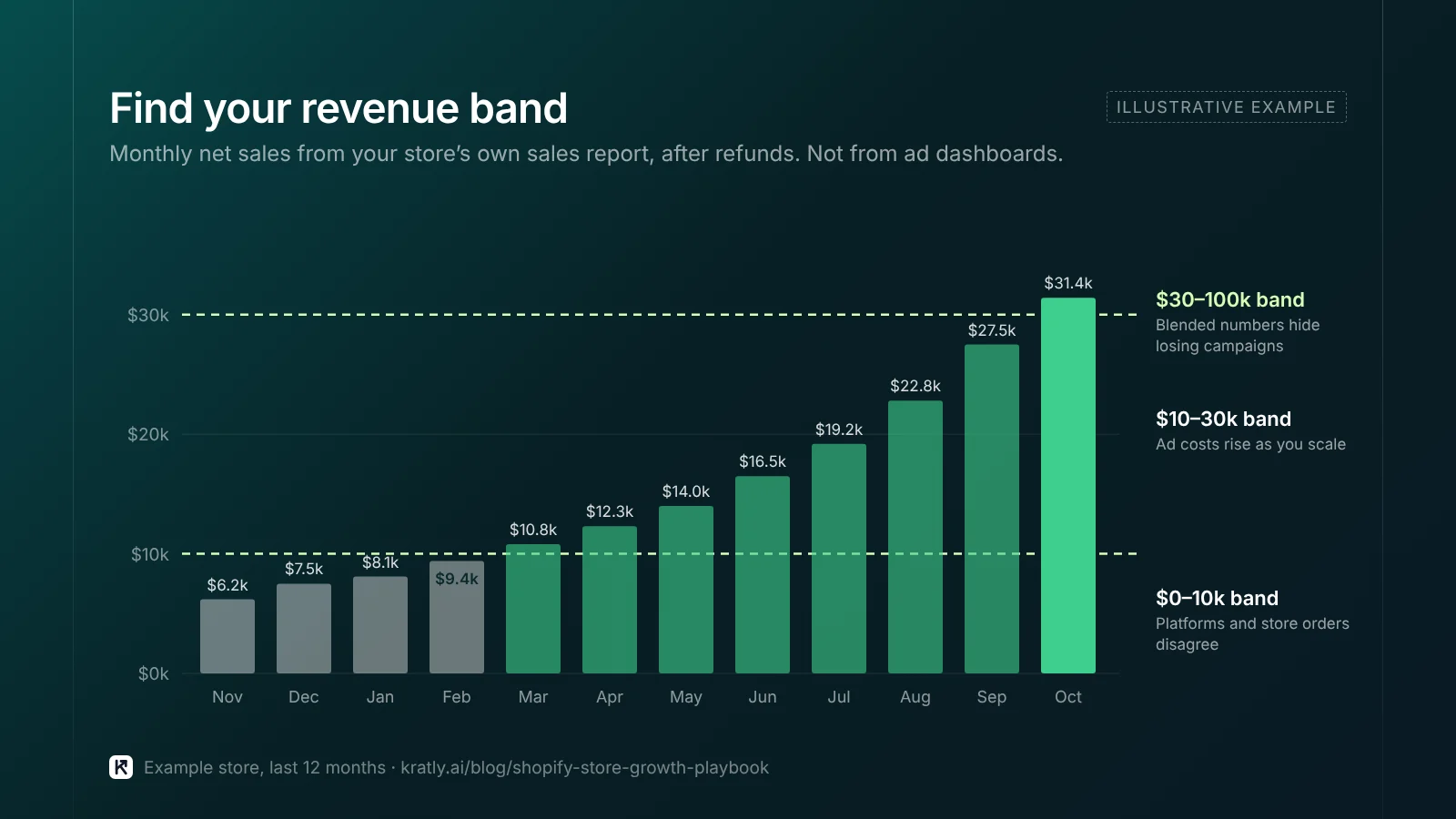
What stage is your Shopify store at?#
Use Shopify monthly revenue after refunds.
| Monthly revenue | What's usually true | What breaks next |
|---|---|---|
| $0–10k | One or two products sell. Most orders come from one channel, often Meta or organic social. The founder does everything. | You can't tell which ads make money. Platform dashboards and Shopify disagree. |
| $10–30k | Paid ads drive most new orders. Email exists but is mostly one-off campaigns. Margins feel fine because nobody counts shipping and returns. | Ad costs rise as you scale. Each extra dollar of spend brings back less. Repeat buyers are an afterthought. |
| $30–100k | Two or more ad channels. Real inventory risk. Maybe a part-time marketer or agency. | Blended numbers hide losing campaigns. Discounts train buyers to wait. Cash gets tied up in stock. |
These bands are a rule of thumb, not a benchmark. Use "what breaks next" to pick your first move.
How to grow a Shopify store: the five moves that matter#
Contribution margin is what an order leaves you after product cost, shipping, payment fees, discounts and returns, before ad spend. Your break-even ROAS is 1 ÷ that margin (Amazon Ads). At a 40% contribution margin, every $1 of ads must bring back $2.50 in sales just to break even.
1. Fix tracking and judge ads on Shopify orders ($0–10k and up)#
What to do: Install the Google & YouTube app with enhanced conversions. Install the Facebook & Instagram app with the Conversions API on. Remove old duplicate tags. Put UTMs on every ad. Then compare each channel's Shopify-attributed ROAS with your break-even ROAS.
Why: Shopify credits one channel per order, while each ad platform counts any sale its ad touched (Shopify Help Center). If you scale on platform numbers, you can scale a loss.
Cost: The apps are free. Setup takes about 4–8 hours, plus 20 minutes a week to reconcile.
Time to revenue: Savings from week one, as you cut campaigns below break-even.
The full setup is in Shopify Google Ads conversion tracking: match ads to real orders.
2. Build the three email flows that sell on autopilot ($10–30k)#
What to do: Set up an abandoned checkout flow, a welcome flow for new subscribers and a post-purchase flow that asks for a second order.
Why: Baymard Institute puts the average documented cart abandonment rate at 70.22%, across 50 studies (Baymard). Among shoppers who abandoned (setting aside browsers), 40% blamed extra costs like shipping, tax and fees. Show shipping costs early, then remind the rest.
Cost: Shopify Email gives 10,000 free emails a month on most plans, and abandoned checkout automations don't count toward the limit (Shopify Help Center). Expect 6–10 hours to write and test three flows.
Time to revenue: Abandoned checkout emails start earning within days. Post-purchase flows take one to three months, because they depend on your reorder cycle.
The second-order side is covered in Ecommerce retention strategy: email, SMS and repeat purchases.
3. Scale paid ads by margin, not by ROAS target alone ($10–100k)#
What to do: Raise budget on campaigns that beat break-even ROAS on Shopify orders, in steps of about 20% a week. Add Google Shopping if you only run Meta, or the reverse. List your products for free on Google through Merchant Center, which the Google & YouTube app connects. Free listings can show on the Shopping tab, Search, Images and Lens at no cost, though display isn't guaranteed (Google Merchant Center Help).
Why: Each extra dollar of spend tends to bring back less. Judge the last $1,000 you added, not the account average.
Cost: Ad spend, plus 2–4 hours a week or an agency retainer.
Time to revenue: Days for spend you add. Two to four weeks before a new campaign has enough orders to judge.
Channel detail by revenue band is in our DTC marketing strategy for Meta and Google.
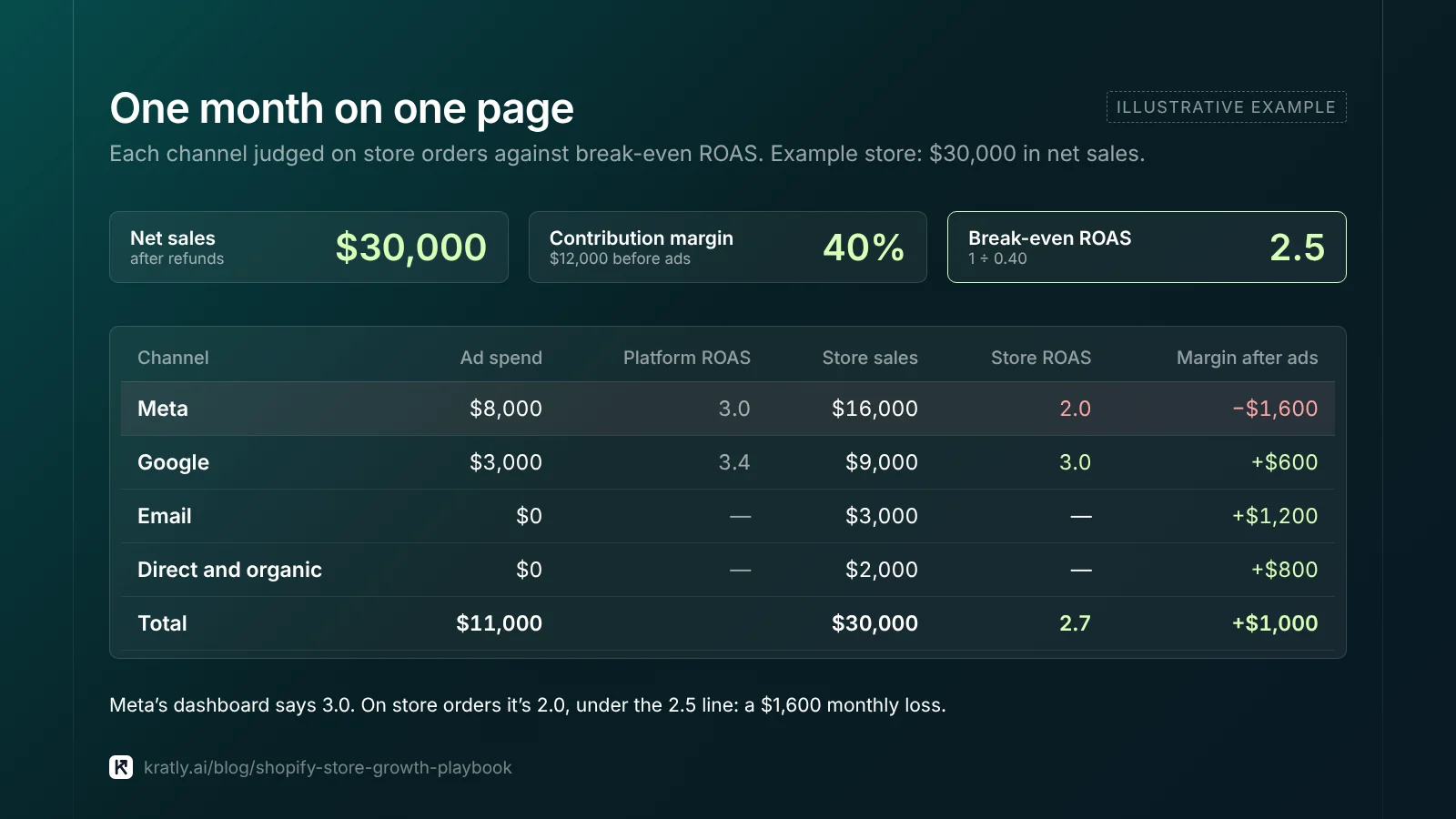
A worked example (illustrative numbers, not a real store): A store sells $30,000 a month at a 40% contribution margin. Break-even ROAS is 2.5. Meta reports a 3.0 ROAS on $8,000 of spend. Shopify credits $16,000 in sales to Meta, a ROAS of 2.0. That's $6,400 of margin against $8,000 of ads: a $1,600 monthly loss the dashboard hides.
4. Make collection pages rank ($30–100k)#
What to do: Treat each collection page as a landing page. Give it a clear title that matches how people search, a short intro and links to every product in it. Link your bestsellers from the homepage.
Why: Google says that if category pages don't link directly to all products, Googlebot may not find them all by crawling. It also suggests linking a best-selling product from the home page (Google Search Central). On Shopify, collections are your category pages.
Cost: 1–2 hours per collection page. No ad spend.
Time to revenue: Three to six months. That's why I'd start it at $30k, when paid ads already cover the bills.
5. Raise order value and second orders ($30–100k)#
What to do: Set a free-shipping threshold just above your average order. Add bundles of products people already buy together. Send a reorder reminder timed to when a product runs out.
Why: A higher order value and a second order spread ad cost over more revenue. A study of more than 156,000 DTC customers by Beauchamp Sullivan & Co., cited by Shopify, found an average repeat purchase rate of 18.8% (Shopify). So roughly four in five buyers never order again.
Cost: A few hours. Bundle discounts cost margin, so check them against contribution margin.
Time to revenue: Order value moves within weeks. Repeat rate takes one to two reorder cycles to show.
What to measure in revenue#
| Metric | Formula | Where the data comes from | Reference range |
|---|---|---|---|
| Contribution margin % | (Net sales − product cost − shipping − fees − returns) ÷ net sales | Shopify sales and costs, plus your 3PL and payment invoices | No sourced range; varies by product |
| Break-even ROAS | 1 ÷ contribution margin % | Calculated | 2.5 at 40% margin (Amazon Ads) |
| Shopify-attributed ROAS by channel | Shopify sales credited to channel ÷ channel ad spend | Shopify marketing reports + ad platform spend | Must beat your break-even ROAS |
| Store conversion rate | Orders ÷ sessions | Shopify analytics | 2.04% average across Triple Whale brands, Sept 2024–Aug 2025, vendor data (Triple Whale) |
| Cart abandonment | 1 − (orders ÷ sessions with an add to cart) | Shopify analytics | 70.22% average cart abandonment (Baymard) |
| Repeat purchase rate | Customers with 2+ orders ÷ all customers in a cohort | Shopify customer cohort analysis report | 18.8% average across 156,000+ DTC customers (Shopify) |
Shopify's cohort analysis report groups buyers by first-order month and tracks repeat purchases (Shopify Help Center). Compare yourself with last quarter first, and with benchmarks second.
What should you stop doing?#
Stop scaling on platform ROAS. Meta and Google each claim sales their ads only touched. Cost: in the example above, $1,600 a month lost behind a profitable-looking dashboard.
Stop running sitewide discounts every week. Each one cuts contribution margin and raises your break-even ROAS. At 40% margin, a 15%-off sale drops margin to roughly 29% and lifts break-even ROAS from 2.5 to about 3.4.
Stop adding an app for every problem. Each adds a fee and often a script that slows pages. Two apps sending one purchase event double-count it.
Stop sending paid traffic to the homepage. Send it to the page the ad promised. You pay for every click that has to search again and leaves.
Stop treating email as a newsletter only. Flows run daily without you. Without them, every abandoned checkout is ad money you paid once and never followed up.
How to do this in Kratly#
- Connect Shopify, Google Ads, Meta Ads and Search Console. Kratly reads orders, ad spend and search data.
- Check every campaign against break-even. Kratly shows each campaign's revenue per ad dollar from Shopify orders, not platform claims; compare it with your break-even ROAS (1 ÷ contribution margin).
- See revenue by campaign, page and email. Collection pages and emails get credit for their orders.
- Approve suggested changes. Kratly suggests budget shifts and pauses. You approve them, and each change is logged and reversible.
Questions, answered
How long does it take to grow a Shopify store to $100k a month?
There is no fixed timeline. It depends on margin, order value and how much cash you can put into ads and stock. Jonah's watch store reached about $13,500 a month in its first year, per Shopify's interview. Reaching $100k usually takes several channels, email flows and repeat buyers, not one winning ad.
What is a good ROAS for a Shopify store?
Any ROAS above your break-even ROAS, which is 1 ÷ contribution margin. At 40% margin, that's 2.5. At 50%, it's 2.0. Measure it on Shopify-attributed orders, not platform-reported sales. Each ad platform counts sales its ads only touched, so its ROAS usually looks better than what reached your store.
Should a new Shopify store start with Meta ads or Google ads?
Start where buyers already look for your product. If people search for it by name or type, Google Shopping and free listings come first. If they don't know it exists yet, Meta is usually better at creating demand. Either way, install the official Shopify apps and judge results on Shopify orders.
Does SEO work for Shopify stores?
Yes, but slowly. Collection and product pages can rank for buying searches, and Google advises linking every product from its category page. Expect three to six months before revenue shows. That's why I'd start serious SEO work around $30k a month, once paid ads and email already pay the bills.
Written by
Priyansh Kumar
Priyansh Kumar has spent more than a decade in growth, scaling brands from 1 to 10 and from 10 to 100. He now builds Kratly, an autonomous growth team that ties every campaign, page and email to the revenue it brings.
Sources
- Shopify blog: Jonah / Watch Outfitters interview (Aug 30, 2016) · How to improve ecommerce customer retention (updated Sep 23, 2026)
- Shopify Help Center: Marketing performance and attribution · Shopify Email pricing · Customers reports
- Google Search Central: Help Google understand your ecommerce site structure
- Google Merchant Center Help: Free listings for products
- Baymard Institute: Cart abandonment rate statistics (updated Sep 22, 2025)
- Amazon Ads: Ads math and break-even ROAS
- Triple Whale: What is a good conversion rate? (vendor data, Sept 2024–Aug 2025)
Was this article useful?