Short answer
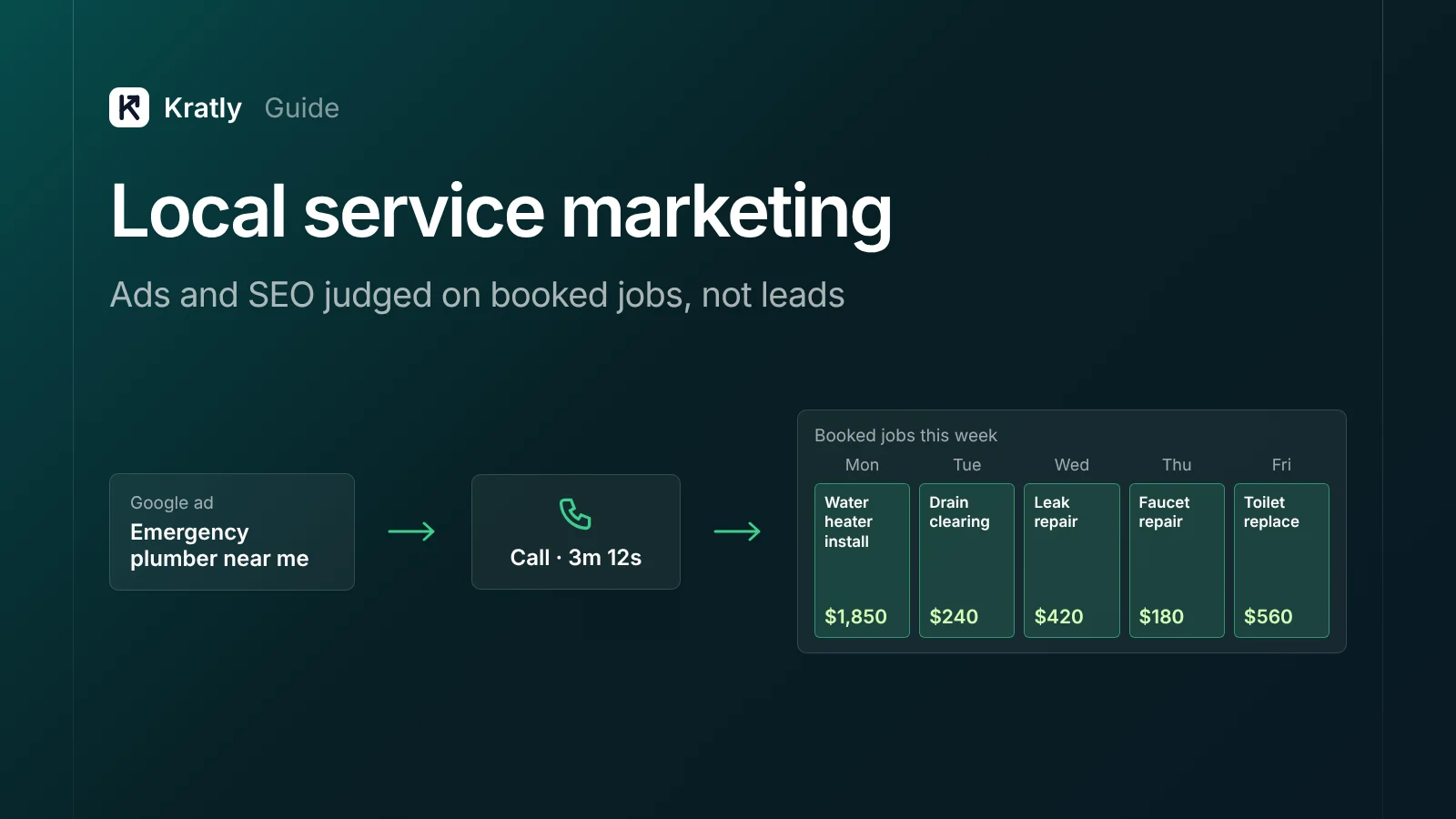
Local service business marketing works when you judge it on booked jobs, not leads. Track every call and form back to the ad or page that drove it. Set Google Ads to people in your area and block junk searches. Test Local Services Ads, keep your Business Profile complete and ask every customer for a review.
Broward Plumbing is a residential and commercial plumber in South Florida. In early 2019, its cost per lead on Google Ads was too high. It wasn't getting enough leads to keep its technicians busy. That's according to a case study by its agency, Xi Digital.
The agency helped it apply for Google Local Services Ads. After approval, the case study reports "an immediate and significant increase in both leads and sales." Within the first month, the company hired more staff and added a truck.
Notice what the story measures: busy technicians and a new truck. Good local service business marketing ends on the invoice, not in a lead report. This guide is part of our growth playbooks by business type.
What stage is your local service business at?#
Use yearly revenue from your invoices, after refunds.
| Yearly revenue | What's usually true | What breaks next |
|---|---|---|
| Under $500k | Owner answers the phone. Work comes from referrals and the Business Profile. | Calls get missed on the job. Nobody knows which ad or search brought a customer. |
| $500k–$2M | A few trucks. Google Ads, maybe an agency. Jobs booked in software. | Lead reports look fine while profit per job slips. Spend leaks to wrong areas and wrong searches. |
| $2M–$10M | Several services and towns. A dispatcher. Several ad channels. | Blended numbers hide which service, town or campaign makes money. Reviews lag behind growth. |
These bands are a rule of thumb. Use "what breaks next" to pick your first move.
Local service business marketing: the five moves that matter#
Cost per booked job is your marketing spend divided by the jobs that actually got scheduled from it. It's the number every move below tries to lower.
1. Track every call and form to a booked job (all stages)#
What to do: Turn on phone call conversions in Google Ads. Google can count calls from ads, calls to a forwarding number on your site, and clicks on your number on mobile. You set the minimum call length that counts (Google Ads Help). Then mark each call and form in your job software as booked or not, with the job value.
Why: A 20-second wrong number and a booked water heater install look the same in a lead count. Google lets you import call conversions tracked in a CRM (Google Ads Help). For form leads, offline conversion import matches a sale to the click ID, which Google keeps for 90 days (Google Ads Help).
Cost: Free in Google Ads. Setup takes 3–6 hours, plus a minute per lead to mark outcomes.
Time to revenue: Two to four weeks, once you see which campaigns book jobs.
2. Fix the two biggest Google Ads leaks for a local business (all stages)#
What to do: First, check location options. The default is "Presence or interest," which also shows ads to people only interested in your area (Google Ads Help). Switch to "Presence" so only people in or regularly in your area see ads. Second, add negatives for searches that never book: "jobs," "DIY," "how to," "free."
Why: A "plumber jobs near me" click costs the same as "emergency plumber near me." The full audit is in Google Ads wasted spend: the 9 places your budget leaks. The keyword method is in how to find negative keywords.
Cost: Two to three hours, then 20 minutes a week.
Time to revenue: Savings show in the first week.
3. Test Local Services Ads, then audit every lead ($500k and up)#
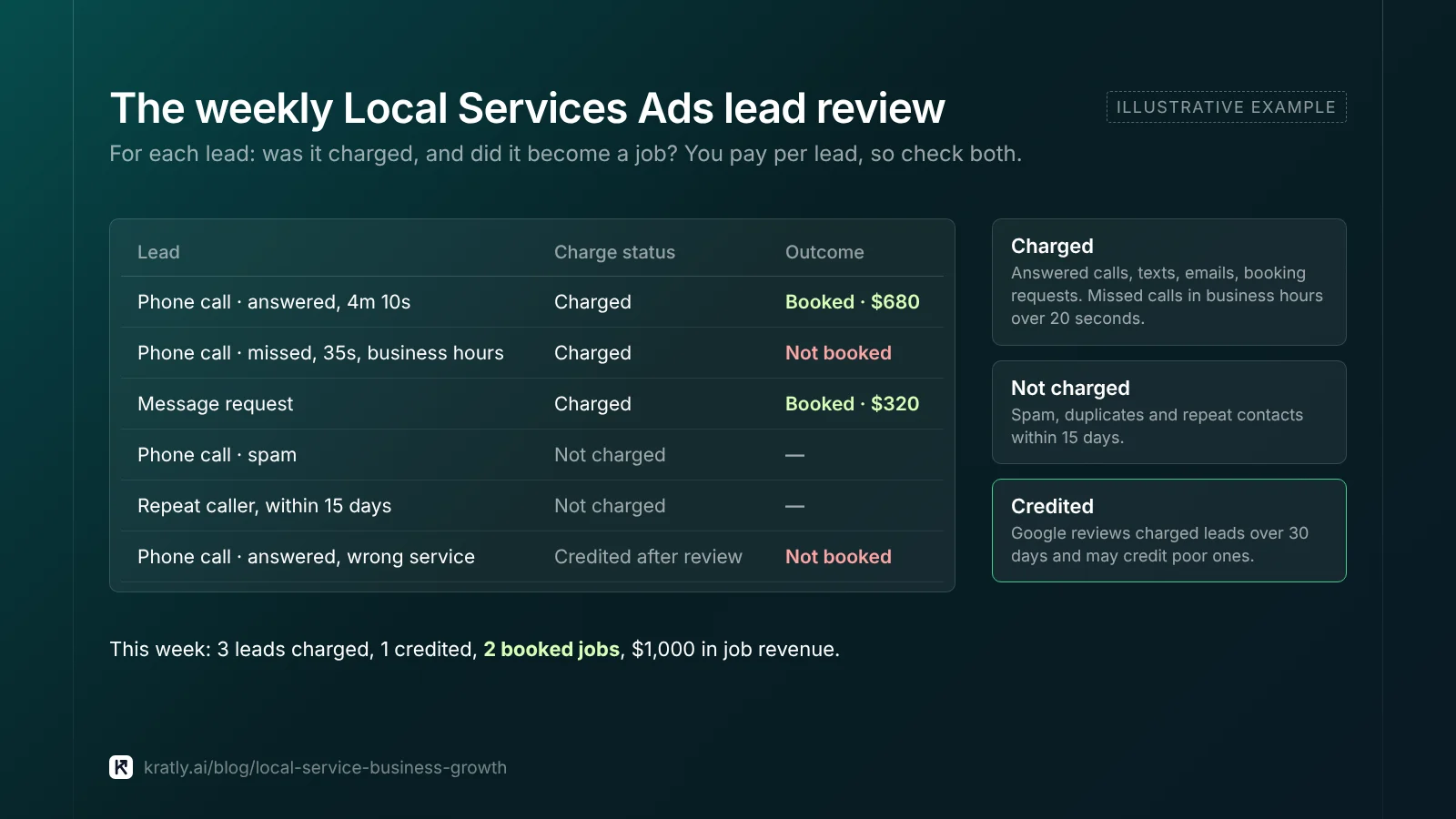
What to do: Apply for Local Services Ads and pass Google's screening and verification. Verified advertisers now earn a single "Google Verified" badge on their profile (Local Services Help). Check each lead's charge status weekly.
Why: You pay per lead, not per click (Google Ads Help). Answered calls, texts, emails and booking requests are charged. A missed call during business hours is charged if the caller stays on over 20 seconds. Spam, duplicates and repeat contacts within 15 days aren't charged. Google reviews charged leads over 30 days and may credit poor ones automatically.
Cost: Lead prices vary by town and job type. Plan one to two hours a week to review leads.
Time to revenue: Days after approval. Judge it on booked jobs after four to six weeks.
One marketer shared 2022 data from a single HVAC client: of 53 leads, 14 were credited back. About 22% of leads became sold jobs (The Data Driven Trades). One client isn't a benchmark, but it shows why lead counts mislead.
4. Make your Business Profile and reviews do the work (all stages)#
What to do: Fill in every Business Profile field: categories, services, service area, hours and photos. Text every customer a review request the same day. Reply to every review.
Why: Google ranks local results on relevance, distance and prominence. It says "more reviews and positive ratings can help your business's local ranking." And "there's no way to request or pay for a better local ranking" (Google Business Profile Help).
Cost: A few hours to set up. Then a text template your techs send after each job.
Time to revenue: One to three months, as reviews build up.
5. Build one page per service and town, and make sure it's indexed ($500k and up)#
What to do: Write a real page for each main service and main town. Include price ranges, photos of real jobs and local reviews. Check each is indexed in Search Console.
Why: These pages match what people type. But Google's spam policies treat near-copies made for each town as doorway abuse (Google Search Central). Write fewer, better pages. If they're missing, follow Google not indexing my pages: causes and fixes by status.
Cost: Two to four hours per page.
Time to revenue: Three to six months for organic traffic.
What to measure in revenue#
| Metric | Formula | Where the data comes from | Reference range |
|---|---|---|---|
| Cost per booked job | Marketing spend ÷ booked jobs | Ad platforms + job software or CRM | No sourced range |
| Booked job rate | Booked jobs ÷ qualified leads | Job software or CRM, with lead source | About 22% in one anonymous HVAC client's LSA data, not a benchmark (The Data Driven Trades) |
| Revenue per lead | Closed job revenue ÷ leads | Invoices + lead source | No sourced range |
| Return on ad spend (closed) | Closed job revenue ÷ ad spend | Invoices + ad platforms | Must beat 1 ÷ your gross margin per job (Amazon Ads) |
| Missed call rate | Unanswered calls ÷ all calls | Google Ads call reports or phone system | No sourced range |
| New reviews per month | Count of new Google reviews | Google Business Profile | No sourced range |
What should you stop doing?#
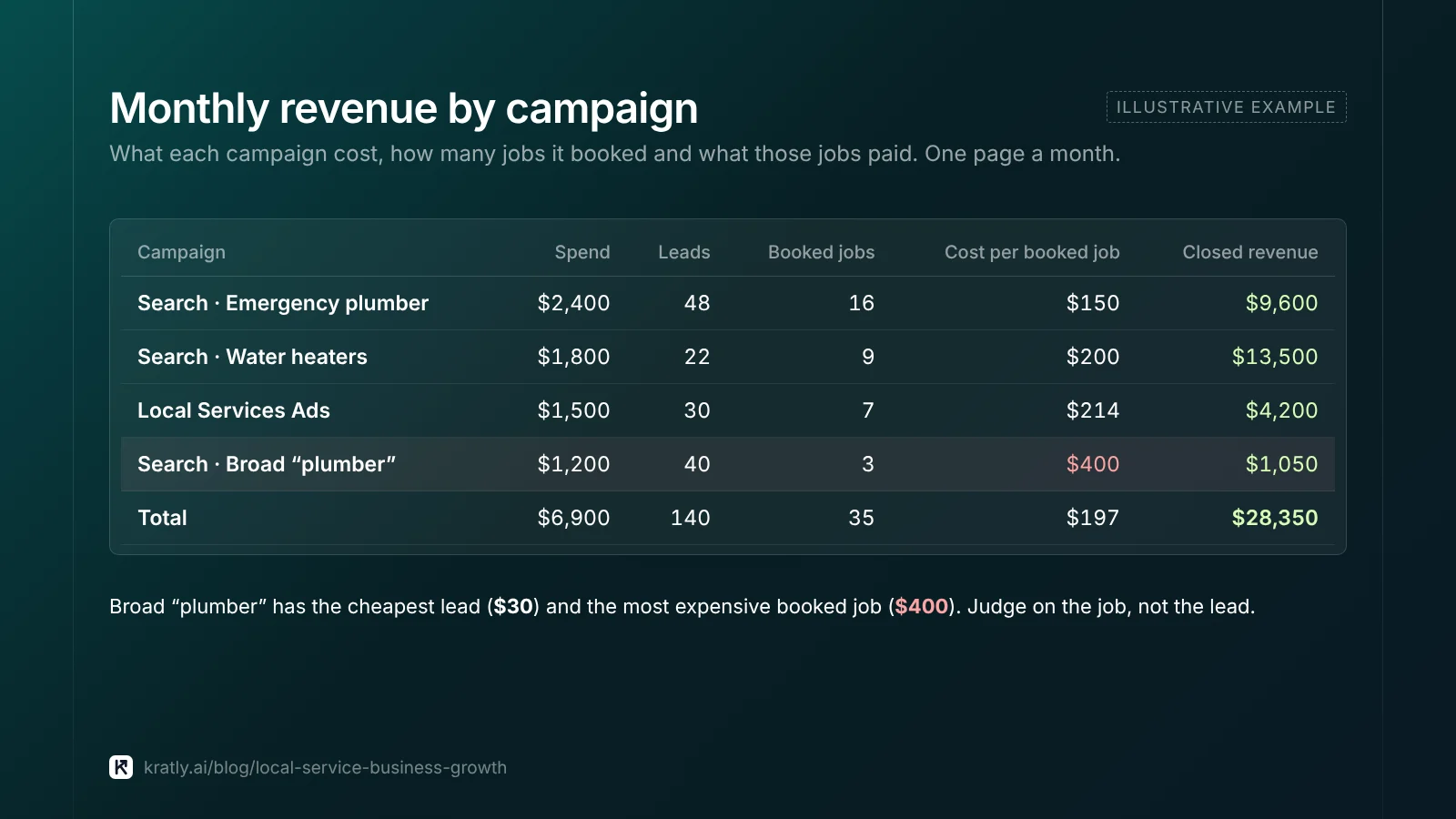
Stop judging campaigns by cost per lead. A cheap lead that never books is your most expensive lead. Cost: you scale campaigns that fill your phone with price shoppers.
Stop missing calls you pay for. Local Services Ads can charge missed calls over 20 seconds during business hours (Google Ads Help). Cost: full price for a caller who rings the next plumber.
Stop gating or paying for reviews. Google bans offering incentives for reviews and "selectively" asking only happy customers (Google Maps contribution policy). The FTC's final rule, announced August 14, 2024, bans fake reviews and incentives tied to positive or negative sentiment. It lets the FTC seek civil penalties against knowing violators (FTC). Cost: removed reviews or a federal penalty.
Stop accepting agency reports without job revenue. Ask for booked jobs and revenue by campaign. Cost: a retainer graded on a number that doesn't pay wages.
How to do this in Kratly#
- Run the free wasted-spend checker. Drop in your Google Ads search terms report; it ranks the searches that spend without converting, with negatives ready to paste.
- Connect Google Ads, your website and Search Console. Kratly sees spend, form leads, the conversions Google Ads records (calls included) and service page traffic.
- Judge campaigns on booked jobs. Import booked jobs into Google Ads as offline conversions with their value, and Kratly compares campaigns on that value, not raw leads.
- Approve suggested changes. Kratly suggests negatives, budget shifts and pauses. You approve them, and each change is logged and reversible.
Questions, answered
What is the best marketing for a local service business?
Start with a complete Google Business Profile and honest reviews, since they're free. Then run tight Google Search ads set to people in your area, and test Local Services Ads. Whatever you run, track every call and form to a booked job. The best channel is the one with the lowest cost per booked job.
Are Google Local Services Ads worth it?
They can be, because you pay per lead instead of per click. But you also pay for answered calls that never book, and some missed calls. Judge them on booked jobs after four to six weeks. Review each lead's charge status and give feedback on poor ones.
How do I track phone calls from Google Ads?
Turn on phone call conversions in Google Ads. You can count calls from ads, calls to a Google forwarding number on your website and clicks on your number on mobile. Set a minimum call length so short calls don't count. Then import booked jobs from your job software so campaigns are judged on revenue.
Can I ask customers for Google reviews?
Yes. Google allows businesses to ask for genuine reviews. You can't offer incentives, ask only happy customers or discourage negative reviews. You also can't ask staff to collect a set number. The FTC's 2024 rule separately bans fake reviews and incentives tied to a positive or negative review, with civil penalties for knowing violators.
How long does local SEO take to bring jobs?
Expect one to three months for Business Profile work and reviews to show in calls. Service and town pages usually take three to six months. That's why I'd run ads and fix tracking first, then build pages once paid jobs cover the bills.
Written by
Priyansh Kumar
Priyansh Kumar has spent more than a decade in growth, scaling brands from 1 to 10 and from 10 to 100. He now builds Kratly, an autonomous growth team that ties every campaign, page and email to the revenue it brings.
Sources
- Google Ads Help: How Local Services Ads charges for leads · About phone call conversion tracking · Location options · Offline conversion import
- Local Services Help: About Google Verified badge
- Google Business Profile Help: How to improve your local ranking on Google
- Google Maps: Prohibited and restricted content (user-contributed content policy)
- Google Search Central: Spam policies for Google web search
- Federal Trade Commission: Final rule banning fake reviews and testimonials (Aug 14, 2024)
- Xi Digital: Broward Plumbing Google Guarantee case study (agency case study)
- The Data Driven Trades: How much revenue does Google Local Services Ads drive for HVAC contractors? (one anonymous client, May–Aug 2022)
- Amazon Ads: Ads math and break-even ROAS
Was this article useful?