Short answer
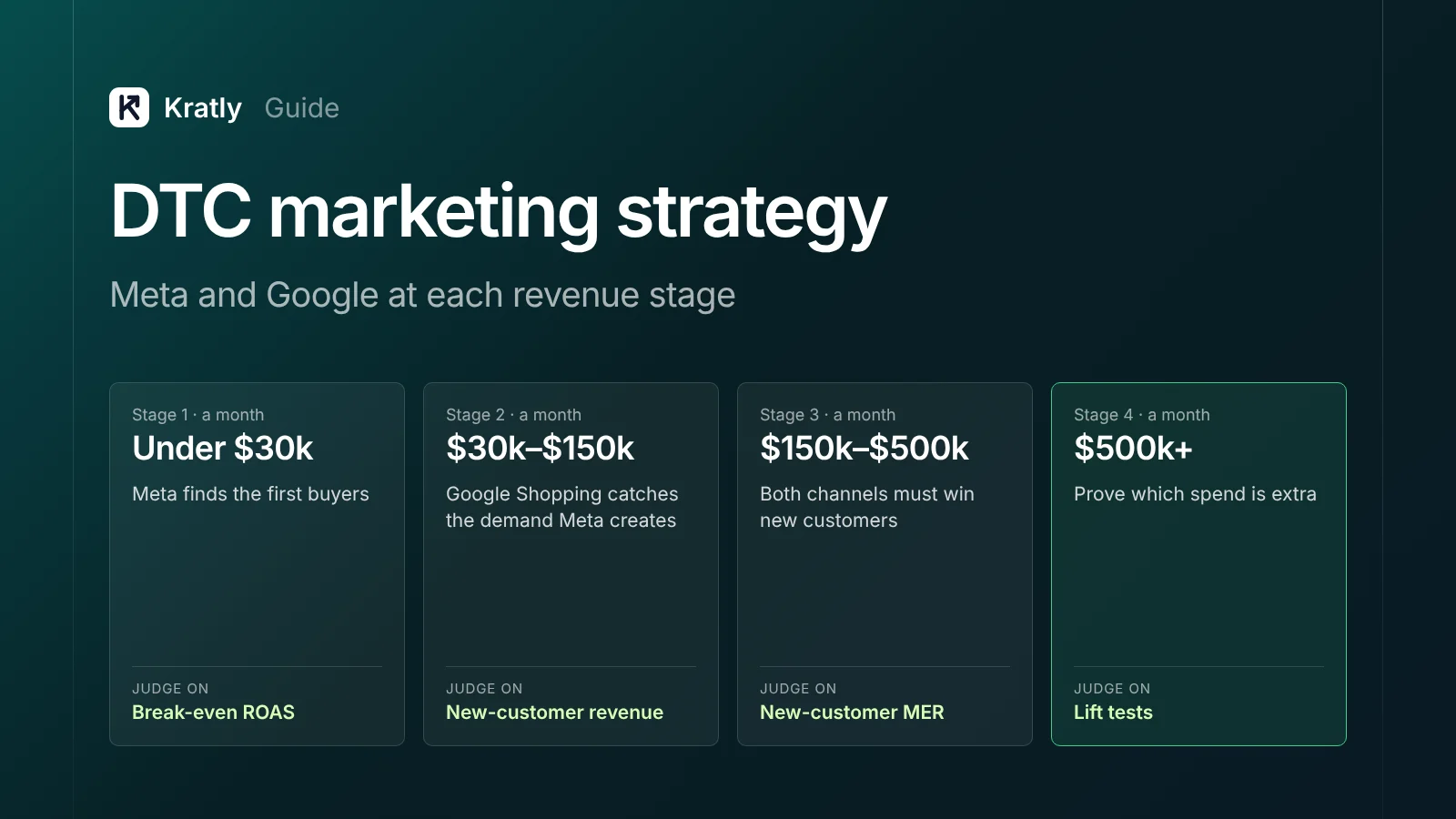
A good DTC marketing strategy changes with revenue. Under $30k a month, fix tracking and find one Meta ad that sells. From $30k to $150k, add Google Shopping to catch the demand Meta creates. Past that, scale creative volume, pay more for new customers, and judge every dollar on MER and contribution margin, not platform ROAS.
Hostage Tape, a mouth tape brand, went from about $900,000 in revenue in 2022 to about $14 million in 2023. That's according to a May 2024 Modern Retail profile. Founder Alex Neist told the outlet: "all my paid media is Facebook." He targets a $2.50 to $3 return per ad dollar. Once repeat buyers grew to a 40% repeat purchase rate, monthly Meta spend fell from seven figures to six.
That's one brand's path, not a rule. But it shows the pattern this DTC marketing strategy follows: Meta creates demand, and repeat buyers change the math.
This playbook is part of our growth playbooks by business type. If you sell on Shopify and are still under $100k a month, start with the Shopify store growth playbook.
What stage is your DTC brand at?#
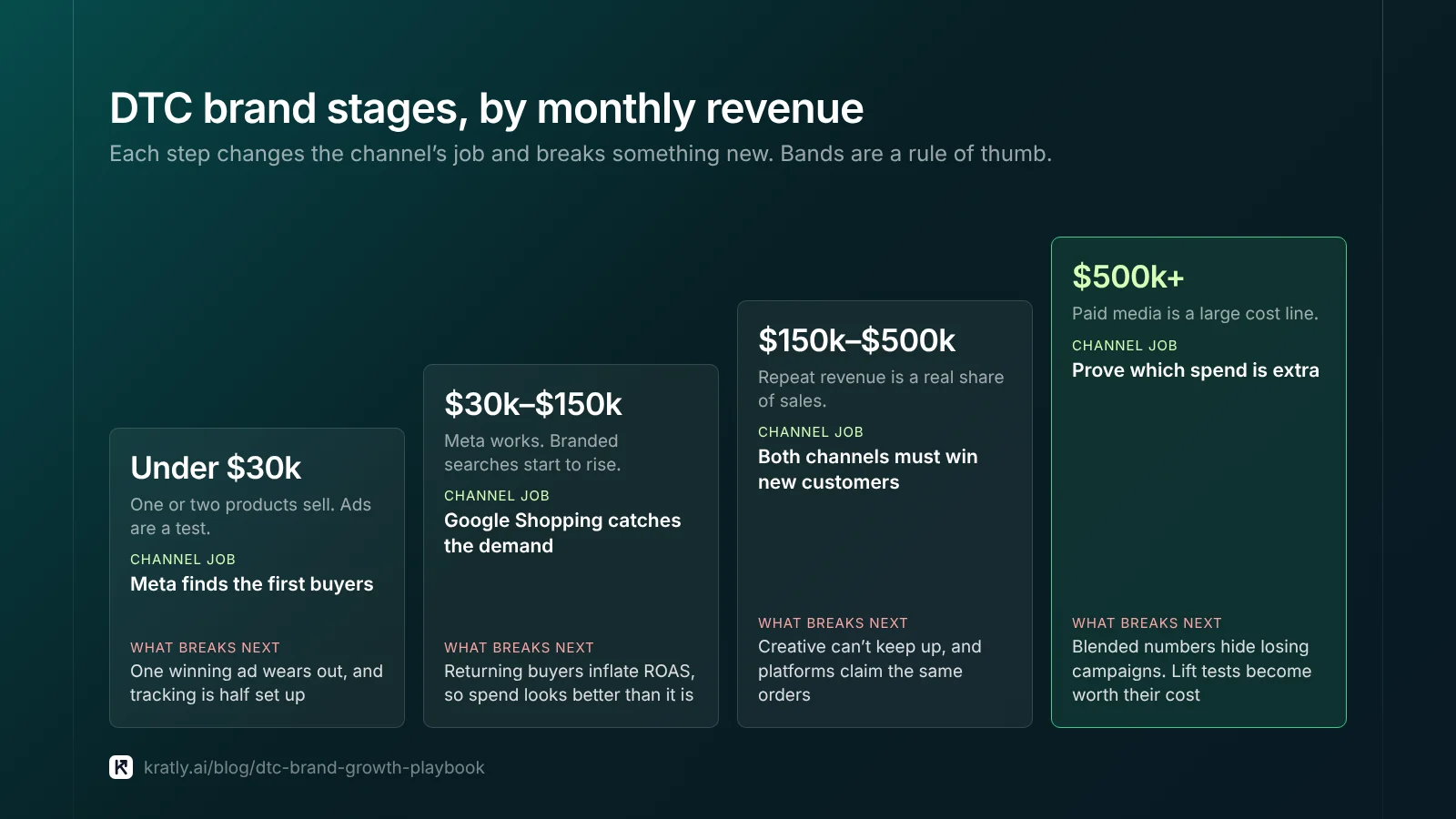
Stages are by monthly store revenue. The bands are my rule of thumb, not an industry standard.
| Monthly revenue | What's true | Main channel job | What breaks next |
|---|---|---|---|
| Under $30k | One or two products sell. Ads are a test. | Meta finds the first buyers | One winning ad wears out, and tracking is half set up |
| $30k–$150k | Meta works. Branded searches start to rise. | Google Shopping catches the demand | Returning buyers inflate ROAS, so spend looks better than it is |
| $150k–$500k | Repeat revenue is a real share of sales | Both channels must win new customers | Creative can't keep up, and platforms claim the same orders |
| $500k+ | Paid media is a large cost line | Prove which spend is extra | Blended numbers hide losing campaigns. Lift tests become worth their cost |
The five moves that matter most#
Do these in order.
1. Fix order tracking before you scale anything#
What to do: On Shopify, install the Facebook & Instagram app and set data sharing to Maximum. That sends purchases through Meta's Conversions API as well as the pixel. Install the Google & YouTube app with enhanced conversions on. Remove old purchase tags so nothing counts twice.
Why: Bidding systems learn from the purchases you send them. Meta removes a duplicate only when the pixel and server events share the same event_id and event name, within 48 hours (Meta for Developers).
Cost: $0 in software, 4–8 hours of setup. Time to revenue: none directly, but every later decision depends on it. The full setup is in Shopify Google Ads conversion tracking.
2. Run one Meta Advantage+ sales campaign, and keep it off past buyers#
What to do: Put most of your Meta budget in one Advantage+ sales campaign (formerly Advantage+ shopping). Upload your customer list. Then add a manual sales campaign with an ad set that excludes that list, and compare the two on first-time buyers.
Why: Meta used to let you cap the share of budget spent on existing customers. That cap is gone. Meta's help center says it "is no longer available" and points to manual setups instead (Jon Loomer, Mar 2025). Without some control, Meta finds buyers who would have bought anyway, and your new-customer count doesn't move. Excluding past buyers often raises cost per purchase. That's the trade.
Cost: your test budget plus 2–3 hours a week. Time to revenue: 2–4 weeks for a stable read. Measuring paid results, not platform claims, is covered in Facebook ads that bring customers who pay.
3. Add Google Shopping and Performance Max to catch demand#
What to do: Once Meta sells, people start searching for your brand and product type. Set up Merchant Center with a clean feed. Then run Performance Max with that feed. Turn on the new customer acquisition goal in "bid higher for new customers" mode.
Why: Google's goal finds new buyers using your customer lists and its own detection. Detection builds a list from "up to the last 540 days" of tracked purchases. Customer lists need at least 100 active members (Google Ads Help). Google suggests running PMax campaigns for "at least 6 weeks" before judging. It also suggests "New Customer Only" mode only for a set acquisition budget, because it can miss repeat sales (Google Ads Help).
Cost: feed cleanup takes 5–15 hours, then 1–2 hours a week. Time to revenue: 6 weeks for a fair read. To see where PMax spends inside Search, Shopping and YouTube, use the reports in Performance Max: see where the money really goes. I'd also exclude or watch brand terms, so PMax doesn't take credit for people typing your name.
4. Set a weekly creative testing cadence#
What to do: Ship a batch of new ads every week. Change one thing per batch: hook, offer, format or face. Retire losers after a set spend.
Why: At the $150k+ stage, creative is usually the limit, not targeting. Advantage+ decides who sees the ad. The ad decides who buys. Hostage Tape's ads lean on clips of well-known partners (Modern Retail). You don't need celebrities. You need volume and a rule for killing losers.
Cost: $500–$5,000 a month for creators or an editor, or 5–10 hours of your own time. Time to revenue: 1–2 weeks per batch.
5. Judge on MER and new-customer revenue, then test what's extra#
What to do: Each week, divide total store revenue by total marketing spend. Track revenue from first-time buyers separately. Above about $150k a month, test whether a channel is truly adding sales.
Why: Platform totals overlap. Your store count doesn't. Google's Conversion Lift now starts at a $5,000 budget (Google Ads Help). Since October 2026, it's self-serve for Search and PMax (Search Engine Land). A simpler option is a holdout, explained in our marketing incrementality test guide.
Cost: 30 minutes a week for MER. A lift test costs its budget plus 4–6 weeks. Time to revenue: you save money the week you cut a channel that wasn't adding sales.
What should a DTC brand measure in revenue?#
MER (marketing efficiency ratio) is total revenue divided by total marketing spend for a period (MarketerHire). It ignores who gets credit, so no platform can inflate it. Contribution margin is what's left of revenue after product cost, shipping, payment fees, discounts and returns. Subtract marketing too and you get contribution after marketing, the money that pays for everything else.
| Metric | Formula | Data source | Healthy range |
|---|---|---|---|
| MER | Store revenue ÷ total marketing spend | Shopify + ad accounts | Northbeam, an attribution vendor, puts 3.0–5.0 as balanced (via MarketerHire) |
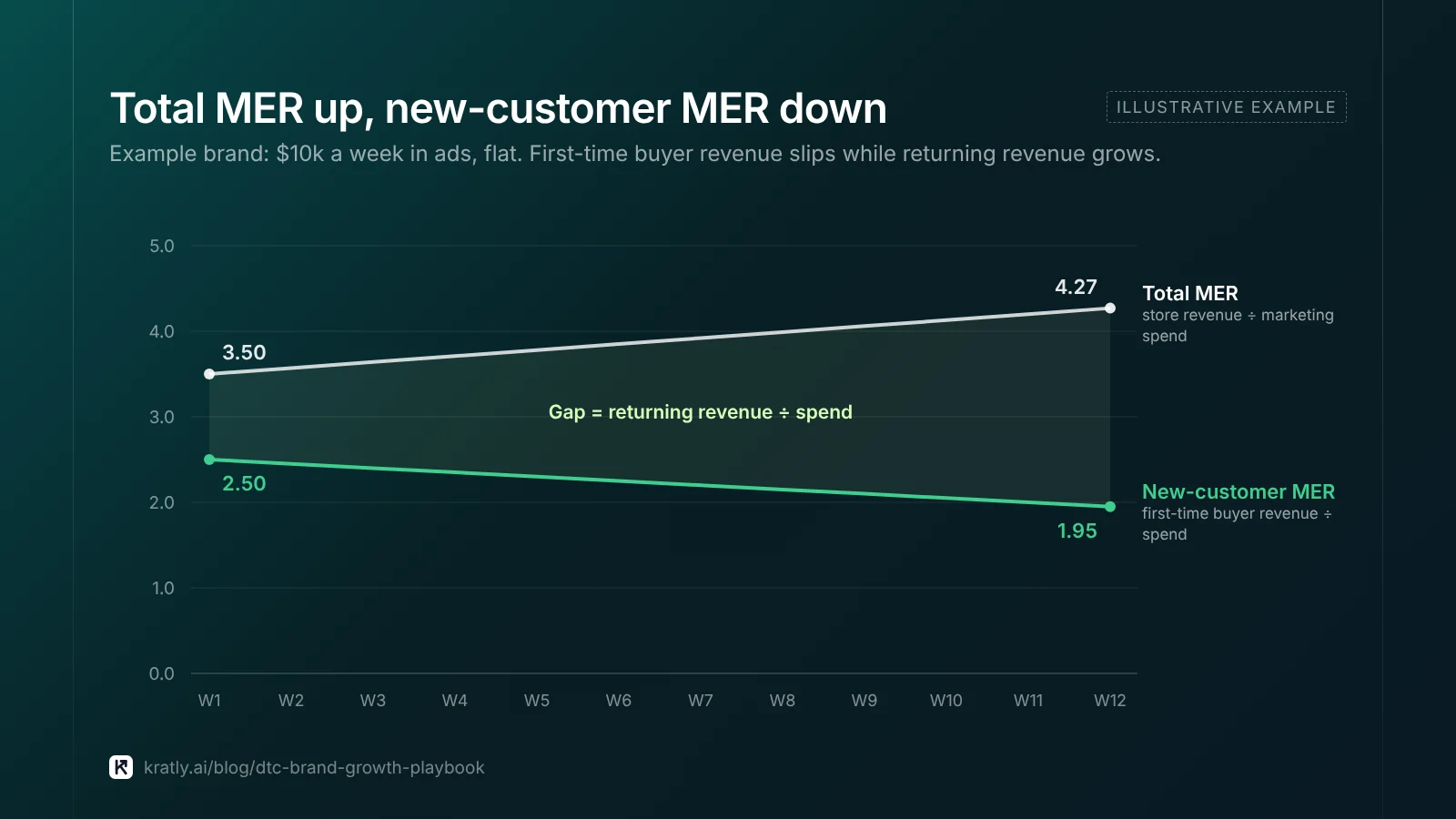
| New-customer MER | First-time buyer revenue ÷ marketing spend | Shopify new vs returning customers report (Shopify Help) | Set your own from first-order margin |
| New-customer CAC | Marketing spend ÷ first-time buyers | Shopify + ad accounts | Below first-order contribution, or within your repeat window |
| Break-even ROAS | 1 ÷ contribution margin before marketing | Your cost data | At 40% margin, 2.5 (Amazon Ads) |
| Contribution after marketing | Revenue − product, shipping, fees, discounts, returns − marketing | Shopify + accounting | Positive, and growing month over month |
If MER rises only because returning revenue grew, your ads didn't get better. Your retention did, which is the work in the ecommerce retention playbook.
What to stop doing#
Stop judging budget on platform ROAS. Meta and Google both claim the same orders. Keep going and you'll scale campaigns that lose money at the margin. The cost is every dollar above break-even that the platform called profit.
Stop letting retargeting eat the budget. Past buyers convert cheaply, so the algorithm loves them. You'd likely get those sales from email for almost nothing. Exclude past buyers in at least one Meta ad set and use Google's new customer goal.
Stop splitting Meta into many small ad sets. Each ad set needs enough purchases to exit the learning phase, which Meta puts at about 50 optimization events in a week (Meta Business Help). Ten small ad sets at $50 a day may never get there. The cost is paying learning-phase prices forever.
Stop leading with discounts to win first orders. A 30% code can turn a profitable first order into a loss and trains buyers to wait for sales. The cost shows up in contribution margin, not ROAS.
How to do this in Kratly#
- Connect Meta Ads, Google Ads and Shopify. Kratly reads spend from each ad account and orders from your store.
- See revenue by campaign. Kratly shows store revenue for each campaign next to what Meta and Google report, so overlap is visible.
- Check break-even. Kratly marks each campaign's revenue per dollar against break-even; apply your contribution margin to get break-even ROAS.
- Approve changes. Kratly suggests budget moves, like shifting spend away from campaigns that only reach past buyers. You approve each one, and every change is logged and reversible.
Questions, answered
What is the best DTC marketing strategy for a new brand?
Start with one channel and clean tracking. For most new DTC brands, that channel is Meta, because it can show a product to people who aren't searching for it yet. Get purchases flowing through the Conversions API, test creative weekly, and add Google Shopping once branded and product searches start to grow.
Should a DTC brand spend more on Meta or Google?
Meta usually comes first, because it creates demand. Google Shopping and PMax capture people who then search. The right split depends on what each adds, not on platform ROAS. Track MER and new-customer revenue as you shift budget, and run a lift test before big moves.
What is a good MER for ecommerce?
There's no universal number, because MER depends on your margin. Northbeam, an attribution vendor, calls 3.0 to 5.0 a balance of growth and profit. A better test is your own: is contribution after marketing positive and growing? A low-margin brand needs a higher MER than a high-margin one to break even.
Is Advantage+ worth it for small DTC brands?
Often, yes, once you have steady purchases flowing through the Conversions API. It puts budget and creative in one campaign, which helps a small account learn faster. The catch: Meta removed the existing-customer budget cap, so it may spend on people who would buy anyway. Run a manual ad set that excludes past buyers alongside it, and compare first-time buyers from each.
How do I know if my ads are bringing new customers?
Use Shopify's new vs returning customers report. Divide first-time buyer revenue by total marketing spend to get new-customer MER. If total revenue rises but first-time buyers don't, your ads are mostly reaching past buyers. Turn on Google's new customer goal and exclude past buyers in a Meta ad set to change that.
Written by
Priyansh Kumar
Priyansh Kumar has spent more than a decade in growth, scaling brands from 1 to 10 and from 10 to 100. He now builds Kratly, an autonomous growth team that ties every campaign, page and email to the revenue it brings.
Sources
- Modern Retail: Hostage Tape is projecting $40M in revenue for 2024 while putting all of its paid media into Meta (May 2024)
- Jon Loomer: No more existing customer budget cap (Mar 2025)
- Meta for Developers: Deduplicate pixel and server events
- Meta Business Help: About the learning phase
- Google Ads Help: Activate the new customer acquisition goal · Optimization tips for PMax with a Merchant Center feed · Conversion Lift
- Search Engine Land: Google opens Conversion Lift to Search and Performance Max (Oct 2026)
- Shopify Help Center: Customers reports
- MarketerHire: Marketing efficiency ratio
- Amazon Ads: Ads math and break-even ROAS
Was this article useful?