Short answer
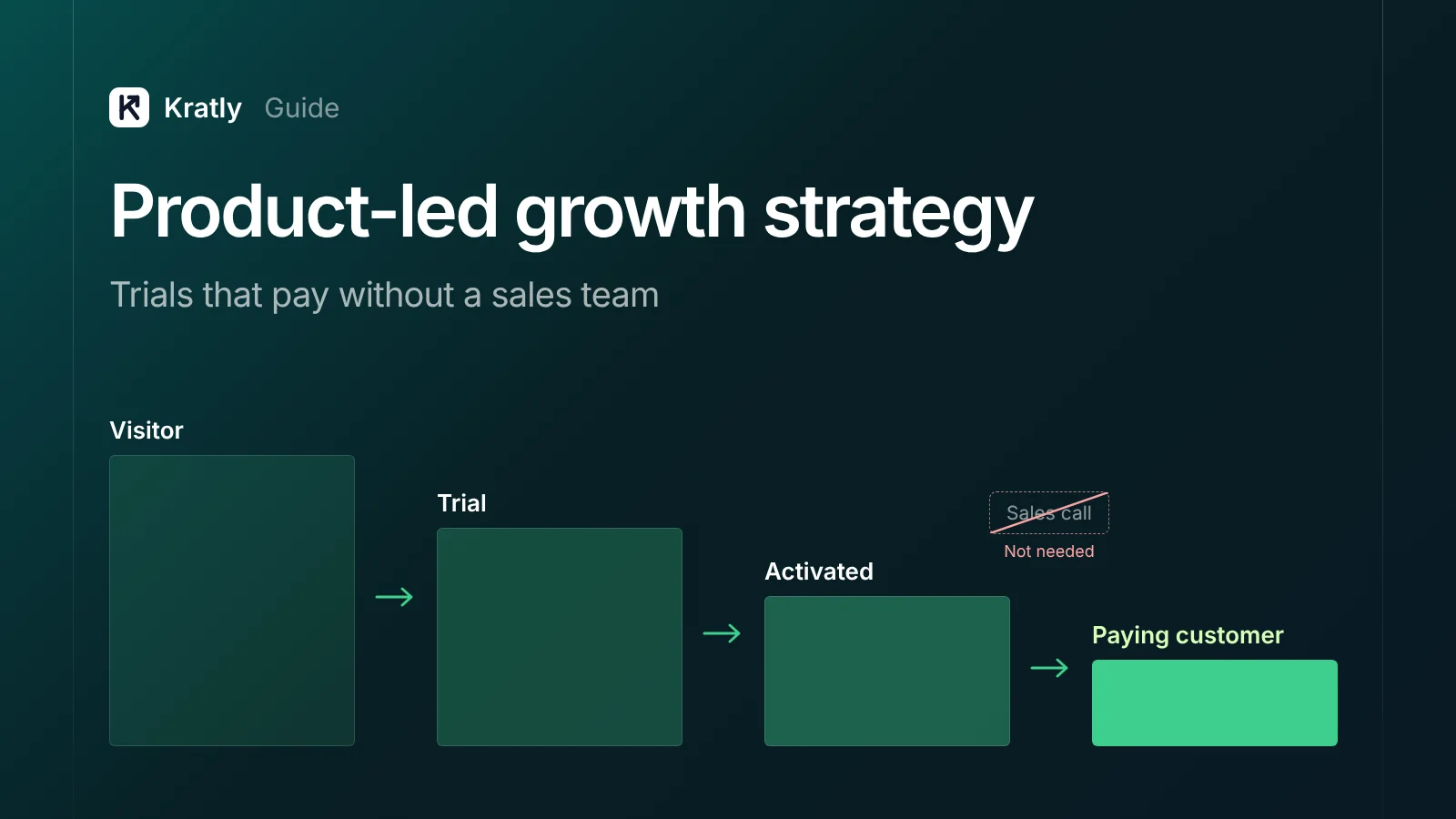
A product led growth strategy lets people try, buy and grow into your product without talking to sales. For self-serve SaaS, it comes down to a few moves. Define activation by who pays. Pick a trial model by payers per visitor. Trigger emails from behavior. Show prices. Add sales only for product-qualified accounts.
In June 2022, Plausible Analytics passed $1M ARR ($83,637 MRR). It had "more than 7,000 paying subscribers" and "a completely independent, self-funded and bootstrapped team of four" (Plausible). It sold through a 30-day free trial. It also said: "We don't use paid advertising."
The early climb was slow. Co-founder Marko Saric shared the stages on Indie Hackers. It took 12 months to go from $0 to $400 MRR, then 9 more to reach $10k (Indie Hackers).
You probably do spend on ads. The rule still holds: a product led growth strategy works only when trials turn into payment on their own. This guide is part of our growth playbooks by business type.
What is a product led growth strategy?#
Product-led growth is a way of selling software in which the product itself wins, converts and keeps customers, instead of a sales team.
Blake Bartlett, then a partner at OpenView, is credited with coining the term in 2016 (Built In). OpenView has since stopped making new investments. Wes Bush's 2019 book Product-Led Growth made the idea mainstream. It describes making "your product the tool that helps you acquire, convert, and retain customers" (Apple Books).
PLG doesn't mean "no humans, ever." It means the default path to paying needs no human. Atlassian is the classic case. Its first annual report as a public company said: "We do not have a direct salesforce and our sales model does not include traditional, quota-carrying sales personnel" (SEC, Atlassian 20-F FY2016).
What stage is your self-serve SaaS at?#
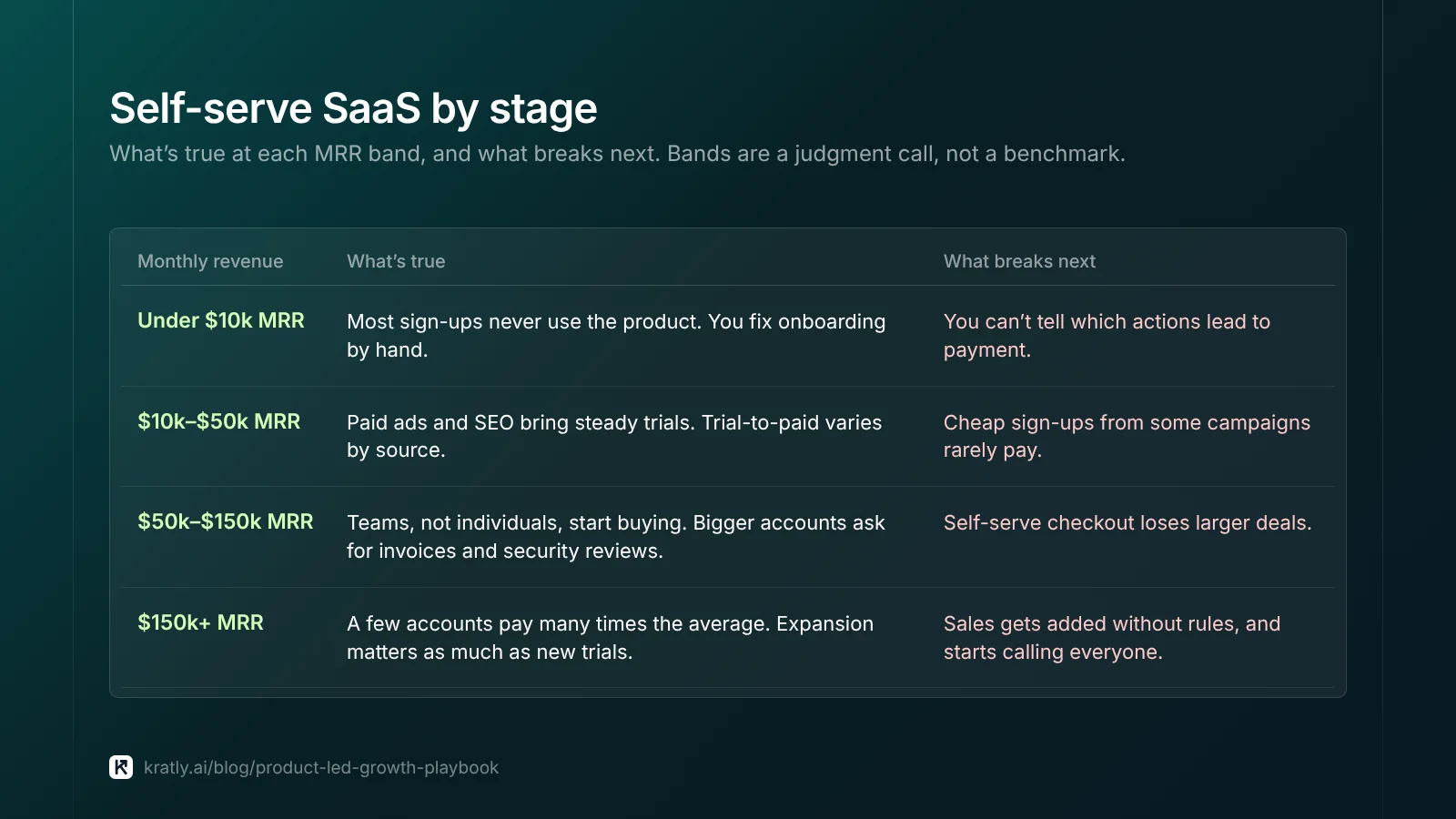
These bands are my judgment, not a benchmark.
| Stage | What's true | What breaks next |
|---|---|---|
| Under $10k MRR | Most sign-ups never use the product. You fix onboarding by hand. | You can't tell which actions lead to payment. |
| $10k–$50k MRR | Paid ads and SEO bring steady trials. Trial-to-paid varies by source. | Cheap sign-ups from some campaigns rarely pay. |
| $50k–$150k MRR | Teams, not individuals, start buying. Bigger accounts ask for invoices and security reviews. | Self-serve checkout loses larger deals. |
| $150k+ MRR | A few accounts pay many times the average. Expansion matters as much as new trials. | Sales gets added without rules, and starts calling everyone. |
Plausible later doubled from $41.6k to $83.3k MRR in eight months (Indie Hackers). Self-serve compounds once the early leaks are fixed.
If you sell bigger contracts through demos, the B2B SaaS growth playbook fits you better.
The five moves that matter most#
Here's the order I'd work in.
1. Define activation by who pays#
Find the one early action that predicts payment. Group past sign-ups by what they did in their first days. Then compare how many in each group paid in Stripe. The method is in SaaS activation metric: the first action that predicts who pays.
Cost: one or two days of analyst time in a spreadsheet. Time to revenue: four to eight weeks, once an onboarding test has enough sign-ups.
2. Pick a trial model by payers per visitor#
Card-required trials convert better per sign-up, but start fewer trials. So compare payers per visitor.
First Page Sage, an agency, reports from its client data that opt-in trials convert 17.3% to paid and card-required trials 49.1%. Yet both produced about 13 paying customers per 1,000 visitors (First Page Sage). Growth Unhinged and ChartMogul surveyed 200 B2B products in January 2026. They found a median free-to-paid rate of 8%, and 30% for card-required trials (Growth Unhinged).
If you already run a free plan that converts poorly, try a reverse trial first. Users get paid features, then drop to the free plan. Only 7% of products in that survey used one. The trade-offs are in free trial vs freemium: which brings more paying customers?
Cost: a few days of billing and copy work. Time to revenue: one trial length plus two weeks to read.
3. Trigger trial emails from behavior#
Send the "connect your data" email only to people who haven't connected it. Tie each email to your activation action.
Card-required trials also need a clear reminder before the first charge. Stripe can email customers 7 days before a trial ends (Stripe Docs). See trial follow-up emails that turn sign-ups into paying customers for the full sequence.
Cost: two to four days to write and wire up. Time to revenue: the next trial cohort.
4. Show prices and let people pay alone#
A self-serve buyer who meets "Contact us" often leaves. Kyle Poyar warns PLG companies against hiding pricing and watering down self-serve plans (Growth Unhinged). Put prices on the page. Let anyone upgrade, add seats and pay by card without a call.
SaaS pricing page best practices lists 12 tests, judged by paying customers.
Cost: a week of design and billing setup. Time to revenue: one to two months for a readable test.
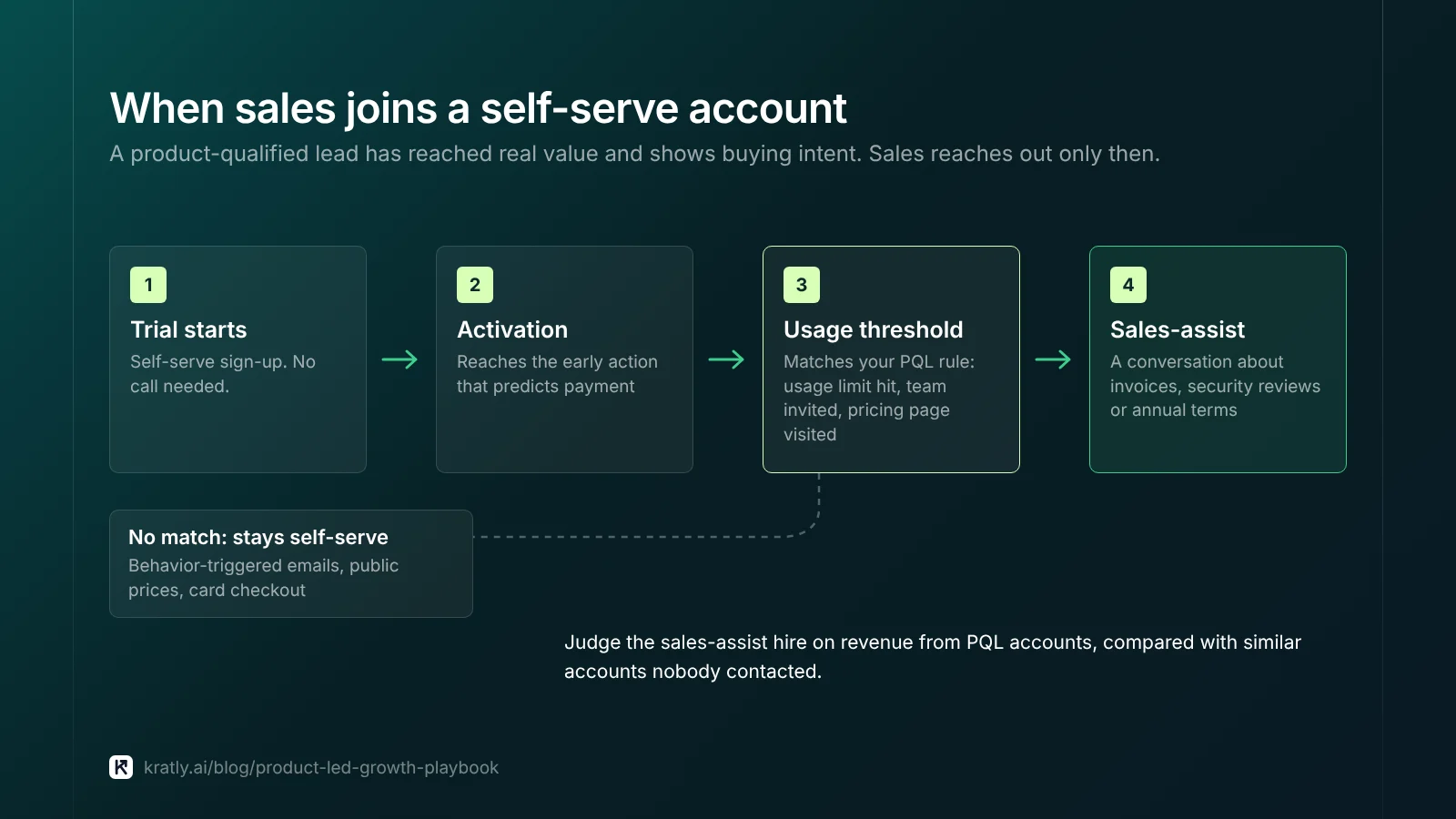
5. Add sales only for product-qualified accounts#
A product-qualified lead (PQL) is a user who has reached real value in your product and shows buying intent. Wes Bush defines it as "a lead who has experienced meaningful value using your product" (ProductLed).
Poyar's advice is to reach out based on what users have done in the product, not on every new sign-up. He also notes that the people who use your product "are generally not the same people as those who buy" (Growth Unhinged).
Most self-serve companies end up hybrid. In the 2026 Growth Unhinged survey, 80% of free-trial products had a human touchpoint when an enterprise user started a trial (Growth Unhinged). Even Atlassian's language changed. By 2022 its filing said its model "does not rely primarily on traditional, quota-carrying sales personnel" (SEC, Atlassian 20-F FY2022). Note "primarily."
My rule: add one sales-assist person when a few accounts a month hit your PQL rule and ask for invoices, security reviews or annual terms. Bartlett put it simply: "Your customers tell you when it's time to hire sales" (Built In).
Cost: one salary, often $100k+ a year with commission. Time to revenue: one to two quarters.
Which revenue numbers show PLG is working?#
Judge everything on payment. These are the numbers I'd review weekly.
| Metric | Formula | Where the data comes from | Healthy range (sourced only) |
|---|---|---|---|
| Activation rate | Sign-ups who reach your activation action ÷ all sign-ups | Product analytics | SaaS average 36%, median 30% (Lenny's Newsletter, 2022 survey) |
| Trial-to-paid | New paying customers ÷ trials started, same cohort | Stripe | 17.3% opt-in, 49.1% card-required (First Page Sage, agency data) |
| Payers per 1,000 visitors | Paying customers ÷ visitors × 1,000 | Site analytics + Stripe | About 13 for trials (First Page Sage) |
| Cost per paying customer by campaign | Ad spend ÷ paying customers from that campaign | Ad accounts + Stripe | No reliable public benchmark; compare with your own payback target |
| PQL-to-paid | PQLs that pay within 60 days ÷ all PQLs | Product data + Stripe or CRM | No study found; track your own |
Cost per paying customer is the one most teams skip. Two campaigns with equal trial costs can differ fourfold in who pays. CAC payback period shows how to turn this into months.
What to stop doing#
Judging campaigns by sign-ups. Ad platforms reward cheap sign-ups. The cost is budget that keeps flowing to people who never pay, often for months.
Calling every new sign-up. Poyar lists this as a common PLG mistake (Growth Unhinged). It annoys buyers and burns sales hours on accounts that would have paid anyway.
Hiding prices behind a demo form. Every self-serve buyer who leaves the pricing page is lost revenue you'll never see in a report.
Sending day-count drip emails to everyone. Activated users get noise and stuck users get nothing useful. You pay in lower trial-to-paid.
Making the free plan better to lift sign-ups. If the free plan solves the whole problem, fewer people pay, and you carry their support and hosting costs.
How to do this in Kratly#
- Connect Google Ads, Meta Ads, your website and Stripe. Kratly ties each trial and each paying customer to the campaign, page or email that brought them.
- Compare campaigns by cost per paying customer. Spot the ones whose trials rarely convert, even when sign-ups look cheap.
- Check pages and emails by revenue. See which landing pages and trial emails come before payment, not just clicks.
- Approve suggested changes. Kratly suggests budget shifts and fixes. You approve them, and each change is logged and reversible.
If you're not ready to sign up, the free wasted-spend checker shows where Google Ads budget goes to searches that never buy.
Questions, answered
What is a product led growth strategy?
It's a go-to-market approach where the product does most of the selling. People find it, try it, see value and pay without talking to a salesperson. The core is a short path to value, public pricing, self-serve checkout, and measuring every channel by the paying customers it brings.
What is a good trial-to-paid conversion rate for PLG SaaS?
It depends on whether you ask for a card. First Page Sage's agency data shows 17.3% for no-card trials and 49.1% for card-required trials. A 2026 Growth Unhinged and ChartMogul survey of 200 B2B products found an 8% median free-to-paid rate. Compare paying customers per 1,000 visitors too, because the rate alone hides how many trials you start.
What is a product-qualified lead?
A product-qualified lead is a user who has reached real value in your product and shows signs of buying. Signs include hitting a usage limit, inviting a team or visiting the pricing page. Write your PQL rule from your own paid data, then test it.
When should a product-led company add sales?
Add sales when larger accounts keep asking for things self-serve can't give. Examples are invoices, security reviews, annual contracts or help reaching the real buyer. Start with one sales-assist person who works only on accounts that meet your PQL rule. Judge the hire on revenue from those accounts compared with similar accounts nobody contacted.
Can product-led growth work with paid ads?
Yes, if you judge ads by paying customers rather than sign-ups. Paid campaigns can fill the trial with people who never activate. Track cost per paying customer and payback by campaign from Stripe. Cut campaigns whose trials don't convert after one trial length plus a week. Keep the ones whose sign-ups activate and pay.
Written by
Priyansh Kumar
Priyansh Kumar has spent more than a decade in growth, scaling brands from 1 to 10 and from 10 to 100. He now builds Kratly, an autonomous growth team that ties every campaign, page and email to the revenue it brings.
Sources
- Plausible Analytics: How we built a $1M ARR open source SaaS (June 2022) · Indie Hackers: Marko Saric, We just reached the $1M ARR milestone (June 2022)
- U.S. SEC: Atlassian Form 20-F, FY2016 · Atlassian Form 20-F, FY2022
- Built In: Mae Rice, Product-Led Growth Won't Replace Sales (May 2020)
- Wes Bush: Product-Led Growth: How to Build a Product That Sells Itself (2019) · ProductLed: Beginner's guide to product qualified leads (May 2023)
- Growth Unhinged (Kyle Poyar): Free-to-paid conversion report (Feb 2026) · PLG and sales in 2023 (June 2023)
- First Page Sage: SaaS free trial conversion benchmarks (Oct 2026, agency client data)
- Lenny's Newsletter: What is a good activation rate (Oct 2022)
- Stripe Docs: Trial compliance and reminders
Was this article useful?