Short answer
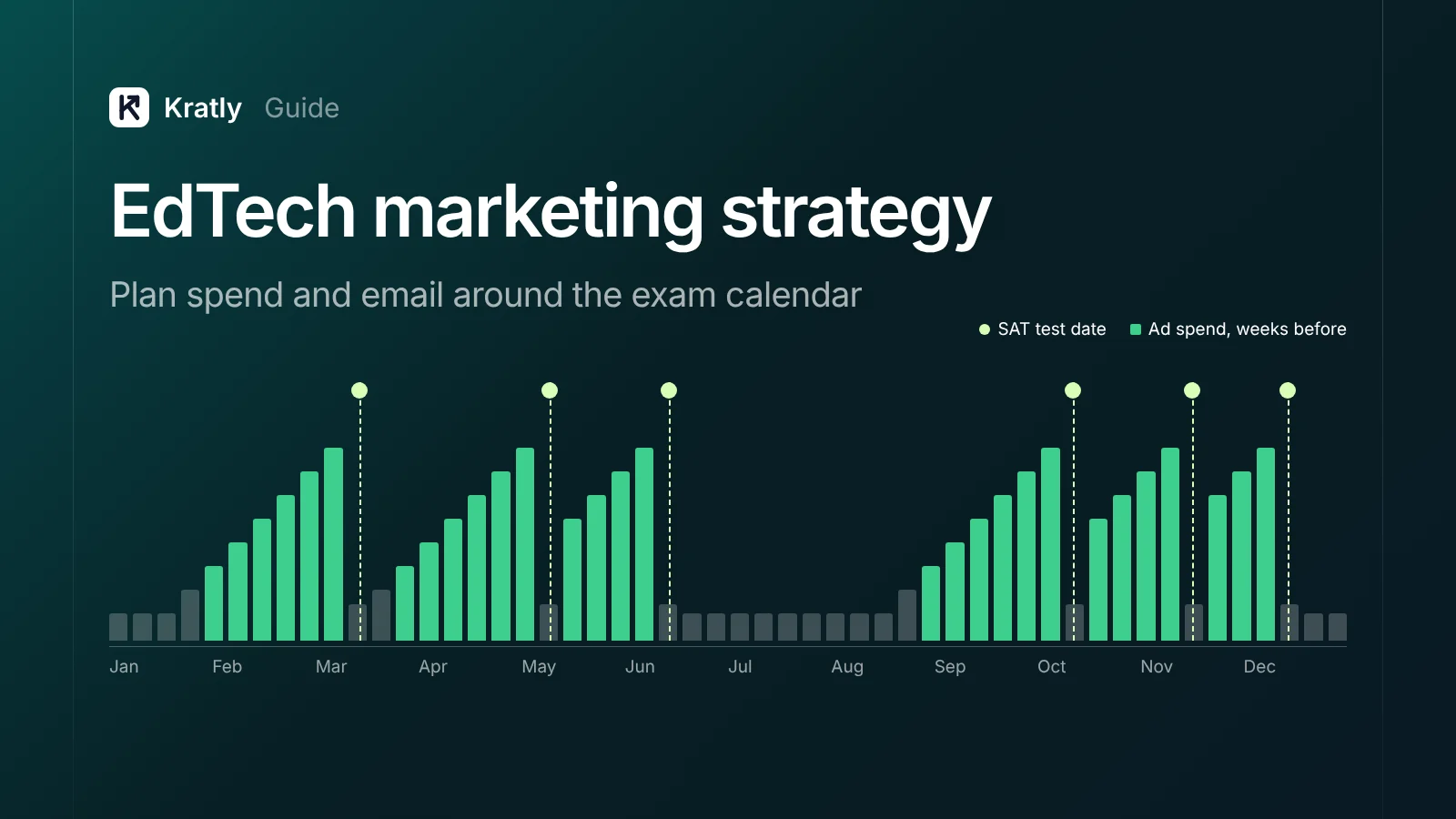
A good edtech marketing strategy follows the exam calendar. Spend and email peak in the weeks before registration deadlines and test dates, not evenly across the year. Free practice tests bring students in. A nurture sequence timed to each student's test date converts them. Judge every channel on paid enrollments per season, not sign-ups.
Magoosh launched its online test prep in fall 2009, while the founders were still in school (Sramana Mitra, part 3). CEO Bhavin Parikh later said, "Content marketing was huge for us in terms of getting the business off the ground" (Sramana Mitra, part 5).
The revenue followed the exam season. The GRE product went "from zero to maybe $20,000 a month over that summer," Parikh said. Then it sat "stuck at $20,000 a month in November, December, and January," before growing again. By September 2012 it was "doing over $100,000 a month" (part 5). It raised only $750,000, across two rounds (part 6).
Free content, patience and timing are the whole playbook. This guide is part of our growth playbooks by business type.
What stage is your edtech business at?#
An edtech marketing strategy is a plan for selling learning products, timed to the exam calendar and judged by paid enrollments.
The revenue bands below are illustrative. Count paid enrollments in Stripe or Shopify, not free accounts.
| Stage | Monthly revenue (illustrative) | What's true | What breaks next |
|---|---|---|---|
| 1. One exam, one product | $0–$20k | One test, one course or app. The founder writes content and answers students. | Revenue swings with the test calendar. Quiet months feel like failure. |
| 2. Seasonal engine | $20k–$100k | Free practice tests and SEO bring steady sign-ups. Paid ads run in peaks. | Budgets stay flat all year. Nobody knows which channel brought paid students. |
| 3. Many exams or buyers | $100k+ | Several exams, or sales to parents and schools as well as students. | Each exam has its own calendar. Refunds, privacy rules and support costs grow. |
What I'd check first: which months brought your last 12 months of paid enrollments? If 60% landed in four months, you're seasonal. Plan like it.
The five moves that matter most#
These are in the order I'd make them. Costs and timings are my estimates, not benchmarks.
1. Build your exam calendar and plan spend around it#
Demand for exam prep rises before registration deadlines and test dates. The calendars are public, so use them.
- SAT: The 2026–27 weekend dates are October 3, November 7 and December 5, then March 6, May 1 and June 5. There is no weekend test in January or February (College Board). Registration closes about two weeks before each date.
- LSAT: US and Canada tests run in September, October, November, January, February, April and June. Registration closes five to six weeks earlier (LSAC).
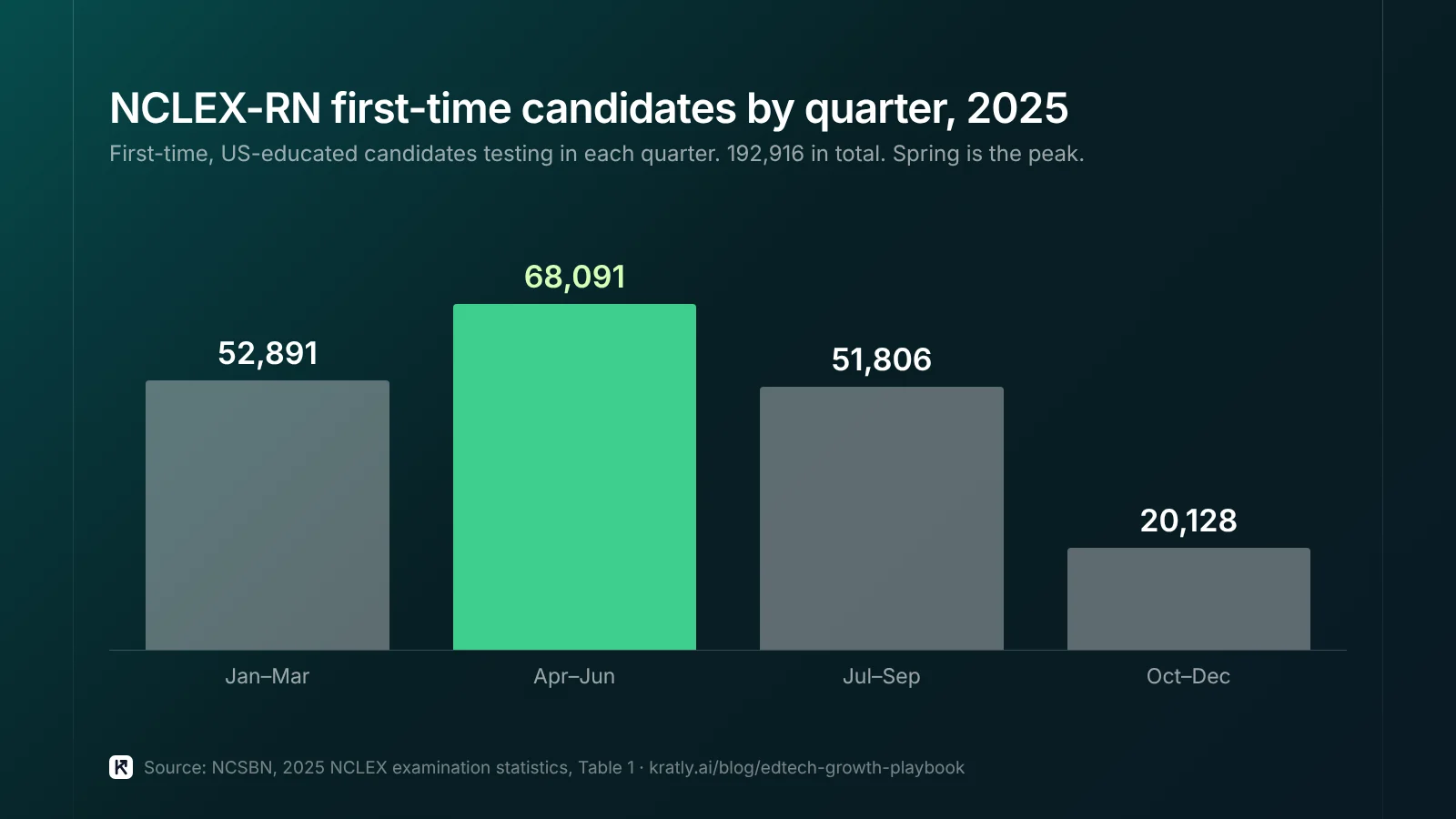
- NCLEX-RN: Testing runs year-round, but candidates follow graduation. In 2025, 68,091 first-time US-educated candidates tested in April to June. Only 20,128 tested in October to December (NCSBN, 2025 exam statistics).
That's more than three times as many in spring as in fall. A flat budget underspends the peak and wastes money in the trough.
Then line up Google Trends for your exam terms with your paid enrollments by week.
- Cost: one day to build the calendar. No extra spend.
- Time to revenue: the next peak. Shifting budget into it usually shows within one season.
2. Give away a real practice test#
Students search for practice before they search for a course. A free full-length test or diagnostic captures them early, with their exam, target score and test date.
You compete with the exam owners here. College Board offers full-length practice in its Bluebook app and Official SAT Prep on Khan Academy (College Board). Your free test must add something: a score breakdown, a study plan, or explanations by a real tutor.
Then build pages for the searches that buy: "[exam] practice test," "[exam] study plan," "[course A] vs [course B]." The method is in SaaS SEO strategy: the bottom-of-funnel pages that bring revenue.
- Cost: two to six weeks to build a good diagnostic. $2k–$10k if you hire question writers.
- Time to revenue: SEO takes three to six months. Paid traffic to the test shows within weeks.
3. Email by test date, not by sign-up date#
A student testing in five weeks needs different emails than one testing in five months. Ask for the test date, then count emails back from it.
A simple sequence:
- Day 0: score report and a study plan.
- Weekly: one lesson and one practice set.
- Seven days before the registration deadline: a reminder.
- Six to eight weeks before the test: the course offer and guarantee.
- Test week: a checklist. No selling.
Course launches use the same logic: see online course creators: launches, evergreen funnels and email that sells. For trial products, see trial follow-up emails. Follow the FTC's CAN-SPAM rules on every send.
- Cost: three to five days to write and set up.
- Time to revenue: the first cohort that reaches its offer window.
4. Sell to the right buyer, and respect the rules for minors#
Your edtech marketing strategy changes with who pays. Adult exam takers (LSAT, NCLEX, GMAT) research and pay for themselves. High school prep is used by the student and often paid for by a parent. Schools buy through budgets and procurement.
Write one page per buyer. Students want a score plan, parents want progress reports, and schools want data protection terms.
Minors bring rules. Google says its teen protections include "disabling ads personalization" for users under 18 (Google Ads policy). So target parents, or use search intent and content, not teen audiences.
If your site or app is aimed at children under 13, the FTC's COPPA Rule applies. The amended rule took effect June 23, 2025, with most compliance due by April 22, 2026 (Federal Register). The changes include a written data retention policy and an information security program (Mayer Brown). Get a lawyer to review your tracking before you add ad pixels.
- Cost: one to two weeks for pages, plus legal review.
- Time to revenue: within a season.
Selling through an app? See the subscription app growth playbook.
5. Make the guarantee clear and price its cost#
Guarantees sell test prep. Kaplan's Higher Score Guarantee, for example, offers a refund or free continued prep if your official score doesn't improve. Students must set a baseline, finish the program's homework and practice tests, and contact Kaplan within 60 days of the program ending (Kaplan).
The FTC guide on guarantees says to use "Money Back Guarantee" only if you refund the full price on request. Ads must disclose "any material limitations or conditions" (16 CFR 239.3).
Write the conditions in plain words, then track refunds by channel. A campaign that sells 100 enrollments and refunds 30 is worse than one that sells 80 and refunds 5.
- Cost: a day to write terms, plus the refunds themselves.
- Time to revenue: a clear guarantee can lift conversion in the next peak. Refund data arrives after the test.
What should you measure in revenue?#
Pull revenue from Stripe or Shopify first. Use ad platforms for spend only.
| Metric | Formula | Where the data comes from | Healthy range (sourced) |
|---|---|---|---|
| Paid enrollments per season | New paying students between two test dates | Stripe or Shopify | None public; compare with the same season last year, never last month |
| Revenue per free test taker | Revenue from takers within 90 days ÷ takers | Stripe + your sign-up data | No public benchmark; track by exam |
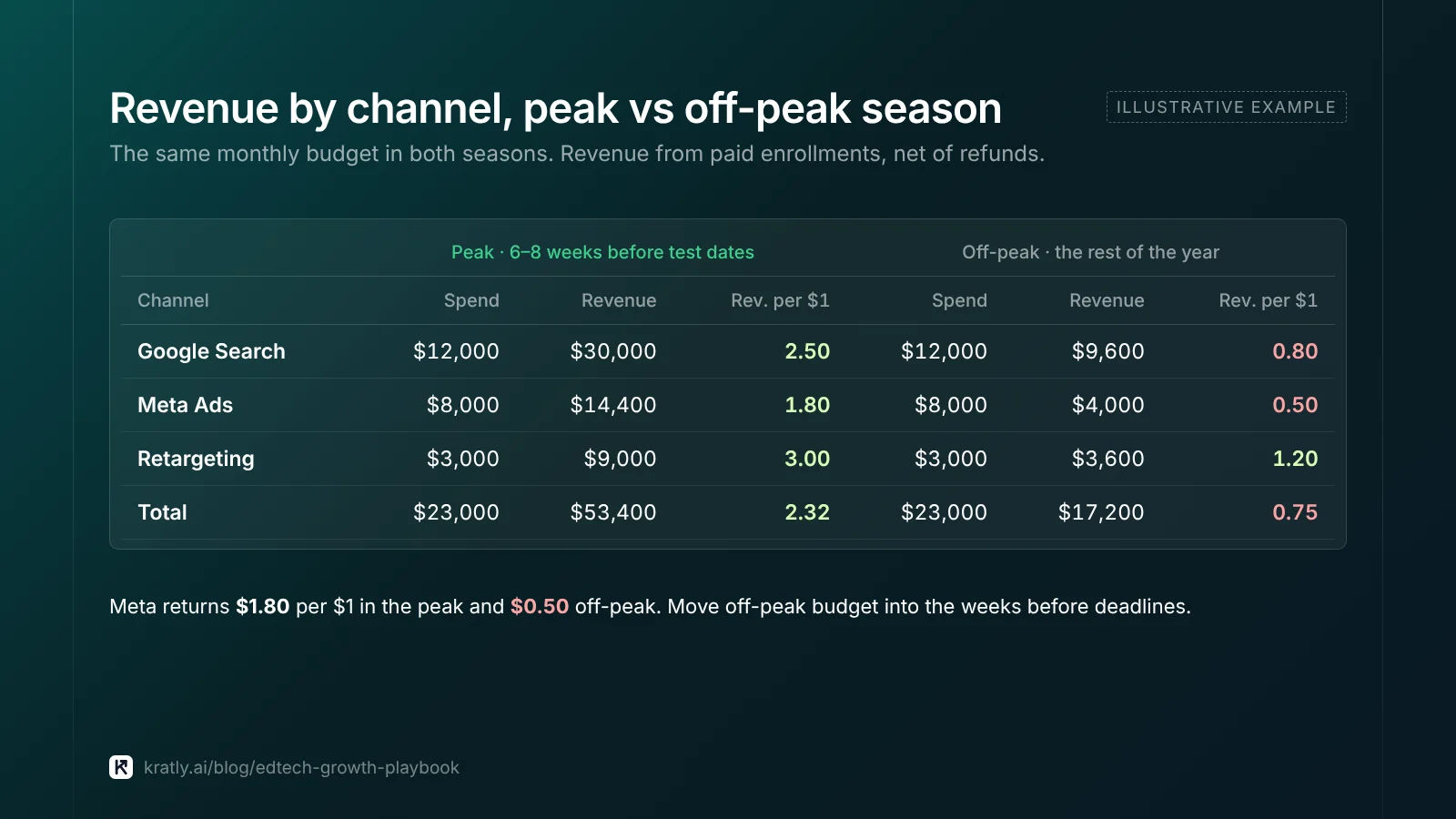
| CAC by channel and season | Channel spend in a season ÷ paid enrollments from it | Ad platforms + Stripe | Compare peak and off-peak |
| Net revenue after refunds | Revenue − refunds, by channel | Stripe or Shopify | No public benchmark; watch the trend |
| Extension or renewal rate | Students who buy more time ÷ students whose access ended | Stripe | No public benchmark |
What to stop doing#
Running the same budget every month#
Flat budgets buy clicks from students who won't buy for months. Move spend into the six to eight weeks before deadlines.
Counting free sign-ups as wins#
A channel can fill your list with students who never pay. Judge it by paid enrollments within your offer window.
Judging ads on a 7-day window#
Students buy weeks after their first visit. A short window makes practice tests look worthless. Judge on 60 to 90 days.
How to do this in Kratly#
- Connect Google Ads, Meta Ads, your website and Stripe or Shopify. Kratly ties each paid enrollment to the campaign, page or email that brought it.
- Compare revenue by season. Set revenue by campaign and page in peak weeks against off-peak weeks.
- Check your practice test pages. Kratly shows which pages bring paying students. The free indexing checker confirms Google can find them.
- Approve budget changes before each peak. Kratly suggests shifts toward channels that bring paid enrollments. You approve each one, and every change is logged and reversible.
Questions, answered
What is the best edtech marketing strategy for exam prep?
Plan around the exam calendar. Put most of your ad budget and offers into the six to eight weeks before deadlines and test dates. Use free practice tests to capture students early, and email them based on their test date. Judge every channel on paid enrollments per season, net of refunds, not on sign-ups or clicks.
When should exam prep companies spend the most on ads?
Before registration deadlines and test dates. For the SAT, the 2026–27 weekend tests fall in October to December and March to June. For the NCLEX, 2025 data from NCSBN shows first-time candidates peaked in April to June. Check Google Trends for your exam terms and your own sales by week to find your peaks.
Do free practice tests bring paying students?
Yes, if you ask for the test date and follow up. A free test captures students when they start studying, often months before they buy. Magoosh's CEO said content conversions lag because students need to build a relationship first. Measure revenue per test taker over 90 days, not sign-ups in the first week.
Can I target high school students with Google Ads?
Not with personalized ads. Google disables ad personalization for users it identifies as under 18. You can still show ads on search queries, which don't depend on audience targeting. You can also target parents. If your product is aimed at children under 13, review COPPA with a lawyer first.
Should test prep offer a money-back guarantee?
It can help sales, but price it first. Model how many students might claim it and what that costs per enrollment. The FTC says a "Money Back Guarantee" should mean a full refund on request, with any conditions disclosed clearly. Kaplan's guarantee, for example, requires a baseline score and completed coursework.
Written by
Priyansh Kumar
Priyansh Kumar has spent more than a decade in growth, scaling brands from 1 to 10 and from 10 to 100. He now builds Kratly, an autonomous growth team that ties every campaign, page and email to the revenue it brings.
Sources
- College Board: SAT Suite test dates and deadlines, 2026–27 · Digital SAT practice
- LSAC: Upcoming LSAT dates
- NCSBN: 2025 NCLEX examination statistics (PDF)
- Federal Register: Children's Online Privacy Protection Rule, final rule (Apr 22, 2025)
- Mayer Brown: FTC announces significant amendments to COPPA (Apr 2025)
- Google Ads policy: Ad protections for children and teens
- eCFR: 16 CFR Part 239, Guides for the Advertising of Warranties and Guarantees
- FTC: CAN-SPAM Act compliance guide
- Kaplan: Higher Score Guarantee
- Sramana Mitra interview with Bhavin Parikh, Magoosh (2015): Part 3 · Part 5 · Part 6
Was this article useful?