Short answer
A SaaS go-to-market in the USA from India works when US buyers see USD prices, pay by card easily and find you where they search. Start with export-ready payments and USD pricing without PPP discounts. Then add Google and Microsoft search ads, bottom-of-funnel content and US-hours support. Judge each step on Stripe revenue.
Freshworks started in 2010 in "a 700 square foot warehouse in Chennai," per its IPO filing (S-1, 2021). Its main sales motion was inbound. Buyers found it through search and word of mouth, then started a 21-day free trial. The filing says its pricing was "transparent, easy to understand, and easily found on our website."
This playbook is part of our growth playbooks by business type.
This article is general information, not legal, tax or financial advice. Rules change. Check your setup with a chartered accountant in India and a US tax adviser.
Where is your SaaS go-to-market in the USA from India today?#
A SaaS go-to-market in the USA from India is how an India-based team prices, bills, finds and supports US customers.
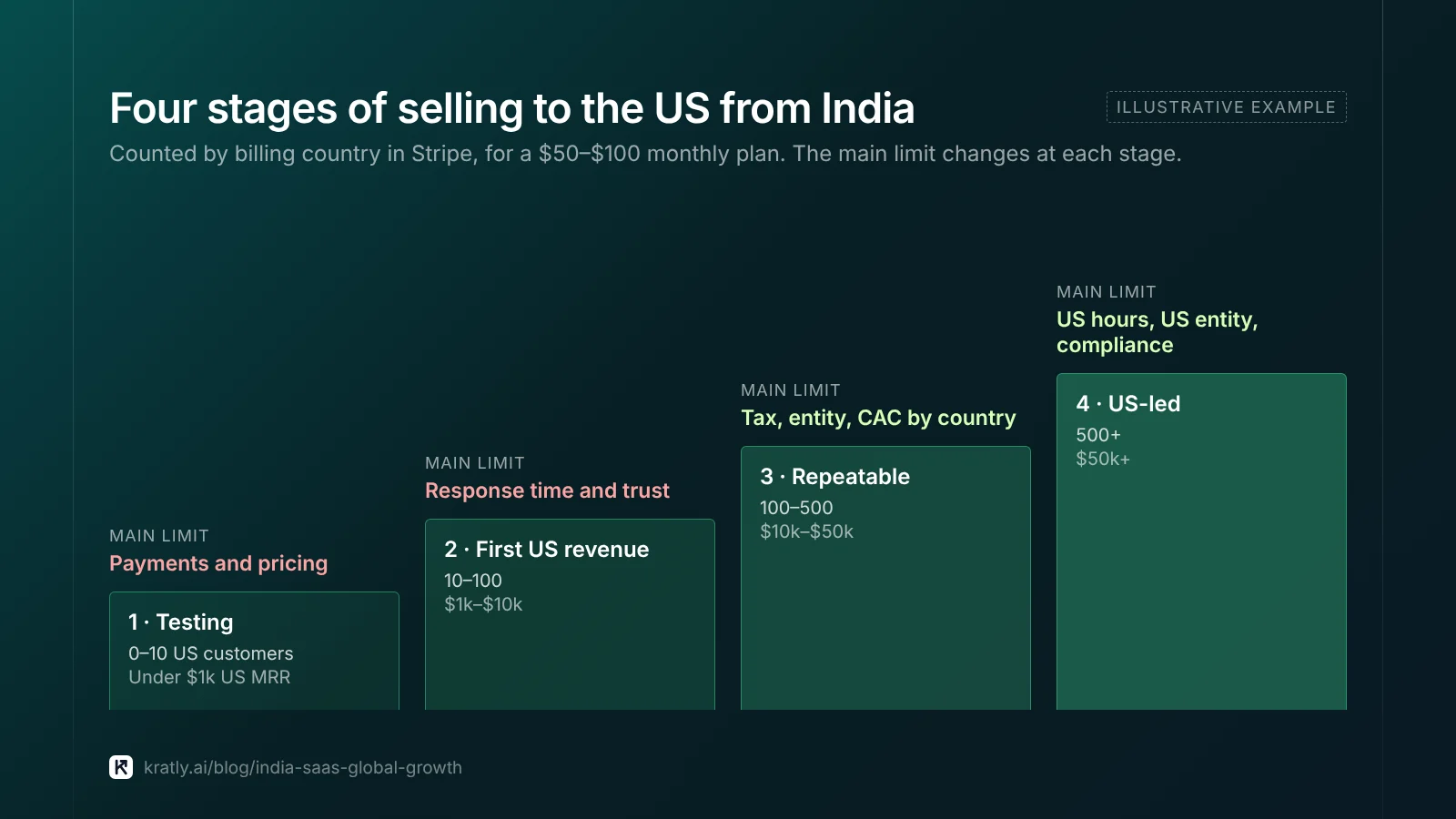
Count US customers by billing country in Stripe. The MRR bands are illustrative, for a $50–$100 monthly plan.
| Stage | US paying customers (US MRR) | What's true | What breaks next |
|---|---|---|---|
| 1. Testing | 0–10 (under $1k) | Sign-ups come from everywhere. US buyers hit INR prices or a failed card. | Payments and pricing, before any channel. |
| 2. First US revenue | 10–100 ($1k–$10k) | One channel brings a few US customers a month. Support replies arrive overnight. | Response time and trust. US buyers ask for security answers. |
| 3. Repeatable | 100–500 ($10k–$50k) | Paid search and content both bring US revenue. Sales tax and entity questions get real. | Tax, entity setup and CAC by country. |
| 4. US-led | 500+ ($50k+) | The US is your biggest market. Larger buyers want SOC 2 and a US contract. | Team in US hours, a US entity, compliance work. |
For the general path, see the B2B SaaS growth strategy by stage.
The five moves that matter most#
These are in the order I'd make them. Costs and timelines are my estimates, not benchmarks.
1. Make your checkout work for US cards#
Fix the payment step before you buy a single click. Your main options:
- Stripe through an Indian entity. Stripe's docs say it "is available by invite only in India." New Indian businesses must request an invite instead of signing up. The account must belong to a registered business, not an individual.
- Export settings. You opt in to exports and pick one RBI purpose code that fits your product. Your accountant should choose it. Each export payment needs the customer's name, billing address and a description. Stripe pays out in INR (Stripe Docs).
- A US entity with its own payment account. This avoids the Indian export flow for US sales but adds a company to run. See move 3.
- A merchant of record. It sells to the buyer for you and handles tax, for a higher fee.
Keep export paperwork tidy. Your bank's e-FIRA proves export payments arrived and supports GST refund claims, per Razorpay (a payments vendor, 2025).
- Cost: one to three weeks of setup, plus a chartered accountant's time.
- Time to revenue: immediate. Every failed checkout is a lost US customer.
2. Price in USD, and don't discount for India's costs#
US buyers compare you with US tools, not with your costs. Show USD prices to US visitors. Don't apply purchasing power parity (PPP) discounts to them.
Pricing low because your costs are low leaves money on the table in your best market. It can also signal "cheap." I'd price near the US tools you replace.
Keep a separate INR plan for Indian buyers. Show the price, too. In a TrustRadius survey, 81% of tech buyers said they want to find pricing on their own (TrustRadius, 2022). The tests are in SaaS pricing page best practices: 12 tests judged on revenue.
- Cost: a few days of pricing and page work.
- Time to revenue: one or two billing cycles to read the change.
3. Choose your US entity and learn sales tax basics#
You can sell to US buyers without a US company. Many teams add one to raise US venture capital.
Stripe Atlas forms a Delaware C corporation or a Delaware LLC. Stripe says institutional investors prefer C corps and may be unable to invest in LLCs. For LLCs with a non-US founder, tax filings "can become complex."
Indian resident founders have extra steps under RBI's overseas investment rules. Stripe's guide for Indian founders describes forming an Indian LLP that owns the US C corp, reported through your bank.
Sales tax is the other half. Since the 2018 South Dakota v. Wayfair ruling, states can require out-of-state sellers to collect tax. In most states the threshold is "$100,000 in sales or 200 transactions over 12 months," per Stripe's sales tax guide. SaaS rules vary. The same guide says SaaS is fully taxable in Connecticut but not taxable in California.
- Cost: setup, yearly filings and adviser fees.
- Time to revenue: none directly. It removes blockers for investors and larger buyers.
4. Win US search: ads first, content alongside#
- Google Ads, US only. Target the US, schedule ads for US working hours and start with high-intent keywords. Read the nine places Google Ads budgets leak before you scale.
- Microsoft Ads. In September 2026, Bing held 18.8% of US desktop search (StatCounter). It also offers LinkedIn profile targeting. See Bing Ads vs Google Ads for B2B.
- Bottom-of-funnel content. Comparison and alternatives pages with US examples and USD prices. See SaaS SEO strategy: bottom-of-funnel pages.
Judge each channel on paying US customers in Stripe.
- Cost: $3k–$5k a month per paid channel during a test, or 20–40 hours a month for content.
- Time to revenue: two to six weeks for paid search. Three months or more for content.
5. Look local: US hours and trust signals#
A US buyer who hears back next morning may already be on a rival's trial. Cover part of the US day, then add trust signals:
A security page, then a SOC 2 report when larger buyers ask. SOC 2 is an AICPA examination of controls for security, availability, processing integrity, confidentiality or privacy.
US customer logos and case studies, with permission.
Cost: a US-hours shift, and months of work plus a CPA firm's fee for SOC 2.
Time to revenue: weeks for support hours. SOC 2 mostly helps mid-market deals.
What should you measure in revenue?#
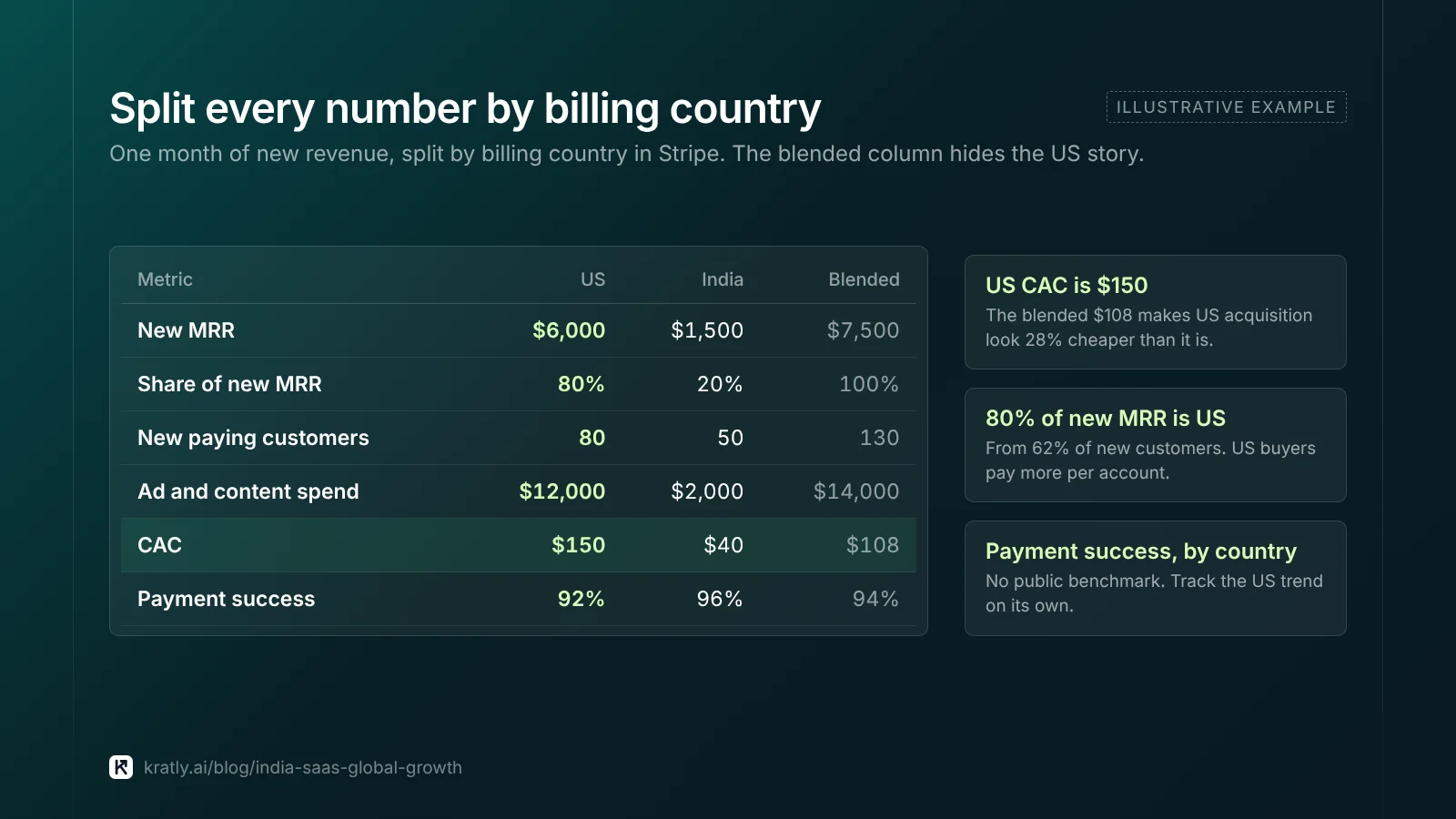
Split every number by billing country in Stripe.
| Metric | Formula | Where the data comes from | Healthy range (sourced) |
|---|---|---|---|
| US share of new MRR | US new MRR ÷ all new MRR | Stripe (billing country) | No benchmark. Freshworks' North America share was 42% in early 2022 (transcript) |
| US CAC | US ad and content spend ÷ new US paying customers | Ad platforms + Stripe | Compare channels with each other |
| US CAC payback | US CAC ÷ (new US MRR per customer × gross margin) | Stripe + finance | Under 12 months for SMB SaaS (Bessemer) |
| International payment success | Successful charges ÷ attempted charges on foreign cards | Stripe | No public benchmark; track the trend |
| US net revenue retention | (Start MRR + expansion − contraction − churn) ÷ start MRR, 12 months | Stripe | Median 101% for private B2B SaaS in 2025 (SaaS Capital) |
SaaS Capital excludes companies under $1M ARR. For the CAC method, see how to calculate CAC by channel.
What to stop doing#
Showing PPP or INR prices to US visitors#
Every US customer on a discount lowers revenue for the life of the account.
Hiding the price behind "contact sales"#
For a $50–$500 monthly plan, a sales call adds a day of time-zone delay. Buyers leave for a rival that shows a price.
Running US campaigns on an IST schedule#
Ads that run through the US night spend while buyers sleep. Schedule by US time.
Judging US campaigns on sign-ups#
Broad campaigns bring sign-ups from many countries and few US payers. If one brings no US Stripe revenue, follow when to pause a Google Ads campaign.
How to do this in Kratly#
- Connect Google Ads, Meta Ads, your website and Stripe. Kratly ties each paying customer to the campaign, page or email that brought them. Microsoft Ads connects too, through a short script you paste into your Microsoft Advertising account.
- See revenue by campaign and page. Compare cost per paying customer across your US campaigns.
- Review the suggestions. Kratly flags spend that brings no paying customers.
- Approve what you agree with. Kratly makes the change. Every change is logged and reversible.
Questions, answered
Can an Indian company sign up for Stripe to sell SaaS in the US?
Not through the website. Stripe says it is invite only in India, so new Indian businesses must request an invite. Accounts must be registered businesses, opt in to exports and pick an RBI purpose code. Payouts arrive in INR. Many founders also weigh a US entity or a merchant of record instead.
Should I price my SaaS in USD or INR?
Price in USD for US buyers and keep INR for Indian buyers. Don't apply purchasing power discounts to US visitors. They compare you with US tools, and a low price can read as low quality. Show the price on the page, too.
Do I need a US company to sell SaaS to American customers?
No, you can sell from an Indian entity. Many founders add a Delaware C corp to raise US venture capital. Indian resident founders have extra RBI overseas investment steps, such as forming an Indian LLP first. Check the setup with a chartered accountant and a US adviser.
Does an Indian SaaS company have to collect US sales tax?
It can. Since the 2018 Wayfair ruling, states can require out-of-state sellers to collect tax once sales pass a threshold. Stripe's guide says most states use $100,000 in sales or 200 transactions in 12 months. Whether SaaS is taxable varies by state. Get advice from a US sales tax professional for your case.
Which marketing channels work best for selling SaaS in the US from India?
Start with high-intent search. Run Google Ads in the US during US working hours, then test Microsoft Ads for desktop B2B buyers. Build comparison and alternatives pages alongside. Judge each channel on US paying customers in Stripe, not sign-ups.
Written by
Priyansh Kumar
Priyansh Kumar has spent more than a decade in growth, scaling brands from 1 to 10 and from 10 to 100. He now builds Kratly, an autonomous growth team that ties every campaign, page and email to the revenue it brings.
Sources
- Freshworks: Form S-1 (SEC, 2021) · Needham Growth Conference transcript, CFO Tyler Sloat (Jan 13, 2022)
- Stripe Docs: Accept international payments from India · Atlas company types · Atlas guide for Indian resident founders
- Stripe Support: Accepting international payments from Stripe accounts in India
- Stripe: Introduction to US sales tax and economic nexus
- AICPA & CIMA: SOC 2 reporting guide
- Razorpay (payments vendor): What is e-FIRA (Sept 2025)
- TrustRadius: Tech buyers demand honest and up-front pricing info (2022)
- StatCounter: US desktop search engine share
- Bessemer Venture Partners: Scaling to $100M
- SaaS Capital: 2025 B2B SaaS Retention Benchmarks (PDF)
Was this article useful?