Short answer
To scale SaaS to $10M ARR, change how growth works, not just how much you spend. Add a second and third channel one at a time. Hand selling and marketing from the founder to a small team. Build expansion revenue into pricing. Judge every channel on CAC payback from billing data, and review it weekly.
Then the growth engine changed. At about $20,000 a month, ConvertKit added an affiliate program paying 30% recurring commission. It ran webinars with those partners. By early 2017, ARR had "just crossed $7M," with a team of 25. Affiliates brought in just over 10% of revenue, per the same interview.
The work that got you to $1M won't get you to $10M. This playbook, part of our growth playbooks by business type, picks up where the B2B SaaS playbook for the first $1M ARR ends.
What stage are you at between $1M and $10M ARR?#
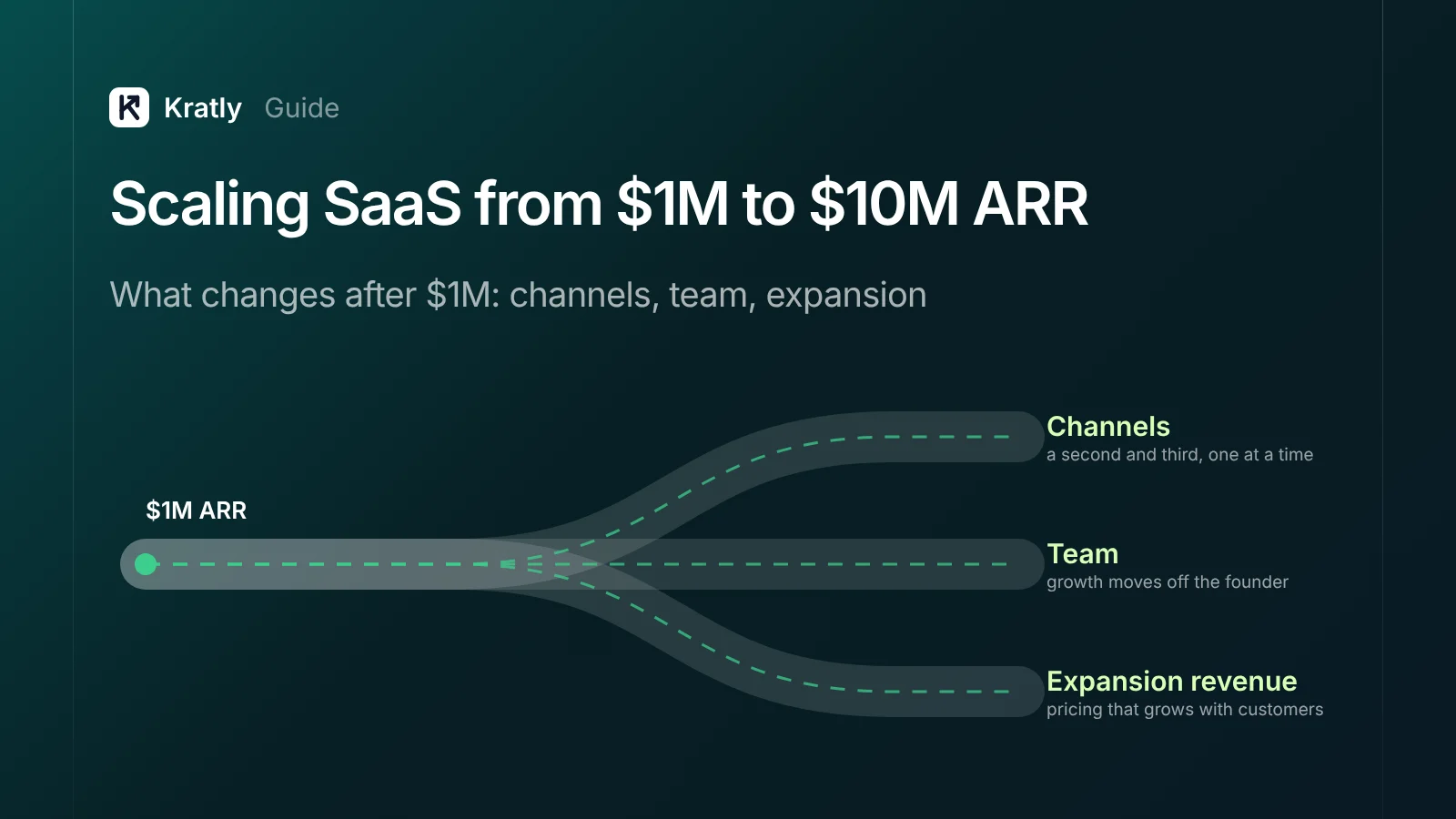
Scaling from $1M to $10M ARR is the stage where growth stops depending on the founder and starts depending on systems: several channels, a team and expansion revenue.
ChartMogul found the median SaaS startup takes "a little more than 5 years" to reach $10M ARR. Only 13% get there even after 10 years (ChartMogul, Aug 2023).
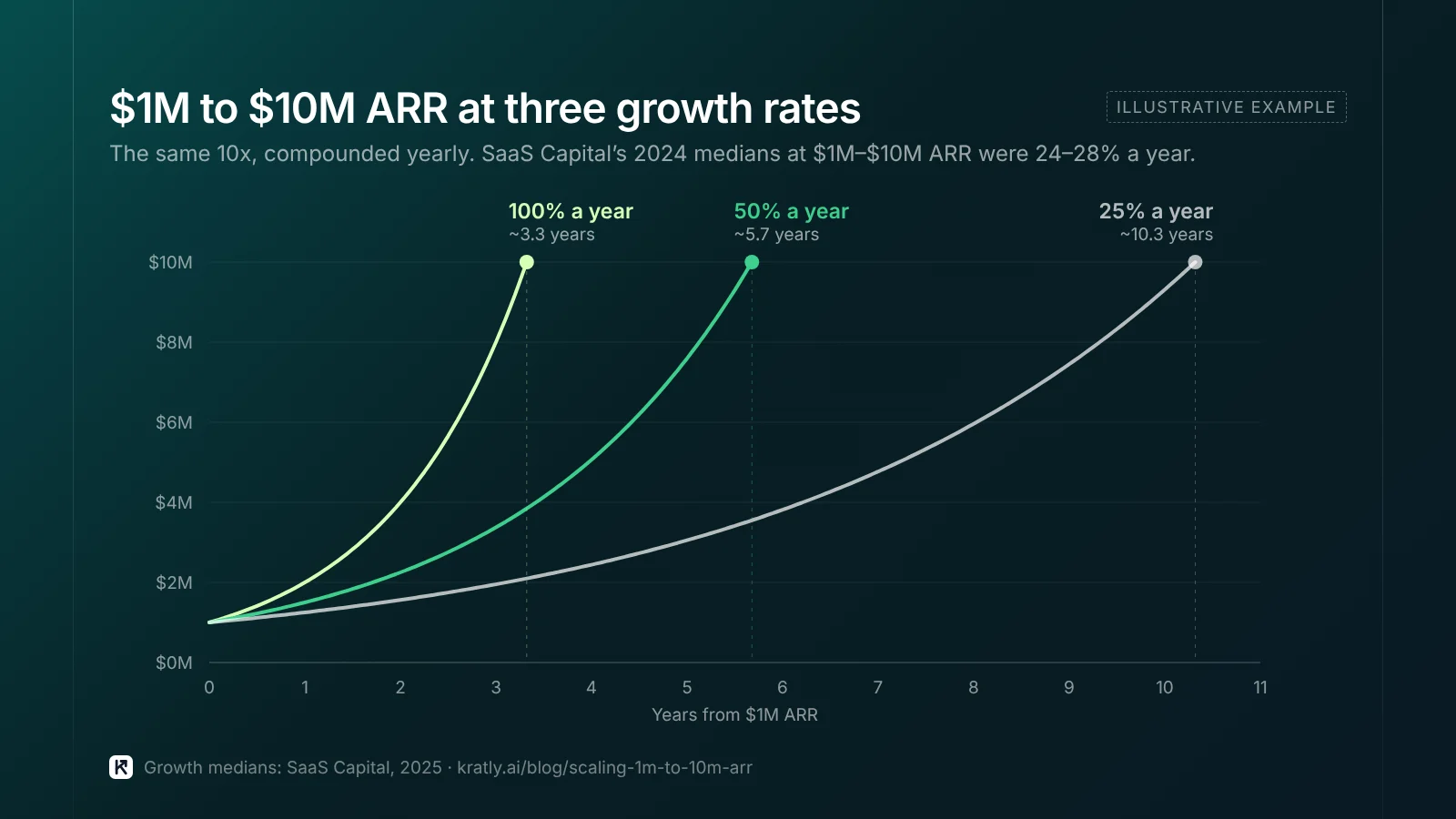
Growth figures below are 2024 medians from SaaS Capital's survey of 1,000+ private B2B SaaS companies (SaaS Capital, 2025).
| ARR band | Median growth (top quartile) | What's true | What breaks next |
|---|---|---|---|
| $1M–$3M | 28% (50%) | One channel works. The founder still closes big deals and writes the key pages. | Founder time. The one channel starts to cost more per customer. |
| $3M–$5M | 24% (40%) | A first team owns sales and marketing. A second channel is in testing. | Nobody can say which channel brought which revenue. |
| $5M–$10M | 24% (42%) | Several channels, managers, and more revenue from existing customers. | Churn and blended numbers hide weak channels. Hiring outruns payback. |
At 25% a year, $1M to $10M takes about ten years. At 100%, a little over three.
The five moves that scale SaaS to $10M ARR#
In the order I'd make them. Costs and timelines are my estimates.
1. Add channels one at a time, judged on payback#
Your first channel will flatten as CAC creeps up. Bessemer notes that early adopters are the cheapest customers to win (Bessemer, Sept 2021).
Add a second channel before the first stalls. Give it 8–12 weeks and a fixed budget.
- Cost: $5k–$15k a month in test budget, or one person's time for content or partner channels.
- Time to revenue: four to twelve weeks for paid channels; six months or more for SEO and partners.
2. Move growth from the founder to a team#
In Battery Ventures' T2D3 model, Neeraj Agrawal describes this jump. Founders close all deals until about $2M ARR. Then they hire a sales leader plus "five to 10 reps," and expect half of them to be productive (TechCrunch, Feb 2015).
Marketing needs the same handoff: someone else owns the channel budget and weekly numbers. Write down what the founder does before you hire.
Agency, in-house hire or AI growth agent? See who to hire at each stage of a growth team.
- Cost: a senior salary or a monthly retainer, plus two to three months of ramp time.
- Time to revenue: one to two quarters before a new owner adds net new revenue.
3. Build expansion revenue into pricing and packaging#
Past $1M, existing customers matter as much as new sales. SaaS Capital calls the link between net revenue retention and growth "exponential." Moving from 90–100% NRR to 100–110% NRR lifted median growth by 5 points. The highest-NRR companies grew 83% faster than the median (SaaS Capital, 2025).
Expansion needs a pricing axis that grows with the customer: seats, usage, contacts or add-ons. ConvertKit priced by subscriber count, from $29 to $599 a month. So customers paid more as their lists grew (Indie Hackers).
Test pricing changes on new customers first, using SaaS pricing page tests judged on revenue.
- Cost: two to four weeks of product and billing work per change.
- Time to revenue: expansion shows up over 6–12 months as accounts grow.
4. Make attribution and experiments a weekly habit#
Run a 30-minute weekly growth review on new revenue, expansion and cost per paying customer by channel.
Tie every sign-up to its source in billing with SaaS marketing attribution tied to real revenue. Test big changes with a holdout, not a before-and-after chart. The method is in how to run a marketing incrementality test.
- Cost: one to two weeks of setup, then 30 minutes a week.
- Time to revenue: the first budget shift usually pays within a month.
5. Watch efficiency, but don't run on the Rule of 40 yet#
The Rule of 40 is the idea that a SaaS company's growth rate plus profit margin should add up to at least 40%. Brad Feld popularized it in 2015. He wrote that it applies to "SaaS companies at scale – assume at least $50 million in revenue" (Feld Thoughts, Feb 2015).
At $1M–$10M, watch CAC payback by channel instead. Bessemer's portfolio averaged 15 months of payback in the $1–10M ARR band (Bessemer). See CAC payback benchmarks and five ways to shorten it.
- Cost: a few hours a month of finance work.
- Time to revenue: none directly; it stops you scaling a losing channel.
What should you measure in revenue?#
Pull revenue from Stripe or your billing system. Use ad platforms and the CRM only for spend and pipeline.
| Metric | Formula | Where the data comes from | Healthy range (sourced) |
|---|---|---|---|
| ARR growth | (ARR now ÷ ARR 12 months ago) − 1 | Stripe or billing | Median 24–28% at $1–10M in 2024 (SaaS Capital) |
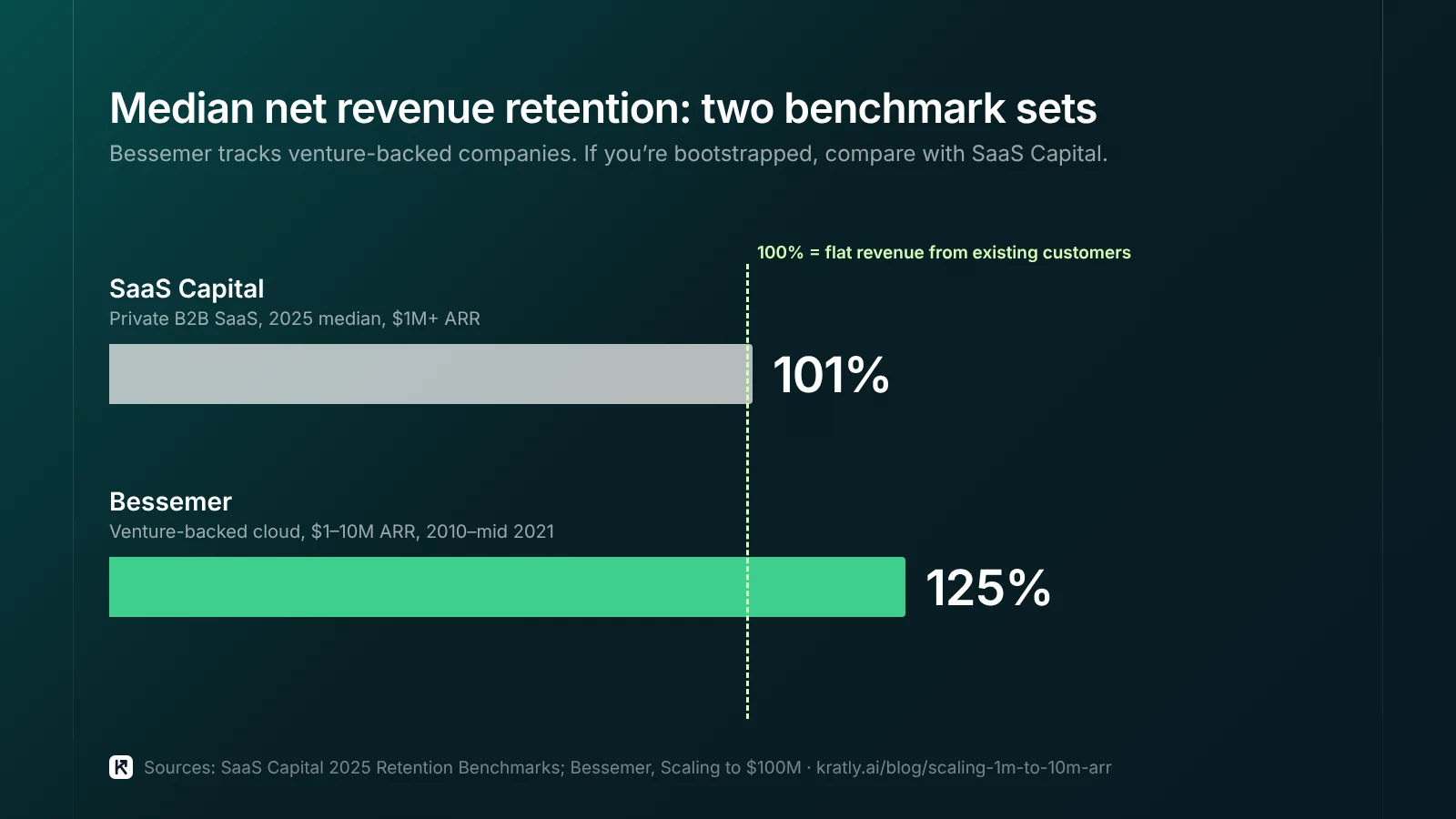
| Net revenue retention | (Starting ARR + expansion − contraction − churn) ÷ starting ARR, 12 months | Stripe | Median 101% in 2025 (SaaS Capital); median 125% in Bessemer's $1–10M portfolio (Bessemer) |
| Gross revenue retention | (Starting ARR − contraction − churn) ÷ starting ARR | Stripe | Median 91% in 2025 (SaaS Capital) |
| CAC payback by channel | Channel CAC ÷ (new MRR per customer × gross margin) | Ad platforms + Stripe | Under 12 months SMB, under 18 mid-market (Bessemer) |
| Rule of 40 | Growth % + profit margin % | Stripe + accounting | 40%+ at $50M+ revenue (Feld) |
Bessemer's NRR comes from venture-backed cloud companies, 2010 to mid-2021. SaaS Capital surveys a broader set of private companies. If you're bootstrapped, compare yourself with SaaS Capital.
What to stop doing#
Planning around T2D3 because a deck said so#
T2D3 means tripling twice, then doubling three times, from about $2M ARR. Agrawal wrote it for venture-backed companies with founders closing $30K–$80K deals (TechCrunch). The median private company grew 25% in 2024 (SaaS Capital). Hiring for 3x growth on a 25% engine burns a year of cash.
Reporting only blended CAC#
Blended CAC mixes your best channel with your worst, plus revenue from existing customers. In the KeyBanc 2021 survey, blended payback was 18 months. Payback on new customers alone was 26 (KeyBanc 2021 SaaS Survey). Fund on blended numbers and a losing channel hides for quarters.
Keeping the founder as the bottleneck#
If every pricing call and campaign waits for the founder, the team moves at the founder's pace. New hires sit idle, on salary, waiting for decisions.
Chasing new logos while churn leaks#
With gross retention at 91%, you lose about 9% of revenue each year before you sell anything. Fix failed payments and cancellation reasons before you raise spend.
How to do this in Kratly#
- Connect Stripe, your website and your ad accounts. Google Ads and Meta Ads connect today. LinkedIn Ads is coming soon. Until then, tag LinkedIn traffic with UTMs and upload its spend as a CSV.
- See revenue and cost per paying customer by channel. Kratly ties each paying customer to the campaign, page or email that brought them. That splits blended CAC into channel numbers.
- Approve the changes you agree with. Kratly suggests budget shifts and page fixes. You approve them, and every change is logged and reversible.
Questions, answered
How long does it take to scale SaaS to $10M ARR?
ChartMogul's 2023 report says the median startup takes a little more than 5 years to reach $10M ARR. Best-in-class companies took 2 years and 9 months. Only 13% reached $10M even after 10 years. At 25% annual growth, going from $1M to $10M takes about ten years, so growth rate matters more than start date.
What is T2D3 in SaaS?
T2D3 stands for "triple, triple, double, double, double." Neeraj Agrawal of Battery Ventures described it in 2015. After reaching about $2M ARR, a company triples revenue for two years, then doubles for three. That path ends near $144M. It's a model for venture-backed companies, not a typical outcome.
What is the Rule of 40?
The Rule of 40 says growth rate plus profit margin should add up to at least 40%. Brad Feld popularized it in 2015. He preferred EBITDA as the profit measure and said it applies to companies with at least $50 million in revenue. Below that, CAC payback and net revenue retention are more useful guides.
What is a good growth rate between $1M and $10M ARR?
It depends on how you're funded. SaaS Capital's 2025 survey of private B2B SaaS found median 2024 growth of 28% at $1–3M ARR and 24% at $3–10M. Bessemer's venture-backed portfolio grew a median 165% in the $1–10M band. Compare yourself with companies funded like yours.
When should a SaaS company add a second marketing channel?
Add one before your first channel stalls, usually when its CAC payback starts creeping up. Test the second channel for 8–12 weeks with a fixed budget. Judge it on paying customers in Stripe, not leads. Add a third channel only once the second clears your payback target.
Written by
Priyansh Kumar
Priyansh Kumar has spent more than a decade in growth, scaling brands from 1 to 10 and from 10 to 100. He now builds Kratly, an autonomous growth team that ties every campaign, page and email to the revenue it brings.
Sources
- Indie Hackers (Nathan Barry with Courtland Allen): The story of ConvertKit from $0 to $597,000 in monthly revenue (March 2017)
- TechCrunch (Neeraj Agrawal, Battery Ventures): The SaaS Adventure (Feb 1, 2015)
- Bessemer Venture Partners: Scaling to $100 Million (Sept 2021)
- Feld Thoughts (Brad Feld): The Rule of 40% For a Healthy SaaS Company (Feb 3, 2015)
- SaaS Capital: 2025 Benchmarking Private SaaS Company Growth Rates (PDF) · 2025 B2B SaaS Retention Benchmarks (PDF)
- ChartMogul: SaaS Growth Report (Aug 2023, 2,200+ SaaS businesses)
- KeyBanc Capital Markets: 2021 SaaS Survey (PDF)
Was this article useful?