Short answer
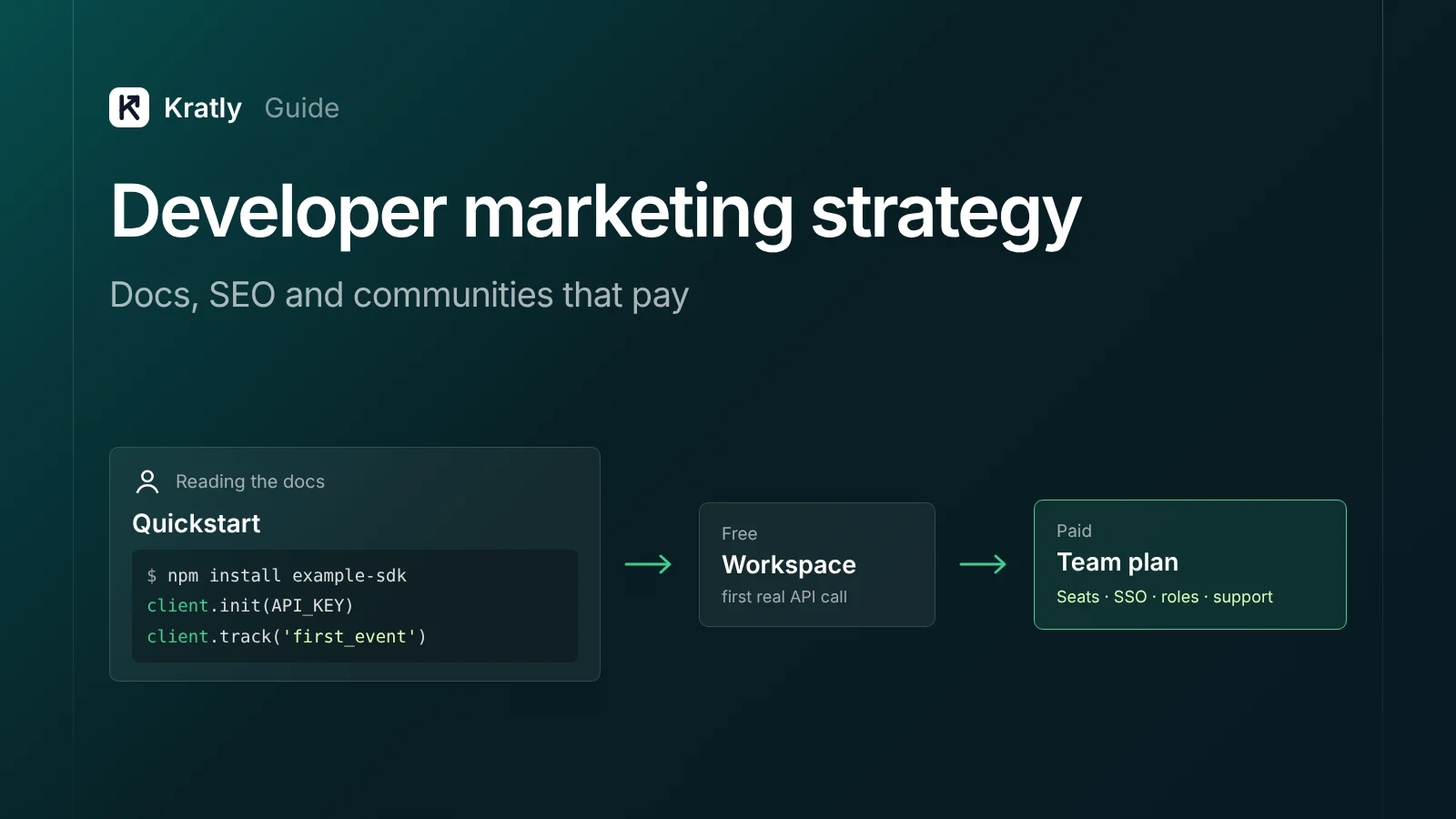
A good developer marketing strategy puts docs, tutorials and honest developer SEO first, then shows up in communities by their rules. Developers try the tool free. Revenue comes when a team adopts it and needs seats, security or support. Measure signups to active workspace to paid team, not GitHub stars.
PostHog launched its first version on Hacker News in February 2020, four weeks after it started writing code. Two weeks later it had passed 1,500 GitHub stars (PostHog handbook). Stars didn't pay the bills. The same timeline shows revenue growing 6x in 2022, then a free tier and new pricing in February 2023.
Its order of work is a useful developer marketing strategy for most devtools. This playbook is part of our growth playbooks by business type.
What stage is your developer tool at?#
A developer marketing strategy is the plan for how developers find, try and adopt your tool, and how that use turns into paying teams.
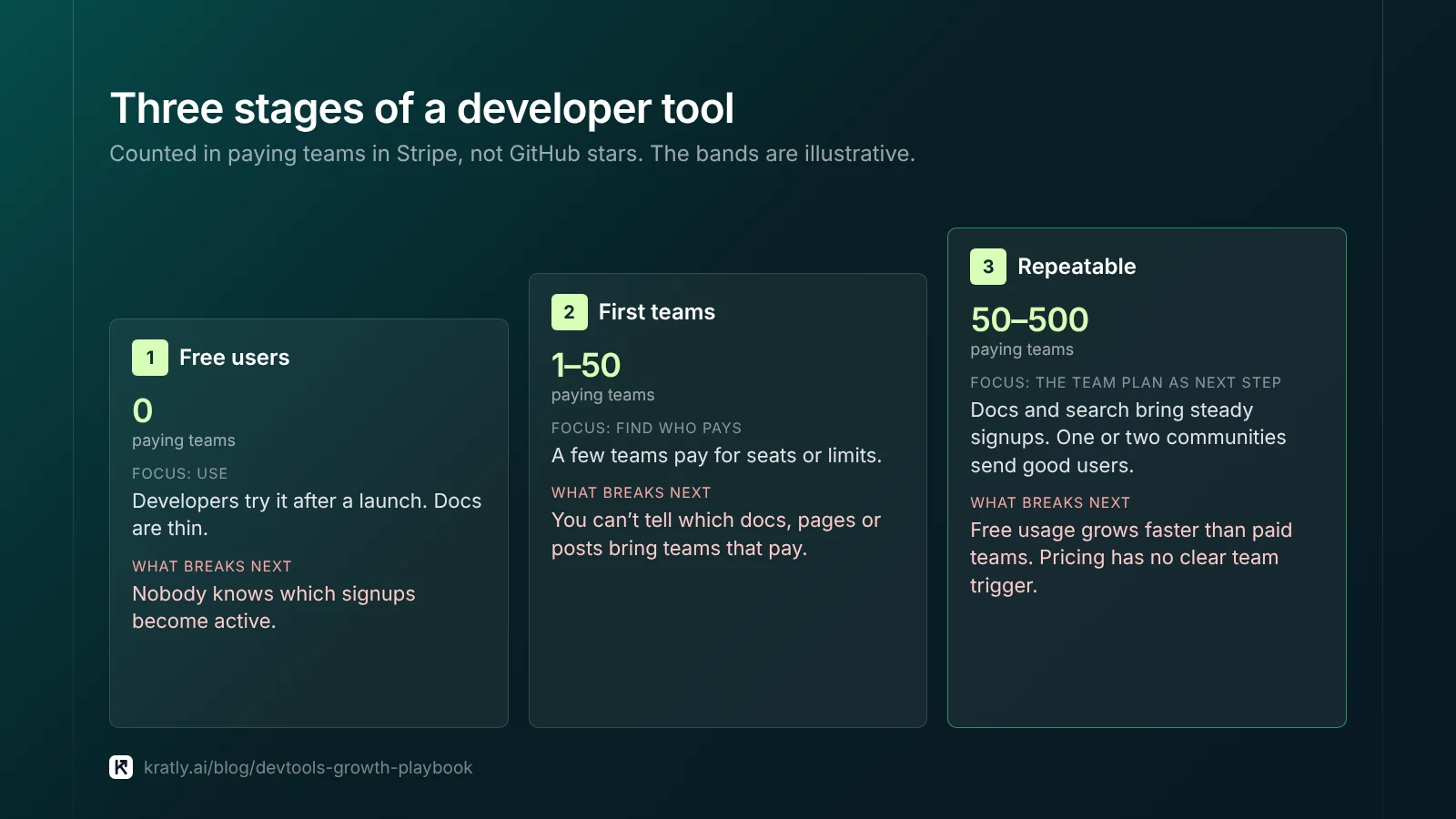
Count paying teams in Stripe, not stars. The bands are illustrative.
| Stage | Paying teams | What's true | What breaks next |
|---|---|---|---|
| 1. Free users | 0 | Developers try it after a launch. Docs are thin. | Nobody knows which signups become active. |
| 2. First teams | 1–50 | A few teams pay for seats or limits. | You can't tell which docs, pages or posts bring teams that pay. |
| 3. Repeatable | 50–500 | Docs and search bring steady signups. One or two communities send good users. | Free usage grows faster than paid teams. Pricing has no clear team trigger. |
In Stack Overflow's 2025 survey, 52.6% said they had not influenced or endorsed any tool at work. Only 19.8% had influenced the purchase of a substantial addition to the stack (Stack Overflow Developer Survey 2025). The developer opens the door; a manager often signs.
The five moves that matter most#
These are in the order I'd make them. The costs and timelines are my estimates, not benchmarks.
1. Treat your docs as your main marketing page#
Developers learn from docs before anything else. In Stack Overflow's 2025 survey, 67.8% of respondents used technical documentation to learn in the past year. Stack Overflow came second at 51.4% (Stack Overflow Developer Survey 2025).
The same survey asked what developers value when they endorse a tool. An easy-to-use API ranked first, and a complete API second (Stack Overflow Developer Survey 2025). Your docs are where they judge both.
What I'd fix first: a ten-minute quickstart, code that runs when pasted, and public pricing.
- Cost: one engineer or technical writer for 20–40 hours a month.
- Time to revenue: weeks, because better docs lift activation for traffic you already have.
2. Write developer SEO pages for the jobs developers search#
Developers search for tasks, like "add feature flags in Next.js." Build tutorials, integration guides and honest comparisons for those tasks. The page types and the revenue math are in SaaS SEO strategy: the bottom-of-funnel pages that bring revenue.
Quality beats volume here. PostHog's Charles Cook put it bluntly: "1 great article >>> 25 mediocre ones" (PostHog, Feb 2023). PostHog's Ian Vanagas wrote that SEO took them five to six months to show progress (PostHog newsletter, July 2025).
AI assistants now sit in the middle. GitHub says nearly 80% of new developers use Copilot within their first week (GitHub Octoverse 2025). Clear, crawlable docs help AI tools describe you correctly.
- Cost: 15–30 hours per strong tutorial, written by someone who codes.
- Time to revenue: three to six months for search traffic to build.
3. Show up in dev communities by their rules#
Each community has rules, and breaking them costs more than skipping them.
The Show HN rules say it's for "something you've made that other people can play with." They also say "Don't post landing pages or fundraisers" and "Please don't ask friends to upvote or comment" (Show HN guidelines). Cook says a front-page hit brings "a noticeable but small signup boost," with about a "1 in 10 hit rate" (PostHog).
Read Reddit marketing for SaaS without getting banned before you post there. For video, see YouTube marketing for B2B SaaS.
- Cost: 5–10 hours a week of a developer's or founder's time.
- Time to revenue: days for a spike, months for steady referrals.
4. Build the path from free user to paying team#
Most developer tools earn from teams, not single users. Common triggers are a second seat, shared projects, SSO, audit logs, roles and support.
Supabase shows the shape on its pricing page. The Free plan allows two active projects and pauses them after a week of inactivity. Pro starts at $25 a month. Team starts at $599 a month and adds SOC 2, dashboard SSO, access roles and priority support (Supabase pricing).
In the 2025 survey, security or privacy concerns ranked first among reasons developers oppose a tool. Prohibitive pricing ranked second (Stack Overflow Developer Survey 2025).
- Cost: one to three weeks of product and pricing work.
- Time to revenue: one or two billing cycles after launch.
5. Add paid ads only after people stick#
Developers say they ignore ads. Vanagas disagrees: "You might read this and think you are immune to ads; and therefore, they are useless. You're wrong" (PostHog newsletter).
Cook placed paid ads after product-market fit. He warned that it's "very easy to spend tons of money" on poor results, "especially in Google Ads" (PostHog). Start with small tests. Vanagas suggests experiments of about $500 and two weeks each.
Judge each test on paid teams in Stripe. The full test-then-scale loop is in our B2B SaaS growth strategy playbook.
- Cost: $500–$2,000 per test, then a monthly budget you can justify.
- Time to revenue: your trial length plus one billing cycle.
What should you measure in revenue?#
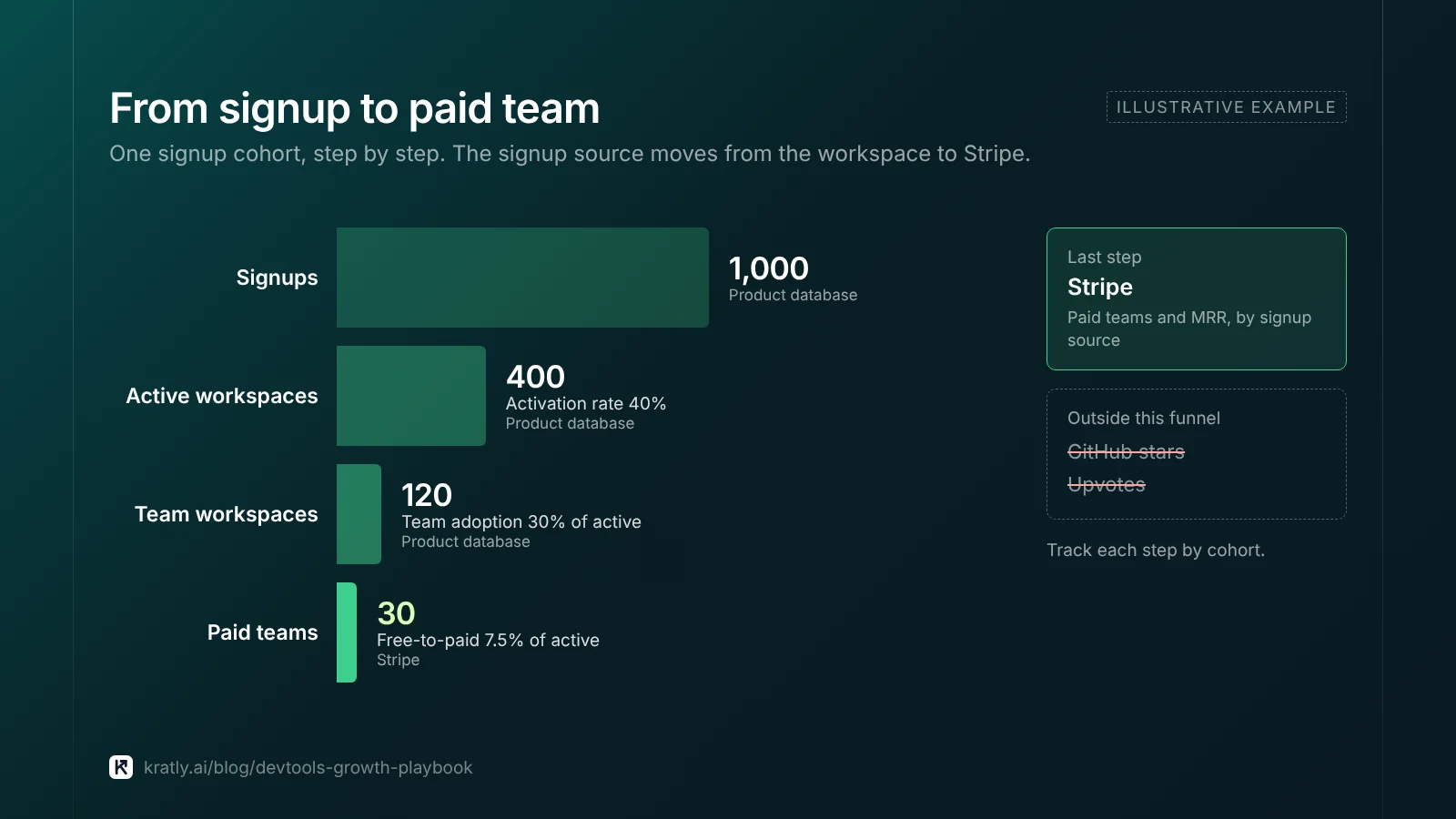
The funnel runs signup → active workspace → team workspace → paid team. Stripe covers the last step.
| Metric | Formula | Where the data comes from | Healthy range (sourced) |
|---|---|---|---|
| Activation rate | Workspaces with a first real API call or event ÷ signups | Product database | No sourced benchmark; set your own baseline |
| Team adoption rate | Workspaces with 2+ active members ÷ active workspaces | Product database | No sourced benchmark |
| Free-to-paid team rate | New paid teams ÷ active workspaces, same cohort | Product database + Stripe | No sourced benchmark for devtools |
| Revenue by source | Paid team MRR grouped by first-touch page, post or campaign | Website tracking + Stripe | Compare sources with each other |
| CAC payback | CAC ÷ (new MRR per team × gross margin) | Stripe + finance | Under 12 months for SMB SaaS (Bessemer) |
PostHog reports payback within three months of a paid plan signup (PostHog). That's one company's claim, not a benchmark. The method is in CAC payback period benchmarks.
Store the signup source on the workspace and copy it to the Stripe customer when the team pays.
What to stop doing#
Treating GitHub stars as revenue#
Stars are easy to fake. Carnegie Mellon researchers found about 4.5 million suspected fake stars across 15,835 repositories. They note the star count is "known to be poorly correlated to usage or importance" (He et al., arXiv, Dec 2024). Report paid teams instead.
Gating docs behind a signup form#
A form in front of docs blocks the people most likely to adopt. Crawlers can't read gated pages either, so you lose search traffic too.
Posting the same launch everywhere#
Copy-paste launches break community rules. One banned account can cost you a community for good.
Publishing content no developer would bookmark#
Thin "what is" posts cost 5–10 hours each and rarely bring a signup. Put those hours into one tutorial for a real task.
How to do this in Kratly#
- Connect Stripe, your website and Search Console. Kratly ties each paying team to the page, post or campaign that brought it. Docs and tutorials show up as pages with revenue.
- Connect Google Ads and Meta Ads if you run them. Reddit Ads is coming soon. Until then, tag Reddit traffic with UTMs and upload its spend as a CSV.
- Run the free AI search audit. It checks whether Google's AI Overviews cite your tool for the tasks developers search for.
- Review and approve suggestions. Kratly flags spend that brings no paying teams and pages that do. You approve each change, and every change is logged and reversible.
Questions, answered
What is the best developer marketing strategy for an early devtool?
Start with docs and a quickstart that works fast. Then write tutorials for the tasks your users search for, and post in one or two communities by their rules. Add a team plan with clear triggers like seats and SSO. Leave paid ads until people keep using the product. Judge every channel on paying teams in Stripe.
Do developers respond to ads?
Some do, though few admit it. PostHog's Ian Vanagas wrote that thinking you're immune to ads is wrong. Developers do punish ads that feel misleading. So keep claims plain and link to docs, not a sales form. Test with small budgets of about $500, and judge each test on paid teams, not clicks or signups.
Is a Show HN launch worth it?
It can be, if the product works and you can answer questions all day. The Show HN rules require something people can try, and they ban landing pages and asking friends to upvote. PostHog says a front-page hit brings a big traffic spike but only a small signup boost. Treat it as one launch, not a channel.
Do GitHub stars matter for a developer tool?
They help with social proof, but they aren't revenue. A Carnegie Mellon study found about 4.5 million suspected fake stars on GitHub, and noted stars correlate poorly with usage. Track active workspaces, team workspaces and paid teams instead. If stars rise while paid teams stay flat, your marketing is reaching fans, not buyers.
How do developer tools turn free users into paying teams?
They make the team plan the natural next step. Common triggers are a second seat, shared projects, SSO, roles, audit logs and support. Supabase's Team plan, for example, adds SOC 2, dashboard SSO and access roles. Publish your security details and prices, since security concerns and high prices top developers' reasons to reject a tool.
Written by
Priyansh Kumar
Priyansh Kumar has spent more than a decade in growth, scaling brands from 1 to 10 and from 10 to 100. He now builds Kratly, an autonomous growth team that ties every campaign, page and email to the revenue it brings.
Sources
- PostHog: How we got here (handbook timeline) · How we get users · Dev tool marketing for early-stage startups, Charles Cook (Feb 2023) · 40 things we've learned about marketing for developers, Ian Vanagas (July 2025)
- Stack Overflow: 2025 Developer Survey, learning resources · Work: technology purchases
- GitHub: Octoverse 2025 (Oct 28, 2025)
- Y Combinator / Hacker News: Show HN guidelines
- Supabase: Pricing
- He, Yang, Burckhardt, Kapravelos, Vasilescu, Kästner: 4.5 Million (Suspected) Fake Stars in GitHub (arXiv, Dec 2024)
- Bessemer Venture Partners: Scaling to $100M
Was this article useful?