Short answer
Kratly ties ad clicks, site visits and payments to revenue, then proposes or makes changes within limits you set. Its alternatives fall into eight groups: analytics, ad attribution, B2B attribution, PPC automation, SEO suites, CRM hubs, people, and other AI agents. Pick by the job. If you need product analytics, a CRM or rank tracking, Kratly isn't the tool.
People who look at Kratly usually already pay for something nearby. They have GA4, or Triple Whale, or HubSpot, or an agency. The real question is not "which tool is best." It's "which job is still not getting done."
This guide sorts the main alternatives by the job they do. It links to a detailed comparison for each one. All third-party pricing was checked on the vendor's own pages, as of October 2026.
A note on bias: Kratly is our product. We've tried to be fair, linked every fact about other tools to its source, and said plainly where they do more than we do.
Start with the job, not the tool#
Most growth stacks grow one tool at a time. Each tool answers one question well. Trouble starts when nobody owns the step from "the report says" to "we changed it, and it paid."
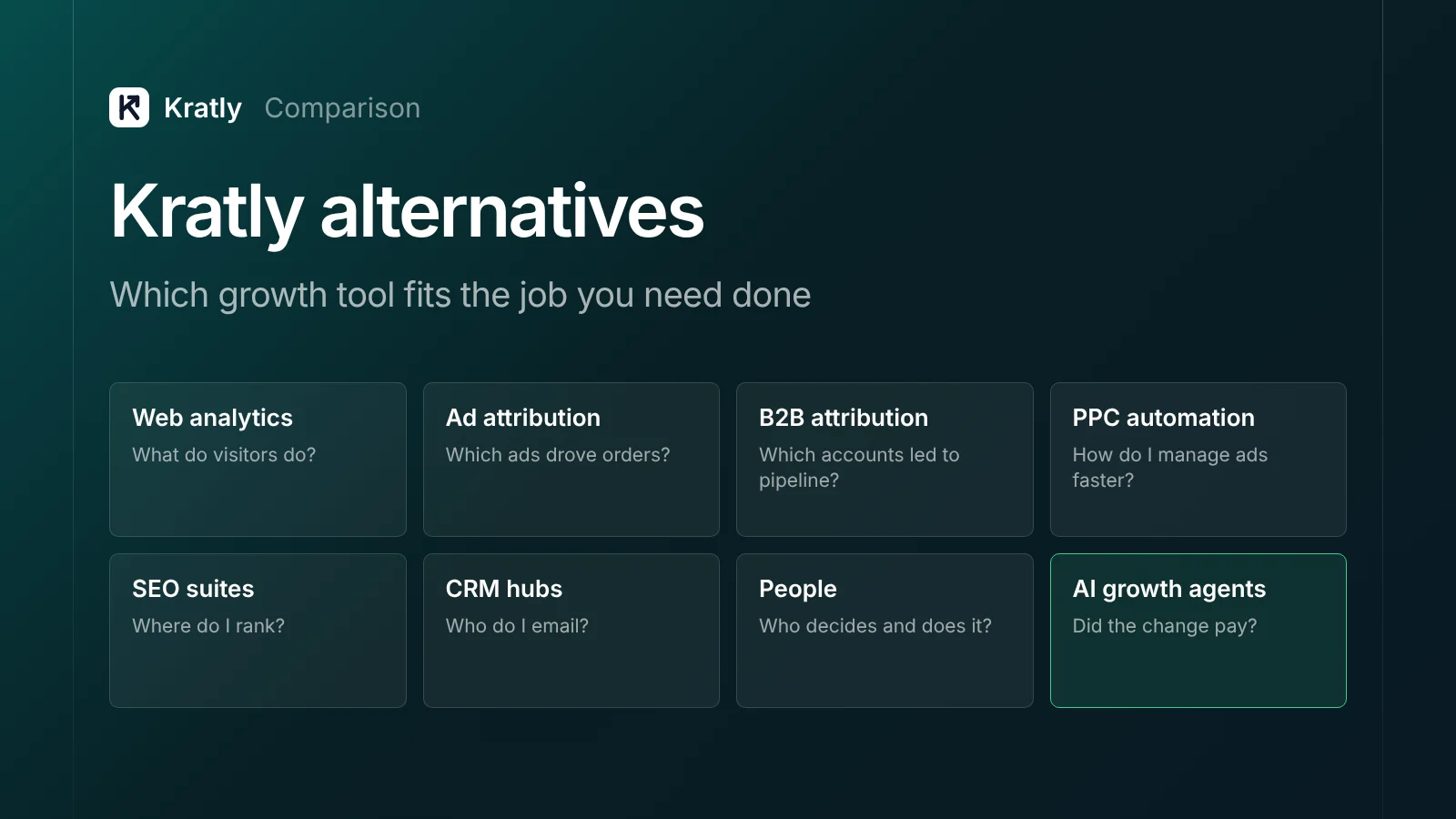
Here are the eight groups of tools people compare with Kratly, and the question each one answers.
| Category | The question it answers | Examples |
|---|---|---|
| Web analytics | What do visitors do on my site and app? | GA4 |
| Ecommerce and ad attribution | Which ads drove store orders? | Triple Whale, Northbeam, Hyros |
| B2B attribution | Which accounts and channels led to pipeline? | Dreamdata |
| PPC automation | How do I manage ad accounts faster? | Optmyzr |
| SEO suites | What do people search for, and where do I rank? | Semrush |
| CRM and marketing hubs | Who are my contacts, and what do I email them? | HubSpot Marketing Hub |
| People | Who will think, decide and do the work? | Agencies, freelancers, hires |
| AI growth agents | Can software do the repeatable work and prove it paid? | Kratly and others |
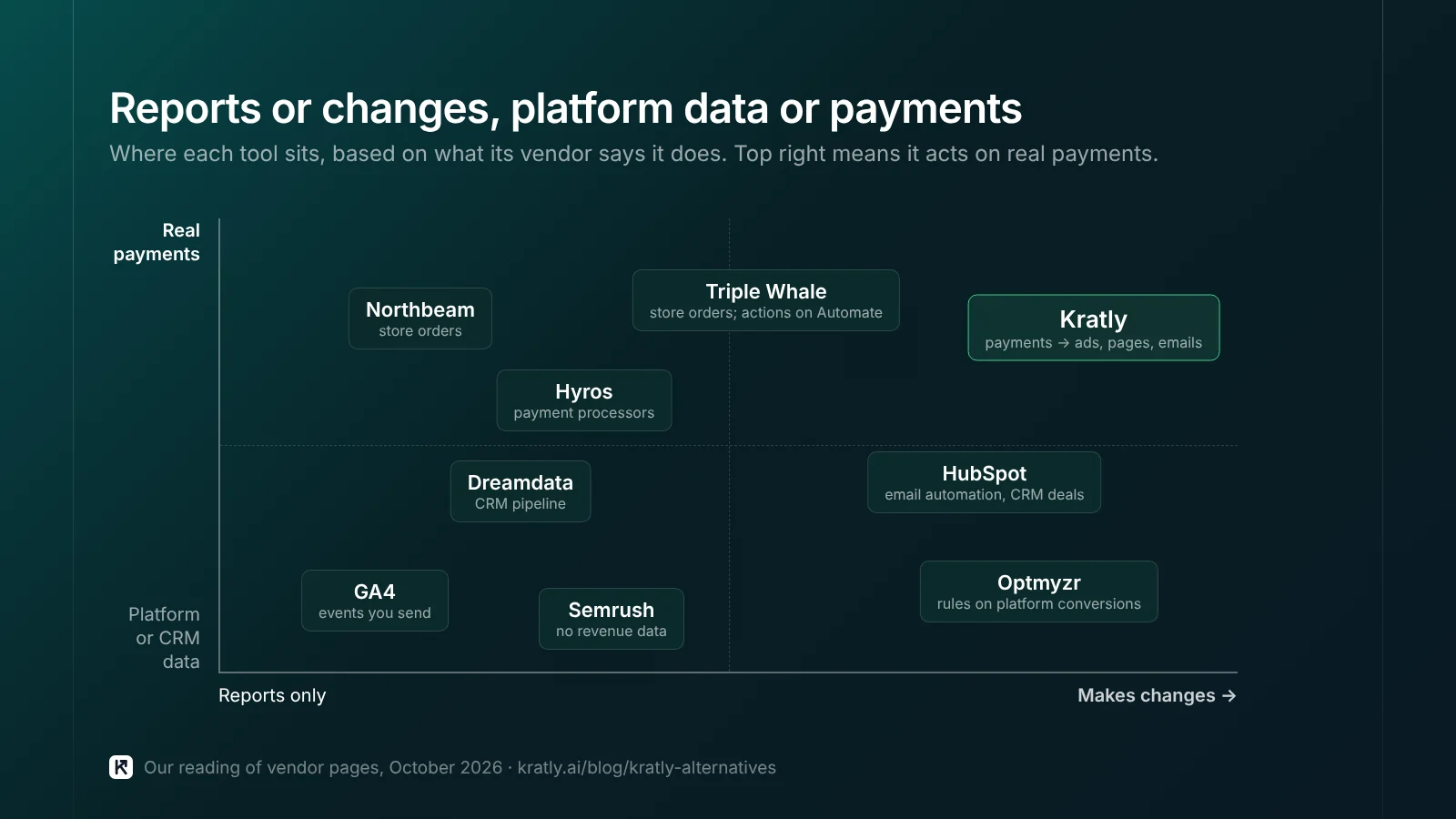
A useful test: for each tool you pay for, ask what changed last month because of it. If the answer is "nothing," that tool is a report, not a growth system. Our guide to marketing tool sprawl walks through that audit.
Kratly alternatives at a glance#
Prices are as listed on each vendor's site as of October 2026. Many vendors quote on a call, and several scale price by revenue, spend or data volume.
| Tool | Best for | Revenue it reads | Makes changes for you? | Starting price, Oct 2026 |
|---|---|---|---|---|
| Kratly | SaaS, app and store teams that want spend tied to payments, plus action | Stripe, store and app-store payments | Yes: suggest, ask first or autopilot, within limits | $49/month; 14-day trial |
| GA4 | Site and app behavior, Google Ads links | Events you send it | No | Free; 360 via sales |
| Triple Whale | Shopify and ecommerce brands | Store orders | Yes, on Automate (with approvals) | Free; paid tiers by GMV |
| Northbeam | Ecommerce brands with large ad budgets | Store orders | No (media advice on higher tiers) | Starter listed at $1,500 |
| Hyros | Ecommerce, courses, calls, SaaS | Payment processors | No | Quoted on a call |
| Dreamdata | B2B companies with a sales team | CRM pipeline and deals | No | Free; Advanced custom |
| HubSpot Marketing Hub | Contacts, email and automation | CRM deals | Automates email and workflows | Free; Pro from $800/month |
| Optmyzr | PPC teams and agencies | Ad platform conversions | Yes: rules and scripts | Plans by monthly ad spend |
| Semrush | Keyword research and SEO | None | No | Free; SEO plan $139/month |
Sources for each row are in the sections below. "Makes changes" means acting inside your ad accounts, pages or email, not only sending alerts.
Web analytics: GA4#
Google Analytics is free. Its paid version, Analytics 360, is sold through sales for large enterprises. It doesn't list a price.
Where GA4 wins: it records what people do on your site and app, in detail. It links natively to Google Ads, Search Console and other Google tools. Standard properties can export raw events to BigQuery, up to 1 million events a day (Google). For behavior, funnels and audiences, it's hard to beat free.
Where it's thin for revenue: GA4 offers three attribution models: data-driven, paid and organic last click, and Google paid channels last click. First click, linear, time decay and position-based were removed in November 2023 (Google). It only knows about payments you send it. Renewals and refunds that happen in Stripe stay invisible unless you push them in yourself.
Choose GA4 if you need site behavior and audiences. Most teams keep it either way.
Read the full comparison: Kratly vs GA4.
Ecommerce and ad attribution: Triple Whale, Northbeam, Hyros#
These tools answer one question for brands that spend heavily on ads: which ads really drove orders?
Triple Whale#
Triple Whale is built for ecommerce teams. It offers eight attribution models, a first-party pixel, post-purchase survey data, and benchmarks against peer brands. Its integrations cover Shopify, WooCommerce and BigCommerce, plus Amazon, TikTok Shop and Klaviyo (integrations).
It has a free plan. Paid prices depend on annual GMV and package (pricing). Its Shopify App Store listing shows Foundation at $219 a month and Automate at $749 a month (Shopify App Store). Automate adds paid media actions within approval settings.
Choose Triple Whale if you run a Shopify brand and want deep ecommerce reporting. Read Kratly vs Triple Whale.
Northbeam#
Northbeam focuses on multi-touch attribution for ecommerce brands. Its pricing page lists Starter at $1,500 for brands spending under $1.5M a year on ads, and Professional at $3,500 a month. Enterprise is custom and can add MMM and incrementality. Pricing also depends on pageview volume.
Choose Northbeam if you're an ecommerce brand with a large, multi-channel ad budget. Read Kratly vs Northbeam.
Hyros#
Hyros tracks ads server-side and receives transactions from payment processors. It serves ecommerce, course and coaching businesses, B2B call funnels, SaaS and agencies. Price is "quoted on your call" and sized to the revenue Hyros tracks for you (pricing).
Choose Hyros if you sell through calls, webinars or high-ticket offers and want tracking help on a sales call. Read Kratly vs Hyros.
Where Kratly differs from all three: Kratly reads Stripe and app-store payments as well as store orders, so it suits SaaS and apps too. It also acts beyond ads, on pages and follow-up emails, and measures changes against a control group. These tools go deeper on ecommerce measurement than Kratly does.
B2B attribution: Dreamdata#
Dreamdata is B2B analytics and attribution. Its free plan includes company identification, engagement scoring, ad spend reports and benchmarks, with 2 months of user history and 5 seats. The Advanced plan has custom pricing and adds AI and custom attribution models, revenue analytics and a dedicated CSM.
Where Dreamdata wins: account-level journeys for companies with long, sales-led cycles. It shows which companies engage before a deal.
Where Kratly differs: Kratly starts from payments, not CRM pipeline. It suits self-serve and product-led SaaS, where the first invoice is the conversion. It also makes changes, rather than only reporting.
Choose Dreamdata if most revenue closes through a sales team and your CRM is the source of truth. Read Kratly vs Dreamdata.
PPC automation: Optmyzr#
Optmyzr is PPC management software. It supports Google, Microsoft, Meta, Amazon, LinkedIn and TikTok ads. Features include a rule engine, scripts with no coding needed, audits, and budget pacing. Its plans are Essentials, Premium and Enterprise, priced by monthly ad spend, with a trial that needs no card.
Where Optmyzr wins: breadth of PPC tooling, many platforms, and agency workflows. If your team lives in ad accounts all day, it saves hours.
Where Kratly differs: Optmyzr optimizes on what the ad platform reports. Kratly ranks wasted spend and budget shifts by paid revenue from Stripe or your store. It also covers pages and email, not just ads.
Choose Optmyzr if you're a PPC specialist or agency managing many accounts. Read Kratly vs Optmyzr.
SEO suites: Semrush#
Semrush sells an SEO and AI search toolkit. As of October 2026 its SEO plan costs $139 a month, Starter $199 and Pro+ $299, billed monthly. Advanced is custom. There's a free plan with 10 reports a day, and a 7-day trial.
Where Semrush wins: keyword research, competitor research, backlinks and rank tracking. Kratly is not a rank tracker and doesn't try to be.
Where Kratly differs: Kratly ties each page to the revenue it brings. It proposes page fixes and content drafts based on which pages make money. Its free AI search audit checks Google AI Overviews only.
Choose Semrush if keyword and competitor research is your daily job. Read Kratly vs Semrush.
CRM and marketing hubs: HubSpot#
HubSpot Marketing Hub is free for up to 2 users, with 2,000 email sends a month. Starter is priced per seat, listed at $20 a seat a month, with a $7 offer shown. Professional starts at $800 a month with 3 core seats and a $3,000 onboarding fee. Enterprise starts at $3,600 a month with a $7,000 onboarding fee.
Where HubSpot wins: contacts, forms, email, workflows and a shared CRM for marketing and sales. Kratly is not an all-in-one CRM.
Where Kratly differs: Kratly sends follow-up emails through your own SendGrid account, with holdout groups to prove whether they changed revenue. It ties ad spend to Stripe payments directly.
Choose HubSpot if you need one system of record for contacts and sales. Read Kratly vs HubSpot Marketing Hub.
Agencies and hires#
People are the oldest alternative, and often the right one. A good growth marketer sets positioning, writes the offer and owns the number. A specialist agency brings skills you can't hire for, such as paid social creative.
The costs are real, though. A US growth marketing manager costs around $150,000 a year with benefits. Agencies often charge a percentage of ad spend, with minimums. We break down the numbers, with sources, in growth marketer vs AI growth agent.
Choose people if you need strategy, creative ideas or relationships. Software doesn't do those well. Most teams end up with a person who owns the target and tools that do the repeatable work.
AI growth agents#
This is the newest group. An AI growth agent reads your data, decides what to change, makes the change and checks whether it paid. Some attribution tools are adding agent features too. Triple Whale's Automate plan, for example, lists paid media actions within approval settings (pricing).
When you compare agents, look past the demo. Ask four things:
- What revenue does it read? Ad platform conversions, or real payments?
- What can it change? Ads only, or pages and emails too?
- Who approves? Can you set which actions need sign-off, with spend limits?
- How does it prove results? Against a control group, or a before-and-after chart?
Our autonomous growth guide covers the guardrails in more depth.
Where Kratly fits, and where it doesn't#
What Kratly does:
- Joins ad clicks, site visits and Stripe, store or app-store payments into revenue by campaign, page and email.
- Shows that revenue under first touch, last touch or linear models.
- Connects to Google Ads, Microsoft Ads, Meta (through the Conversions API) and Shopify. LinkedIn Ads is coming soon.
- Finds wasted ad spend and proposes negative keywords and budget shifts.
- Suggests page fixes and drafts content.
- Sends follow-up emails through your own SendGrid account, with holdout groups.
- Runs every change as Suggest, Ask first or Autopilot, within limits you set. Each change is logged and can be undone.
- Measures results against a control group.
What Kratly is not:
- Not an all-in-one CRM. Keep HubSpot or your CRM for contacts and deals.
- Not a full product analytics suite. Keep GA4 or a product analytics tool for in-app behavior.
- Not a rank tracker or keyword database. Keep an SEO suite if research is your daily job.
- Not a media mix model or a deep ecommerce benchmark tool. Triple Whale and Northbeam go further there.
Pricing: Starter is $49 a month, Growth $199, Scale $599 and Enterprise custom. The self-serve plans start with a 14-day free trial.
How to choose#
| If your main problem is... | Start with |
|---|---|
| You don't know what visitors do on your site | GA4 |
| You run a Shopify brand and want deep order attribution | Triple Whale or Northbeam |
| You sell high-ticket offers through calls or webinars | Hyros |
| Revenue closes through a sales team and lives in your CRM | Dreamdata, with HubSpot or your CRM |
| You manage many PPC accounts and want rules and audits | Optmyzr |
| You need keyword and competitor research | Semrush |
| You need contacts, email and sales workflows in one place | HubSpot Marketing Hub |
| You need strategy and creative | A person or a specialist agency |
| You know your numbers but nobody acts on them, and you sell through Stripe, a store or an app store | Kratly |
This table is our judgement, based on what each vendor says its product does.
How to do this in Kratly#
If you want to see whether Kratly fills the gap in your stack, start with one job.
- Connect your ad accounts and your revenue source. Stripe, Shopify or an app store, plus Google Ads, Microsoft Ads or Meta.
- Look at revenue by campaign, page and email. Switch between first touch, last touch and linear to see where credit is contested.
- Review the proposed changes. Kratly lists wasted spend, budget shifts, page fixes and follow-up emails, ranked by revenue at stake.
- Choose the mode for each type of change. Suggest, Ask first or Autopilot within limits. Every change is logged and can be undone.
- Check the result against a control. Keep what paid, and drop what didn't.
Not ready to connect anything? Try the free wasted-spend checker. It reads a Google Ads search-terms CSV in your browser.
Questions, answered
What are the main alternatives to Kratly?
It depends on the job. GA4 for site analytics. Triple Whale, Northbeam or Hyros for ad attribution. Dreamdata for B2B attribution. Optmyzr for PPC automation. Semrush for SEO research. HubSpot for CRM and email. Agencies or hires for strategy. Most teams use two or three together.
Is Kratly a replacement for GA4?
No. GA4 records site and app behavior and is free. Kratly ties spend and pages to the payments in Stripe, your store or app stores, then acts on it. Most teams keep GA4 for behavior and use Kratly for revenue and changes.
Is Kratly an attribution tool or an AI agent?
Both. It attributes revenue by campaign, page and email under first touch, last touch or linear. It then proposes or makes changes within limits you set, and measures each against a control group.
Which is cheapest: Kratly, Triple Whale or Northbeam?
As of October 2026, Triple Whale has a free plan, and its paid tiers depend on GMV. Northbeam lists Starter at $1,500. Kratly starts at $49 a month. Compare the price at your own revenue, spend and data volume.
When should I not choose Kratly?
When you need a CRM, a full product analytics suite, a rank tracker or a media mix model. Also when your revenue closes mostly through a sales team inside a CRM. Specialist tools do those jobs better.
Written by
Priyansh Kumar
Priyansh Kumar has spent more than a decade in growth, scaling brands from 1 to 10 and from 10 to 100. He now builds Kratly, an autonomous growth team that ties every campaign, page and email to the revenue it brings.
Sources
- Google: Google Analytics · Analytics 360 · Attribution models · BigQuery Export
- Triple Whale: Pricing · Attribution · Integrations · Shopify App Store listing
- Northbeam: Pricing
- Hyros: Pricing · What is Hyros
- Dreamdata: Pricing
- Optmyzr: Home · Pricing
- Semrush: SEO and AI search pricing
- HubSpot: Marketing Hub pricing
All third-party details as of October 2026.
Was this article useful?