Short answer
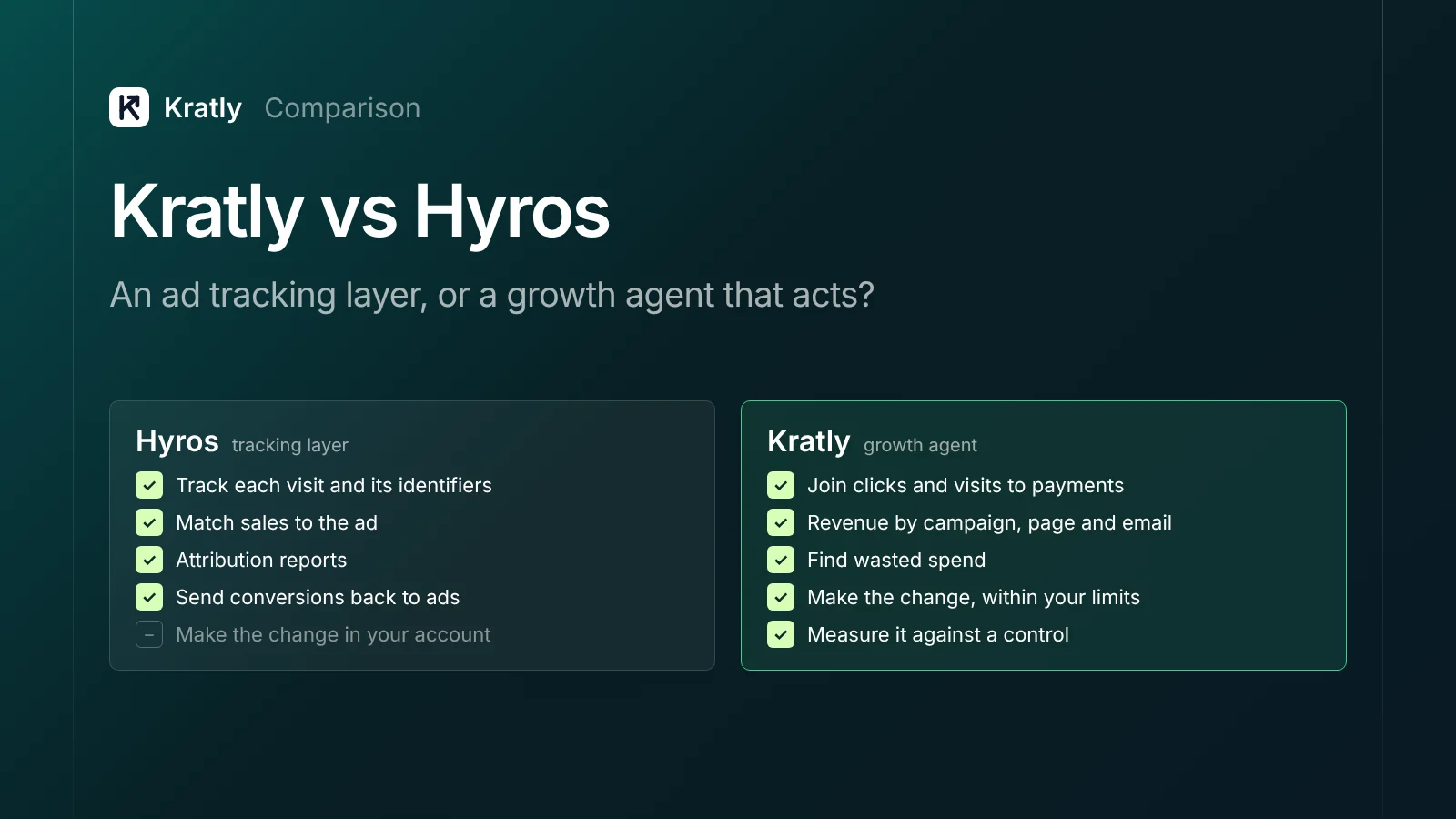
Hyros is a dedicated ad tracking and attribution layer. It is strongest for info-product, course and call-funnel businesses with long funnels and heavy Meta spend. Kratly also ties ad clicks to payments, then goes further: it finds wasted spend, proposes the change, makes it within your limits and measures the result against a control. Pick Hyros for deep funnel tracking; pick Kratly if you want the work done.
People usually compare these two when platform numbers stop matching the bank account. Both tools answer "which ad brought this sale?" They differ in what happens next.
A note on bias: Kratly is our product. Every fact about Hyros below comes from Hyros's own pages, checked in October 2026 and linked inline. We've said plainly where Hyros is the better choice.
Who each tool is for#
Hyros describes itself as "an ad tracking and attribution platform that measures which ads produce actual revenue" (Hyros). It lists four groups it serves: DTC and ecommerce brands, info-product and course creators, agencies, and SaaS companies.
Hyros's own comparison page is unusually candid about fit. It says Hyros is a weaker fit for advertisers spending under $10K a month, for pure Shopify stores with a clean native pixel, and for teams that want a dashboard rather than a tracking layer (Hyros vs Triple Whale). It calls funnels for info-products, webinars and multi-step checkouts a "core strength."
Kratly is for SaaS, ecommerce and app teams that want revenue tied to campaigns, pages and emails, and want something to act on it. It is built for founders and small growth teams who don't have hours each week to turn a report into changes. It is not a CRM, not a full product analytics suite and not a rank tracker.
What each does, side by side#
| Hyros | Kratly | |
|---|---|---|
| Core job | Tracking and attribution layer | Attribution plus an agent that makes changes |
| How visits are matched | "Print tracking": IP, cookies, device data, email, phone and click IDs, matched deterministically | Ad click and site visit joined to the Stripe, store or app-store payment |
| Revenue source | Payment processors, carts and CRMs; Stripe listed in Hyros docs | Stripe, Shopify and app-store payments |
| Ad platforms | Meta, Google (incl. YouTube and Performance Max), TikTok, Snapchat | Google Ads, Microsoft Ads, Meta (Conversions API); LinkedIn coming soon |
| Sends conversions back to ads | Yes, "ad feedback loops" and AIR | Yes, paid conversions with value |
| Attribution windows | Long, configurable windows for 60+ day funnels | First touch, last touch and linear |
| Calls and appointments | No-show tracking via Calendly, Acuity, HubSpot, GoHighLevel and others | Not a call-tracking tool |
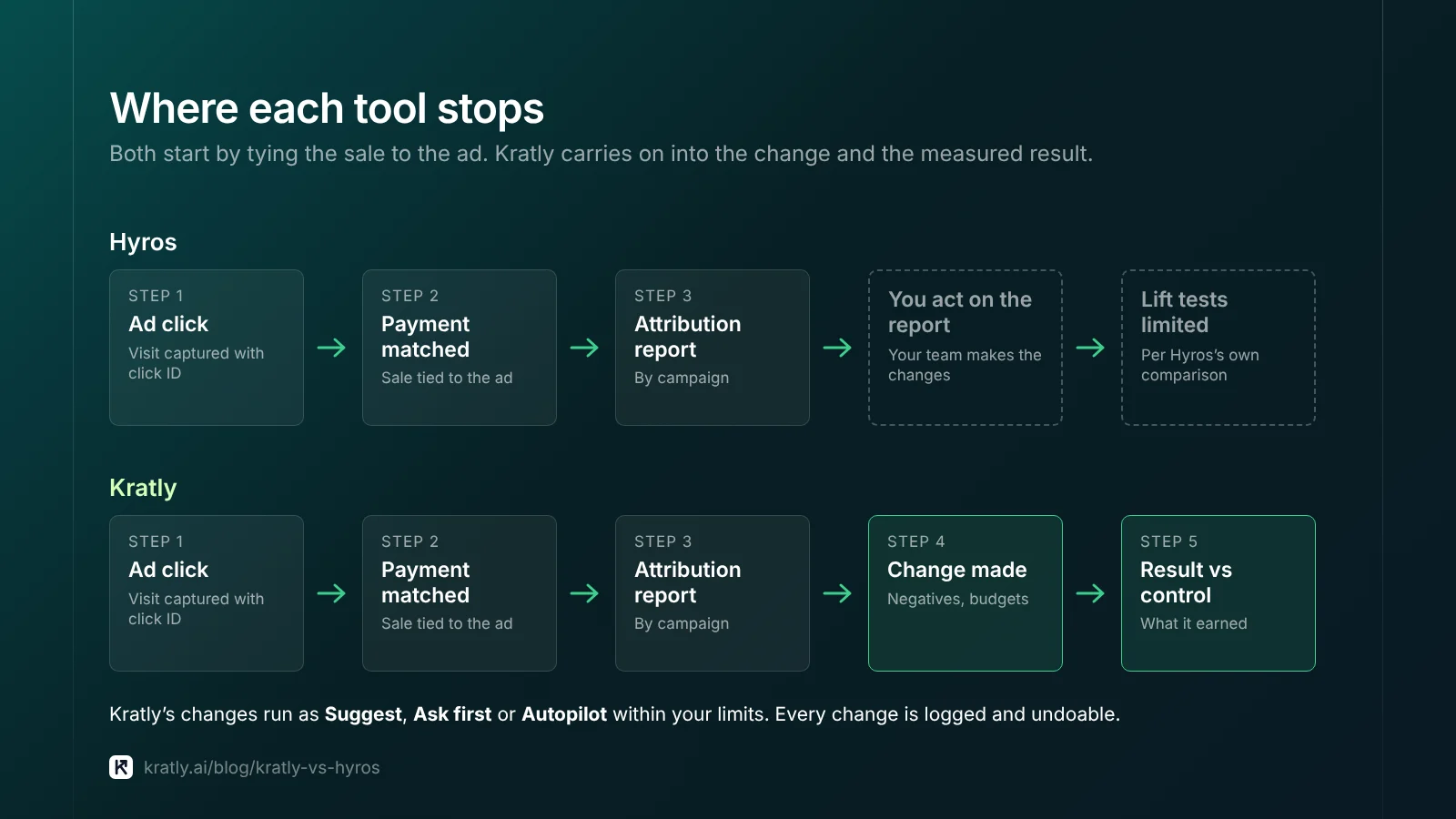
| Makes account changes | No; it is a tracking layer | Proposes negatives and budget shifts; runs them as Suggest, Ask first or Autopilot |
| Pages and email | Not covered | Page fixes, content drafts, follow-up emails through your SendGrid with holdouts |
| Proves the result | Attribution reports | Each change measured against a control group |
Hyros facts: What is Hyros, Hyros vs Triple Whale, No-show call tracking, Hyros docs. All checked October 2026.
Pricing as of October 2026#
| Hyros | Kratly | |
|---|---|---|
| Entry plan | Organic: from $49/month, non-paid traffic only | Starter: $49/month |
| Main plan | Business: from $230/month on annual billing, or about $379 monthly; scales with tracked revenue | Growth: $199/month; Scale: $599/month |
| Large teams | Agency and enterprise: custom quote | Enterprise: custom |
| How price scales | By tracked monthly revenue | By plan limits (sites, seats, tracked revenue) |
| Try before buying | Demo call required; 90-day money-back guarantee | 14-day free trial |
| Free tier | None | None (free tools available) |
Hyros pricing: What is Hyros and Hyros vs Triple Whale. Hyros says these prices are "current as of April 2026." It quotes each account after a call, so your price will depend on your revenue. Kratly pricing is on our pricing page; yearly billing costs less.
The headline numbers look close at the bottom. The real gap is in what you pay for. With Hyros, you pay for tracking that grows with your revenue. With Kratly, you pay for tracking plus the agent work: wasted-spend reviews, page fixes and follow-up emails.
Where Hyros is better#
Be honest with yourself about these. If several apply, Hyros is probably the right tool.
- Long, multi-step funnels. Webinars, applications, booked calls and high-ticket offers with 60+ day journeys are what Hyros is built around.
- Call-based sales. Hyros tracks booked calls and no-shows by source through common schedulers. Kratly does not track calls.
- Identity matching depth. Print tracking combines many identifiers per visitor. If your buyers switch devices often, that matters.
- TikTok and Snapchat. Hyros lists both. Kratly connects Google, Microsoft and Meta, not TikTok or Snapchat (LinkedIn is coming soon).
- Agencies. Hyros offers multi-account views and cross-account reporting for agencies.
- A dedicated specialist. If you only want tracking, and your team already acts on reports well, Hyros does one job deeply.
Where Kratly is better#
- It acts, not only reports. Kratly reviews search terms, proposes negative keywords and budget shifts, and makes them within limits you set. Every change is logged and can be undone.
- It proves what the change earned. Each change is measured against a control group, so you see lift, not a before-and-after guess.
- It covers more than ads. Page fixes, content drafts and follow-up emails sit in the same loop, judged on the same revenue.
- SaaS and app revenue. Kratly reads Stripe subscriptions and app-store payments directly, so trial-to-paid journeys show up as revenue by campaign.
- Microsoft Ads. B2B teams running Bing get those campaigns in the same view.
- Smaller budgets. Hyros itself says it is a weaker fit under $10K a month. Kratly's Starter plan is built for teams at that stage.
- Self-serve start. A 14-day trial with no sales call. Hyros asks for a demo first.
For background on how attribution models differ, see attribution models compared.
Can you use both?#
Yes, though most small teams won't need to. A sensible split:
- Hyros stays your source of truth for call funnels and long-window ad attribution.
- Kratly handles the work: search-term cleanup, budget shifts, page fixes and follow-up emails, each measured against a control.
Watch for double counting. If both tools send conversions back to Meta or Google, the platforms may count a sale twice. Pick one tool to send conversions for each platform, and turn the other off.
How to decide#
| If this sounds like you | Choose |
|---|---|
| Info-product or course business with webinars and sales calls | Hyros |
| Agency tracking many client funnels, mainly Meta and TikTok | Hyros |
| SaaS paid by Stripe, wanting revenue by campaign and someone to act on it | Kratly |
| Spending under $10K a month on ads | Kratly |
| Running Google and Microsoft Ads for B2B | Kratly |
| Long call funnels and want ad changes made for you | Both, with one tool sending conversions |
This table is our judgement from the facts above.
How to do this in Kratly#
- Connect your ad accounts and payments. Link Google Ads, Microsoft Ads or Meta, plus Stripe, Shopify or your app store.
- See revenue by campaign. Switch between first touch, last touch and linear to see which campaigns bring paying customers.
- Review the proposed fixes. Kratly flags wasted spend and proposes negatives and budget shifts. Choose Suggest, Ask first or Autopilot within limits.
- Check the result. Each change is measured against a control group, logged and undoable.
Want a quick first look before a trial? Run your search-terms CSV through the free Google Ads wasted-spend checker. It works in your browser.
Questions, answered
Is Kratly a Hyros alternative?
For many teams, yes. Both tie ad clicks to real payments. Kratly also makes changes and measures them against a control. Hyros is the stronger pick for call-based and long info-product funnels, and for TikTok or Snapchat spend.
How much does Hyros cost?
As of October 2026, Hyros's own pages list an Organic plan from $49 a month and a Business plan from $230 a month on annual billing, scaling with tracked revenue. Agency plans are quoted. Hyros says these prices are current as of April 2026 and requires a demo call.
Does Hyros make changes to my ad accounts?
Hyros sends conversion data back to ad platforms to improve their bidding, which it calls ad feedback loops. It describes itself as a tracking layer. It does not describe making bid, budget or keyword changes for you.
Does Kratly track phone calls like Hyros?
No. Kratly joins ad clicks and site visits to Stripe, store and app-store payments. If booked calls and no-shows are central to your sales, Hyros covers that and Kratly does not.
Can I run Kratly and Hyros together?
Yes. Let Hyros handle call-funnel attribution and let Kratly do the account work and testing. Choose one tool to send conversions to each ad platform, so sales aren't counted twice.
Written by
Priyansh Kumar
Priyansh Kumar has spent more than a decade in growth, scaling brands from 1 to 10 and from 10 to 100. He now builds Kratly, an autonomous growth team that ties every campaign, page and email to the revenue it brings.
Sources
- Hyros: What is Hyros? How the ad tracking platform works (pricing, features, who it's for)
- Hyros: Hyros vs Triple Whale (2026) (monthly price, fit, agency tools, attribution windows)
- Hyros: Track no-show calls · Hyros documentation index (Stripe listed as a payment processor)
- Kratly: Pricing
Was this article useful?