Short answer
Optmyzr is a mature PPC management and automation platform for agencies and in-house teams running many ad accounts. Its rules, audits and reports go deeper than Kratly's. Kratly is a smaller, revenue-first growth agent. It joins ad clicks to Stripe, store or app-store payments, then changes ads, pages and emails based on what pays. PPC specialists managing dozens of accounts should choose Optmyzr. Small SaaS and app teams without a PPC specialist should look at Kratly.
The two tools overlap in one place: both can find wasted spend and change your Google Ads account. They differ in what they're built around. Optmyzr is built around the ad account. Kratly is built around the revenue.
A note on bias: Kratly is our product. Every Optmyzr fact below links to the page we read in October 2026. Where Optmyzr is better, we say so.
Who each tool is for#
Optmyzr describes itself as "a B2B paid media management and automation platform." It was founded in 2013 by Frederick Vallaeys, Geetanjali Tyagi and Manas Garg (Optmyzr). It lists four kinds of customer: agencies, in-house teams, one-person PPC consultancies and enterprises. It reports more than 430,000 ad accounts connected.
Kratly is an autonomous growth team for smaller companies. It starts from paid revenue in Stripe, Shopify or the app stores and works back to the campaign, page or email that brought it. Then it proposes or makes changes within limits you set.
Put simply, Optmyzr gives a PPC professional better tools. Kratly does a slice of the work for teams that don't have that professional.
What each tool does#
| Optmyzr | Kratly | |
|---|---|---|
| Core job | Manage, automate and report on paid media accounts | Tie ads, pages and emails to revenue, then improve what doesn't pay |
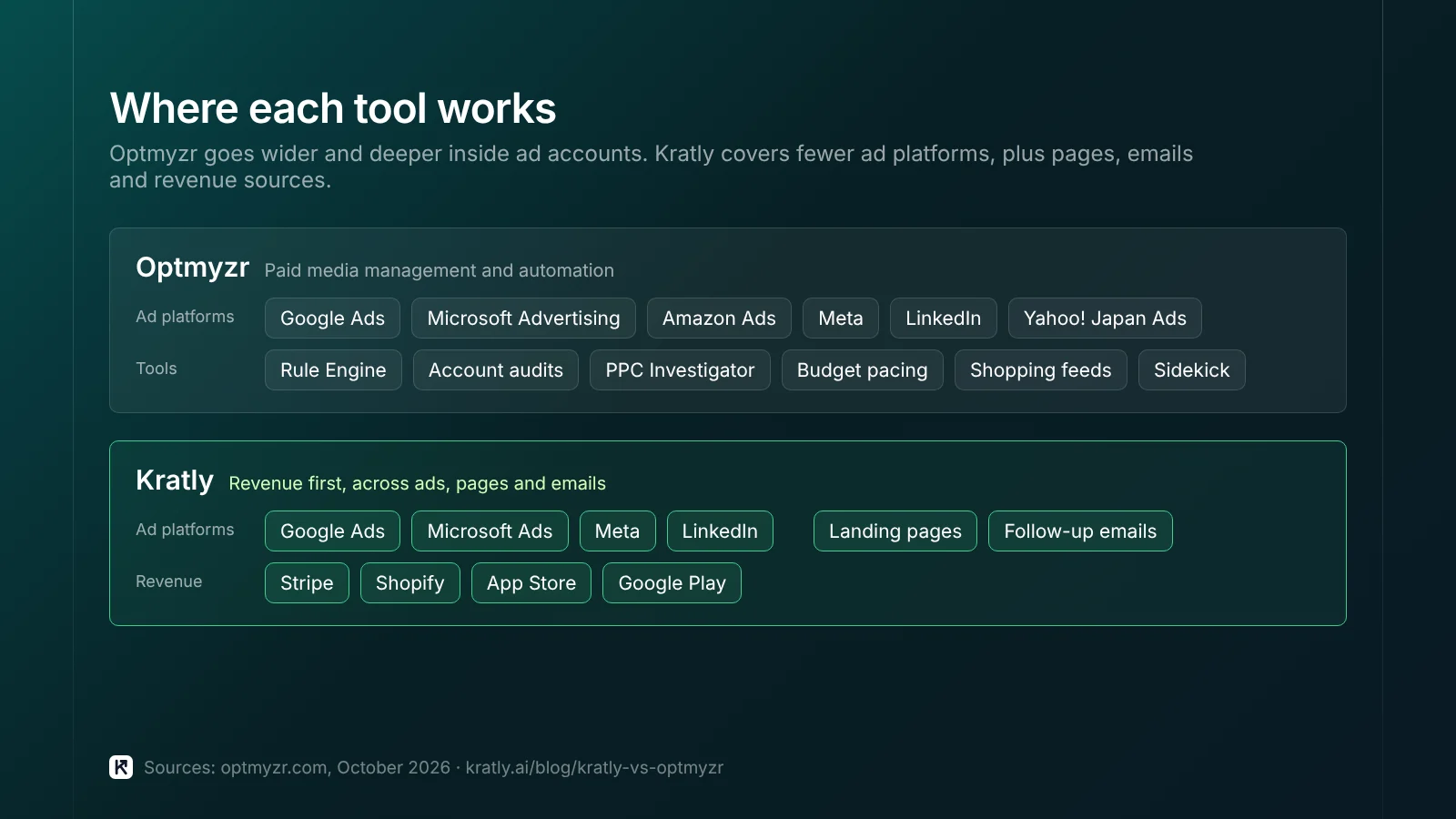
| Ad platforms | Google Ads, Microsoft Advertising, Amazon Ads, Meta, LinkedIn, Yahoo! Japan Ads | Google Ads, Microsoft Ads, Meta (Conversions API); LinkedIn coming soon |
| Automation | Rule Engine with strategies, conditions and actions; hourly runs on request for Enterprise | Suggested negatives and budget shifts, run as Suggest, Ask first or Autopilot within limits |
| Audits | PPC Account Audit, scored 0–100 | Wasted-spend review ranked by spend with no paying customer |
| Diagnosis | PPC Investigator explains why performance changed | Revenue by campaign, page and email |
| Budget pacing | Budget Dashboard, alerts, Spend Projection | Alerts and the weekly brief |
| Shopping and feeds | Campaign Automator, Shopping tools, Smart Product Labeler | No |
| AI assistant | Sidekick: answers questions, and can apply keywords and budget targets after preview | Ask AI about your numbers |
| Revenue data | Imports offline conversions, CRM lists and margin data | Reads Stripe, Shopify and app-store payments directly |
| Beyond ads | No | Landing-page fixes, content drafts, follow-up emails via SendGrid |
| Proof of impact | Reporting and period comparisons | Changes measured against a control group |
| Free trial | 14 days, no card | 14 days |
Optmyzr sources: product overview, pricing page, Sidekick (Aug 2026), data integrations, all as of October 2026.
Optmyzr pricing vs Kratly pricing#
Optmyzr prices by monthly ad spend. As of October 2026, its billing help page describes three plans (Optmyzr help):
| Plan | Ad spend covered | Price |
|---|---|---|
| Essentials | Up to $150K a month | From $209/month at $25K spend, up to 25 accounts (Optmyzr blog); $299/month on Capterra (Capterra) |
| Premium | Up to $500K a month | $389/month on Capterra |
| Enterprise | Above $500K a month | Custom |
The two Essentials figures likely differ by billing. Optmyzr says annual prepaid billing is 30% cheaper than monthly, and $299 less 30% is about $209. That's our reading; confirm on the live page.
Other pricing details from Optmyzr's help page:
- Overages are billed per extra $1,000 of spend. On the $25K tier that's $3.50 per $1,000 up to $100,000.
- Plans include a 15–20% buffer above the spend limit.
- Essentials includes 25 accounts. Extra accounts cost $5 each per month. Premium allows unlimited accounts under fair use.
- If overages stay high for two months, Optmyzr may upgrade you to the next plan, with 7 days' notice.
Optmyzr's pricing page also showed a promotion of 45% off the first year for sign-ups by September 30 (Optmyzr pricing). That offer has ended as of this writing.
Kratly doesn't price by ad spend. Plans are Starter $49/month, Growth $199/month, Scale $599/month and Enterprise custom, with a 14-day free trial. The ads and page-fix autopilots start on Growth.
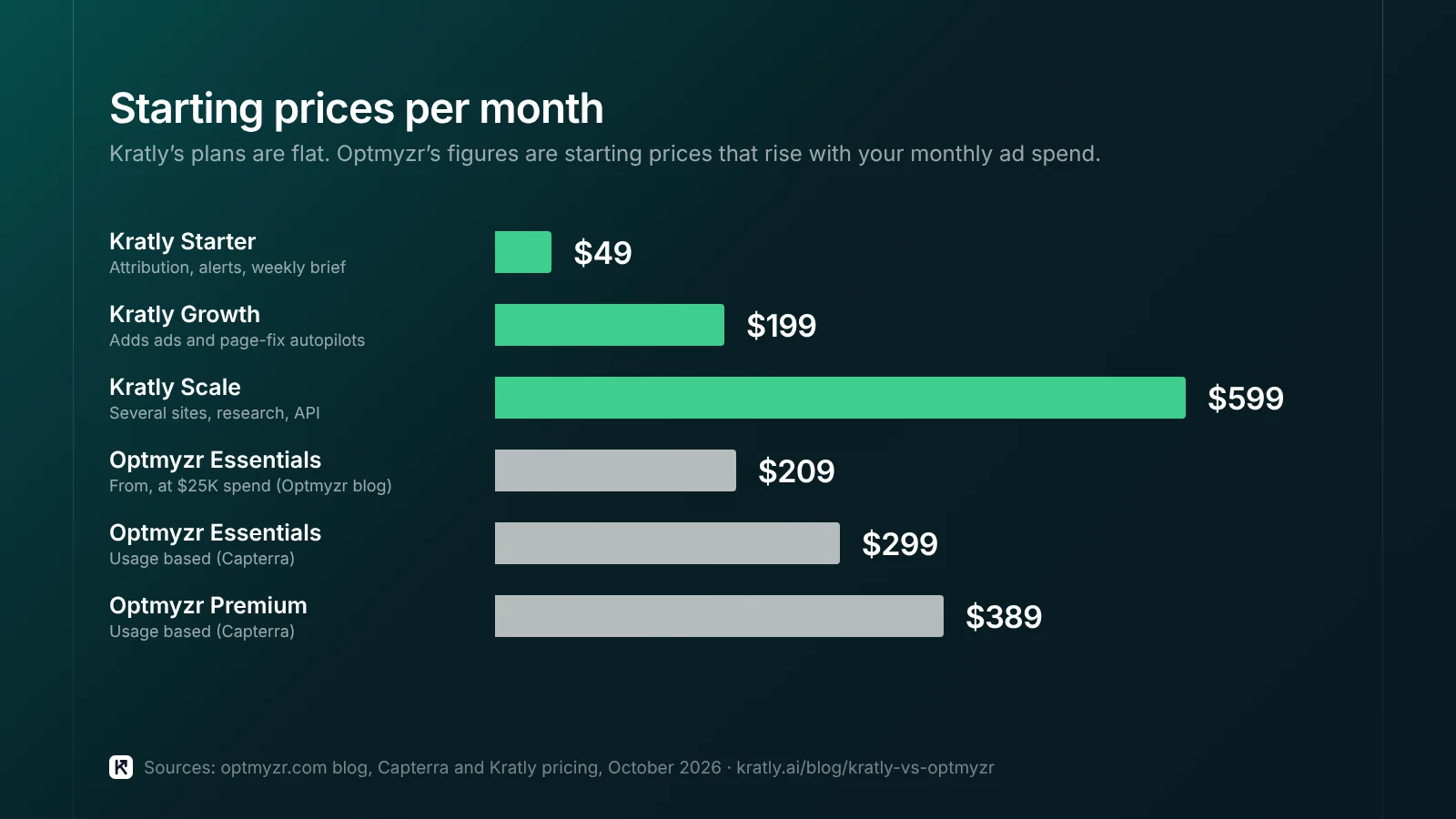
At low spend the two cost about the same. As spend grows, Optmyzr's price rises with it. That's fair for a tool whose work grows with account size, but it's worth modeling before you sign.
Where Optmyzr is better#
Optmyzr is the more complete PPC tool. Be honest with yourself about whether you need that.
- Depth inside the ad account. The Rule Engine, PPC Investigator, audits, budget pacing and ad text tools cover far more than Kratly's ad features.
- More platforms. Amazon Ads and Yahoo! Japan Ads are supported. Kratly supports neither.
- Shopping and feed-based campaigns. Campaign Automator and Smart Product Labeler suit retailers with large catalogs. Kratly has no feed tools.
- Agencies and many accounts. Portfolios, multi-account reporting and unlimited accounts on Premium are built for agencies.
- Track record. Optmyzr has been around since 2013. It reports $5.39 billion in ad spend managed in 2025, a vendor figure.
- AI tools for specialists. Sidekick can now create and apply keywords after a preview. An MCP connection lets Claude or ChatGPT work with Optmyzr data.
Choose Optmyzr if you have a PPC specialist or agency, run many accounts or large catalogs, or advertise on Amazon. It will make that person much faster.
Where Kratly is better#
- Revenue first, without setup. Kratly reads Stripe, Shopify and app-store payments directly. Optmyzr can use revenue too, through offline conversion imports and data integrations, but someone has to set those up. Our guide to tracking Stripe conversions in Google Ads shows what that involves.
- Judged on paying customers. Kratly ranks search terms and campaigns by spend with no paying customer, not by conversions. That matters for SaaS, where many sign-ups never pay. See how to find negative keywords.
- Beyond the ad account. Kratly also finds landing pages that don't convert, drafts fixes and sends follow-up emails through your SendGrid, with holdout groups.
- Measured against a control. Kratly compares its changes against a control group, so you see the revenue they added.
- No specialist needed. You choose Suggest, Ask first or Autopilot within limits. Every change is logged and undoable.
- Price doesn't climb with spend. Plans are flat.
Choose Kratly if you're a founder or small team on a few channels, under about $100,000 a month in spend. It suits teams who care about paying customers more than account metrics.
Can you use both?#
Yes. The split is natural:
- Optmyzr for deep account work: bid rules, Shopping feeds, audits and client reporting.
- Kratly for the revenue view across ads, pages and emails, and for page and email fixes.
One rule: don't let two tools change the same thing. If Optmyzr's Rule Engine manages bids and budgets, keep Kratly in Suggest mode for those. Use Kratly's findings as input to your Optmyzr rules. Let Kratly act on pages and emails, where Optmyzr doesn't work.
Most small teams won't need both. If you have no PPC specialist, Optmyzr's depth may go unused.
How to decide#
If you checked "specialist," "dozens of accounts" or "Amazon," trial Optmyzr. If you checked "Stripe," "pages and emails" and nobody owns PPC full time, trial Kratly.
How to do this in Kratly#
- Connect Google Ads and your revenue source. Add Microsoft Ads or Meta if you use them, plus Stripe, Shopify or your app store.
- See spend with no paying customer. Kratly ranks campaigns and search terms by money spent without a paying customer.
- Review the proposed changes. Negatives and budget shifts, each with the spend at stake and the evidence.
- Pick a mode. Suggest, Ask first or Autopilot within limits. Every change is logged and undoable.
- Measure. Kratly checks the result against a control group, in revenue.
Want a quick look first? The free Google Ads wasted-spend checker reads a search-terms CSV in your browser, without connecting an account.
Questions, answered
Is Kratly an Optmyzr alternative?
For small teams without a PPC specialist, it can be. Both find wasted spend and change Google Ads. Optmyzr has much deeper PPC tools and more platforms. Kratly judges by Stripe or store revenue and also works on pages and emails.
How much does Optmyzr cost?
As of October 2026, Optmyzr prices by ad spend. Its own blog lists Essentials from $209 a month at $25K spend, and Capterra lists Essentials at $299 and Premium at $389 a month. Enterprise is custom, and overages are billed per $1,000 of extra spend.
Does Optmyzr have a free trial?
Yes. Optmyzr offers a 14-day free trial with no credit card required. Kratly also has a 14-day free trial.
Can Optmyzr optimize for revenue instead of conversions?
It can work with revenue you bring in. Optmyzr supports offline conversion imports for value-based bidding, plus CRM lists and margin data. You need to set up that data flow. Kratly reads Stripe and store payments directly.
Does Kratly support Amazon Ads?
No. Kratly connects Google Ads, Microsoft Ads and Meta. If Amazon Ads matter to you, Optmyzr supports them.
Written by
Priyansh Kumar
Priyansh Kumar has spent more than a decade in growth, scaling brands from 1 to 10 and from 10 to 100. He now builds Kratly, an autonomous growth team that ties every campaign, page and email to the revenue it brings.
Sources
- Optmyzr: Official information page · Pricing · Subscription, overages and billing FAQs · Best PPC automation tools (pricing line) · Sidekick, August 19, 2026 · Data integrations · Optmyzr for Social (all as of October 2026)
- Capterra: Optmyzr pricing
- Kratly: pricing page (plans and 14-day trial)
Was this article useful?