Short answer
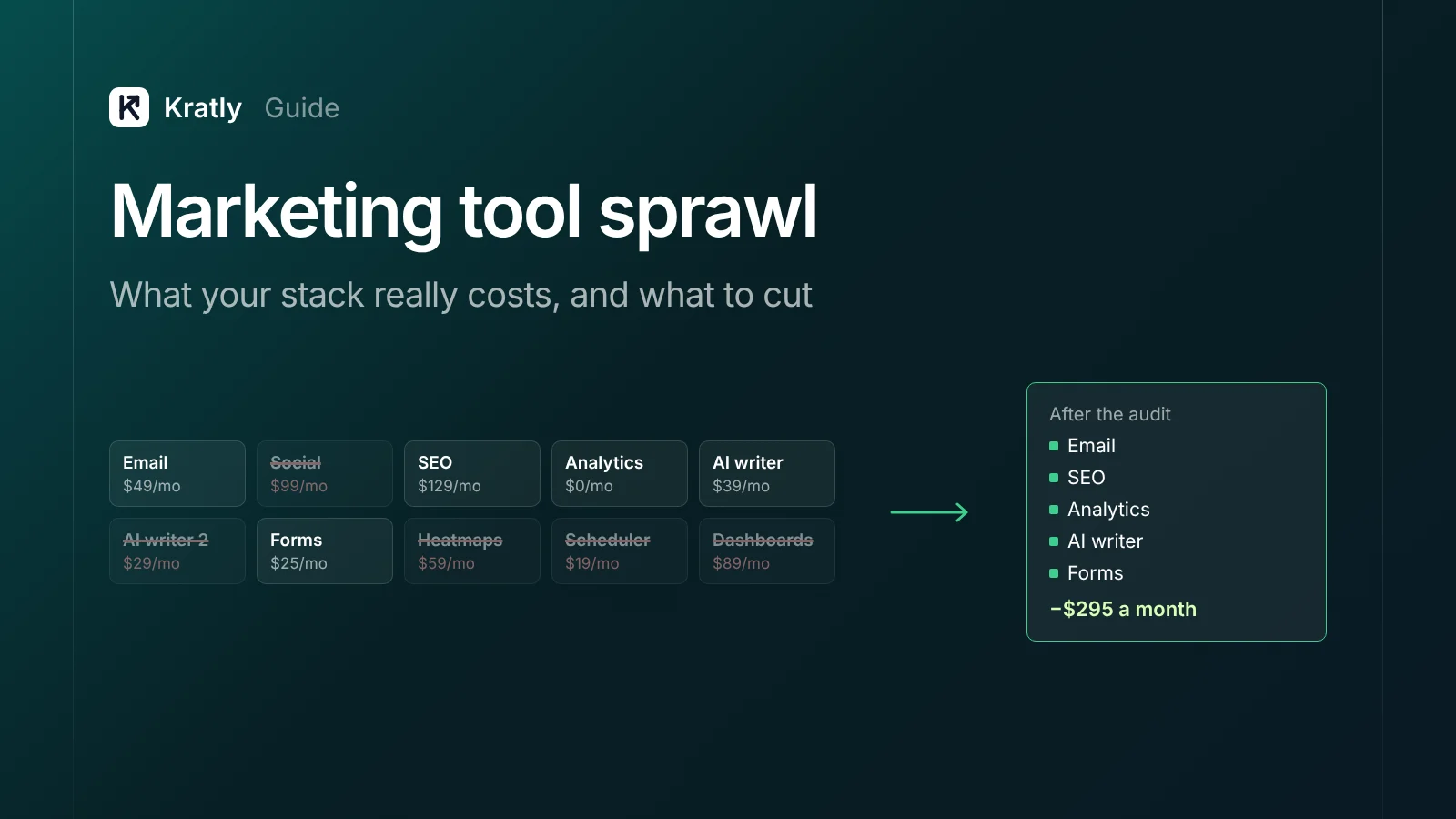
Marketing tool sprawl is when a team pays for more marketing software than it uses or acts on. The cost goes beyond subscriptions: price rises, unused seats, broken integrations, security risk and hours lost switching between apps. Fix it with an audit: list every tool, check usage, ask what decision each one drove, then cut, merge or keep.
It starts innocently. A tool for email, one for social, one for SEO, one for analytics, an AI writer, a second AI writer. One founder counted: "I had 14 paid subscriptions before my first paying customer… like buying office furniture before signing a lease" (Indie Hackers).
Another described stacks that become "Frankenstein monsters that drain more energy than they give back" (Indie Hackers). This guide shows what sprawl really costs and how to cut it without breaking what works.
Signs you have too many marketing tools#
MarTech lists warning signs worth checking (MarTech):
- Different dashboards show different numbers for the same thing
- People ask which tool to use for a task
- Three or more tools do the same job
- You use under 30% of a tool's paid features
- Subscriptions are spread across several company cards
Add one more: nobody can name a decision the tool drove in the last 90 days. That's the clearest sign a tool is reporting, not working.
What your marketing tech stack really costs#
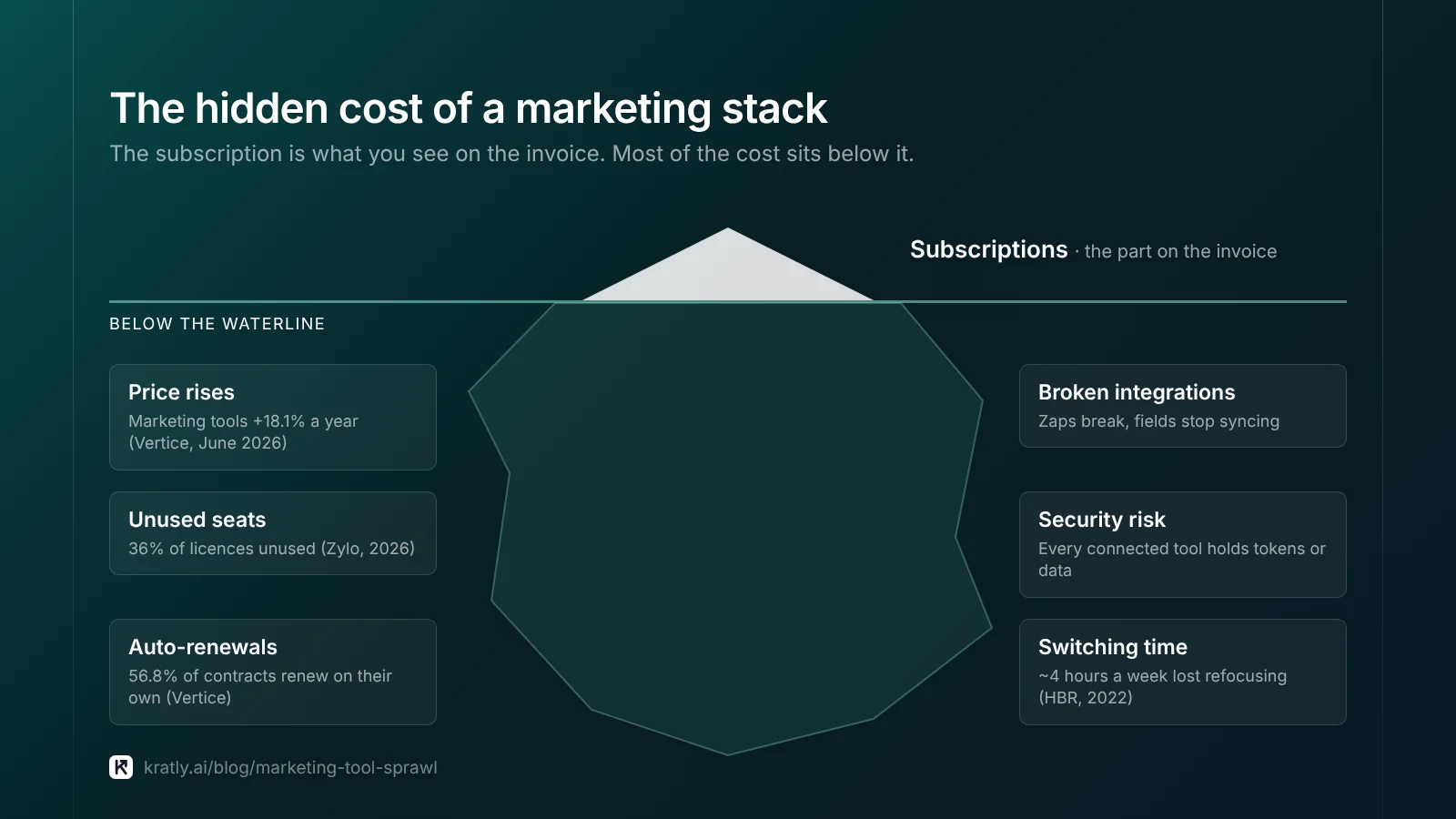
The subscription is the visible part. Here's the rest.
| Hidden cost | What the data says |
|---|---|
| Price rises | SaaS prices rose 16.4% year on year in June 2026, a record in Vertice's index; marketing tools rose 18.1% (Vertice) |
| Auto-renewals | 56.8% of marketing software contracts auto-renew (Vertice, Q3 2026) |
| Unused licences | Companies leave 36% of licences unused against recommended levels (Zylo, 2026) |
| Hidden spend | SaaS bought through expense reports rose 267% year on year (Zylo, 2026) |
| Broken data flow | Only 29% of apps are integrated in large enterprises; IT spends 39% of its time on custom integrations (MuleSoft, 2025) |
| Security risk | Third parties were involved in 30% of breaches, double the year before (Verizon DBIR, 2025) |
| Switching time | Workers switched apps about 1,200 times a day, losing just under 4 hours a week to refocusing (HBR, 2022) |
Two notes. Several of these studies come from vendors that sell SaaS management tools, and the HBR and MuleSoft samples are large companies. But the direction is consistent.
Budgets are tightening too. In Gartner's 2026 CMO Spend Survey, martech fell to 19.4% of the marketing budget, a five-year low, down from 26.6% in 2021 (Chief Marketer). Fewer dollars for tools means each one has to earn its place.
Security is the cost people forget. Every connected marketing tool holds data or access tokens. In the 2025 Salesloft Drift breach, stolen access tokens from a sales chat tool were used to pull customer data from Salesforce (Expert Insights). A tool you forgot about can still be connected.
How to audit your stack in 8 steps#
1. Find every tool#
Pull 12 months of bills, company card statements and expense reports. Check your single sign-on and "Sign in with Google/Microsoft" connections, and browser extensions. Expense reports are where most hidden tools live.
For each tool, record: cost, plan, seats, owner, renewal date and notice period.
2. Check real usage#
Compare seats paid for with people who logged in during the last 30 and 90 days. Note which features you actually use.
3. Ask the decision question#
Ask each owner: "What decision did we make from this tool in the last 90 days?" "We check it sometimes" isn't a decision. A paused campaign, a rewritten page or a changed price is.
4. Map the overlap#
Make a grid with jobs down the side (email, social scheduling, analytics, attribution, forms, SEO, AI writing, design) and tools across the top. Any job with two or more tools needs a choice.
5. Score each tool#
Score cost, usage, how deeply it's connected, what data it holds and how hard it is to replace. Then apply the rules in the next section.
6. Build a renewal calendar#
List every renewal date and notice period, often 30 to 90 days. Set a reminder 120 days before each one. Most surprise renewals happen because nobody remembered the notice period.
7. Plan each change#
Before cancelling: export the data, rebuild any integrations that matter, tell the team, and revoke the tool's access tokens and logins. Cancel at renewal so you don't pay early-exit fees.
8. Calculate the savings#
Cut, merge or keep: how to fix marketing tool sprawl#
| Decision | When | Example |
|---|---|---|
| Cut | Low usage, no decision in 90 days, and another tool does the job | A second social scheduler nobody opened since spring |
| Merge | Your CRM, email platform or an all-in-one tool already does the job at lower total cost | Standalone forms tool replaced by your email platform's forms |
| Keep | It drives revenue decisions, holds your source of truth, or is deeply connected | Billing, CRM, the analytics you report from |
| Replace | It's needed, but costs far more than an alternative for what you use | A premium plan used for one basic feature |
One rule above the others: keep the tools that connect to revenue. If a tool can show which campaigns, pages or emails brought paying customers, it earns its place. If it only reports activity, it's the first to question.
Martech stack consolidation without breaking things#
Consolidation fails when it's treated as a cost cut alone. CMSWire's 2026 take: fix the workflow, not just the vendor list (CMSWire).
Do it in this order:
- Agree the jobs that matter. Usually: get traffic, turn it into sign-ups, turn sign-ups into revenue, and measure which did what.
- Choose one source of truth for revenue. Stripe or your store, joined to campaigns.
- Cut duplicates first. They're the easiest savings with the least risk.
- Merge next, one job at a time. Never switch two critical tools in the same month.
- Review every quarter. Sprawl comes back as soon as you stop looking.
The bigger point: adding tools rarely adds revenue. Acting on what the tools tell you does. Our pillar guide on autonomous growth explains why, and how to close the gap between data and action.
How to do this in Kratly#
Kratly isn't a SaaS management tool. It helps with the part of sprawl that matters most: tools that report but don't act.
- Connect your ad accounts, site and Stripe. Kratly joins activity to revenue in one place.
- See what drives revenue. Find which campaigns, pages and emails bring paying customers.
- Act from one place. Kratly proposes changes, such as negative keywords and follow-up emails, and makes them once you approve, so fewer dashboards need watching.
- Review what you can cut. If a tool's only job was a report Kratly now covers, it's a candidate to cancel.
Deciding between adding a hire, an agency or an AI agent? Read growth marketer vs AI growth agent.
Go deeper: Google Analytics alternatives for SaaS that track revenue
Questions, answered
How many marketing tools is too many?
There's no fixed number. You have too many when several tools do the same job, people aren't sure which to use, dashboards disagree, or nobody can name a decision a tool drove in the last 90 days. Small teams often feel the strain at a dozen tools or fewer.
How do I audit a martech stack?
List every tool from bills, cards, expense reports and SSO. Record cost, seats, owner and renewal date. Compare paid seats with active users, ask what decision each tool drove recently, map overlaps, then cut, merge or keep. Book a renewal calendar and review quarterly.
What does a marketing tech stack cost?
More than the subscriptions. Add price rises (marketing tools rose about 18% in 2026, per Vertice), unused seats, integration upkeep, security risk from connected vendors and time lost switching between apps. Build your own number from bills plus these hidden costs.
How do I consolidate martech without losing functionality?
Start by agreeing the jobs that matter, then cut true duplicates first. Merge one job at a time, export data and rebuild key integrations before cancelling, and revoke access for retired tools. Time changes to renewal dates to avoid early-exit fees.
Why does tool sprawl happen?
Each tool solves a real problem when it's bought, and nobody owns the whole stack. Free trials, expense-report purchases, auto-renewals and new AI tools all add to it. Without a regular audit, tools pile up faster than anyone uses them.
Written by
Priyansh Kumar
Priyansh Kumar has spent more than a decade in growth, scaling brands from 1 to 10 and from 10 to 100. He now builds Kratly, an autonomous growth team that ties every campaign, page and email to the revenue it brings.
Sources
- Vertice: SaaS inflation rate · Auto-renewal clauses
- Zylo: 2026 SaaS Management Index
- Salesforce/MuleSoft: 2025 Connectivity Benchmark
- Verizon: 2025 Data Breach Investigations Report
- Harvard Business Review via Canadian Underwriter: Time lost toggling between applications
- Chief Marketer: Gartner CMO Spend Survey 2026
- MarTech: Signs of too many tools · CMSWire: Martech consolidation in 2026
Was this article useful?