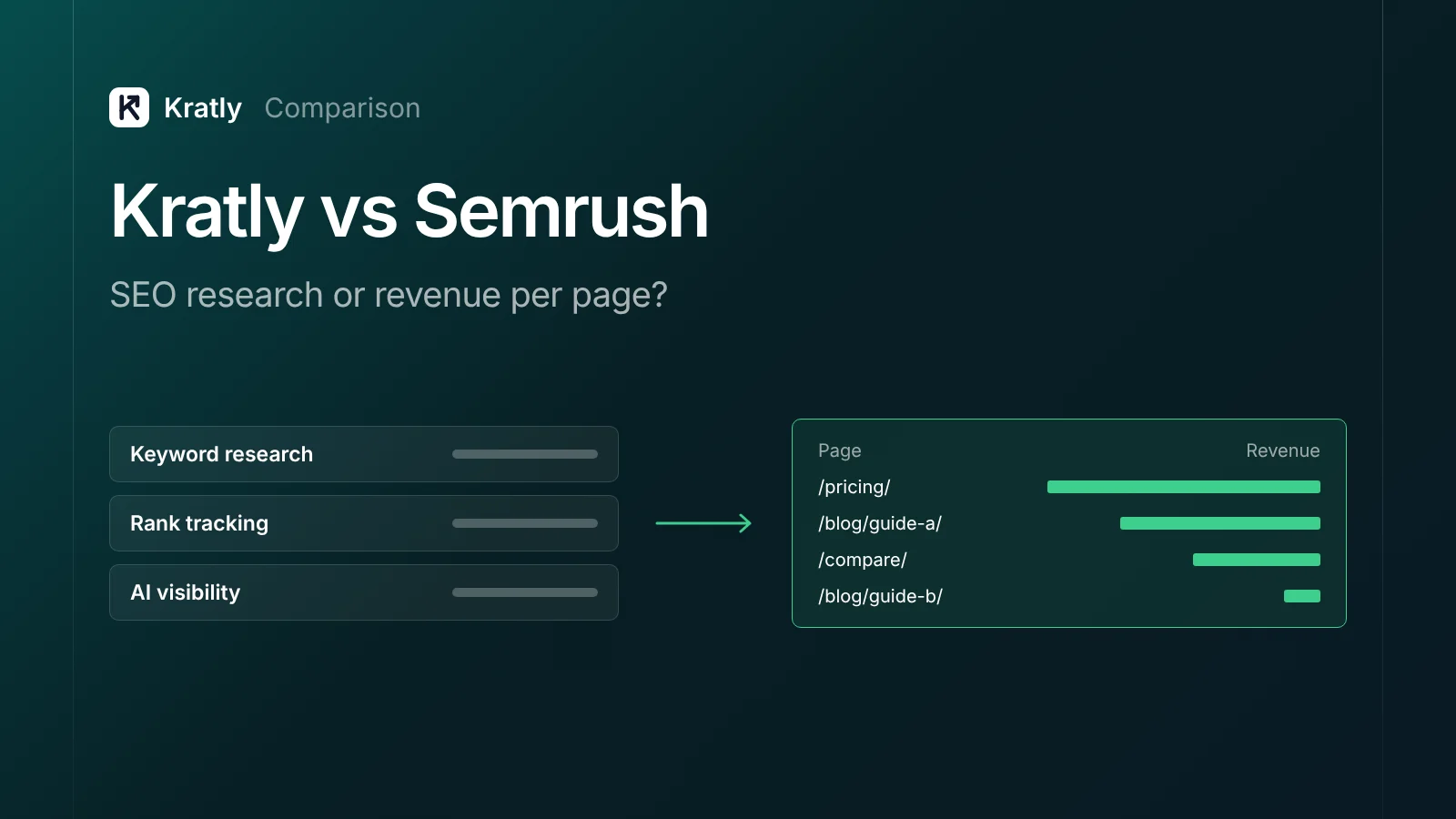
Short answer
Semrush is a full SEO and search research suite: keyword research, rank tracking, site audits, backlinks, competitor research and AI search visibility. Kratly doesn't do most of that. Kratly tells you which pages, campaigns and emails bring paying customers in Stripe, a store or the app stores, then fixes the ones that don't. They solve different problems, so many teams use both. If you need to find keywords and track rankings, choose Semrush.
This is less a head-to-head than most comparisons. Semrush helps you decide what to publish and whether it ranks. Kratly helps you see whether what ranks makes money. The question is which problem you have right now.
A note on bias: Kratly is our product. Every Semrush fact below links to the Semrush page we read in October 2026. Semrush is the stronger tool for SEO research, and we say so.
Who each tool is for#
Semrush is a marketing suite built around search data. Its flagship, Semrush One, bundles the SEO Toolkit and the AI Visibility Toolkit (Semrush). The SEO Toolkit covers "keyword research, site audits, rank tracking, and competitor analysis." Separate toolkits cover local, content, social, advertising and PR (Semrush subscriptions). Its plans range from freelancers and small businesses to agencies and enterprises.
Kratly is an autonomous growth team for smaller SaaS, app and Shopify businesses. It joins ad clicks and site visits to paid revenue. Then it drafts page fixes and content, cuts wasted ad spend and sends follow-up emails, within limits you set.
In short: Semrush is for the person doing SEO and content research. Kratly is for the person who owns the revenue number and needs to know which pages earn it.
What each tool does#
| Semrush | Kratly | |
|---|---|---|
| Core job | Search research, SEO and AI visibility | Revenue by campaign, page and email, then changes to improve it |
| Keyword research | Yes, a core feature | No |
| Rank tracking | Yes: 500 to 5,000+ keywords tracked daily by plan | No; Kratly is not a rank tracker |
| Site audit | Yes, including an "AI-ready" Site Audit | Indexing and sitemap checker; page fixes for pages that don't convert |
| Backlinks and competitor research | Yes | Competitor research on Scale |
| AI search visibility | Google AI Overviews, AI Mode, ChatGPT, Gemini, Perplexity | Free AI search audit for Google AI Overviews only |
| Content tools | SEO Writing Assistant, Topic Research on some plans | Content drafts and page fixes |
| Ads | Advertising Toolkit: competitor ad research, AI recommendations | Connects Google, Microsoft and Meta; finds wasted spend and proposes negatives and budget shifts |
| Revenue data | Not described on the plan pages we read | Stripe, Shopify, App Store and Google Play |
| Makes changes | Research and recommendations | Suggest, Ask first or Autopilot within limits, logged and undoable |
| Free option | Free plan with 10 reports a day; 7-day trial on paid plans | 14-day trial and free tools |
Semrush sources: SEO and AI Search pricing, Semrush One, Advertising Toolkit pricing, all as of October 2026.
Semrush pricing vs Kratly pricing#
Semrush has changed its plan names, and both old and new names appear on its site. As of October 2026, the main pricing page lists these SEO and AI search plans (Semrush pricing):
| Plan | Monthly | Per month, billed yearly | Key limits |
|---|---|---|---|
| Free | $0 | $0 | 1 demo project, 10 reports a day |
| SEO | $139 | $117.33 | 5 websites, 500 keywords tracked daily |
| Starter | $199 | $165.17 | 5 websites, 500 keywords, 50 AI prompts daily |
| Pro+ | $299 | $248.17 | 15 websites, 1,500 keywords, 100 AI prompts daily |
| Advanced | Custom | Custom | 40+ websites, 5,000+ keywords, unlimited AI prompts |
| Enterprise | Custom | Custom | Custom limits |
Semrush's help center still lists the SEO Toolkit as Pro at $139.95, Guru at $249.95 and Business at $499.95 a month (Semrush SEO Toolkit). Check which plans you're offered at sign-up.
Other costs to plan for:
- Extra users start at $45 a month on plans with the SEO Toolkit (Semrush subscriptions).
- The Advertising Toolkit is separate: Base $99 and Pro $220 a month, billed annually (Semrush Advertising).
- Annual billing saves up to 17%. Paid plans have a 7-day free trial.
Kratly has four plans: Starter $49/month, Growth $199/month, Scale $599/month and Enterprise custom, with a 14-day free trial.
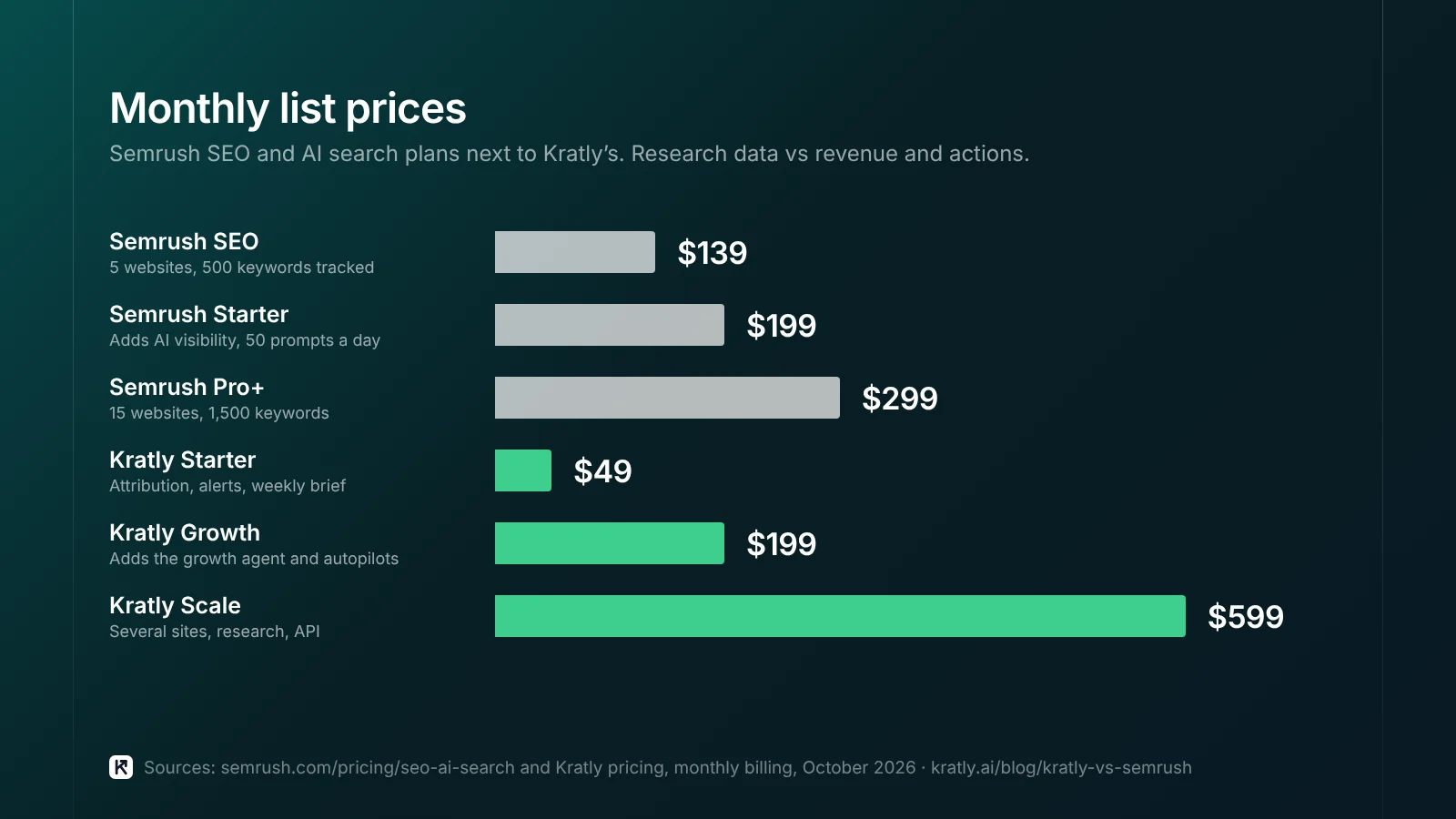
The prices sit in a similar range. But you're not choosing between equivalents. A Semrush plan buys research data. A Kratly plan buys revenue attribution and changes made for you.
Where Semrush is better#
For SEO work, Semrush is the better tool by a wide margin.
- Keyword and competitor research. Finding what to write, who ranks and why is Semrush's core. Kratly doesn't offer keyword research.
- Rank tracking. Semrush tracks hundreds to thousands of keywords daily, with location and device tracking on Pro+. Kratly is not a rank tracker.
- Technical SEO audits. Semrush crawls up to 1,000,000 pages a month on the Business SEO Toolkit plan. Kratly's free checker covers indexing and sitemaps, not a full crawl.
- AI search beyond Google. Semrush tracks visibility in ChatGPT, Gemini and Perplexity as well as Google. Kratly's free AI search audit covers Google AI Overviews only.
- Breadth. Local, content, social, PR and advertising research toolkits are available as add-ons.
- A free plan. You can run 10 reports a day without paying.
Choose Semrush if organic search is your main channel and you need to research keywords, track rankings and audit a large site. Our SaaS SEO strategy guide shows what to do with that research.
Where Kratly is better#
- Revenue per page. Kratly follows each paying customer back to the page they first landed on. Rankings and traffic don't tell you that. Semrush's plan pages don't describe connecting Stripe or store revenue.
- Paid and organic in one view. Kratly ranks campaigns, pages and emails by the revenue they bring, using first touch, last touch or linear.
- It does the work. Kratly drafts fixes for pages that don't convert, writes content drafts and sends follow-up emails via your SendGrid. You choose Suggest, Ask first or Autopilot within limits.
- Ads clean-up. Kratly finds search terms that spend without paying customers and proposes negatives. Semrush's Advertising Toolkit focuses on research and recommendations.
- Proof in revenue. Changes are measured against a control group, not just before and after.
Choose Kratly if you already get traffic but can't tell which pages, campaigns or emails bring paying customers. It also fits when you need someone to act on it.
Can you use both?#
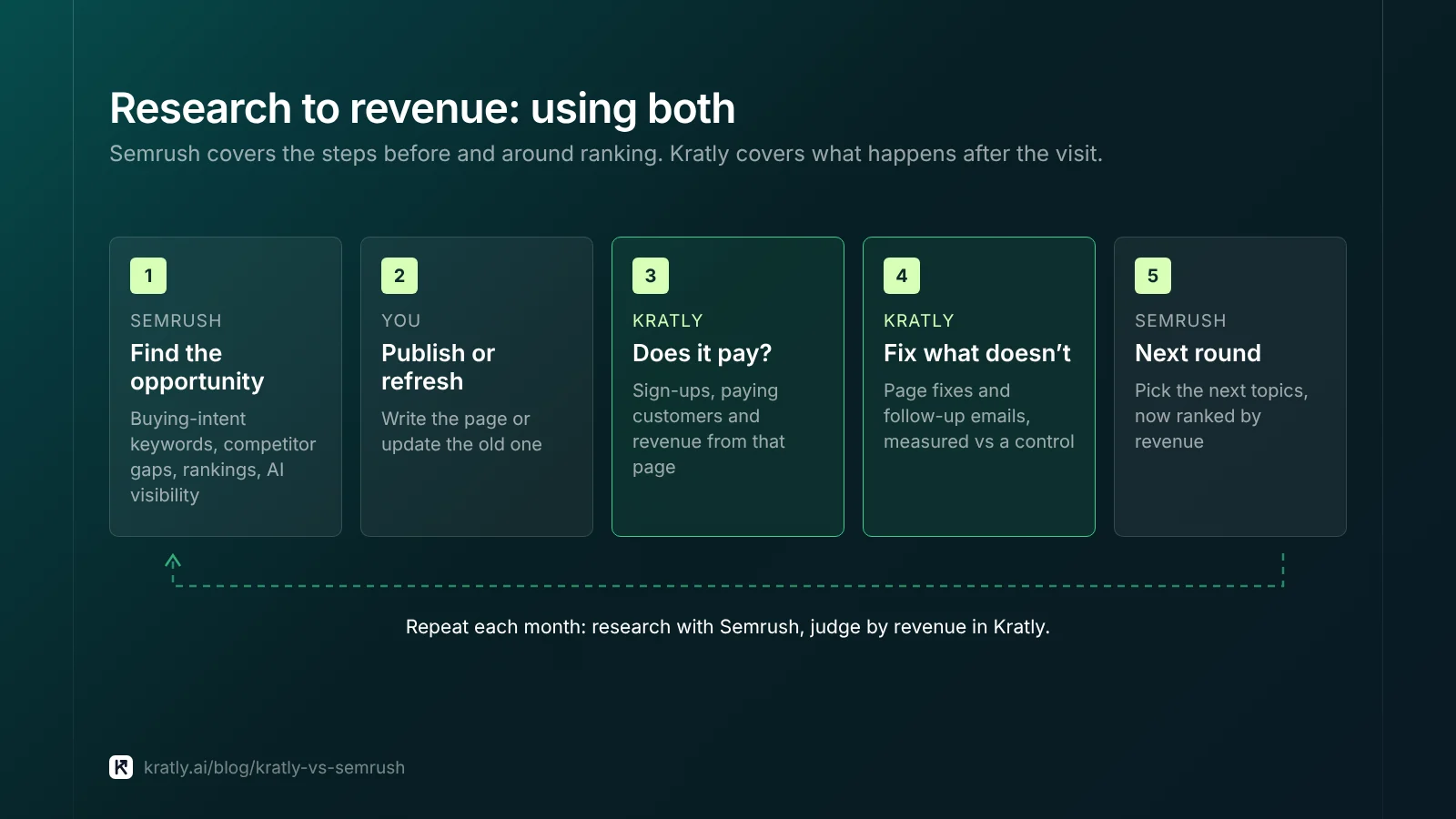
Yes, and for many SaaS teams this is the best setup. They fit together with little overlap:
- Semrush finds the opportunity. Keywords with buying intent, gaps against competitors, pages losing rankings.
- You publish or refresh the page. See our guide to content refresh SEO.
- Kratly shows if it pays. Sign-ups, paying customers and revenue from that page.
- Kratly fixes what doesn't. Page fixes and follow-up emails for pages that rank but don't convert.
- Back to Semrush for the next round, now prioritized by revenue, not traffic.
The only overlap is AI search. Semrush covers more assistants. Kratly's free audit is enough if Google AI Overviews are your main concern. Our AI search visibility guide covers the manual checks for other assistants.
How to decide#
If most of your ticks are research questions, start with Semrush. If they're about revenue and action, start with Kratly. If both, use both.
How to do this in Kratly#
- Connect your site and revenue source. Add the Kratly tracker and link Stripe, Shopify or your app store.
- See revenue by landing page. Kratly shows which pages paying customers first arrived on, with revenue per page.
- Find pages that rank but don't pay. Compare high-traffic pages with the revenue they bring.
- Let Kratly draft the fixes. Page fixes and content drafts, run as Suggest, Ask first or Autopilot within limits.
- Measure. Kratly compares each change against a control, in paying customers and revenue.
Check Google first with the free AI search audit. It shows which of your buyer searches get a Google AI Overview, and who it cites.
Questions, answered
Is Kratly a Semrush alternative?
Not for SEO research. Kratly has no keyword research, backlink data or rank tracking. It complements Semrush by showing which pages bring paying customers and fixing the ones that don't. Most teams that need both use both.
How much does Semrush cost?
As of October 2026, Semrush's pricing page lists SEO at $139, Starter at $199 and Pro+ at $299 a month. Advanced and Enterprise are custom. There's also a free plan. Annual billing saves up to 17%, and extra users start at $45 a month.
Does Kratly track keyword rankings?
No. Kratly is not a rank tracker. It measures revenue by page, campaign and email. Use Semrush or Google Search Console for rankings.
Can Semrush show revenue per page?
The Semrush plan pages we read don't describe connecting Stripe or store revenue. For revenue per landing page, you need a tool that joins visits to payments, like Kratly, or your own analytics setup.
Which is better for AI search visibility?
Semrush covers more assistants: Google AI Overviews, AI Mode, ChatGPT, Gemini and Perplexity. Kratly's free AI search audit covers Google AI Overviews only. If you need several assistants tracked daily, use Semrush.
Written by
Priyansh Kumar
Priyansh Kumar has spent more than a decade in growth, scaling brands from 1 to 10 and from 10 to 100. He now builds Kratly, an autonomous growth team that ties every campaign, page and email to the revenue it brings.
Sources
- Semrush: SEO and AI Search plans and pricing · SEO Toolkit pricing and limits · What is Semrush One? · Subscription plans and toolkits · Advertising Toolkit pricing (all as of October 2026)
- Kratly: pricing page (plans and 14-day trial)
Was this article useful?