Short answer
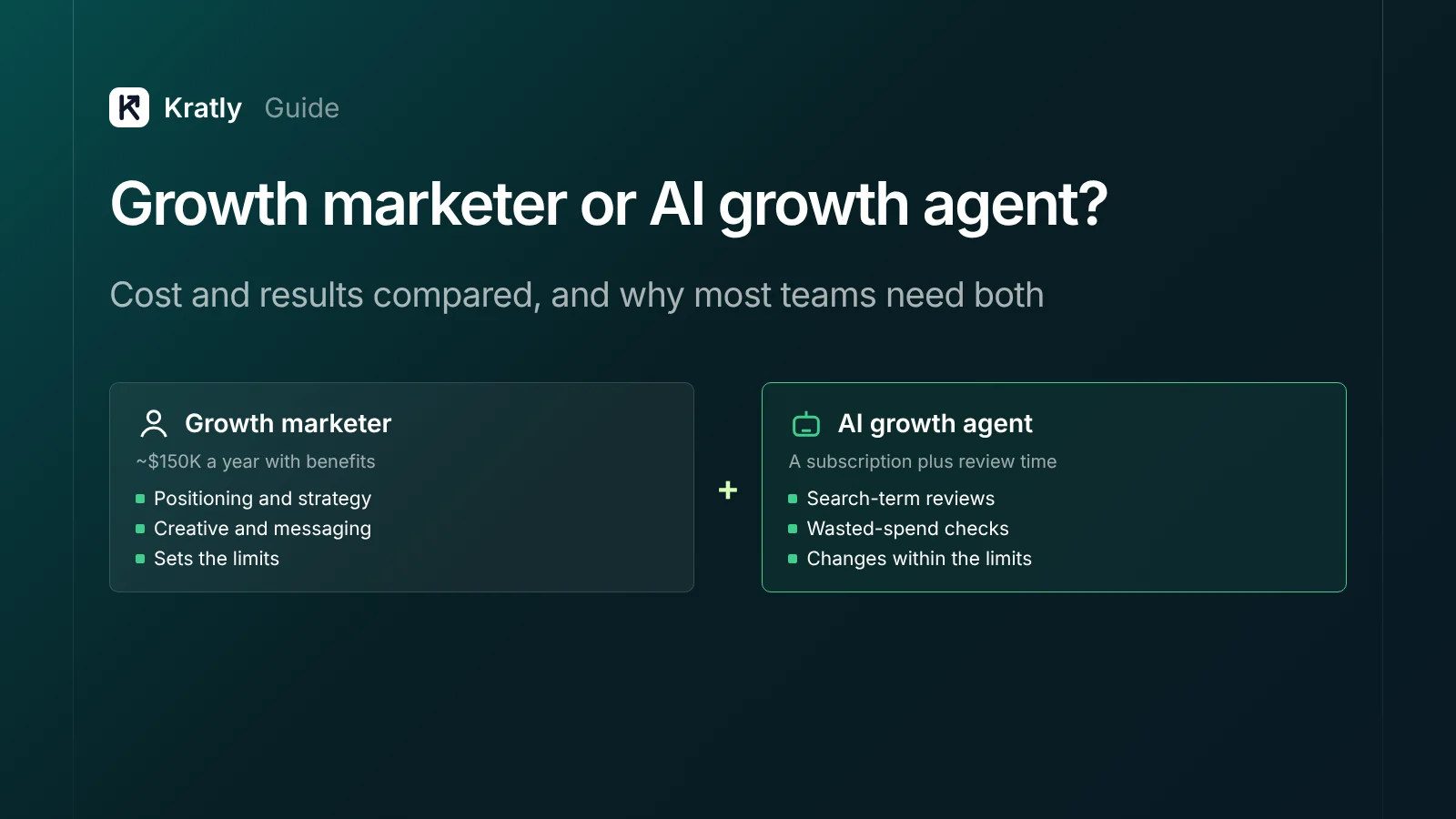
A US growth marketing manager costs around $150,000 a year once benefits are included. An agency typically charges 10–20% of ad spend. An AI growth agent costs far less and handles repetitive analysis and account changes well. It can't set positioning or own strategy. For most teams spending $10k to $100k a month, a person plus an agent beats either alone.
You know you need help with growth. The question is what kind. One bootstrapped founder put the fear well: "I don't want to spend a limited budget just to get busier without bringing in customers who stick around" (Indie Hackers). Another, after a 90-day agency program on a $5K retainer, said the results "were shit" (r/DigitalMarketing).
This guide compares the options on cost, speed and results, using independent data where we can find it.
A note on bias: Kratly sells an AI growth agent. We've tried to be fair, used outside sources for every number, and said plainly where AI falls short.
What each option really costs#
| Option | Typical US cost | Source |
|---|---|---|
| Growth marketing manager (base salary) | $105,000 median; range $72K–$144K | Payscale, 2026 |
| Growth marketer (base salary) | $123,799 average | Indeed, 2026 |
| Head of growth, seed to Series A | $130K–$180K plus equity | Growth.Talent, 2026 (job-board data) |
| Marketing manager, all types (BLS) | $166,790 median | BLS, May 2025 |
| PPC or growth agency | 10–20% of ad spend, or about $500–$2,000/month flat for smaller accounts | AgencyAnalytics, 2025 |
| Freelancer (expert) | $60–$120+ per hour | Upwork |
| AI growth agent | A software subscription, plus your team's time to review and manage it | Varies by vendor |
Salary isn't the full cost of a hire#
Benefits make up about 31.5% of total pay for management and professional roles in US private industry (BLS, June 2026). That puts the loaded cost at roughly 1.46 times base salary:
- $105,000 base → about $153,000 a year
- $166,790 base → about $243,000 a year
That's before recruiting fees, equity, tools and the months before a new hire is fully up to speed.
An AI agent isn't free either#
The subscription is the small part. The real cost is management time. SaaStr, which runs more than 20 AI agents, reported that its AI "VP of marketing" needs 30+ minutes of training and fixes every day, and that "AI agents require about as much management time as humans" (SaaStr, 2026). Budget for that time.
Growth marketing agency cost at your ad spend#
Percentage fees look reasonable until you apply minimums. Here's what 10–20% of spend means, alongside common minimum retainers of $1,000 to $3,000 a month (Credo, older data from 2019).
| Monthly ad spend | 10–20% fee | Effect of a $1K–$3K minimum |
|---|---|---|
| $5,000 | $500–$1,000 | The minimum applies: you pay 20–60% of spend |
| $25,000 | $2,500–$5,000 | Fee usually above the minimum |
| $50,000 | $5,000–$10,000 | Approaches the monthly cost of a senior hire |
| $100,000 | $10,000–$20,000 | Often more than a full-time growth lead |
Our arithmetic from the published ranges; your quotes will vary.
The pattern: at low spend, minimums make agencies expensive per dollar. At high spend, percentage fees can cost more than hiring. In the middle, agencies can make sense, especially for specialist skills like paid social creative.
One more thing to check: how the agency measures success. A common complaint is agencies claiming credit for sales that would have happened anyway, for example by "investing more and more in remarketing campaigns" (Indie Hackers). Ask for results measured on your revenue, not platform conversions.
How fast each option gets going#
Hiring takes time. SHRM's 2026 benchmark puts the median time to fill a non-executive role at 39 days (SHRM). LinkedIn data from 2023 put marketing roles at about 48 days (Tulane). Add a few months for a new hire to learn your product, customers and data.
Agencies start in weeks, but also need time to learn your business.
An AI agent can start analysing in days, once it's connected to your ad accounts and revenue data. But it's only as good as that data. In Gartner's 2025 survey, 50% of martech leaders said their tech and data stack wasn't ready for AI agents (Gartner). If you can't tie revenue to campaigns yet, fix that first: see our SaaS marketing attribution guide.
What AI growth agents do well, and where they fail#
The best evidence on AI at work is a 2023 Harvard and BCG study of 758 consultants. On tasks inside AI's capabilities, people using AI completed 12.2% more tasks, 25.1% faster, with more than 40% higher quality. On a task outside those capabilities, they were 19 percentage points less likely to get it right (Dell'Acqua et al.). The study called this a "jagged frontier."
Those were consulting tasks, not marketing. But the lesson carries: AI is excellent at some jobs and confidently wrong at others.
Where AI growth agents do well:
- Reviewing thousands of search terms and finding the ones that waste money
- Making bid, budget and negative-keyword changes within set limits
- Watching for sudden drops or spikes, every hour
- Joining ad data to revenue and reporting it
- Producing creative variations to test
Where they fail:
- Over-promising. 45% of martech leaders said vendor AI agents fell short of the business performance promised (Gartner, 2025).
- Acting outside their lane. SaaStr logged four agent incidents in one week, including "an unauthorized A/B test that gave away free tickets" (SaaStr).
- Scaling without proving value. McKinsey's 2025 survey found no more than 10% of respondents in any single business function were scaling AI agents, and only 39% reported any profit impact from AI (McKinsey).
The guardrails that make agents safe, such as approval steps, spend caps and rollback, are covered in our autonomous growth guide.
What a human growth marketer does better#
- Positioning and offer. Who you're for, what you say, and what you charge.
- Original creative ideas. The concept, not the twenty variations of it.
- Choosing what to stop. Killing a channel the team loves takes judgement and authority.
- Partnerships and relationships. Co-marketing, communities, podcasts, sales alignment.
- Questioning the numbers. Spotting when a "win" is really brand traffic or a tracking bug.
- Owning the target. Someone has to be accountable for the revenue number.
SaaStr's own conclusion was similar: judgement, relationships and creative decisions remained human work.
Growth marketer vs AI: which fits your stage?#
| Your situation | Suggested setup | Why |
|---|---|---|
| Before product–market fit, under $10k/month ads | Founder + AI agent, with a few hours of expert advice | Agency minimums eat your budget; you need to learn the market yourself |
| One channel working, $10k–$40k/month | AI agent + one mid-level growth marketer | The agent handles account work; the person owns tests and messaging |
| Several channels, $40k–$100k/month | Senior growth lead + AI agents for execution | A person owns the number; agents keep accounts clean daily |
| Need a specialist skill (e.g. paid social creative) | Specialist agency or freelancer for that piece | Cheaper than hiring for a narrow skill |
| Revenue not yet tied to campaigns | Fix measurement first | Neither a person nor an agent can optimise what they can't see |
This table is our judgement, based on the costs above. Your mix may differ.
The model that works for most teams: a human owns the revenue target and makes the calls. An AI agent does the repetitive analysis and account changes, within limits that person sets. That's cheaper than a larger team and safer than an agent alone. If your stack has grown faster than your results, read what your marketing stack really costs and what to cut.
How to do this in Kratly#
Kratly is built to work alongside a growth marketer or founder, not replace their judgement.
- Connect your ad accounts and Stripe. Kratly starts from paid revenue.
- Kratly does the daily account work. Search term reviews, wasted-spend checks, budget checks and reporting.
- You approve what matters. Kratly proposes each change; you approve it, or let autopilot approve small, safe ones.
- See results in revenue. Every change is measured against a control, in paying customers and revenue.
Go deeper: Fractional CMO vs AI agent vs agency: cost and what you get
Questions, answered
Can AI replace a growth marketer?
Not fully. AI agents handle repetitive analysis, account changes and monitoring well, but they don't set positioning, invent strong creative ideas or own a revenue target. Research shows AI raises quality on suitable tasks and lowers it on unsuitable ones. A person plus an agent usually works best.
How much does it cost to hire a growth marketer in the US?
A growth marketing manager's median base salary is about $105,000, according to Payscale. With benefits, which are about 31.5% of total pay for professional roles, the cost is around $150,000 a year, before recruiting, equity and tools.
How much does a growth marketing agency cost?
Paid media agencies typically charge 10–20% of monthly ad spend, or a flat fee of about $500 to $2,000 a month for smaller accounts. Many have minimum retainers of $1,000 to $3,000, which makes them expensive for small budgets.
When should a startup hire its first growth marketer?
Usually once at least one channel shows it can bring paying customers and you have budget to scale it. Before that, founders often learn more by running early tests themselves, with AI tools and occasional expert advice.
Is an AI growth agent worth it for a small team?
It can be, if it connects to your revenue data, makes changes within limits you set, and saves more time than it takes to manage. Check that it measures results in paying customers, not activity, and start with one narrow job such as cutting wasted ad spend.
Written by
Priyansh Kumar
Priyansh Kumar has spent more than a decade in growth, scaling brands from 1 to 10 and from 10 to 100. He now builds Kratly, an autonomous growth team that ties every campaign, page and email to the revenue it brings.
Sources
- Payscale: Growth Marketing Manager salary · Indeed: Growth marketer salaries · Growth.Talent: Growth marketing salary guide
- US Bureau of Labor Statistics: Marketing managers · Employer costs for employee compensation, June 2026
- AgencyAnalytics: PPC pricing · Credo: PPC pricing survey · Upwork: Hourly rates
- SHRM: Recruiting benchmarks
- Gartner: Martech leaders on AI agents (Oct 2025)
- SaaStr: We built an AI VP of Marketing
- McKinsey: The state of AI 2025
- Dell'Acqua et al. (Harvard/BCG): Navigating the jagged technological frontier
Was this article useful?