Short answer
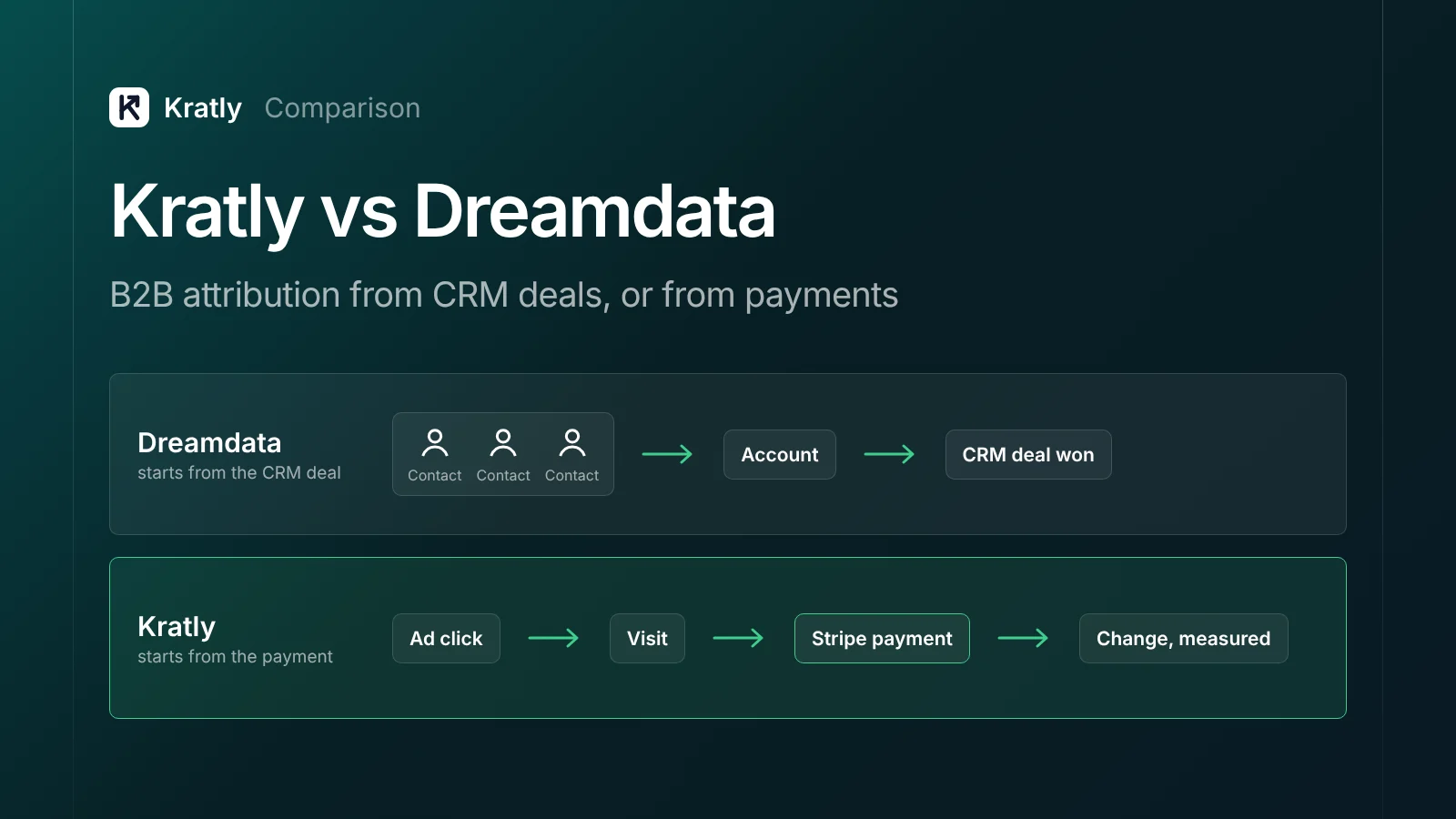
Dreamdata is B2B attribution built around your CRM. It groups touches by account and credits deals and pipeline, which suits sales-led companies with long cycles. Kratly ties ad clicks and visits to Stripe, store or app-store payments, then acts: it cuts wasted spend, fixes pages and sends follow-up emails, measured against a control. Sales-led with a CRM at the center: Dreamdata. Self-serve revenue in Stripe: Kratly.
Both tools answer "which marketing brought this revenue?" The difference is where each looks for the revenue, and what each does with the answer.
A note on bias: Kratly is our product. Every fact about Dreamdata below comes from Dreamdata's own pricing page, website and documentation, checked in October 2026 and linked inline.
Who each tool is for#
Dreamdata positions itself as "attribution for B2B SaaS companies" (Dreamdata). It tracks people on your site, then "sorts all your recorded touches by the accounts they belong to." Its setup guide asks you to install a tracking script and plug in your tech stack, "particularly your CRM" (Dreamdata docs).
That makes it a natural fit for sales-led B2B teams. Think demo requests, opportunities in Salesforce or HubSpot, buying committees and quarter-long cycles. Marketing ops teams that want to show pipeline influence to a board are its core audience.
Kratly is for SaaS, ecommerce and app teams whose revenue lands in Stripe, a store or an app store. It ties each payment back to the campaign, page and email that led to it, then makes changes to improve it. It is not a CRM, not a full product analytics suite and not an account-based marketing platform.
What each does, side by side#
| Dreamdata | Kratly | |
|---|---|---|
| Core job | B2B account journeys and revenue attribution | Revenue attribution plus an agent that makes changes |
| Revenue source | CRM deals: "expected revenue of deal created or actual revenue of deal won" | Stripe, Shopify and app-store payments |
| CRMs | Salesforce, HubSpot, Microsoft Dynamics, Pipedrive | Not a CRM; reads payments directly |
| Unit of analysis | Contacts grouped into accounts | Customers and payments |
| Attribution models | Ten built in (first, last, linear, U-shaped, W-shaped, plus non-direct versions); custom and AI models on paid plans | First touch, last touch, linear |
| Ad sources | Google, Meta, LinkedIn, Microsoft, X, NextRoll, G2, Capterra | Google Ads, Microsoft Ads, Meta (Conversions API); LinkedIn coming soon |
| Company identification | Yes, "up to 80% of companies," per Dreamdata | No |
| Audiences and activation | Audience builder; Activation add-on syncs audiences to ad platforms | Not offered |
| Makes changes | Audience syncs and sales alerts | Negatives, budget shifts, page fixes, follow-up emails; Suggest, Ask first or Autopilot |
| Proves the result | Attribution and ROI reporting | Each change measured against a control group |
Dreamdata facts: pricing, SaaS attribution, setup guide, revenue attribution docs. All checked October 2026.
Why the revenue source matters#
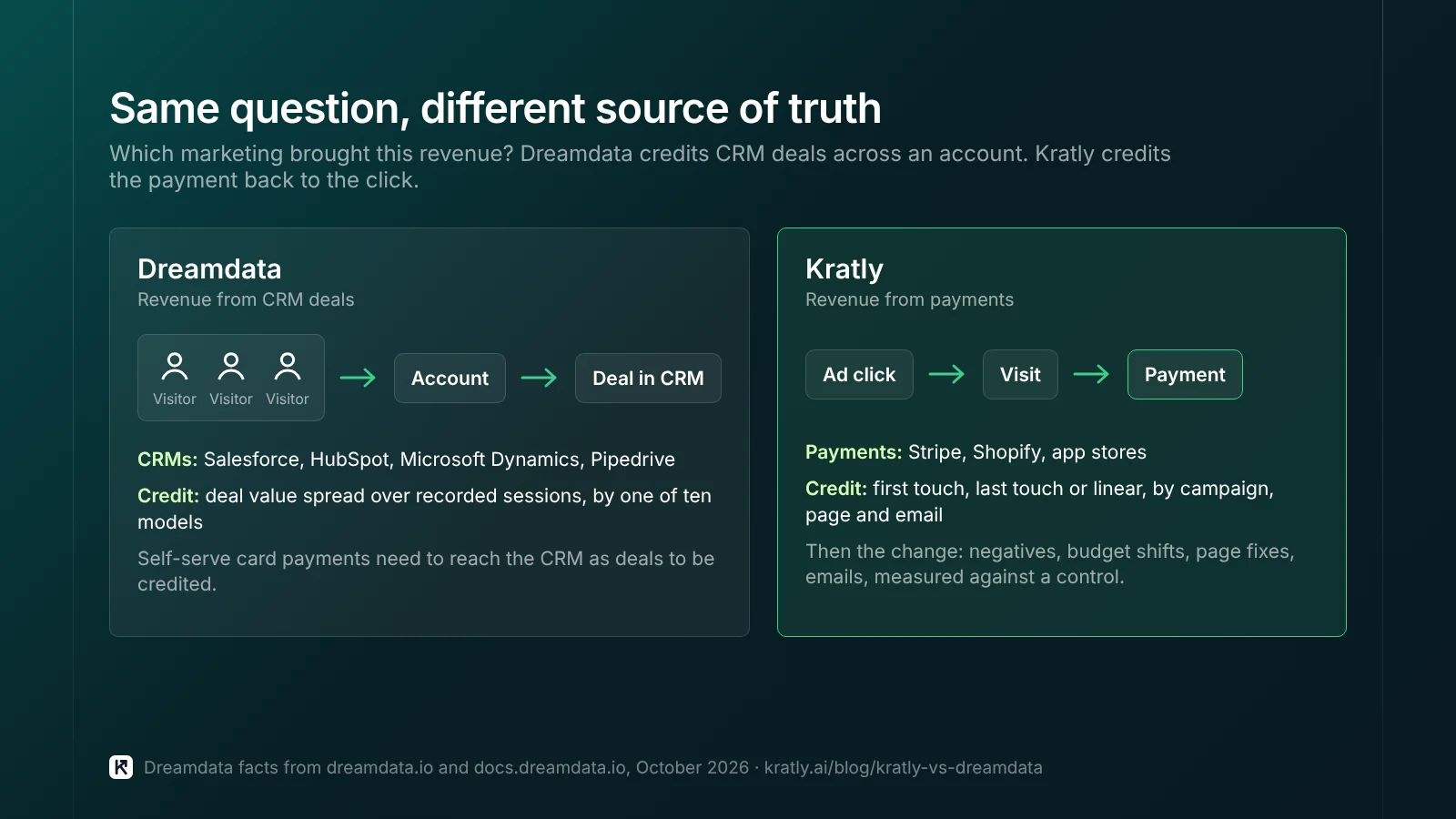
Dreamdata's documentation is clear that its value comes from your CRM. Deals are attributable only "where we have a recorded history of sessions" (Dreamdata docs). That works well when sales reps log every deal.
It works less well when most customers never talk to sales. A self-serve SaaS customer who starts a trial and pays by card may never become a CRM deal. In that case, the money is in Stripe, and Stripe is where attribution should start. We found no native Stripe connection in Dreamdata's documentation. Its ecommerce tracking runs through the tracking script or Zapier (Dreamdata docs).
Pricing as of October 2026#
| Dreamdata | Kratly | |
|---|---|---|
| Free or entry plan | Free: $0, B2B web analytics, company identification, engagement scoring, ad spend report | Starter: $49/month |
| Free plan limits | 2 months of user history, 5 seats, 3 stage models, 2 notifications, 1 sync; free until you exceed the monthly tracked-user limit | No free plan; free tools available |
| Paid plan | Advanced: custom price via demo; attribution models, revenue analytics, ROI/ROAS reports | Growth: $199/month; Scale: $599/month |
| Add-ons | Activation, data warehouse, SCIM | None needed for core features |
| Onboarding | Advanced includes full onboarding, a dedicated CSM and technical manager | Self-serve; Enterprise adds dedicated onboarding |
| Try first | Free plan; guided trial on Advanced | 14-day free trial |
Dreamdata pricing: dreamdata.io/pricing, checked October 2026. Dreamdata doesn't publish Advanced prices. Kratly pricing is on our pricing page.
The free plan is a real strength. You can install Dreamdata's tracking and see which companies visit without paying. Attribution models and revenue reporting, though, are listed under Advanced on the pricing page.
Where Dreamdata is better#
- Sales-led B2B. If revenue is a closed-won opportunity in Salesforce or HubSpot, Dreamdata reads it where it lives.
- Account-level journeys. It groups many contacts into one account, which suits buying committees.
- More attribution models. Ten built-in models, including U-shaped and W-shaped, plus custom and AI models. Kratly offers three.
- Company identification. Dreamdata identifies visiting companies from anonymous traffic. Kratly does not.
- Review-site and niche ad sources. G2, Capterra, X and NextRoll are listed sources.
- ABM activation. Its Activation add-on builds audiences and syncs them to ad platforms, with sales alerts on engaged accounts.
- Data team access. BigQuery and data warehouse options suit teams that model data themselves.
- A free tier. You can start at $0.
Where Kratly is better#
- Payments, not deals. Kratly starts from the Stripe, Shopify or app-store payment. Self-serve customers who never become a CRM deal still count.
- It acts on the numbers. Kratly reviews search terms, proposes negatives and budget shifts, drafts page fixes and sends follow-up emails through your SendGrid. You choose Suggest, Ask first or Autopilot, within limits.
- It proves lift. Each change is measured against a control group. Attribution shows correlation; a holdout shows what the change caused. See did my marketing change work?
- Published prices. Kratly lists $49, $199 and $599 plans. Dreamdata's paid plan needs a demo.
- Faster start for small teams. No CRM, sales process or marketing ops hire needed. Connect ads and Stripe, and the first view comes from real payments.
- Ecommerce and apps. Shopify and app-store revenue sit in the same model as Stripe.
Can you use both?#
Yes, and for hybrid companies it can make sense. Many SaaS businesses have a self-serve plan and a sales-led enterprise plan.
- Dreamdata covers the sales-led side: accounts, opportunities and pipeline influence.
- Kratly covers the self-serve side: Stripe revenue by campaign, wasted-spend cleanup, page fixes and trial follow-up emails.
Agree in advance which tool reports which number. Otherwise two dashboards will credit the same campaign with different revenue, and the meeting turns into a debate about tools.
How to decide#
| If this sounds like you | Choose |
|---|---|
| Demo-led sales, deals tracked in Salesforce or HubSpot, cycles of months | Dreamdata |
| Account-based marketing with target account lists | Dreamdata |
| Self-serve SaaS, most revenue paid by card in Stripe | Kratly |
| Small team with no marketing ops hire, wanting changes made for you | Kratly |
| Ecommerce or app revenue alongside SaaS | Kratly |
| Self-serve plan plus an enterprise sales team | Both, with clear ownership of each number |
This table is our judgement from the facts above.
How to do this in Kratly#
- Connect your ad accounts and Stripe. Link Google Ads, Microsoft Ads or Meta, and Stripe. Kratly joins clicks and visits to payments.
- See revenue by campaign and page. Compare first touch, last touch and linear to spot where credit is contested.
- Approve the fixes. Kratly proposes negatives, budget shifts, page fixes and follow-up emails. Run them as Suggest, Ask first or Autopilot.
- Measure the lift. Each change is compared with a control group, logged and undoable.
For the measurement basics behind this, read SaaS marketing attribution and attribution models compared.
Questions, answered
Is Kratly a Dreamdata alternative?
For self-serve SaaS, yes. Both attribute revenue to marketing. Dreamdata reads revenue from CRM deals and groups touches by account. Kratly reads it from Stripe, store and app-store payments, then makes changes and measures them. Sales-led B2B teams are usually better served by Dreamdata.
How much does Dreamdata cost?
As of October 2026, Dreamdata has a free plan with B2B web analytics, company identification and an ad spend report, limited to 2 months of history and 5 seats. Its Advanced plan, with attribution and revenue analytics, is priced on request after a demo.
Does Dreamdata need a CRM?
Its setup guide tells you to connect your tech stack, "particularly your CRM." Revenue in its attribution reports comes from CRM deal values. Supported CRMs include Salesforce, HubSpot, Microsoft Dynamics and Pipedrive.
Does Dreamdata connect to Stripe?
We didn't find a native Stripe connection in Dreamdata's documentation as of October 2026. Its ecommerce order tracking uses the tracking script or Zapier. Ask Dreamdata directly if card payments are most of your revenue.
Which attribution models does each tool offer?
Dreamdata lists ten built-in models, including first touch, last touch, linear, U-shaped and W-shaped, plus custom models. Kratly offers first touch, last touch and linear, and tests big decisions with control groups.
Written by
Priyansh Kumar
Priyansh Kumar has spent more than a decade in growth, scaling brands from 1 to 10 and from 10 to 100. He now builds Kratly, an autonomous growth team that ties every campaign, page and email to the revenue it brings.
Sources
- Dreamdata: Pricing · Free plan · SaaS marketing attribution
- Dreamdata documentation: Setting up Dreamdata · Revenue attribution · E-commerce order tracking
- Kratly: Pricing
Was this article useful?