Short answer
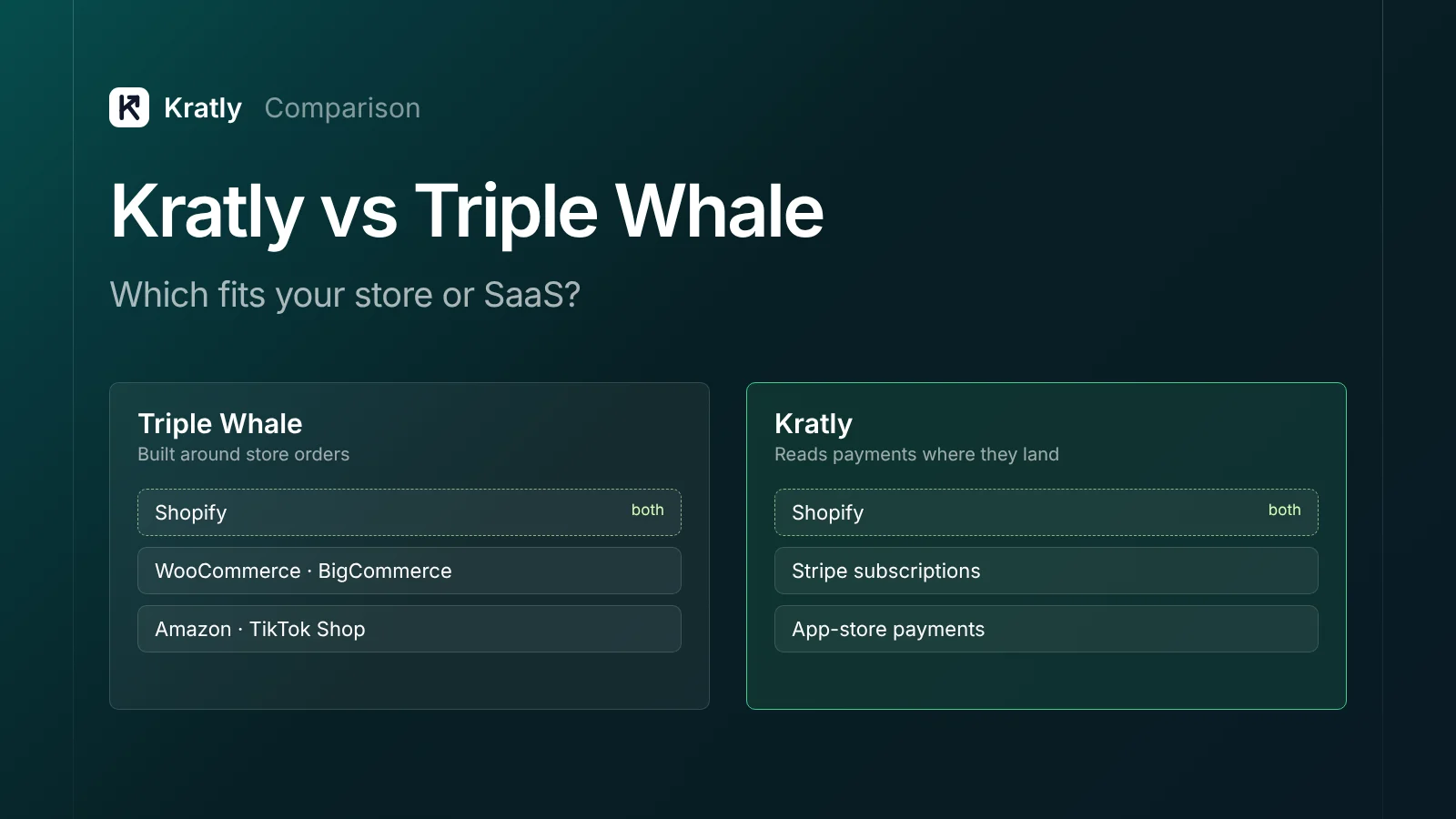
Triple Whale is an ecommerce analytics and attribution platform. For a Shopify brand that wants deep order attribution, benchmarks and media mix modeling, it's the stronger choice. Kratly ties ad spend to Stripe, store and app-store payments and acts on ads, pages and emails. It fits SaaS, apps and smaller stores that want changes, not just reports.
Both tools answer "which ads made money?" They start from different places. Triple Whale starts from the store. Kratly starts from wherever the payment lands, then proposes or makes the change.
Every fact about Triple Whale below comes from its own pages or its Shopify App Store listing, as of October 2026.
A note on bias: Kratly is our product. We've tried to be fair and said plainly where Triple Whale does more.
Who each tool is for#
Triple Whale is for ecommerce teams. Its attribution page speaks to founders, marketing leaders, performance marketers, analysts and agencies at online brands. It says more than 60,000 businesses use it (Triple Whale). Its store integrations are Shopify, WooCommerce and BigCommerce, with a custom option for platforms such as Magento (integrations).
Kratly is for teams whose revenue lands in Stripe, a store or an app store. That includes SaaS, subscription apps and Shopify stores. It joins ad clicks and visits to payments, then works on ads, pages and follow-up emails.
The split is mostly about the business model. Triple Whale's integrations page lists no Stripe connection. Its "Subscription" category covers Recharge and Skio, which are subscription tools for online stores (integrations).
What each does#
| Triple Whale | Kratly | |
|---|---|---|
| Built for | Ecommerce brands | SaaS, apps and stores |
| Revenue sources | Shopify, WooCommerce, BigCommerce; Amazon, Walmart (beta), TikTok Shop | Stripe, Shopify, app stores |
| Attribution models | Eight, including First Click, Last Click, Linear and Total Impact | First touch, last touch, linear |
| Tracking | Triple Pixel, plus post-purchase survey data in Total Impact | Site tracking joined to payments |
| MMM and incrementality | Compass, on Enterprise | Changes measured against a control group |
| Ad platforms | Meta, Google, TikTok, Snapchat, Pinterest, Microsoft, LinkedIn, Reddit and more | Google Ads, Microsoft Ads, Meta (Conversions API); LinkedIn coming soon |
| Email and SMS | Integrates with Klaviyo, Attentive, Omnisend | Sends follow-up emails through your SendGrid, with holdouts |
| Acting on findings | Automate plan: paid media actions within approval settings, creative variations, landing pages | Negatives, budget shifts, page fixes, content drafts, emails; Suggest, Ask first or Autopilot |
| SEO and pages | Not a focus | Page fixes and content drafts tied to revenue |
| Benchmarks | Compare ad results with peer brands | No |
Triple Whale details: models, attribution, integrations, pricing.
Pricing as of October 2026#
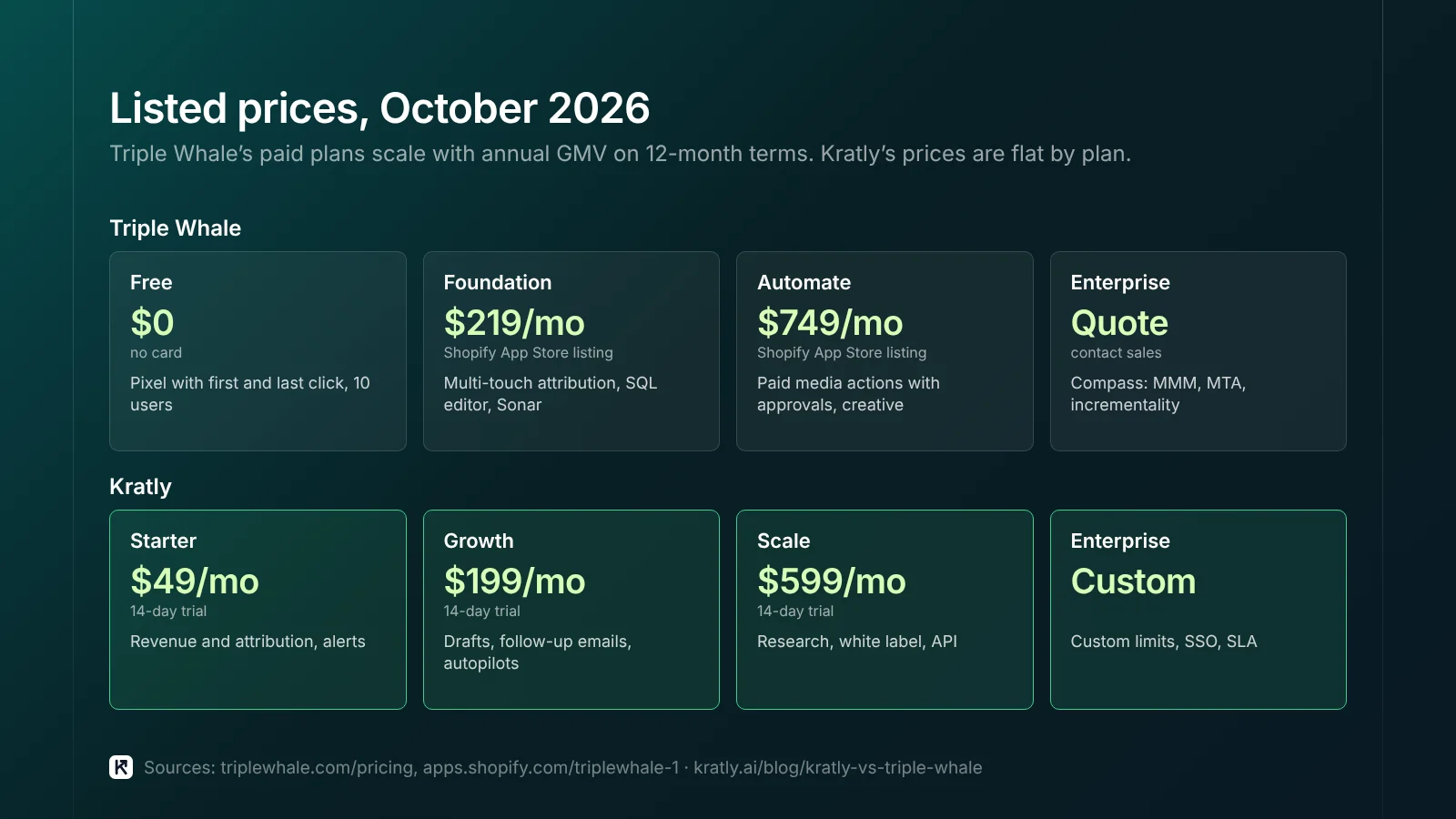
Triple Whale prices paid plans on "a combination of your brand's annual GMV and the package you choose." Paid plans are 12-month subscriptions, billed monthly or annually (pricing).
| Triple Whale plan | Price | Adds |
|---|---|---|
| Free | $0, no card | Triple Pixel with first and last click, AI search tracking, limited Moby AI, 10 users, 12 months of data |
| Foundation | $219/month on the Shopify App Store | Multi-touch attribution, dashboards, SQL editor, customer segments, Sonar |
| Automate | $749/month on the Shopify App Store | Paid media actions within approval settings, scheduled automations, creative variations, landing pages |
| Enterprise | Contact sales | Compass (MMM, MTA and incrementality), retail and wholesale data, custom integrations, SOC 2 Type 2 |
Sources: Triple Whale pricing and Shopify App Store listing. The App Store also lists $2,190 and $7,490 a year. Because price scales with GMV, larger brands should expect a quote.
Kratly lists flat prices by plan, not by revenue: Starter $49 a month, Growth $199, Scale $599, Enterprise custom. Tracked revenue limits rise by plan, from $10k a month on Starter to $100k on Growth and $1M on Scale. The self-serve plans start with a 14-day free trial.
Where Triple Whale is better#
Triple Whale is the more complete ecommerce tool. If you run a Shopify brand, these points matter.
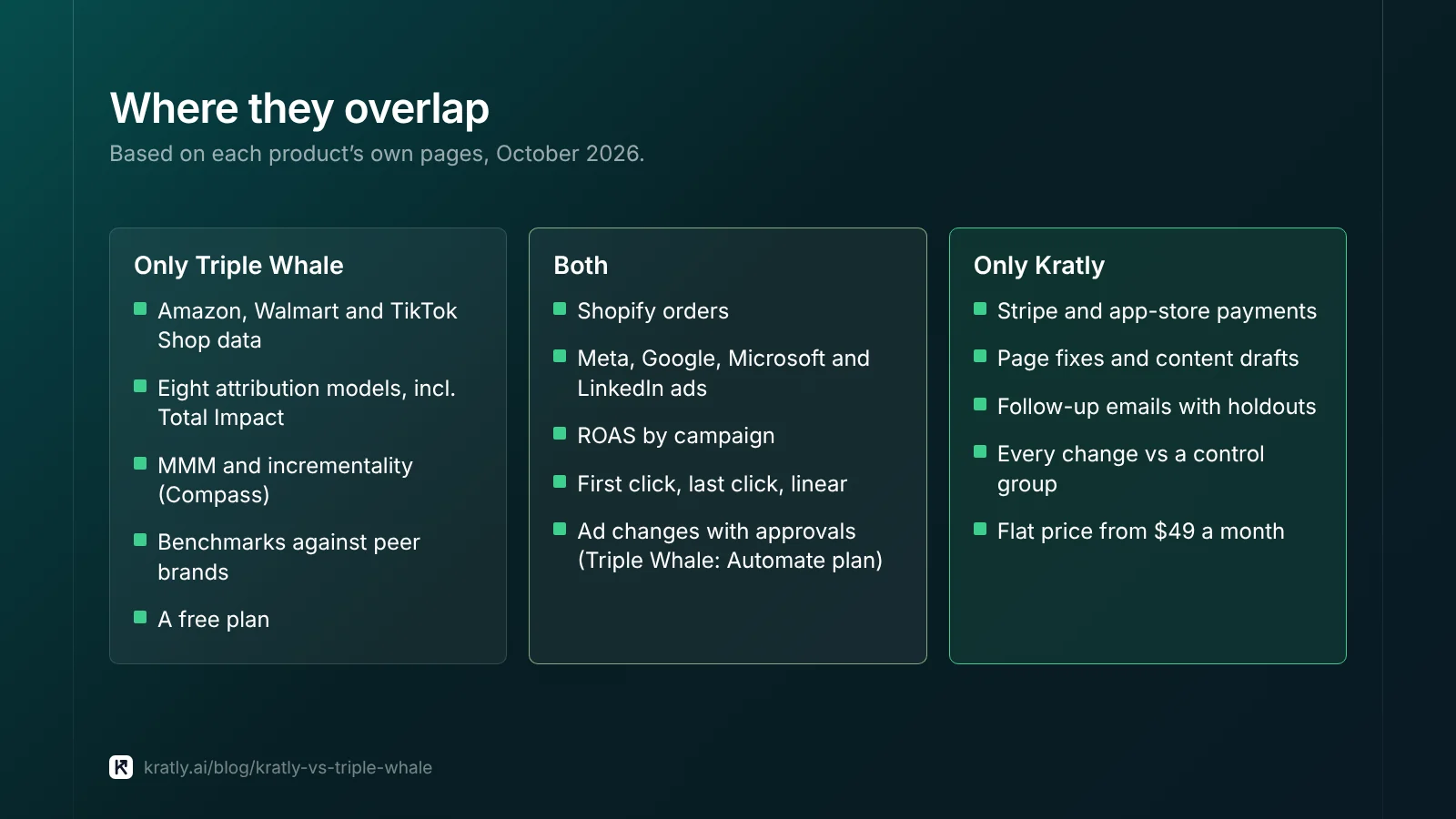
- Ecommerce depth. Store, marketplace and retail data in one place: Shopify, Amazon, Walmart (beta), TikTok Shop, and retail and wholesale on Enterprise.
- More models. Eight attribution models, including Total Impact, which weights channels using post-purchase survey answers (Triple Whale KB). Kratly has three.
- MMM and incrementality. Compass combines media mix modeling, multi-touch attribution and incrementality (Triple Whale). Kratly doesn't do media mix modeling.
- Benchmarks. You can compare ad performance with peer brands. Kratly has no benchmark data set.
- More channels. A long list of ad, CTV, email, SMS and subscription integrations (integrations).
- A free plan. First and last click with the Triple Pixel costs nothing. Kratly offers a trial, not a free plan.
- Creative tools. Automate includes creative variations and landing pages (pricing).
If you're a multi-channel Shopify brand spending heavily on Meta and TikTok, start with Triple Whale.
Where Kratly is better#
SaaS and apps, not only stores#
Kratly reads Stripe subscriptions and app-store payments, so trial-to-paid, renewals and refunds show up as revenue by campaign. Triple Whale's integrations page lists no Stripe or app-store revenue connection. If you sell software, Kratly fits the data you have. See SaaS marketing attribution and web to app attribution.
It works beyond ads#
Kratly finds wasted ad spend and proposes negative keywords and budget shifts. It also suggests page fixes, drafts content and sends follow-up emails through your SendGrid account. Triple Whale's action features focus on paid media and creative.
Proof against a control group#
Each Kratly change is measured against a control group. Follow-up emails run with holdouts, so you can see whether the email changed revenue or just took credit for it. Our guide to incrementality tests explains why that matters.
You choose how much it does alone#
Each kind of change runs as Suggest, Ask first or Autopilot, within limits you set. Every change is logged and can be undone.
Price at low revenue#
Kratly's Starter plan is $49 a month and Growth is $199, with monthly prices listed on the site. Triple Whale's paid plans are 12-month subscriptions priced by GMV. For a small store or an early SaaS, the entry cost is lower with Kratly.
Can you use both?#
Yes, if you're a store. A Shopify brand could use Triple Whale for deep order attribution and benchmarks. It could use Kratly for wasted search spend, page fixes and follow-up emails measured against a control.
Watch for overlap, though. Both tools report ROAS by campaign, and their numbers won't match exactly. Pick one as the number you budget on, and say so in your weekly review. Our weekly growth review template helps.
For SaaS and apps, there's little reason to run both. Triple Whale is built around store data.
How to decide#
Choose Triple Whale if:
- You run an ecommerce brand on Shopify, WooCommerce or BigCommerce.
- You sell on Amazon, Walmart or TikTok Shop as well.
- You want media mix modeling, incrementality and peer benchmarks.
- You want a free plan to start.
Choose Kratly if:
- Your revenue lands in Stripe or an app store.
- You want ads, pages and emails worked on, not only reported.
- You want every change measured against a control.
- You want a low, flat entry price.
How to do this in Kratly#
- Connect your revenue source. Stripe, Shopify or an app store.
- Connect your ad accounts. Google Ads, Microsoft Ads or Meta (through the Conversions API).
- See revenue by campaign, page and email. Switch between first touch, last touch and linear.
- Review proposed changes. Wasted spend, budget shifts, page fixes and follow-up emails, ranked by revenue at stake.
- Set the mode and limits. Suggest, Ask first or Autopilot. Kratly then measures each change against a control.
For a store, our Shopify ads attribution guide shows how to compare platform claims with real orders.
Questions, answered
Is Kratly a Triple Whale alternative?
For some teams. If your revenue lands in Stripe or an app store, Kratly fits better, since Triple Whale is built around store data. For a multi-channel Shopify brand that wants benchmarks and media mix modeling, Triple Whale does more.
How much does Triple Whale cost?
As of October 2026, Triple Whale has a free plan. Paid plans are priced by annual GMV and package, on 12-month terms. Its Shopify App Store listing shows Foundation at $219 a month and Automate at $749 a month. Enterprise is quoted by sales.
Does Triple Whale work for SaaS?
Its integrations page lists store platforms and marketplaces, not Stripe or app stores. Its subscription integrations are Recharge and Skio, built for online stores. A SaaS company would need its own way to bring software revenue in.
Does Kratly do media mix modeling?
No. Kratly measures each change it makes against a control group, but it doesn't build a media mix model. Triple Whale offers that through Compass on its Enterprise plan.
Can I use Kratly with Shopify?
Yes. Kratly connects to Shopify and reads store orders alongside ad spend from Google Ads, Microsoft Ads and Meta. It then proposes budget shifts, page fixes and follow-up emails.
Written by
Priyansh Kumar
Priyansh Kumar has spent more than a decade in growth, scaling brands from 1 to 10 and from 10 to 100. He now builds Kratly, an autonomous growth team that ties every campaign, page and email to the revenue it brings.
Sources
- Triple Whale: Pricing · Attribution · Integrations · Attribution models (Knowledge Base)
- Shopify App Store: Triple Whale listing
All Triple Whale details as of October 2026.
Was this article useful?