Short answer
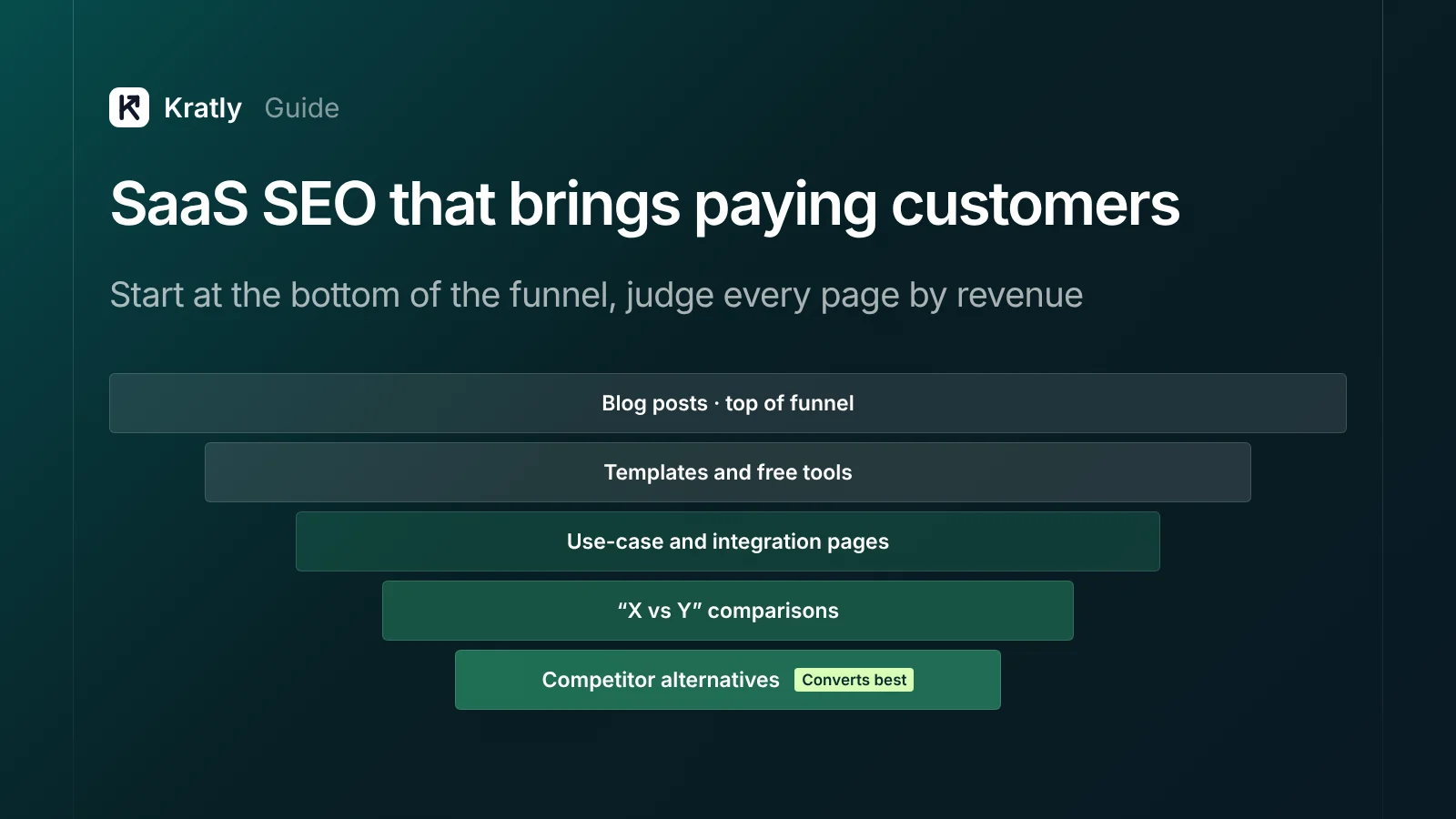
A SaaS SEO strategy that brings paying customers starts at the bottom of the funnel. Build competitor alternatives pages, "X vs Y" comparisons, use-case pages, integration pages, an honest pricing page and useful templates or free tools. They convert far better than blog posts and face fewer AI Overviews. Judge each page by the Stripe revenue it brings.
Your blog traffic is up. Sign-ups aren't. A thread on r/SaaS titled "Your SaaS blog has 50 articles and zero signups" summed it up: "Great traffic numbers. Zero conversions" (r/SaaS). One founder on Indie Hackers tripled traffic for two weeks and wrote: "Signups during those 14 days of 3x traffic: zero" (Indie Hackers).
The fix isn't more content. It's different content, measured differently.
Why a traffic-first SaaS SEO strategy stopped paying#
For years, the B2B SaaS SEO playbook was to publish lots of top-of-funnel posts ("what is X", "how to Y"), win traffic, and hope some readers sign up. Two things broke it.
First, those readers rarely bought. Grow and Convert, an agency that tracks conversions by post, found most SEO content converts to product sign-ups at "less than half a percent" (Grow and Convert).
Second, AI now answers those questions directly. Ahrefs' study of 146 million search results found AI Overviews appear very unevenly by intent (Ahrefs, Nov 2025):
| Query type | Share showing an AI Overview |
|---|---|
| Question queries | 57.9% |
| Informational | 21.4% |
| Commercial | 4.3% |
| Transactional | 2.1% |
So the "what is" posts that drove traffic are the ones AI now answers. As one founder wrote: "If your blog ranked for 'what is content marketing' last year, that traffic is gone" (Indie Hackers).
Commercial searches aren't immune. Semrush found AI Overviews on commercial results grew 71% between late 2025 and spring 2026 (Semrush). But they're still far less exposed.
And buyers are researching in AI too. In G2's 2026 survey of 1,076 software buyers, 51% said they start their research in an AI chatbot (Demand Gen Report). The pages that win them over are the same ones this guide covers: clear comparisons, honest pricing, real use cases. See AI search visibility for how to check whether AI recommends you.
Bottom-of-funnel SEO: conversion rates by page type#
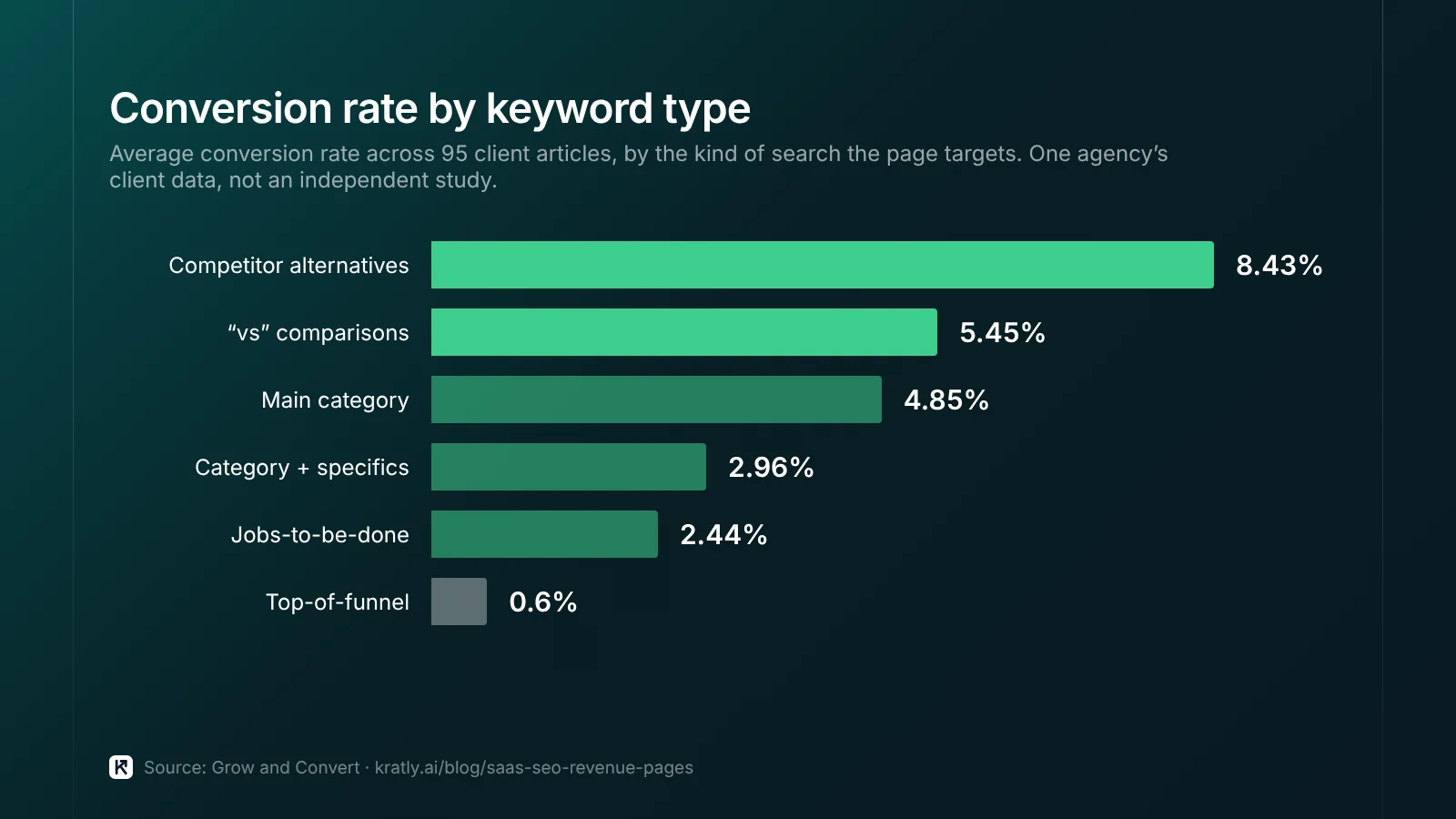
Bottom-of-funnel SEO targets searches from people already comparing or choosing a product. Grow and Convert measured conversion rates across 95 client articles by keyword type (Grow and Convert):
| Keyword type | Example | Average conversion rate |
|---|---|---|
| Competitor alternatives | "Mailchimp alternatives" | 8.43% |
| "vs" comparisons | "Asana vs Monday" | 5.45% |
| Main category | "email marketing software" | 4.85% |
| Category + specifics | "email software for nonprofits" | 2.96% |
| Jobs-to-be-done | "how to automate onboarding emails" | 2.44% |
| Top-of-funnel example | "what is email marketing" | 0.6% |
The example searches are ours. The rates are from one agency's clients, not an independent study, but the gap is large and consistent with other reports. An alternatives page converting at 8% is worth roughly 14 top-of-funnel posts at 0.6%.
The six page types to build first#
1. Competitor alternatives pages#
Search: "[competitor] alternatives", "[competitor] competitors", "tools like [competitor]".
What makes a good one: be honest about who should not switch. Include a feature and price comparison, how to migrate, screenshots and customer proof. Ask your sales team which tools prospects leave, and why.
2. "X vs Y" comparison pages#
Search: "[you] vs [competitor]", and "[competitor A] vs [competitor B]" where you're a credible third option.
What makes a good one: a side-by-side table, a clear "choose A if… choose B if…" section, and evidence from actually using both. Google's guidance on reviews asks for "evidence… of your own experience" and to "explain what sets something apart from its competitors" (Google Search Central). Those pages are written for product reviews, but the same principles fit software comparisons.
3. Use-case and "best X for Y" pages#
Search: your category plus an industry, team size or job: "CRM for real estate agents", "best invoicing tool for freelancers".
What makes a good one: show the specific workflow for that audience, with their terms, examples and proof. If the page could swap "real estate" for "dentists" with no other change, it's too thin.
4. Integration pages#
Search: "[your product] [partner] integration", "connect [tool A] to [tool B]". Your integration list is your keyword list.
What makes a good one: real workflows and setup steps. Zapier's app pages drove about 16% of its organic traffic, and partners wrote unique copy for them (Ahrefs, 2022 data). But Zapier's three-app combination pages got close to zero traffic. Only build pages people search for.
5. Pricing pages#
Search: "[your product] pricing", "[competitor] pricing", "[category] cost".
What makes a good one: real numbers, what each plan includes, who each plan suits, and what costs extra. Hidden pricing sends buyers to a competitor's page, or to an AI answer that guesses.
6. Templates and free tools#
Search: "[document] template", "[task] calculator", "[task] checker".
What makes a good one: the tool actually works without sign-up, then shows how your product does more. Notion's template directory and Canva's feature pages are well-known examples of this at scale (Ahrefs). These convert lower per visit, so judge them on activations, not traffic.
Stay on the right side of Google's rules#
Many of these page types can be built at scale. That's where teams get into trouble.
Google's spam policies define scaled content abuse as "many pages are generated for the primary purpose of manipulating search rankings and not helping users," "no matter how it's created" (Google Search Central). Google's March 2024 update targeted this and said it cut low-quality, unoriginal content in results by 45% (Google). Google's John Mueller has called programmatic SEO "often a fancy banner for spam" (Ahrefs).
Practical rules:
- Build a page only when real people search for it and you have something specific to say.
- Every page needs unique substance: real workflows, real data, real screenshots.
- Comparisons must be fair and checkable. Update them when competitors change.
- If a page wouldn't be useful without Google, don't build it.
If pages aren't getting indexed at all, that's often Google's quality judgement at work. See why Google isn't indexing your pages.
Measure SEO by revenue per page#
Traffic and rankings are inputs. The scorecard is paying customers. Here's how to see revenue by landing page:
- Record the first landing page and source on each visitor's first visit, in a first-party cookie or your database.
- Copy it onto the user at sign-up.
- Pass the user ID into Stripe as
client_reference_idor metadata at checkout (Stripe Docs). - Join Stripe revenue to landing page and report paying customers, MRR and 90-day revenue by page and page type.
- Cross-check in GA4 with the landing page report filtered to organic search.
Our SaaS marketing attribution guide covers the full setup. Once it's in place, you'll often find a handful of pages bring most of your SEO revenue. Those are the pages to improve, expand and link to.
Also watch Search Console for a common AI Overviews pattern: impressions steady or rising while click-through rate falls. That page is being answered by AI. Make it worth citing: see how to get cited in Google AI Overviews.
A 90-day SEO plan for SaaS startups#
| Weeks | Build | Why first |
|---|---|---|
| 1–2 | Pricing page; revenue-per-page tracking | Every later decision depends on measuring revenue |
| 3–5 | 3–5 alternatives pages for your main competitors | Highest conversion rate; low AI Overview exposure |
| 6–8 | 3–5 "vs" pages | Strong conversions; feeds sales conversations |
| 9–10 | Integration pages for your top 5 integrations | Searchers already use the partner tool |
| 11–12 | Use-case pages for your 2–3 best customer segments | Matches how buyers search for fit |
| Ongoing | One template or free tool per quarter | Builds links and sign-ups over time |
This order is our recommendation for a startup with few pages. If you already rank for some of these, start where revenue per page is highest.
How to do this in Kratly#
- Connect your site, Search Console and Stripe. Kratly records where each paying customer first arrived, including the landing page.
- See which pages bring payers. Follow paying customers back to the organic pages they landed on, not just the traffic each page gets.
- Find the gaps. Kratly's free AI search audit shows which buying-intent searches get a Google AI Overview that cites competitors and not you.
- Fix and track. Improve the pages that matter and watch revenue per page change.
Questions, answered
What is the best SEO strategy for SaaS?
Start with bottom-of-funnel pages: competitor alternatives, comparisons, use cases, integrations and pricing. They convert many times better than general blog posts and are less exposed to AI Overviews. Measure each page by the paying customers it brings, then build more of what works.
How long does SaaS SEO take to work?
New pages usually need weeks to be indexed and months to rank well, longer for competitive terms and new domains. Bottom-of-funnel pages can bring customers sooner because they need less traffic to produce sales. Track revenue per page from day one.
Is SEO worth it for early-stage SaaS?
Yes, if you focus on buying-intent pages. A handful of strong alternatives, comparison and pricing pages can bring customers at low volume. Large top-of-funnel blogs are harder to justify early, especially as AI answers more informational searches.
What is bottom-of-funnel SEO?
Bottom-of-funnel SEO targets searches from people close to buying, such as "[competitor] alternatives", "[tool A] vs [tool B]" or "[product] pricing". These searches have lower volume but convert at far higher rates than informational searches.
Are programmatic SEO pages safe?
Only if each page is useful on its own. Google's scaled content abuse policy targets pages made mainly to rank, however they're produced. Build pages people actually search for, give each one unique substance, and skip combinations nobody needs.
Written by
Priyansh Kumar
Priyansh Kumar has spent more than a decade in growth, scaling brands from 1 to 10 and from 10 to 100. He now builds Kratly, an autonomous growth team that ties every campaign, page and email to the revenue it brings.
Sources
- Grow and Convert: Bottom-of-the-funnel keywords · Average SEO conversion rate by keyword type
- Ahrefs: What triggers AI Overviews · Zapier SEO case study · Programmatic SEO
- Semrush: AI Overviews in commercial search
- Demand Gen Report: G2 buyer behavior survey 2026
- Google Search Central: Spam policies · Write high-quality reviews · Google: March 2024 core update and spam policies
- Stripe: Metadata
Was this article useful?