Short answer
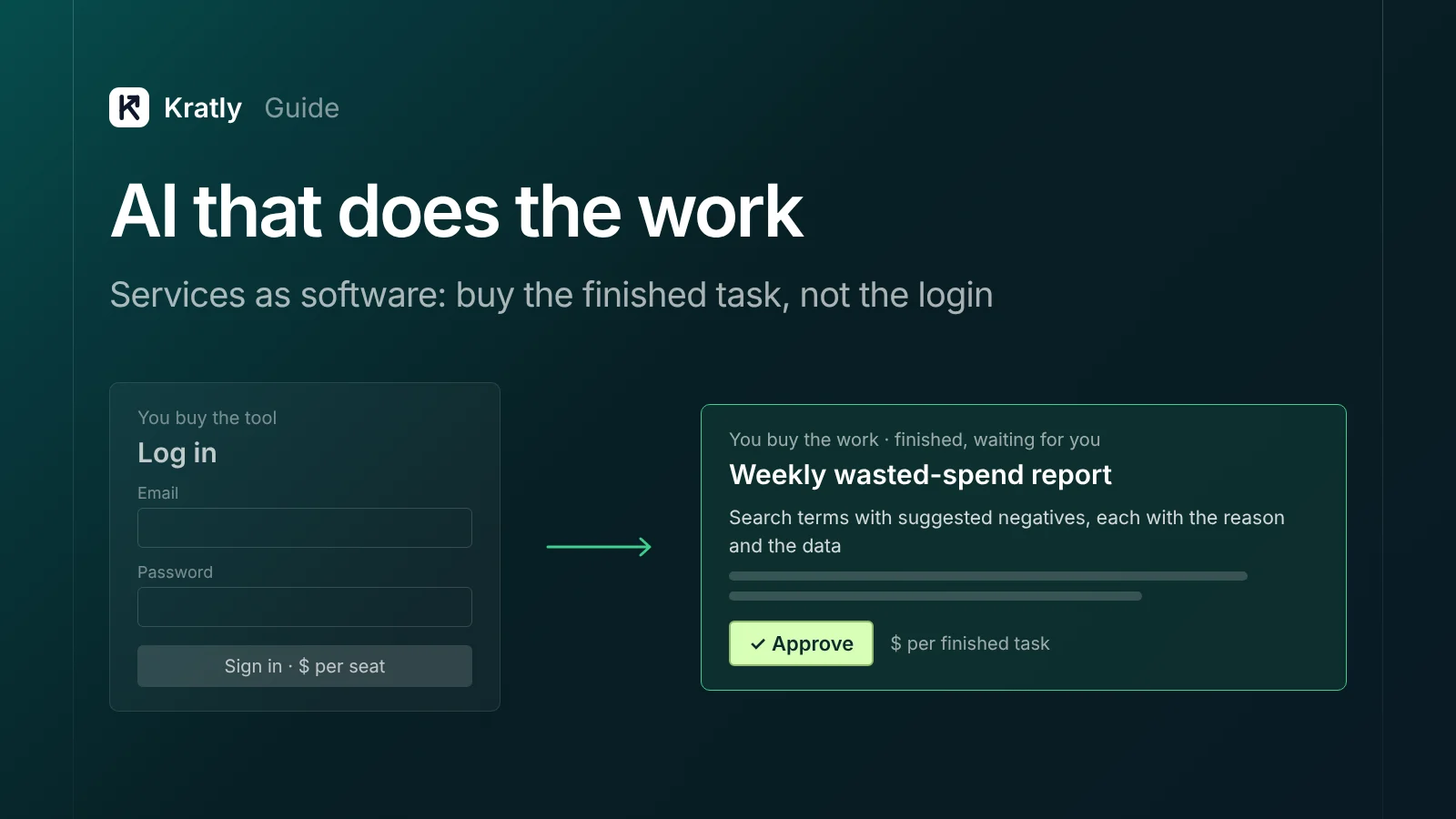
AI that does the work is software that completes a marketing task and is sold by the task or the result, not by the login. This model is called services as software. For buyers it means paying for outcomes, approving work instead of doing it, and writing down who is accountable when the AI gets it wrong.
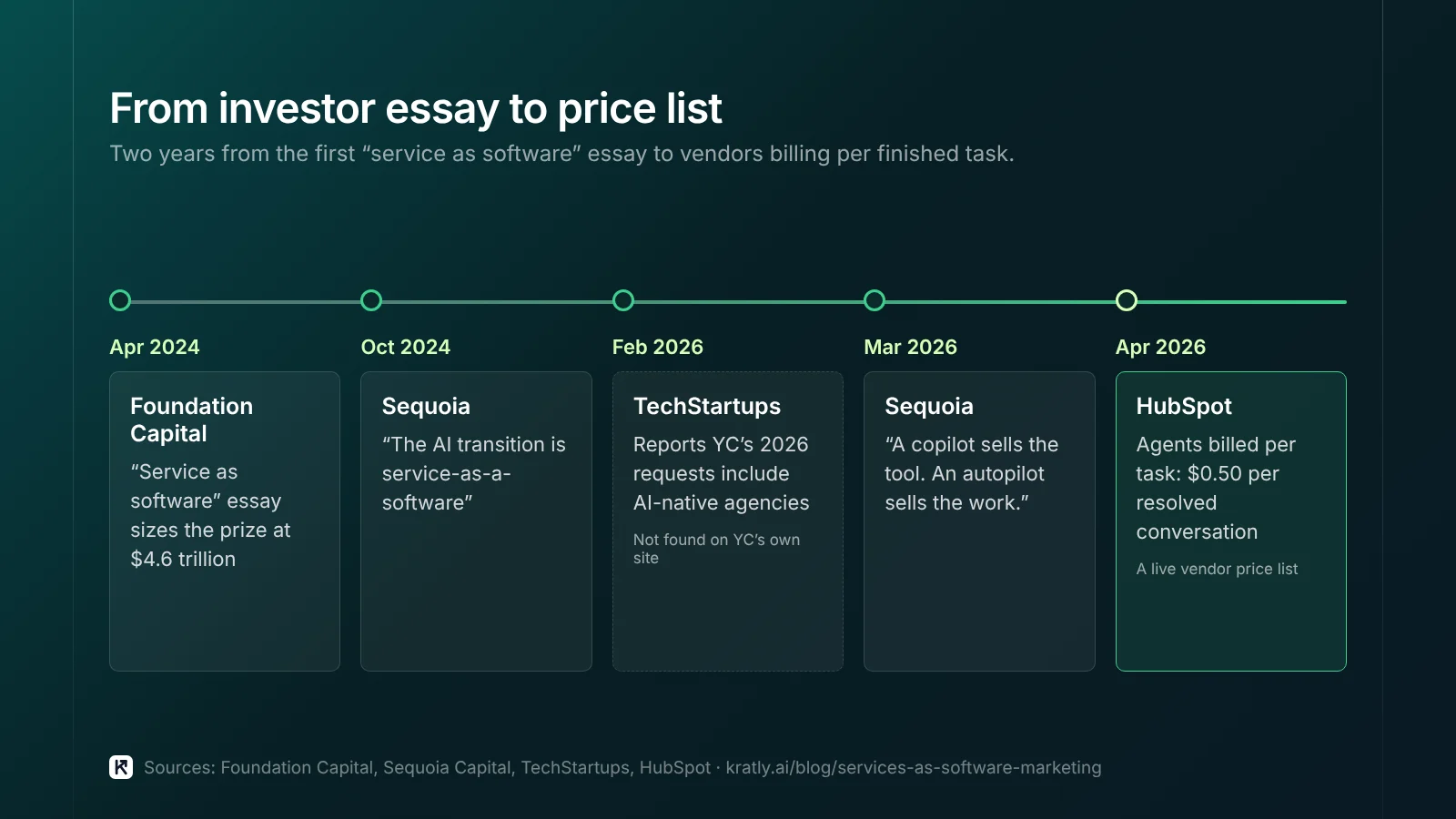
In March 2026, Sequoia partner Julien Bek put the shift in two short sentences: "A copilot sells the tool. An autopilot sells the work" (Sequoia Capital, March 2026).
He backed it with a ratio. "For every dollar spent on software, six are spent on services," he wrote (Sequoia Capital). His example was a company paying $10K a year for QuickBooks and $120K for an accountant to close the books.
Marketing looks the same. You pay for a few tools, then pay much more for the people and agencies who use them. US advertising and PR firms took in about $58.3 billion in the second quarter of 2026 alone. That figure comes from the Census Bureau, via FRED.
So the real question for a buyer in 2026 is not which AI tool to add. It is which pieces of work you can buy finished, and on what terms.
A note on bias: the company behind this blog builds AI that does growth work, so we have a stake in this shift. We've linked a source for every claim about other companies, and we say plainly what AI can't do yet.
What is services as software?#
Services as software is a model where an AI company sells finished work, priced by the task or result, not by the seat.
The phrase comes from venture investors. Foundation Capital's Joanne Chen and Jaya Gupta used it in April 2024. They wrote that "AI companies are leading a transition from software as a service to service as software" (Foundation Capital, April 2024).
Their key point is about who carries the risk. "In the services business, responsibility for achieving the desired outcome sits with the company selling the service," they wrote. With normal software, "customers are still responsible for using that tool to achieve the desired outcome" (Foundation Capital).
That gives us three ways to buy marketing help:
| SaaS tool | Agency or freelancer | Services as software | |
|---|---|---|---|
| What you buy | Access to software | People's time and skill | Finished work done mostly by AI |
| Who does the work | Your team | The agency's team | AI agents, with people checking |
| Typical price unit | Per seat per month | Retainer, hours or % of ad spend | Per task, per outcome, or usage |
| Who owns the result | You | Shared, by contract | The vendor, for the unit they sell |
| How it scales | Your headcount | Their headcount | Compute, plus a few reviewers |
| Where it breaks | Tool sits unused | Thin margins, junior staff on your account | Wrong output at scale, fuzzy outcome terms |
An AI agency is one version of this. It looks like an agency from the outside, with deliverables and a monthly bill. Inside, AI agents do most of the production. Some AI agencies sell retainers. Others sell per piece of work.
"Sell the work, not software" is not a slogan#
Sell the work, not software, changes the incentive. A seat-based vendor earns the same whether you log in or not. A work-based vendor earns only when work ships. Foundation Capital puts it plainly: with outcome pricing, "vendors no longer have a financial incentive to limit usage of their product" (Foundation Capital).
The catch: a vendor paid per piece of work also has a reason to ship more pieces. We'll come back to that under pricing.
Why is AI that does the work showing up now?#
Three things lined up in 2024 to 2026.
Models started to plan, not just write. In October 2024, Sequoia's Sonya Huang and Pat Grady wrote that "the AI transition is service-as-a-software" (Sequoia Capital, October 2024). The market, they added, is "the services market measured in the trillions of dollars." Their example of outcome pricing was a customer service company: "Sierra gets paid per resolution."
Investors put numbers on the labor budget. Foundation Capital sized the opportunity at $4.6 trillion. Of that, it estimated $1.1 trillion a year goes on sales and marketing salaries worldwide. On sales work it wrote, half joking, "AI can now do everything but eat dinner."
Startup programs reportedly asked for AI agencies. TechStartups reported in February 2026 that Y Combinator's 2026 Requests for Startups included AI-native agencies. The reported pitch: agencies have thin margins, so use AI inside and sell the finished output. We couldn't find that request on YC's own site. As of November 2026, YC's current request page lists its Winter 2027 ideas, and no agency request is shown.
How big is the marketing work budget?#
For US marketing buyers, the clearest public number is agency revenue. The Census Bureau's Quarterly Services Survey tracks advertising, public relations and related services (NAICS 5418). From Q3 2025 to Q2 2026, taxable firms in that group earned about $231 billion across four quarters.
That leaves out in-house teams. The median US marketing manager earned $166,790 in May 2025, per the Bureau of Labor Statistics. That labor budget is the prize every AI agency is chasing.
What changes for buyers when you pay for the work?#
Buying AI that does the work feels like hiring an agency more than buying a tool. Four things change.
You pay for results you define, not logins#
With seats, you can't overpay for unused output, but you can pay for a tool nobody opens. With work-based pricing, the bill follows the work. So the definition of "done" becomes the most important line in the contract. "Resolved," "qualified" and "published" all need a written meaning.
Your job moves from doing to approving#
Someone on your side still checks the work. The difference is that they review a finished draft, change or report instead of building it. That takes less time, but it's not zero. Budget a named approver and set hours each week. Our guide on keeping AI marketing agents safe with one approval, not fifty covers how to batch approvals so they don't pile up.
Accountability has to be written down#
An agency has people you can call when a campaign goes wrong. An AI vendor has a support queue. Before you buy, write down who fixes a mistake, how fast, and who pays for it. "Our AI is very accurate" is not an answer.
Your data becomes part of the deal#
AI that does the work needs access to do it. That means ad accounts, analytics, payments, and sometimes your CRM. Decide what it can read, what it can change, and what happens to that access when you leave.
What can AI do end-to-end in marketing today?#
"End-to-end" means the AI does the task from start to finish, and a person only approves or spot-checks.
Our AI marketing agent buyer's guide lists what agents do well today and the published ways they fail. Our comparison of a growth marketer vs an AI growth agent covers which tasks still need a person's judgment. And our fractional CMO vs AI agent vs agency guide covers what an "AI CMO" can and can't own.
Here is our view of where marketing work stands in late 2026. Treat the middle column as a judgment, not a benchmark.
| Marketing task | End-to-end by AI today? (our view) | Where a person still decides | Go deeper |
|---|---|---|---|
| Weekly performance reports | Mostly yes, if tracking is clean | Which numbers matter and what to do next | AI marketing agent |
| Finding wasted ad spend | Mostly yes for analysis | Approving cuts to live campaigns | Growth marketer vs AI growth agent |
| Ad account changes (negatives, small budget moves) | Partly, inside hard limits | Budget increases and new campaigns | One approval, not fifty |
| Cold email research and drafts | Partly | Who to contact, sending volume, claims made | Cold emails per meeting |
| Social posts and short videos from existing pages | Partly | Brand voice, claims and final publish | Product pages to short video |
| Customer support answers | Yes for common questions, per vendors' own outcome pricing | Refunds, edge cases, angry customers | Pricing section below |
| Positioning, pricing and strategy | No | All of it | Fractional CMO vs AI agent vs agency |
AI does well where the task repeats, the data is clean and a mistake is cheap to undo.
Platform rules also limit what any AI can do for you. In 2026 several APIs changed what outside software can read or post. See our guides to Google Ads API access levels, Reddit's API in 2026 and the Instagram API publishing limit. A vendor that promises "full automation" on a platform that blocks it is selling a plan, not a product.
How is AI that does the work priced?#
There are five common ways to price AI that does the work. Each one rewards the vendor for something different. The examples below were checked on the vendors' own pages as of November 2026.
| Model | Example (as of November 2026) | The vendor earns more when… | What can go wrong for you |
|---|---|---|---|
| Per seat | Salesforce Agentforce add-ons at $125 per user per month | You add users | You pay whether or not work ships |
| Usage or credits | Agentforce: $500 per 100,000 Flex Credits, 20 credits per action, or $2 per conversation | The AI takes more actions | Busy but useless actions still cost money |
| Per outcome | Intercom: Fin AI Agent at "$0.99 per outcome". HubSpot: $0.50 per resolved conversation and $1.00 per lead recommended for outreach, effective April 2026 | More outcomes are counted | The outcome is defined loosely |
| Percent of ad spend | Agencies often charge 10–20% of spend | You spend more on ads | Little reason to tell you to cut |
| Retainer for set deliverables | Common for AI agencies; check each quote | Scope stays fixed and cheap to produce | Volume without results |
A few notes on the examples:
- Intercom's page says a resolution is counted when the customer "confirms it helped or leaves without requesting more help." So a customer who gives up also counts.
- HubSpot bills a lead when it is "qualified and handed to your team." A qualified lead is not a paying customer.
A worked example: what one outcome really costs#
Assumption: a support agent resolves 1,000 chats a month, and 10% of those customers come back later with the same problem. These are made-up round numbers. Use your own.
At $0.99 per outcome, 1,000 outcomes cost $990. If 100 of them weren't really solved, you paid $99 for answers that didn't help. You also paid a person to handle the follow-up. The real cost per solved problem is $990 ÷ 900, or about $1.10, plus that person's time.
The same math applies to marketing outcomes. Divide the bill by the outcomes that still look good 30 days later, not the ones the vendor counted on day one.
Which pricing incentive should you want?#
Pick the model whose unit sits closest to your revenue. A meeting held beats an email sent. A paying customer beats a lead. The closer the unit is to money, the harder it is to game.
If the vendor can't price that close to revenue, ask for two things. First, a cap on monthly spend. Second, a clawback: outcomes that fail your check within 30 days aren't billed. Most vendors will push back. Their answer tells you how sure they are of their own work.
Vendor costs matter too. See what it costs to run an AI growth agent.
How to evaluate a services-as-software vendor#
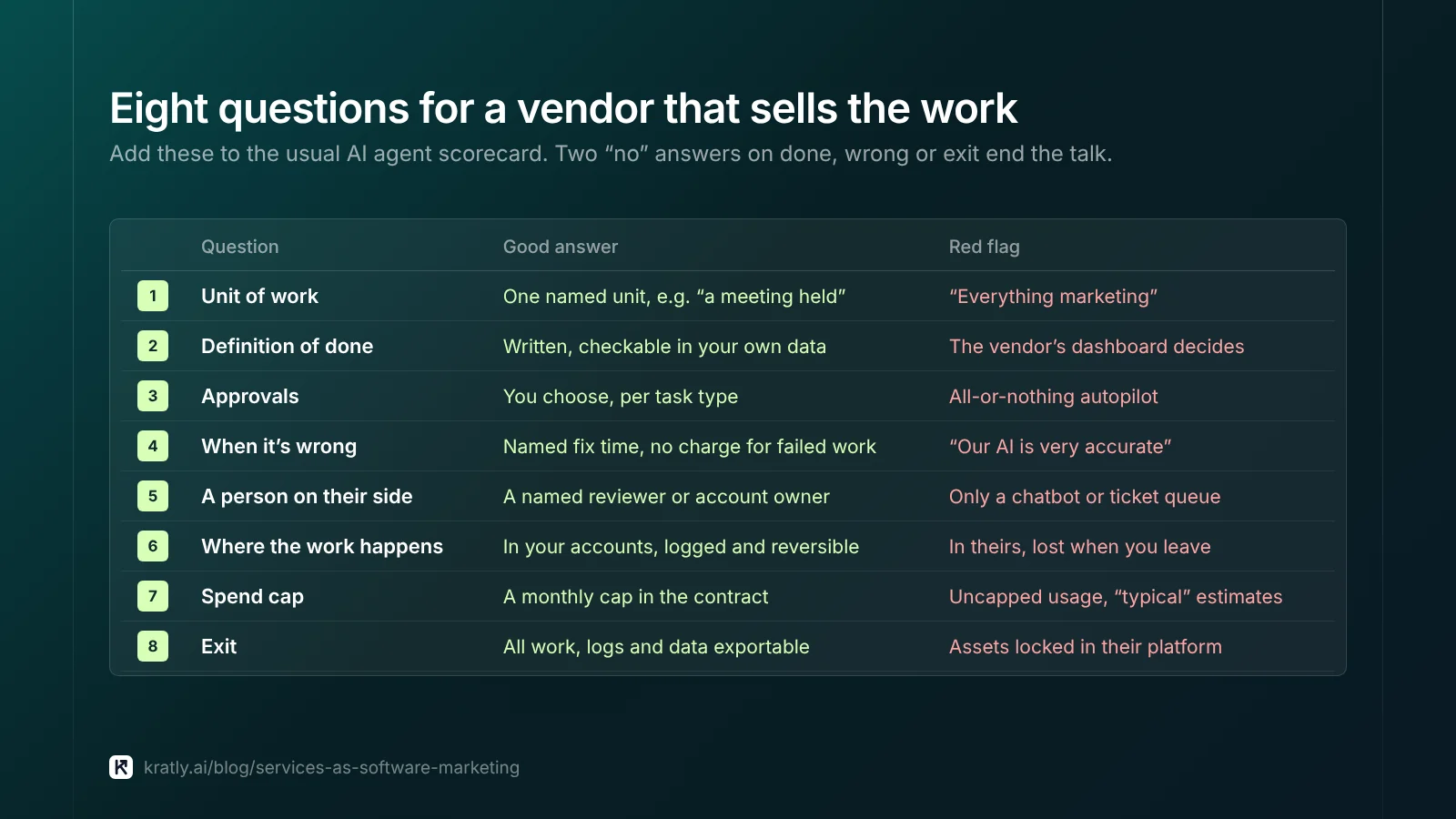
Our AI marketing agent scorecard covers data access, guardrails and audit logs. Use it. When the vendor sells work rather than software, add the questions below. They are about the deal, not the tech.
| Question | Good answer | Red flag |
|---|---|---|
| What is the unit of work? | One named unit, such as "a negative keyword change applied" or "a meeting held" | "Everything marketing" |
| What counts as done? | A written definition you can check in your own data | The vendor's dashboard decides |
| Who approves before it goes live? | You choose, per task type | All-or-nothing autopilot |
| What happens when it's wrong? | A named fix time and no charge for failed work | "Our AI is very accurate" |
| Is there a person on the vendor's side? | A named reviewer or account owner for your work | Only a chatbot or ticket queue |
| Where does the work happen? | In your accounts, logged and reversible | In the vendor's accounts, which you lose on exit |
| Is spend capped? | A monthly cap in the contract | Uncapped usage with "typical" estimates |
| What do you keep if you leave? | All work, logs and data, exportable | Assets locked in their platform |
Score each row yes, partly or no. Two "no" answers on done, wrong or leave should end the talk. That cut-off is our judgment.
What are the risks of buying the work, not the software?#
Every model has risks. These are the ones that grow when the vendor, not your team, does the work.
Quality drifts quietly#
A tool fails loudly: nobody uses it. Outsourced work fails quietly: it ships, it looks fine, and results slide. Spot-check a fixed share of work every week. Five pieces a week is a fair start for a small team; that's our rule of thumb, not a benchmark.
Your brand speaks in someone else's words#
AI that writes ads, posts or emails speaks for you. A made-up claim, a wrong price or an off tone is your problem, not the vendor's. Keep anything customers will read on approval until the vendor has a clean record with you. Our guide to AI marketing approval workflows covers which tasks to keep on approval and which can run alone.
Accountability gets fuzzy#
When an agency makes a mistake, a person owns it. When an AI makes one, the vendor may point at your settings, your data or the platform. Settle this in the contract before the first mistake. Who fixes it, by when, and who pays.
Outcome terms get gamed#
Any number you pay for becomes a target. A vendor paid per lead will find cheap leads. A vendor paid per resolution benefits when tired customers stop asking. Pick units close to revenue, and check them in your own systems. For B2B, our guide to measuring pipeline, not form fills shows how.
Lock-in moves from software to work#
If the vendor runs campaigns from its own accounts, you may lose history when you leave. Keep work in your accounts. Keep logs exportable.
A 30-day pilot: buy one unit of work#
Our AI marketing agent guide has a pilot that widens an agent's permissions week by week. When you're buying work rather than a tool, run the pilot as a small work order instead. You're testing the deal, not just the software.
Before day 1, write a one-page work order. It needs five lines:
- The unit: one task, such as "weekly wasted-spend report with suggested cuts."
- Done means: how you'll check it in your own data.
- Approver: one named person, with set hours each week.
- Price and cap: the per-unit price and the most you'll pay this month.
- Success metric: one number tied to revenue, measured against your last 60–90 days.
Then run four weeks:
| Week | What the vendor delivers | What you check | Pay for it if… |
|---|---|---|---|
| 1 | First units, all on approval | Are the facts right? Is the work usable as is? | It meets your "done" definition |
| 2 | Same unit, more volume | How much did your approver change? How long did review take? | Edits were small and review fit the hours |
| 3 | Same unit; low-risk pieces may run without approval | Spot-check five pieces; read the log | Spot-checks pass and nothing broke a limit |
| 4 | Same unit | Success metric vs baseline; total cost per accepted unit | The metric moved and cost per unit beats your alternative |
At the end, compare three numbers. The vendor's bill. Your approver's hours. The cost of doing the same work your current way. If you don't know that last number, our guide to growth marketer vs AI growth agent costs helps you estimate it.
Good first units are cheap to check and cheap to undo:
- A weekly revenue report by campaign
- Wasted search terms with suggested negatives
- Draft cold emails for one segment, sent only after you approve
Bad first units are strategy, pricing, or anything that can spend a lot of money in a day.
Where Kratly fits#
We build Kratly, so read this section knowing we have a stake in the shift. Kratly is built as an AI growth team: named agents read revenue by campaign, page and email from your website tracking and Stripe or Shopify, propose changes with the reason and data, and log every change with a way to undo it. You choose, area by area, whether it only suggests, waits for your approval or acts within limits you set. Changes inside Meta, Google and Microsoft ad accounts are built but stay switched off until each platform approves access and the change passes a live test on our own accounts. There are also four free tools: a wasted-spend checker, AI search audit, indexing checker and app store audit.
Questions, answered
What does "AI that does the work" mean?
It means AI that finishes a task, such as a report, an ad account change or a draft campaign, instead of helping a person do it. It is usually sold by the task or the result instead of by the seat. A person still sets the goal, approves risky changes and checks quality on a regular schedule.
What is the difference between SaaS and services as software?
With SaaS, you buy access to a tool and your team does the work. With services as software, you buy the finished work, and AI agents do most of it. Pricing moves from seats to tasks, usage or outcomes. Responsibility for the result also moves toward the vendor, so the contract must define what counts as done.
Is an AI agency the same as a marketing agency?
Not quite. An AI agency sells deliverables like a normal agency, but AI agents do most of the production and a few people review it. That can mean lower prices and faster turnaround. It can also mean less human judgment on your account. Ask who reviews your work, and how often.
Is outcome-based pricing always better for buyers?
No. It is better only when the outcome is close to revenue and you can check it in your own data. A "resolved conversation" or a "qualified lead" can be counted when nothing useful happened. Ask for a written definition, a monthly cap and no charge for outcomes that fail your own check within 30 days.
Can AI do all of my marketing in 2026?
No. AI handles repeatable work well, such as reports, finding wasted spend, small account changes and first drafts. It is weak at positioning, pricing, new ideas and calls that put your brand at risk. Most small teams do best with one person who owns strategy and AI that does the repeatable work.
Written by
Priyansh Kumar
Priyansh Kumar has spent more than a decade in growth, scaling brands from 1 to 10 and from 10 to 100. He now builds Kratly, an autonomous growth team that ties every campaign, page and email to the revenue it brings.
Sources
- Sequoia Capital: Services: The New Software (Julien Bek, March 5, 2026) · Generative AI's Act o1 (Sonya Huang and Pat Grady, October 9, 2024)
- Foundation Capital: AI leads a service-as-software paradigm shift (Joanne Chen and Jaya Gupta, April 19, 2024)
- U.S. Census Bureau, Quarterly Services Survey, via FRED: Total revenue for NAICS 5418, advertising, public relations and related services, taxable establishments
- TechStartups: Y Combinator is out with its 2026 Request for Startups (February 4, 2026) · Y Combinator: Requests for Startups (current page)
- Intercom: Intercom pricing (September 2026)
- HubSpot: Customer Agent and Prospecting Agent: pay when the task is complete (April 13, 2026)
- Salesforce: Agentforce pricing
- AgencyAnalytics: PPC pricing
Was this article useful?