Short answer
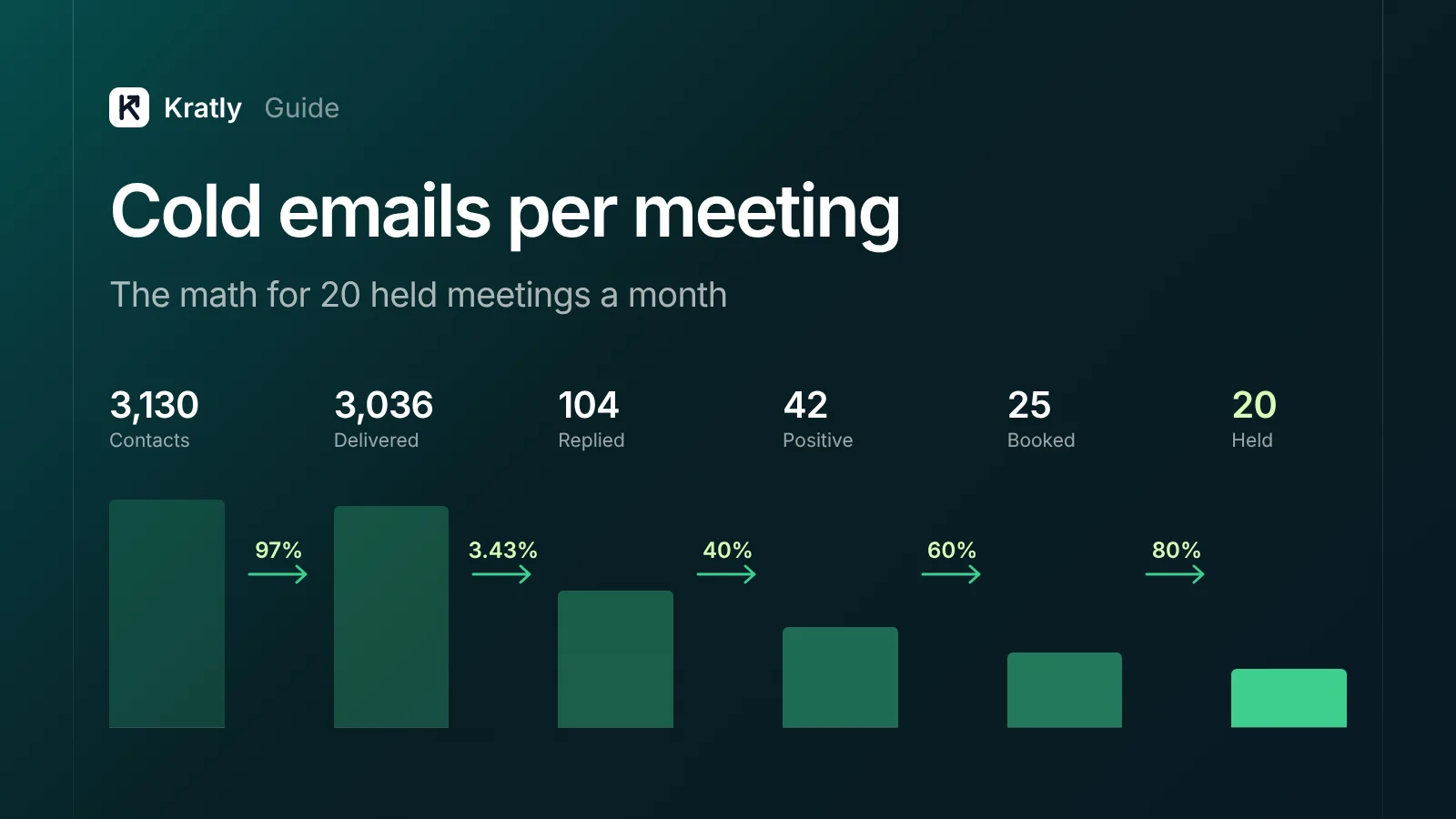
How many cold emails per meeting depends on your own reply rate. With a 3.43% reply rate and the stated assumptions below, you book one meeting per 125 contacts. Twenty held meetings a month then need about 3,130 contacts, 9,400 emails and 15 mailboxes. Replace each assumption with your own numbers.
Composite example: a founder sells a B2B tool and wants 20 sales meetings a month from cold email. This is an illustrative case, not a real company. Last month she sent 1,000 emails and booked 3 meetings. She wants to know whether to send 7,000 emails, write better ones, or both.
The answer is a chain of rates. Below, I work through each one with labeled assumptions, then show how to use your own.
What is the cold email funnel?#
The cold email funnel is the chain of steps from a contact on your list to a meeting that actually happens. Each step has its own rate:
- Contacts: people you plan to email.
- Delivered: emails that didn't bounce.
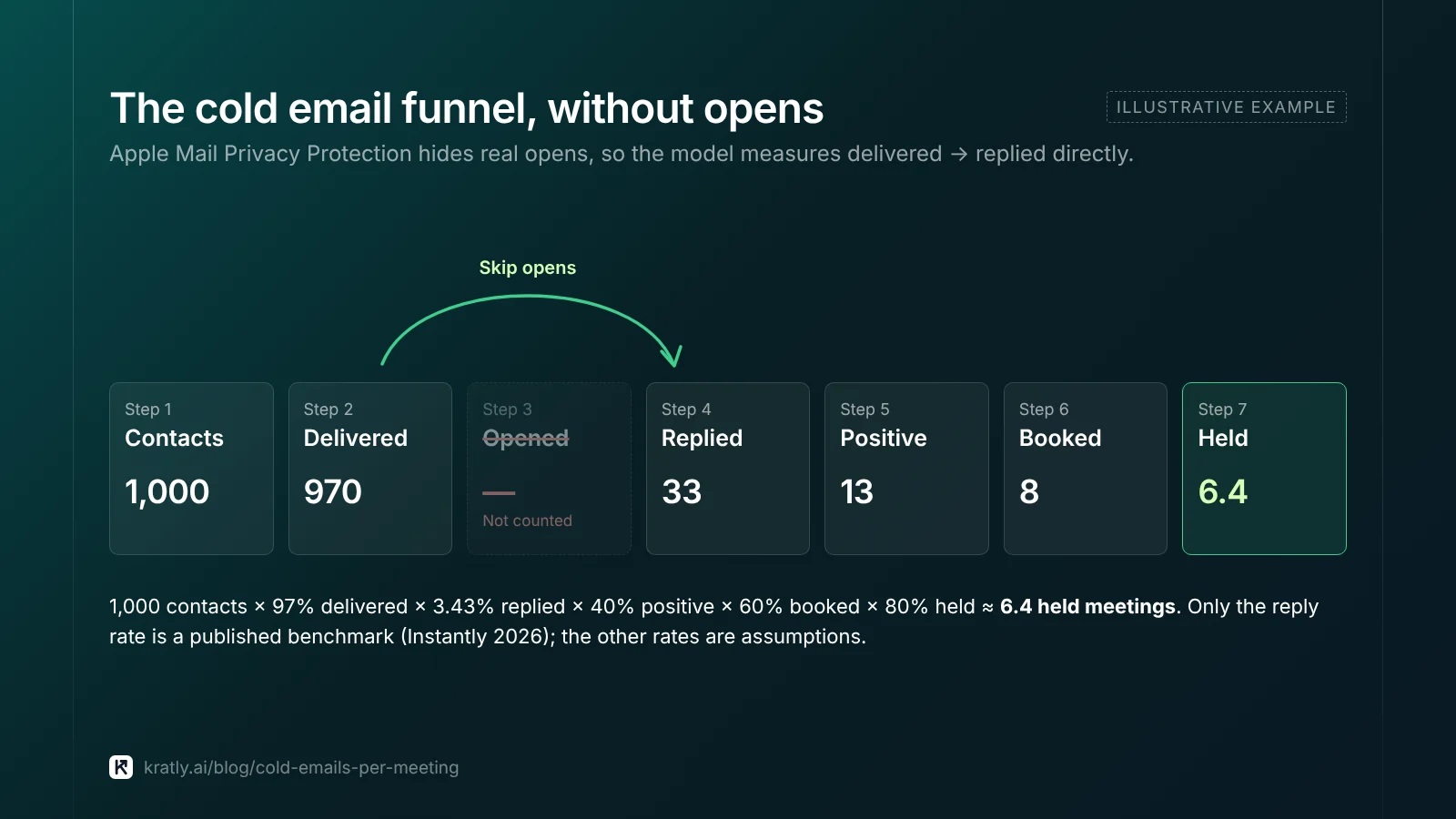
- Opened: skip this one (see below).
- Replied: any human reply, not auto-replies.
- Positive: replies that show interest.
- Booked: a meeting on the calendar.
- Held: the meeting took place.
Multiply the rates together and you get meetings per contact.
Why opens don't belong in the math#
Open tracking uses a hidden image. Apple's Mail Privacy Protection "prevents senders from seeing if you've opened the email they sent you" (Apple Support, in its Apple Vision Pro user guide; the iPhone guide says it "makes it harder for senders to learn about your Mail activity"). So an open rate mixes real reads with privacy noise. Measure from delivered straight to replied.
How many cold emails per meeting: the worked example#
Here are the inputs. Only the reply rate comes from a published benchmark. The rest are assumptions for you to replace.
| Step | Rate used | Where it comes from |
|---|---|---|
| Delivered | 97% of contacts | Assumption: verified list, about 3% bounce |
| Replied | 3.43% of delivered | Average reply rate, Instantly 2026 benchmark (vendor data, 2025 sends) |
| Positive | 40% of replies | Assumption |
| Booked | 60% of positive replies | Assumption |
| Held | 80% of booked | Assumption: one in five no-shows or reschedules |
Now run 1,000 contacts through it:
- 1,000 × 97% = 970 delivered
- 970 × 3.43% = 33 replies
- 33 × 40% = 13 positive replies
- 13 × 60% = 8 meetings booked
- 8 × 80% = 6.4 meetings held
That's one booked meeting per 125 contacts. Assumption: 1 meeting per 125 contacts until you have your own rate. Held meetings come to about one per 156 contacts.
For 20 held meetings a month, divide 20 by 0.64%. You need about 3,130 contacts a month.
Contacts aren't emails, though. Assumption: a three-step sequence, an opening email and two follow-ups. That makes about 9,400 emails a month, or roughly 470 emails per held meeting.
How many mailboxes and days do you need?#
Volume is limited by what each mailbox can send safely. Google Workspace allows a user up to 2,000 messages a day, as of November 2026 (Google Workspace Admin Help). Trial accounts get 500. That's a technical ceiling, not a safe cold email pace.
Assumption: 30 cold emails per mailbox per day. It's a cautious pace for new outreach. Our guide to cold email deliverability in 2026: warm-up, caps and bounces covers how to set yours.
Assumption: 21 sending days a month, weekdays only.
- 9,400 emails ÷ 21 days = about 450 emails a day
- 450 ÷ 30 per mailbox = 15 mailboxes
- 3,130 contacts ÷ 21 days = about 150 new contacts a day
The sender rules that cap you#
Google's sender guidelines name a bulk sender as one that "sends close to 5,000 messages or more to personal Gmail accounts within a 24-hour period." Bulk senders need SPF, DKIM and DMARC. Google asks senders to keep spam rates "below 0.1%" and never reach 0.3%. It also says that "starting November 2025, Gmail is ramping up its enforcement" (Google Workspace Admin Help, as of November 2026).
At 450 a day you're below the bulk line. I'd still follow every rule, since a few spam reports can push a small sender past 0.1%.
Time: the funnel has a lag#
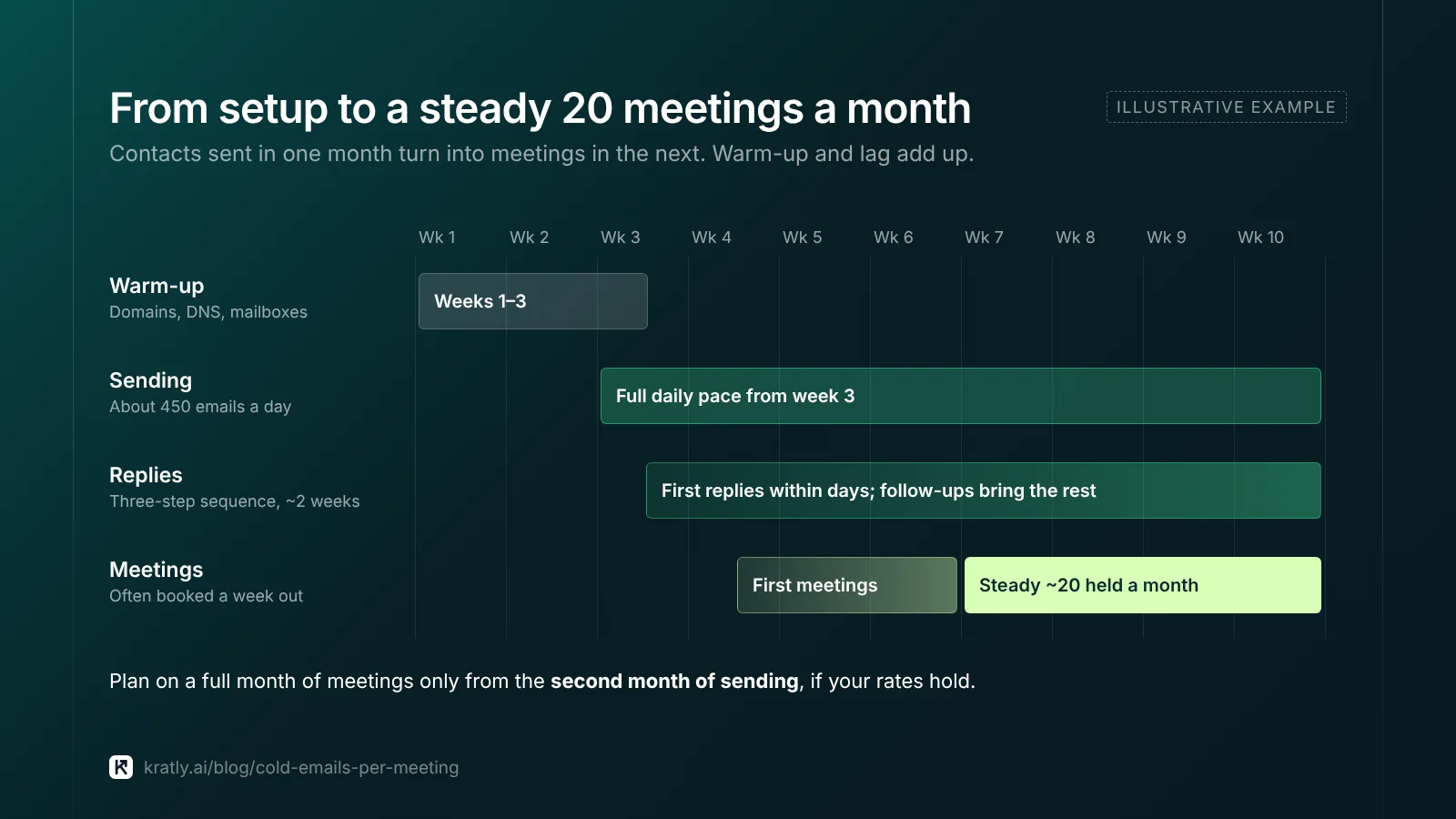
A contact you add today finishes a three-step sequence in about two weeks. That's an assumption about your sequence spacing. Meetings are often booked a week out. So contacts sent in one month produce many meetings in the next. Plan for:
- Weeks 1–3: set up domains and warm up mailboxes (see the deliverability guide).
- Weeks 3–6: start sending at the full daily pace.
- Month 2 onward: expect a steady 20 a month, if your rates hold.
What reply rate should you expect?#
All of these are vendor data. Each vendor defines "reply" and "campaign" its own way.
| Source | Data | Reply rate |
|---|---|---|
| Instantly 2026 benchmark (vendor, updated Jan 12, 2026) | Sends from Jan 1 to Dec 18, 2025 | 3.43% average; top quartile 5.5%+; top 10% 10.7%+ |
| Belkins (agency, June 2023) | About 11 million emails sent by its clients | 7% average; 2.9% when targeting software companies |
Two more findings worth using. Instantly says 58% of replies come from the first email and 42% from follow-ups (Instantly). Belkins found 2–4 contacts per company gave the highest average reply rates (Belkins).
None of these numbers tell you what positive reply, booking or show rates to expect. I found no named, dated source for those. That's why they're assumptions above.
Find your own rates from your last 200 sends#
- Pick 200 contacts whose sequence finished at least two weeks ago.
- Count bounces. Delivered rate = (200 − bounces) ÷ 200.
- Count human replies. Exclude auto-replies and out-of-office notes. Reply rate = replies ÷ delivered.
- Tag each reply as positive, neutral, or "not interested." Positive rate = positive ÷ replies.
- Count meetings booked from those positive replies, then meetings held.
- Multiply the rates to get held meetings per contact.
Two hundred is a small sample. With a 3% reply rate you'd see about six replies. So treat the result as rough. Re-run it every 200 contacts, and use the average of the last three runs.
How to raise each rate#
The cheapest gain is usually the step with the worst rate. Doubling one rate halves the contacts you need.
Delivered: clean the list first#
Verify every address before you send. Remove role addresses and catch-all domains you can't confirm. See email verification for cold email: catch-all, role and disposable.
Replied: smaller segments, shorter emails#
- Write for one segment at a time. One industry, one role, one problem.
- Keep the first email short. Instantly says elite senders keep first emails under 80 words (Instantly).
- Send follow-ups. They brought 42% of replies in Instantly's data.
- Email 2–4 people per company, in line with the Belkins finding above.
Positive: tighter targeting#
A low positive rate means you reached the wrong people. Narrow the list to companies that match your best customers. For a team-wide version of this, see ABM for startups: one account play your team can run in a week.
Booked: answer fast, offer times#
Reply to interested people within the hour if you can. Offer two specific times, not "let me know when works."
Held: confirm and remind#
Send a calendar invite right away. Then send a short reminder the day before with one line on the agenda.
From meetings to revenue#
Meetings are an activity. Pipeline and closed deals are the result. Every rate is an assumption.
| Step | Assumption | Per month |
|---|---|---|
| Meetings held | From the model above | 20 |
| Qualified opportunities | 30% of meetings | 6 |
| Pipeline | 6 × $12,000 average annual contract | $72,000 |
| Closed-won | 25% of opportunities | 1.5 deals |
| New annual revenue | 1.5 × $12,000 | $18,000 |
If your deal size is $1,200, the same 20 meetings bring $1,800. Then outbound may cost more than it returns. Work out the cost per closed deal and compare it with other channels. Our guide on how to calculate CAC by channel using Stripe, not ad reports shows the method.
Judge outbound by pipeline and closed revenue, like any lead source. B2B lead generation strategy: measure pipeline, not form fills sets out the stages. For where outbound fits early, see the B2B SaaS growth strategy guide. For budget, see where to spend your first $5k a month.
Where Kratly fits#
Kratly's outreach tools are built and being tested on our own outbound first: lead lists with email checks, segments, and a campaign drafted from a segment and sent from your own mailbox after a person approves it, within each mailbox's daily cap. Tell it a goal like "20 meetings a month" and it works through the same math as this article, from your real list and mailboxes. Live today is the revenue side: tag outbound links with UTMs and Kratly shows which segment brought paying customers, by campaign, page and email.
Questions, answered
How many cold emails does it take to get one meeting?
With a 3.43% reply rate and our assumptions, it takes about 125 contacts per booked meeting. At three emails each, that's about 375 emails. Held meetings need around 156 contacts. Your number will differ. Work it out from your last 200 contacts by multiplying your delivered, reply, positive, booking and show rates together.
What is a good cold email reply rate?
Instantly's 2026 benchmark, based on 2025 sends, puts the average at 3.43%. Its top quartile is above 5.5% and its top 10% above 10.7%. Belkins reported 7% on average in 2023, but 2.9% when targeting software companies. These are vendor figures with their own definitions, so compare your trend over time more than your rank.
What is a typical outbound meeting rate?
I found no named, dated benchmark for meetings per contact. So this guide uses an assumption: one booked meeting per 125 contacts, about 0.8%. That fits a 3.43% reply rate with 40% positive replies and 60% of those booking. Replace it with your own rate once you have 200 contacts of data.
Should I count opens when I plan cold email volume?
No. Apple's Mail Privacy Protection stops senders from seeing whether an email was opened, so open rates mix real reads with noise. Plan from delivered to replied instead. Replies are a human action you can count and read. Use opens only, if at all, as a rough sign that a mailbox still delivers.
How many mailboxes do I need for 20 meetings a month?
With our assumptions, about 15. That's roughly 450 emails a day at 30 per mailbox over 21 sending days. Google Workspace technically allows 2,000 messages a day per user, but cold email needs a far lower pace. If your reply rate is higher, you need fewer mailboxes. At a 5.5% reply rate, about 10 would do.
Written by
Priyansh Kumar
Priyansh Kumar has spent more than a decade in growth, scaling brands from 1 to 10 and from 10 to 100. He now builds Kratly, an autonomous growth team that ties every campaign, page and email to the revenue it brings.
Sources
- Google Workspace Admin Help: Email sender guidelines FAQ · Gmail sending limits in Google Workspace
- Apple Support: Mail Privacy Protection (Apple user guide) · Use Mail Privacy Protection on iPhone
- Instantly (vendor): Cold Email Benchmark Report 2026
- Belkins (agency): Cold B2B email statistics and benchmarks (June 2023)
Was this article useful?