Short answer
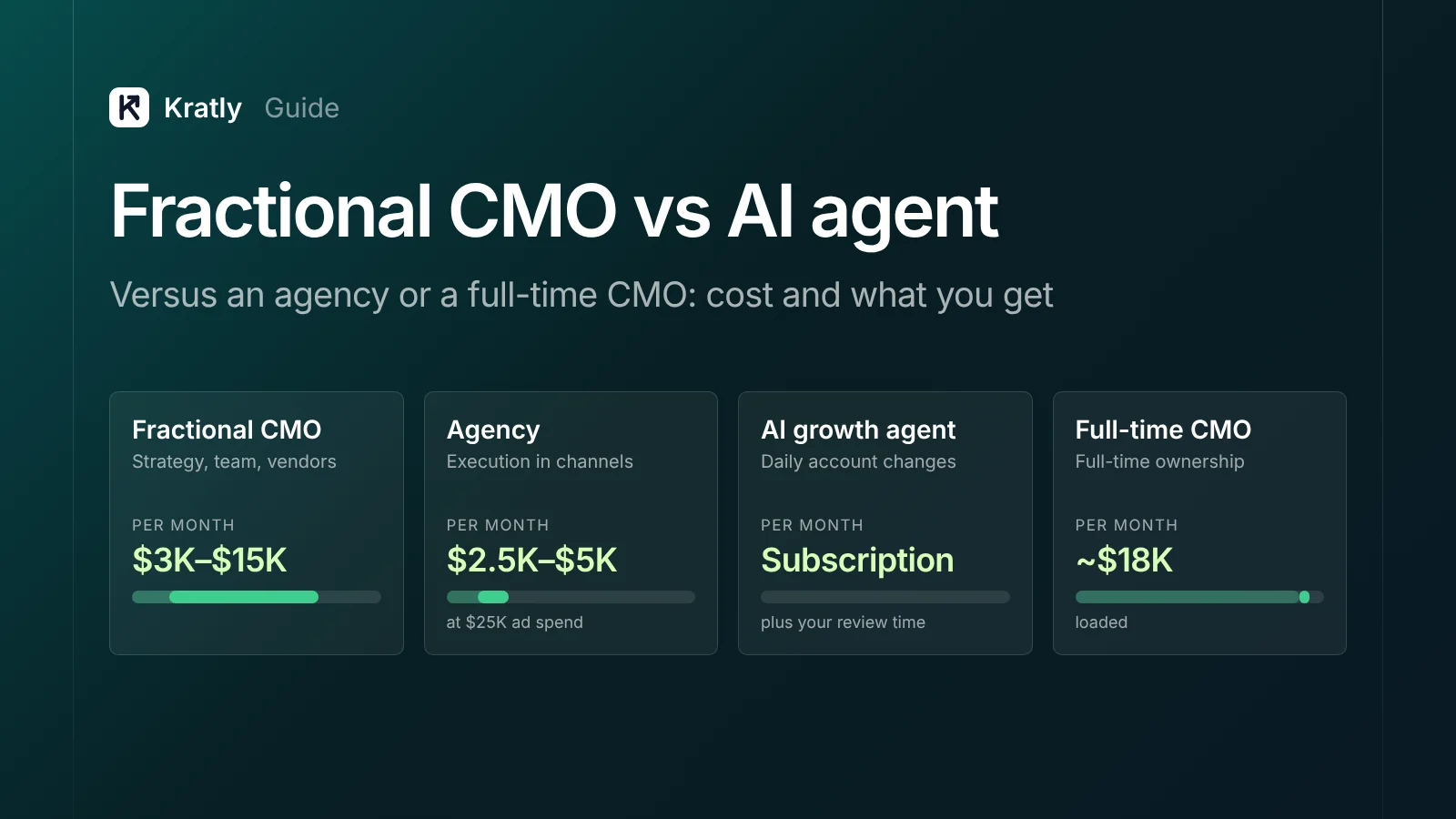
A fractional CMO is a part-time marketing leader who sets strategy, positioning and targets, and manages your team and vendors. Expect roughly $3,000 to $15,000 a month on a retainer. A fractional CMO doesn't run your ads day to day. An agency or an AI agent does that work. Many teams need one leader plus one doer.
In April 2024, columnist Gene Marks wrote about hiring fractional executives. Fees, he reported, "generally run $200 to $300 per hour." Rajat Kapur runs an outsourced sales and marketing team. His typical engagement was about a day and a half a week for about six months. "At about six months, a business owner can determine if the relationship is really working," Kapur said (The Philadelphia Inquirer, April 2024).
Six months at that rate is a real bet. Know what you're buying.
A note on bias: Kratly sells an AI growth agent, one of the options compared here. Every cost links to its source; vendor figures are labeled.
What does a fractional CMO do, and not do?#
A fractional CMO is a senior marketing leader who works part-time for several companies at once, owning strategy and results without a full-time salary.
Per MarketerHire, a marketplace, fractional CMOs "own the marketing strategy, manage your team and vendors, set KPIs, and drive execution" (MarketerHire, April 2026). Most work with two to four clients at once, it says.
What you're paying for:
- Strategy and positioning. Who you sell to, what you say and which channels get money.
- Team and vendors. Hiring and managing marketers, choosing or firing agencies.
- Targets and reporting. KPIs, and reports to the CEO and board.
- Cutting waste. Chief Outsiders, a fractional firm, expects the "first impact will be shutting down all the spending that isn't delivering a return" (Chief Outsiders, updated June 2024).
What you're usually not paying for: building campaigns, writing ads or watching accounts daily. At 10 to 20 hours a week, there's no time. And Chief Outsiders says the job is "to get in, and get out." A fractional CMO decides. Someone else does.
How much does a fractional CMO cost?#
There's no government data on fractional CMO pay. Every range below comes from someone who sells the service.
| Source (type, date) | Price | Time you get |
|---|---|---|
| MarketerHire (marketplace, Apr 2026) | $3,000–$15,000/month retainer; $150–$350/hour; $5,000–$25,000 per project | 10–20 hours a week for most |
| GoFractional (marketplace data, Jul–Oct 2026) | $177/hour average asking rate for SaaS; middle half $150–$200 | Hourly; 114 rate observations |
| Chief Outsiders (fractional firm, updated Jun 2024) | Retainer firms $1,500 to over $30,000/month; about $300–$500/hour | Varies by firm |
| Gene Marks, The Inquirer (column, Apr 2024) | $200–$300/hour | About 1.5 days a week for about six months (Kapur) |
| Toptal (marketplace, checked Oct 2026) | No public price | Up to two weeks' trial; pay only if satisfied |
GoFractional's figures are asking rates and "not a census of the fractional market."
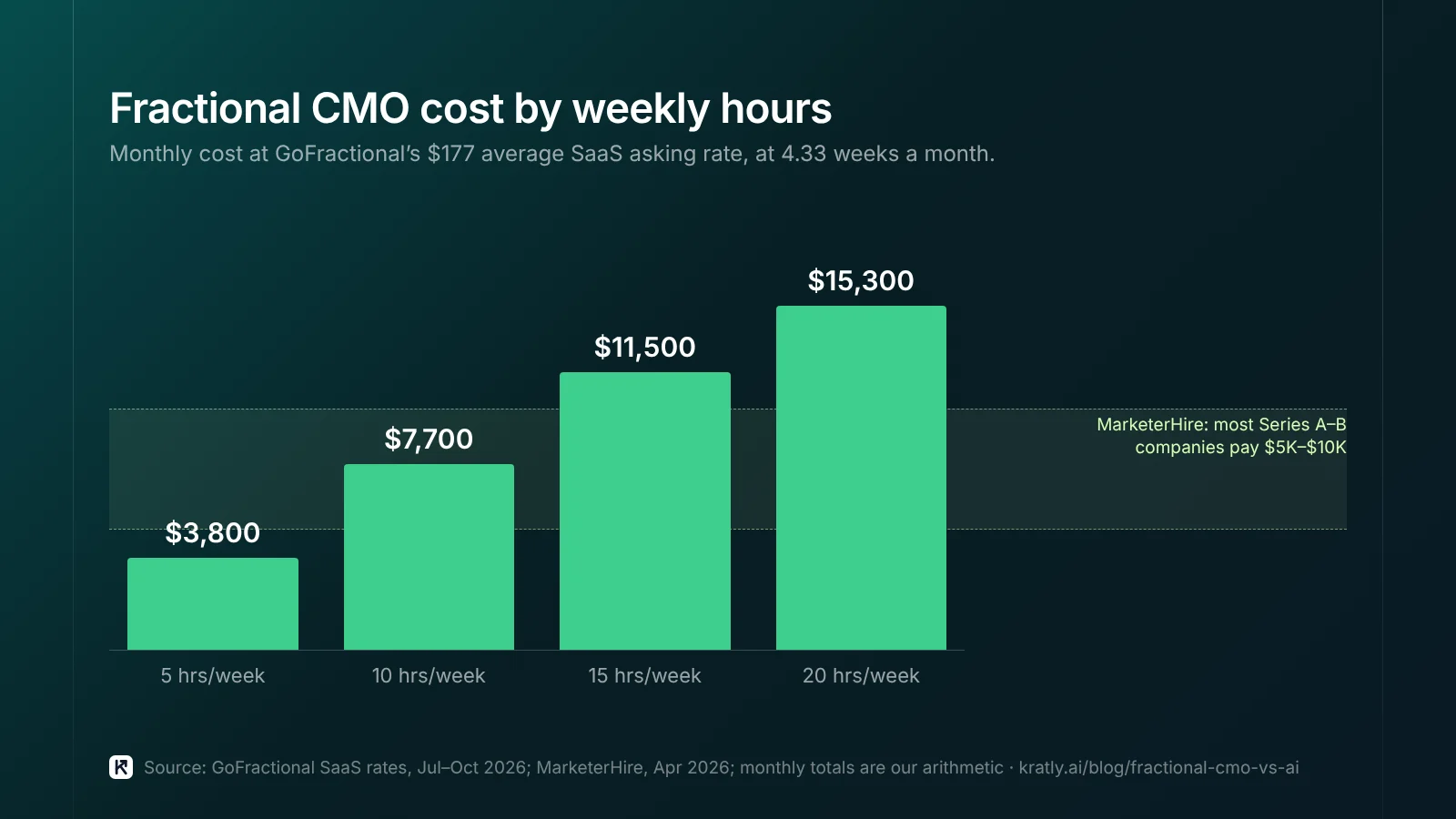
What that means per month. At GoFractional's $177 average, 10 hours a week is about $7,700 a month. Twenty hours is about $15,300 (our arithmetic, 4.33 weeks a month). That fits MarketerHire's view that most Series A and B companies pay $5,000 to $10,000 a month. Below $3,000 a month, MarketerHire says, "you're usually getting a marketing consultant."
Fractional CMO vs agency vs AI agent vs full-time CMO#
Full salary and agency fee tables are in our growth marketer vs AI growth agent cost comparison.
| Fractional CMO | Agency | AI growth agent | Full-time CMO | |
|---|---|---|---|---|
| Monthly cost | $3K–$15K (MarketerHire) | 10–20% of ad spend, or $500–$2,000 flat for small accounts (AgencyAnalytics) | A subscription plus your review time | About $18K loaded* |
| What you get | Strategy, positioning, team and vendor management | Execution in one or more channels | Daily analysis and account changes within limits | Strategy, team and full-time ownership |
| Who does the work | Your team or vendors | The agency | The agent, with a person approving | Their team |
| Owns the revenue number | Yes, part-time | Rarely | No | Yes |
*Payscale lists a $147,806 average base for a mid-career CMO, from 241 profiles (Payscale, May 2026). Benefits are about 31.5% of total pay for management roles (BLS, June 2026). That's about $216,000 a year loaded (our arithmetic). MarketerHire says CMO base at venture-backed companies "typically starts at $200,000."
A worked example. At $25,000 a month in ads, an agency at 10–20% costs $2,500 to $5,000. Add a 10-hour-a-week fractional CMO (about $7,700) and you pay $10,200 to $12,700. That's still below one loaded full-time CMO, but only one of the two does daily work.
How to vet a fractional CMO#
Questions for the first call:
- Which companies at our stage have you led? What changed in revenue while you were there?
- How many clients do you have now, and how many hours a week do we get?
- Who does the execution: our hires, your people, or software?
- Will your monthly report show revenue in Stripe or Shopify, or platform numbers?
Red flags:
- They own an agency and want to bring it in. Chief Outsiders warns that agency executives' "mission is to deploy agency resources." That's a conflict when they also advise you on spend.
- A long lock-in. Toptal offers up to a two-week trial. A three-month minimum is fair. Twelve months isn't.
- They can't name what they'd stop. Saying no is half the job.
Call two past clients they didn't pick. Ask what happened after the CMO left.
What should the first 90 days look like?#
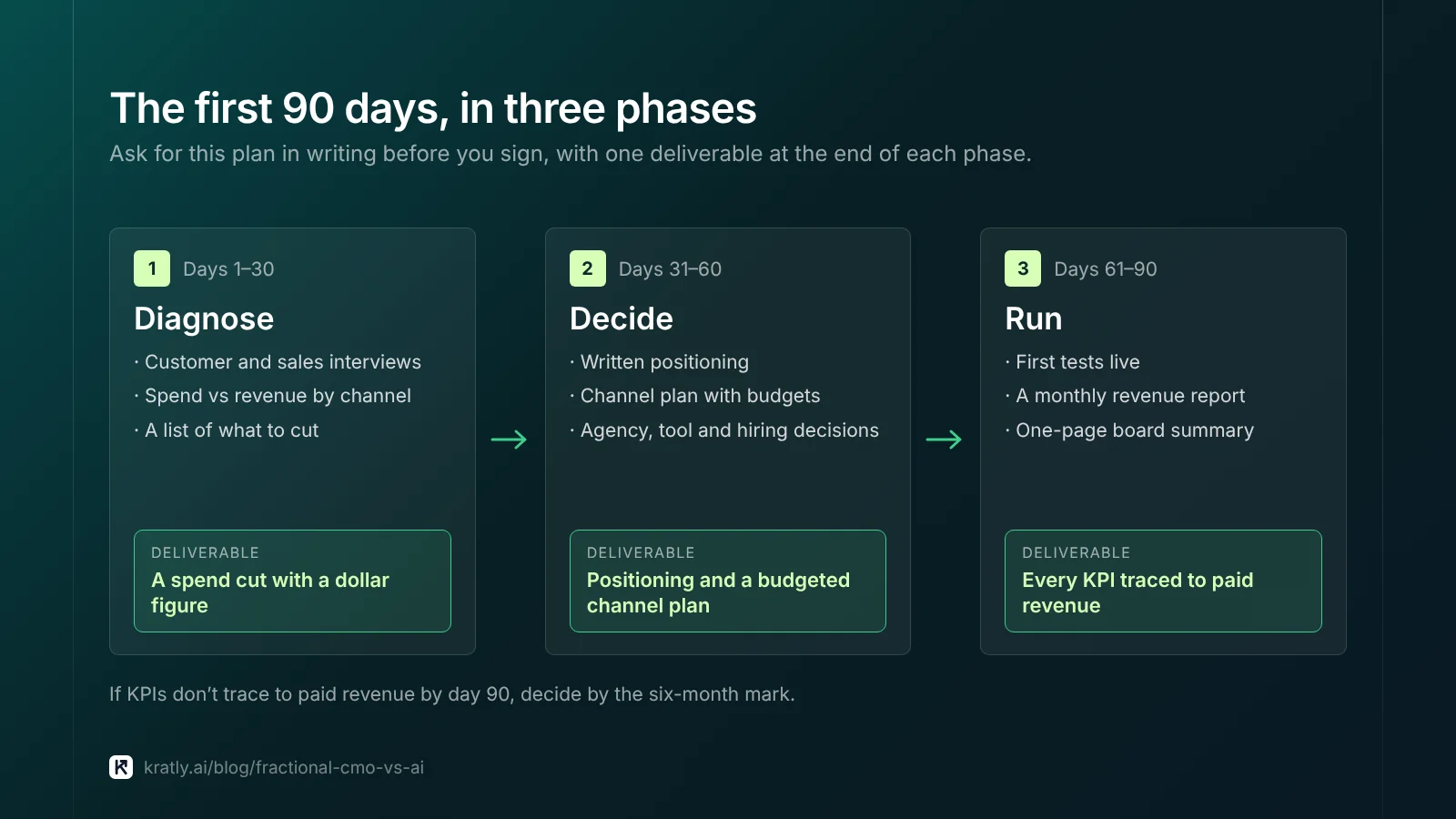
MarketerHire says the first 30 days are "diagnostic." Ask for this plan in writing before you sign. The phases are my recommendation.
| Days | Focus | What you should see |
|---|---|---|
| 1–30 | Diagnose | Customer and sales interviews; spend vs revenue by channel; a list of what to cut |
| 31–60 | Decide | Written positioning; a channel plan with budgets; agency, tool and hiring decisions |
| 61–90 | Run | First tests live; a monthly revenue report; a one-page board summary |
By day 30, expect a spend cut with a dollar figure. By day 90, every KPI should trace to paid revenue. If not, decide by Kapur's six-month mark.
When a fractional CMO plus an AI agent works#
The fractional CMO decides. The AI agent does daily account work within limits the CMO sets. Someone on your team approves changes.
It works when one channel already brings paying customers. Someone inside reviews the agent's suggestions weekly. Revenue is tied to campaigns, so both read the same numbers.
It fails when you don't know your customer yet, or nobody has time to approve changes. Video and design work belongs with an agency or freelancer.
If you're earlier than this, when to hire a growth marketer: agency, in-house or AI by stage maps the order.
What can an "AI CMO" do, and what can't it?#
An AI CMO is a marketing label, not a job. It usually means an AI agent sold as a replacement for marketing leadership.
Okara launched an "AI CMO" in March 2026 at $99 a month. It claims the tool "can replace a marketing team that would typically cost $50,000 to $168,000 a year" (Dealroom/Techleap, March 2026). That's the vendor's claim. We haven't tested it.
What it can do today: draft content, watch accounts around the clock, review search terms, suggest budget moves and report results.
What it can't do: set positioning on thin data, hire or fire people, answer to a board, or own a bad call. It can also be confidently wrong if tracking counts sign-ups as sales.
Even upbeat consultants keep a person in charge. PwC Switzerland writes that "the marketing team provides human oversight and ensures accountability and strategic direction" (PwC, October 2025).
My view: an AI agent replaces execution hours, not a CMO. Our pillar, AI marketing agent: what it can do, what it can't, how to choose, has the scorecard and demo questions. For guardrails, see autonomous growth.
How to do this in Kratly#
Kratly is the doer in this setup, not the leader.
- Connect Google Ads, Meta Ads, your website and Stripe or Shopify. Each campaign, page and email is tied to revenue. LinkedIn, TikTok and Reddit Ads are coming soon; until then, tag that traffic with UTMs and upload its spend as a CSV.
- Give your fractional CMO access to revenue by channel from day one. It speeds up the 30-day diagnosis.
- Let the CMO set the limits. They choose, area by area, whether Kratly only suggests, waits for approval, or acts within limits. Every change is logged and reversible.
- Use one revenue report for the monthly review and the board summary.
Questions, answered
How much does a fractional CMO cost per month?
Usually $3,000 to $15,000 a month on a retainer, according to MarketerHire, a marketplace that places them. Its sweet spot for Series A and B companies is $5,000 to $10,000. Hourly rates cluster around $150 to $350. GoFractional's 2026 SaaS data shows a $177 average asking rate. These are seller figures, so get two or three quotes.
Is a fractional CMO worth it for a startup?
It's worth it once you have a product people pay for and need a plan, not just more hands. A fractional CMO costs far less than a full-time one and can cut waste quickly. It's a poor fit if nobody can execute the plan, or if you haven't found a channel that brings paying customers yet.
What's the difference between a fractional CMO and a marketing agency?
A fractional CMO leads: strategy, positioning, team and budget decisions. An agency executes: it runs campaigns in the channels you hire it for. Agencies usually charge 10–20% of ad spend. Many companies use both, with the fractional CMO choosing and managing the agency. Watch out for a CMO who also owns the agency.
Can an AI CMO replace a fractional CMO?
No. AI agents can handle much of the daily execution, such as reviewing search terms, pacing budgets and reporting. They can't set positioning on thin data, manage people or answer to a board. Treat an "AI CMO" as a strong doer under a human leader. Check any vendor claim with a short pilot first.
Written by
Priyansh Kumar
Priyansh Kumar has spent more than a decade in growth, scaling brands from 1 to 10 and from 10 to 100. He now builds Kratly, an autonomous growth team that ties every campaign, page and email to the revenue it brings.
Sources
- The Philadelphia Inquirer: How small businesses benefit from partnering with "fractional" executives (Gene Marks, Apr 2, 2024)
- MarketerHire: Fractional CMO cost: what to budget in 2026 (Apr 15, 2026; marketplace)
- GoFractional: Fractional CMO rates, SaaS (Jul 26–Oct 24, 2026 window; marketplace data)
- Chief Outsiders: What does a fractional CMO cost? (updated Jun 4, 2024; fractional firm)
- Toptal: Hire fractional CMOs (checked Oct 2026)
- Payscale: Mid-career Chief Marketing Officer salary (May 2026)
- US Bureau of Labor Statistics: Employer costs for employee compensation, June 2026
- AgencyAnalytics: PPC pricing
- Dealroom/Techleap: Okara launches a $99/month AI CMO (Mar 2026)
- PwC Switzerland: How AI agents revolutionise the role of CMOs (Oct 30, 2025)
Was this article useful?