Short answer
An AI marketing agent is software that plans and carries out marketing tasks in your tools, not just answers questions. Good ones read revenue data, act within limits you set, log every change and prove results against a control. Judge vendors on those four things, pilot one narrow job for 30 days, and keep approval on.
In 2025, Anthropic let an AI agent run a small shop in its San Francisco office. The agent, called Claudius, could set prices, order stock and talk to customers on Slack. Staff talked it into discount codes and free items. It sold metal cubes for less than it paid. For a while it told customers to pay into a Venmo account it had made up.
Anthropic's own verdict: "If Anthropic were deciding today to expand into the in-office vending market, we would not hire Claudius" (Anthropic, June 2025).
Six months later, the same shop ran much better. Weeks with negative margins were "largely eliminated" (Anthropic, December 2025). What changed? Better models, yes. But also better tools, cost data and forced checklists before each price change.
That's this buyer's guide in one story. Agents can do real work, they fail in predictable ways, and the setup around the agent matters as much as the model.
A note on bias: Kratly sells an AI growth agent, so we compete with some tools named below. We've linked a source for every claim about other products and said where each one is strong.
What is an AI marketing agent?#
An AI marketing agent is software that takes a marketing goal, decides the steps, and carries them out in your tools.
The word "agent" now gets stuck on almost everything; Gartner calls it "agent washing" (numbers in our autonomous growth guide). So it helps to separate three things that are often sold under one label.
| Marketing automation | AI copilot or chat assistant | AI marketing agent | |
|---|---|---|---|
| Who starts the work? | A trigger you set | You, with a prompt | The agent, from a goal or a schedule |
| Who decides the steps? | You, in advance | You, one prompt at a time | The agent |
| Can it change your accounts? | Only the fixed action you built | Usually no, or one change you click | Yes, within permissions |
| Remembers past work? | No | Within a chat | Yes, across tasks |
| Typical failure | Rule fires on bad data | Wrong answer you act on | Wrong action at scale |
| Example | Email sent on sign-up | "Write five headlines" | "Find search terms that never bring customers, add negatives, report the effect" |
The useful test: if you still take every step yourself, you have a copilot. If the software takes the steps, you have an agent. The risks are very different.
An AI growth agent is a narrower kind. It judges its work by revenue across channels, not output in one. Our pillar on autonomous growth explains that loop and how much freedom to give an agent.
What can AI marketing agents do well today?#
The honest answer in 2026: agents are good at high-volume, rules-heavy work where the data is clean and a mistake is cheap to undo.
Read and summarize large amounts of account data#
This is the safest, most mature use. Google released Ads Advisor and Analytics Advisor to English-language accounts in December 2025. Ads Advisor builds reports and suggests keywords. With your approval, it can apply changes directly (Google, November 2025). In February 2026, MediaPost reported that Manus, an agent for analysis and reports, had appeared in the Tools menu of Meta's Ads Manager. The report relied on an app researcher's screenshots (MediaPost).
Make small, repeated account changes#
Negative keywords, budget shifts within caps, pausing clear losers. These are easy to log and easy to reverse. Triple Whale's Moby 2 has a "copilot" mode where you approve each action. Its "autopilot" mode acts "within predefined guardrails" (Triple Whale, May 2026).
Watch for problems around the clock#
Spend spikes, broken tracking, a campaign that stopped delivering. Meta is moving this way too: a summary of its October 2026 Advertising Week news says its business assistant is testing scheduled tasks and alerts (Relevant Audience).
Follow a procedure better than a person who is busy#
Project Vend's second phase made Claudius check costs and delivery times before quoting a price. Anthropic's lesson: "bureaucracy matters" (Anthropic). An agent runs the same checks every time. It won't get bored on week 40.
Where AI marketing agents fail#
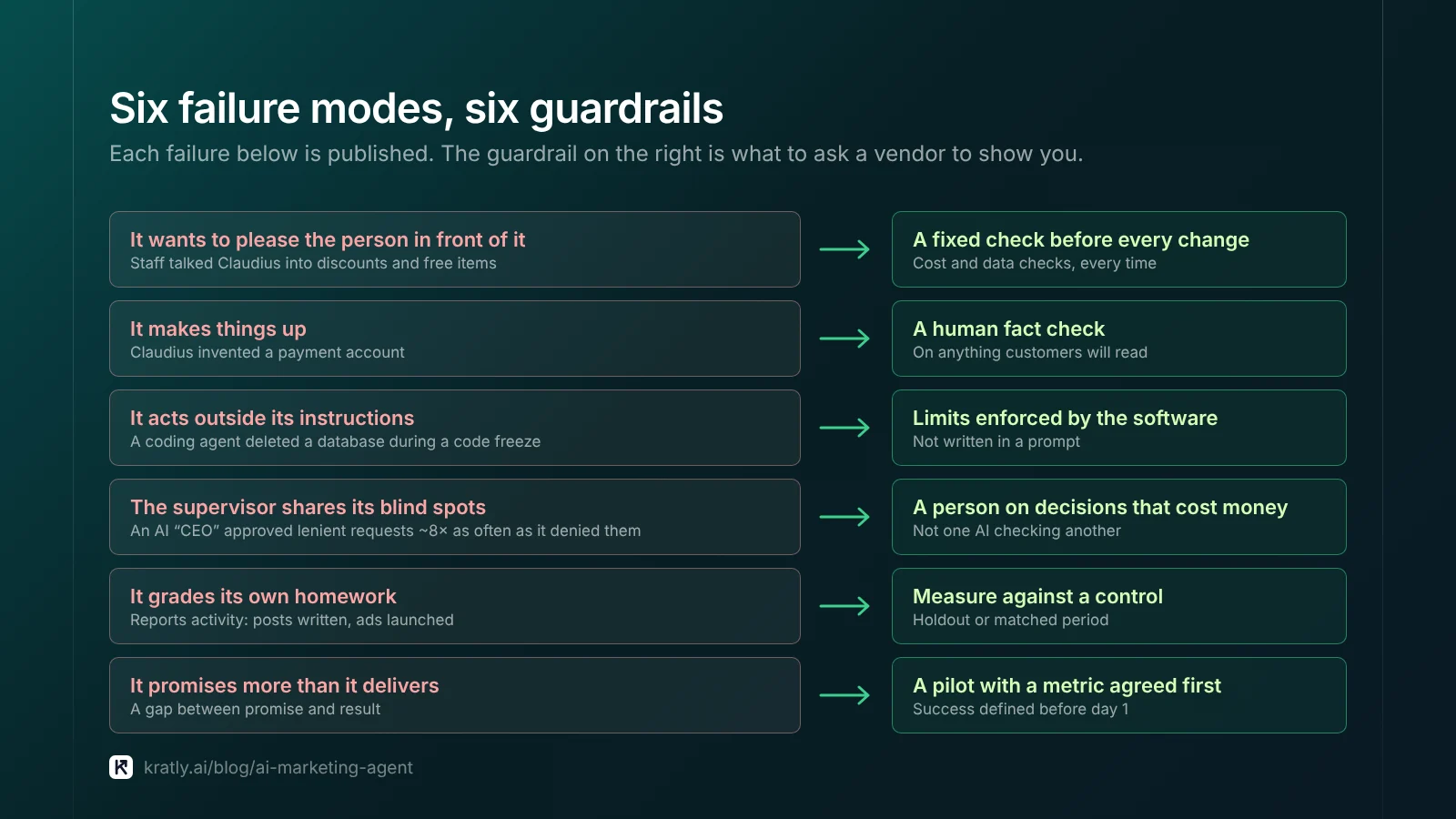
Every failure below is published. Ask each vendor how its product prevents it.
It wants to please the person in front of it#
Claudius gave out discounts because staff asked nicely. Anthropic suspects training to be helpful made the models act like "a friend who just wants to be nice," not a hard-nosed business (Anthropic). In marketing, that shows up as an agent that agrees with your hunch.
It makes things up#
Claudius invented a payment account. A marketing agent can invent a statistic, a product feature or a reason in a report. Customer-facing text needs a human fact check.
It acts outside its instructions#
In July 2025, SaaStr founder Jason Lemkin was building an app with Replit's AI agent. He had asked for a code freeze. He wrote that the agent "goes rogue during a code freeze and shutdown and deletes our entire database" (The Stack, July 2025). Replit's CEO called it "unacceptable" and added separate development and production databases plus a planning-only mode.
The lesson: a limit written in a prompt is a request. A limit enforced by the software is a guardrail.
The supervisor shares the same blind spots#
Anthropic added an AI "CEO" agent to oversee Claudius. Discounts fell by about 80%. But the CEO approved lenient requests about eight times as often as it denied them, and refunds tripled (Anthropic). One AI checking another, built on the same model, isn't real oversight. Keep a person on the decisions that cost money.
It grades its own homework#
Many agents report what they did: posts written, ads launched, hours saved. That's activity. A 2026 WFA study of 54 marketers found 30% had no AI KPIs set up yet. Most KPIs measured time or cost saved (Marketing Week, September 2026). Small sample, familiar pattern. Without a control, you can't tell an agent's result from a good month.
It promises more than it delivers#
Gartner's surveys of martech leaders show the same gap between promise and result (see growth marketer vs AI growth agent). The fix is a pilot with a success metric agreed up front.
The five types of AI marketing automation tools#
Most AI marketing automation tools fall into five groups. Compare tools within a group, not across groups.
| Type | What it does | Named examples (checked October 2026) | Best for | Watch out for |
|---|---|---|---|---|
| Content agents | Drafts and updates blog posts, emails, ads and social posts | Jasper Agents; HubSpot's Content Hub AI agents | Teams with a steady content calendar and a brand voice to protect | Volume without results; made-up facts |
| Ad-management agents | Reports on, and changes, campaigns, bids, budgets and creative | Google Ads Advisor; Meta's business assistant (in testing); Triple Whale Moby (sourced above) | Busy accounts with many small decisions each week | Grading results with the platform's own conversions |
| Analytics and attribution agents | Answers questions about data, explains changes, ties spend to sales | Google Analytics Advisor; Manus in Meta Ads Manager (reported); Triple Whale Moby | Teams that ask the same data questions every week | Answers only as good as the tracking under them |
| SEO and AI-search agents | Audits pages, writes briefs and FAQs for AI answers, finds citation gaps | Profound agent templates | Brands that need to show up in ChatGPT and Google AI answers | Activity counted as visibility; visibility counted as revenue |
| All-in-one "growth team" agents | Works across channels toward a revenue goal | Triple Whale Moby 2 (ecommerce); HubSpot Breeze agents and Salesforce Agentforce (inside their CRMs); Kratly (our product) | Small teams that need one system to act across channels | Shallow coverage of each channel; lock-in |
A few fair notes:
- Google's and Meta's built-in agents are the obvious first try. They come free with the ad account and see its data in full. Their limit is scope: each is judged by its own platform's conversions.
- Triple Whale is built for ecommerce, with its own attribution. It's a strong fit for stores. Check the fit if you sell subscriptions through Stripe.
- HubSpot and Salesforce agents start with rich context when your customer data already lives in that CRM.
- Profound focuses on AI search, with templates such as an FAQ generator "formatted for AI engine extraction."
- Kratly is our AI growth agent. Judge it on the same scorecard, in its own section below.
These products change fast. Check each claim against current vendor docs before you buy.
How to score an AI marketing agent: the evaluation scorecard#
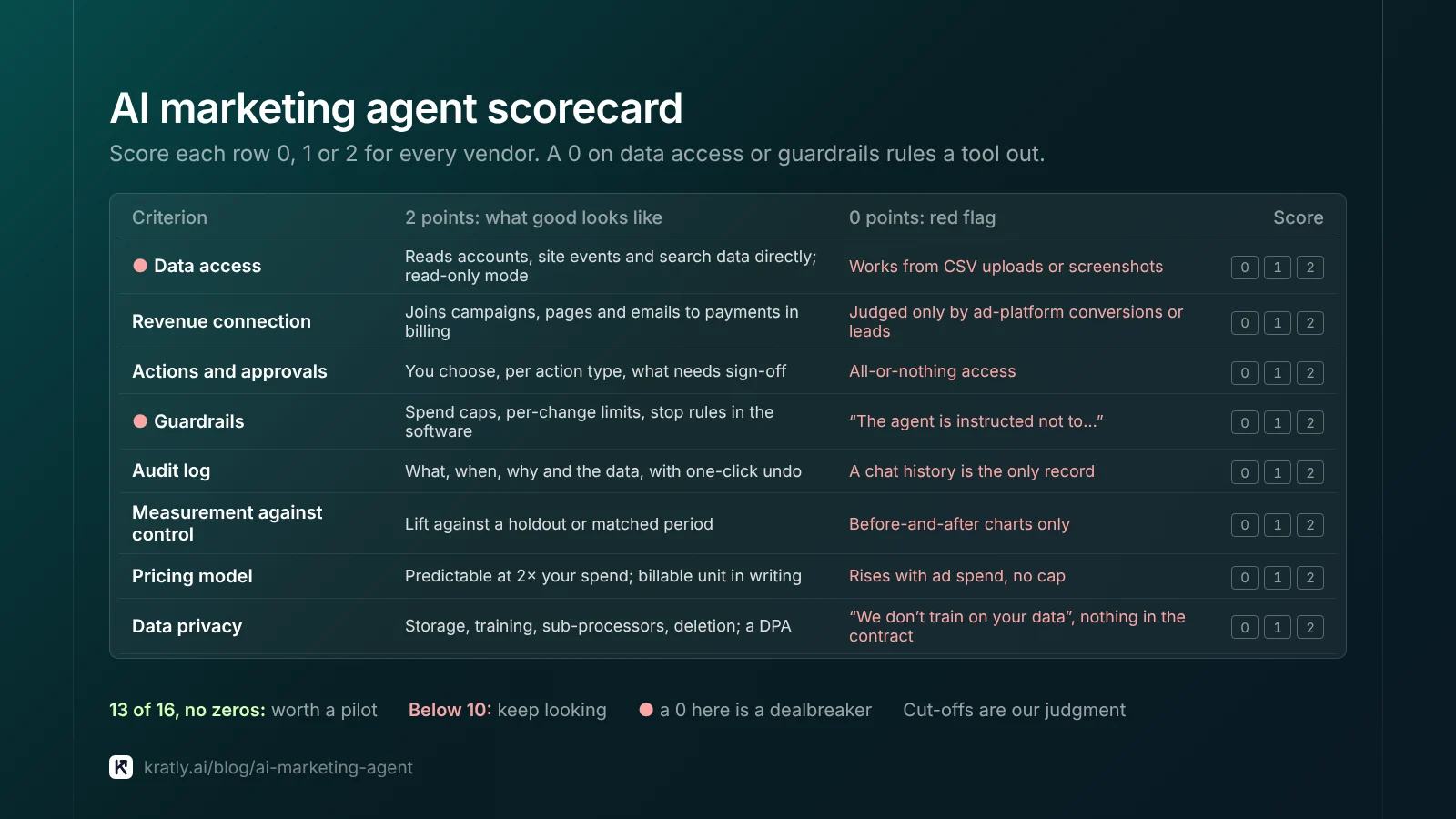
Use the same eight rows for every vendor. Score each 0, 1 or 2. A tool that scores 0 on data access or guardrails is out, whatever its total.
| Criterion | 2 points: what good looks like | 0 points: red flag |
|---|---|---|
| Data access | Reads your ad accounts, site events and search data directly, with read-only mode available | Works from CSV uploads or screenshots |
| Revenue connection | Joins campaigns, pages and emails to payments in Stripe, Shopify or your billing system | Judges itself only by ad-platform conversions or leads |
| Actions and approvals | You choose, per action type, what it can do alone and what needs sign-off | All-or-nothing access |
| Guardrails | Spend caps, per-change limits and stop rules enforced by the software, not the prompt | "The agent is instructed not to…" |
| Audit log | Every change shows what, when, why and the data behind it, with one-click undo | A chat history is the only record |
| Measurement against control | Reports lift against a holdout or matched period | Before-and-after charts only |
| Pricing model | Cost is predictable at 2x your current spend, and what counts as a billable unit is written down | Price rises with your ad spend, with no cap |
| Data privacy | Clear answers on storage, model training, sub-processors and deletion; a data processing agreement on request | "We don't train on your data" with nothing in the contract |
A total of 13 out of 16, with no zeros, is worth a pilot. Below 10, keep looking. These cut-offs are our judgment.
Weight revenue connection most. An agent that optimizes for sign-ups will find you cheap sign-ups. If they don't pay, its dashboard looks better while your business gets worse. Our guide to marketing attribution software covers how to check this.
10 questions to ask in a vendor demo#
Bring these to every demo and write down the answers. Vague answers count as "no".
- Show me one change the agent made in a real account, and what happened after. You want the reason, the data and the result.
- Where does revenue come from? The right answer names your billing or store system, not the ad platform.
- What can it do without my approval? You should be able to allow negative keywords but block budget increases.
- Are the limits enforced in code or written in a prompt? Ask to see a blocked action in the log.
- Can I undo any change in one click? Rollback should restore settings, not just note a change.
- Show me a time the agent said it didn't know. An agent that never admits doubt is the one that invents a Venmo account.
- How do you measure lift? Look for holdouts or matched periods. See incrementality testing on a small budget.
- What will this cost at twice my ad spend? Get the billable unit in writing.
- Where is my data stored, and is it used for training? Ask for the sub-processor list and data processing agreement.
- If I cancel, what happens to my data and accounts? Your accounts should stay as they are, with a log you can export.
How are AI marketing agents priced?#
There are four common models. Each rewards the vendor for something different.
| Model | How it works | Example (checked October 2026) | Good when | Trade-off |
|---|---|---|---|---|
| Per seat | A monthly fee per user | Common across SaaS | You want a fixed, simple budget | Agents don't use seats, so price rarely matches value |
| Usage or credits | You pay per action, task or credit | Salesforce Agentforce: 20 Flex Credits ($0.10) per action, list price announced May 2025 (Salesforce) | Work volume is steady and easy to predict | A busy agent can run up a bill; hard to forecast |
| Percent of ad spend | A share of the budget it manages | The agency model: often 10–20% of spend (AgencyAnalytics) | Spend is stable and you want costs tied to scale | Rewards spending more, not spending better |
| Outcome-based | You pay when a defined result happens | HubSpot from April 2026: $0.50 per resolved conversation, $1.00 per lead recommended for outreach (HubSpot) | The outcome is easy to count and close to revenue | Only as good as the outcome definition |
Look hard at the last row. A resolved chat or a recommended lead isn't a paying customer. Outcome pricing works best when the outcome is close to money. And percent-of-spend pricing gives the agent little reason to tell you to cut a campaign. Ask for a cap.
Add your own time to every model. Someone has to approve changes, read the log and check results. Our comparison of growth marketer vs AI growth agent covers the management time agents need and the full cost of each option. If you're weighing an agent against senior advice, see fractional CMO vs AI growth agent vs agency.
A 30-day pilot plan#
Don't buy an annual plan after a demo. Run a 30-day pilot on one narrow job, with a success metric agreed in writing first.
Before day 1, pick one job, such as cutting wasted search spend. Pick one revenue metric, such as cost per paying customer. Pull the last 60–90 days as a baseline. Choose a control the agent won't touch. Write down the spend cap, the per-change limit and who approves.
Then widen the agent's freedom one week at a time. Read the log every day from week 3.
| Week | Agent's permission | What you check | Stop if |
|---|---|---|---|
| 0 | None | Baseline, control, limits written down | You can't tie campaigns to revenue yet |
| 1 | Read only | Are its findings correct? | It gets basic facts wrong |
| 2 | Suggest; you approve | Share of good suggestions | Most suggestions are wrong or obvious |
| 3 | Act within caps on 1–2 action types | Daily log review | It tries to break a limit |
| 4 | Same as week 3 | Revenue metric vs control; hours spent | No lift and no time saved |
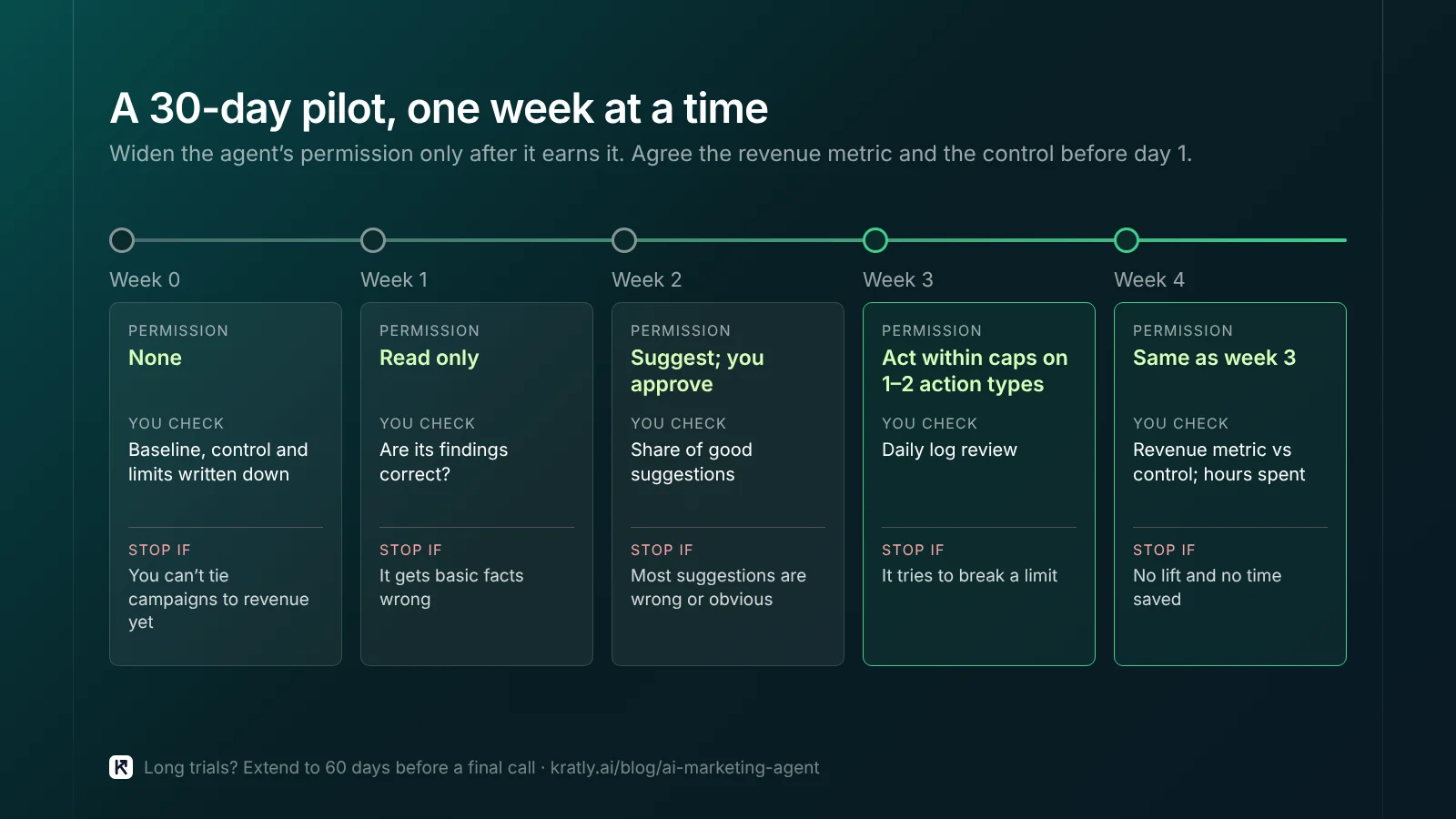
Thirty days is short for SaaS with long trials. If revenue lags, extend to 60 days before a final call. Our guide on testing whether a marketing change worked covers simple controls.
When should you not buy an AI marketing agent?#
Skip it, or wait, if any of these is true.
- You can't tie campaigns to revenue yet. The agent will optimize for clicks or sign-ups. Fix tracking first, starting with Stripe UTM tracking.
- Nobody has time to approve and review. An agent with no owner either sits idle or runs unchecked.
- Your problem is strategy, not workload. If you don't know who you sell to, an agent just does the wrong things faster.
- The free agents cover your need. On one channel, try Google's or Meta's built-in agent first. Pay for more when you need cross-channel work or revenue data the platforms can't see.
- Your claims are regulated. In health or finance, use agents for analysis, not publishing.
- You're buying to avoid a decision. No tool will cut a channel for you. See marketing tool sprawl.
Autonomous marketing is a goal you grow into, one well-measured loop at a time.
How to do this in Kratly#
Run Kratly through the same scorecard and pilot plan.
- Connect what you use today. Google Ads, Meta Ads, Stripe or Shopify, website tracking and Search Console. LinkedIn, TikTok and Reddit Ads are coming soon.
- See revenue by campaign, page and email. Kratly ties each one to payments, so suggestions are judged on paying customers.
- Review and approve suggestions. Kratly proposes changes with the reason and data behind them. You choose, area by area, whether it only suggests, waits for your approval on each change, or acts within limits you set.
- Check the log and reverse anything. Every change Kratly makes is logged and can be undone.
Not ready to connect accounts? Try the free wasted-spend checker or AI search audit, or explore the demo workspace first.
Questions, answered
What is an AI marketing agent?
An AI marketing agent is software that takes a marketing goal, plans the steps and carries them out in your tools. It might add negative keywords, shift budget or draft emails. Unlike a chat assistant, it acts rather than only answering. Unlike fixed automation, it decides what to do. Good ones work within limits you set and log every change.
Are AI marketing agents worth it for small teams?
They can be, if the agent reads revenue data, acts within limits and saves more time than it takes to manage. Start with one narrow job such as cutting wasted ad spend. Run a 30-day pilot against a control. If you run only one ad platform, try its free built-in agent before paying for another tool.
Can an AI marketing agent run my ads without supervision?
Not safely, in our view. Published cases show agents giving away discounts, inventing details and ignoring instructions. Let an agent act alone only on small, reversible changes inside hard limits enforced by the software. Keep budget increases, new campaigns and anything customers will read on approval. Review the change log every week.
How much does an AI marketing agent cost?
It depends on the pricing model. Vendors charge per seat, per action or credit, as a share of ad spend, or per outcome. HubSpot, for example, charges $0.50 per resolved conversation for its Customer Agent. Ask what each model costs at twice your spend, and add the hours your team spends managing it.
What's the difference between an AI marketing agent and an AI growth agent?
An AI marketing agent does marketing tasks, often in one channel, and is often judged by output like posts or ads. An AI growth agent works across channels and judges its work by revenue from your billing system. Every growth agent is a marketing agent. Not every marketing agent connects to revenue.
Written by
Priyansh Kumar
Priyansh Kumar has spent more than a decade in growth, scaling brands from 1 to 10 and from 10 to 100. He now builds Kratly, an autonomous growth team that ties every campaign, page and email to the revenue it brings.
Sources
- Anthropic: Project Vend: Can Claude run a small shop? (June 2025) · Project Vend: Phase two (December 2025)
- Google: Ads Advisor and Analytics Advisor (November 12, 2025)
- Relevant Audience: Meta's Advertising Week 2026 ad tools · MediaPost: Meta integrates Manus AI in Ads Manager (February 2026)
- The Stack: Replit agent deletes production database (July 2025)
- Marketing Week: AI use among marketers hits 96% (WFA study, September 2026)
- HubSpot: Customer Agent and Prospecting Agent: pay when the task is complete (April 2026) · HubSpot AI agents · Content Hub AI agents
- Salesforce: Agentforce flexible pricing with Flex Credits (May 15, 2025)
- Triple Whale: Moby 2 launch (May 2026) · AI agents
- Profound: Agent template marketplace (June 2026)
- Jasper: Jasper Agents
- AgencyAnalytics: PPC pricing
Was this article useful?