Short answer
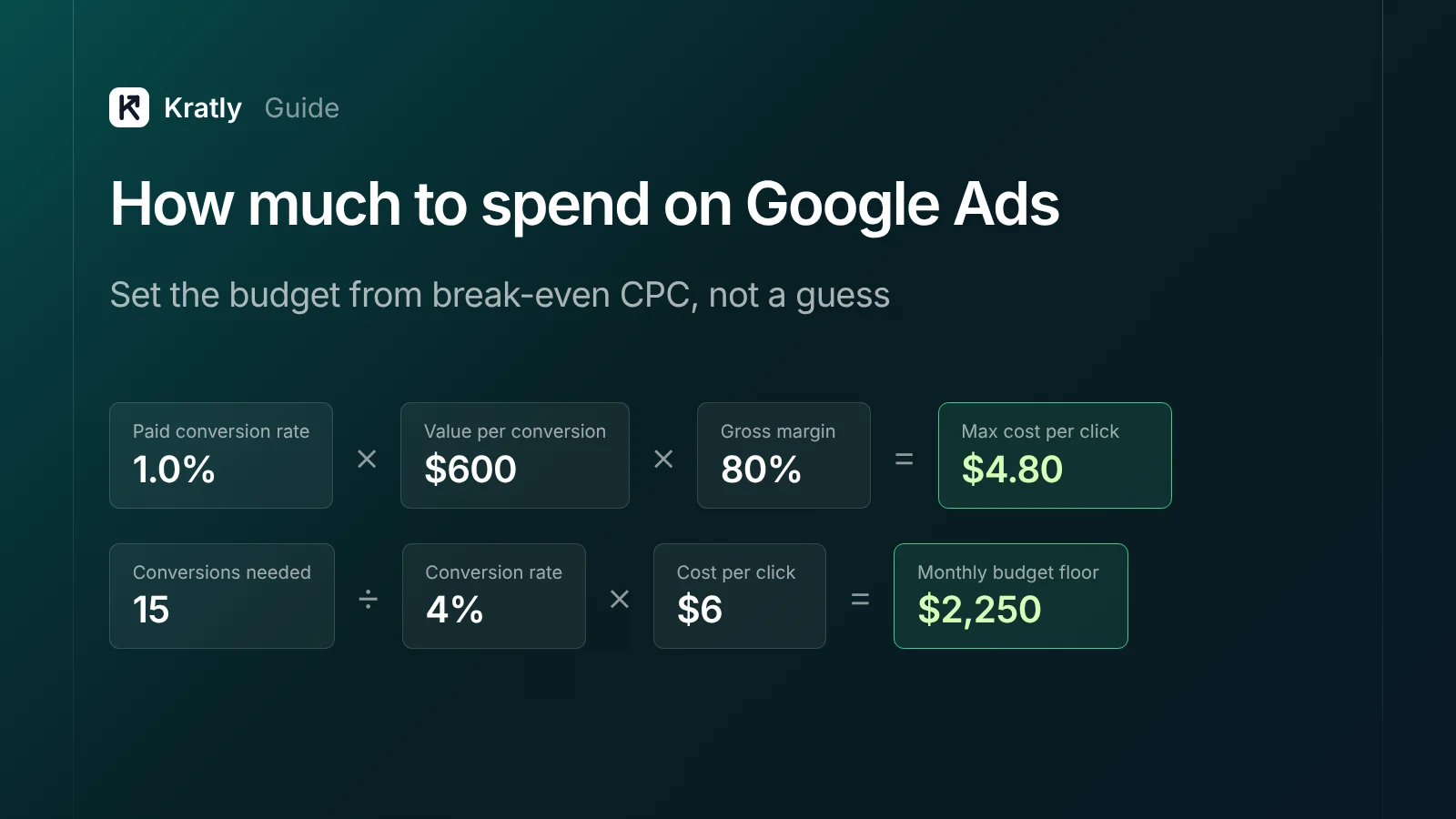
How much to spend on Google Ads depends on two numbers. First, your break-even CPC: conversion rate × value per conversion × gross margin. Second, the clicks you need for about 15 conversions a month, so bidding can learn. Multiply those clicks by your CPC. That's your floor. Spend more only while paying customers cost less than break-even.
Composite example: a founder sets $3,000 a month on Google Ads because an agency called it a normal starting budget. Clicks cost $8, so she buys about 375. At a 1% click-to-paid rate, that's three or four customers. Her break-even CPC was $4.80. Every click lost money from day one. (Made-up example, not a real company or Kratly customer.)
The budget was a guess. This guide shows how much to spend on Google Ads from your own numbers. For splitting a whole marketing budget across channels, see where to spend your first $5k a month.
What is the most you can pay per click?#
Break-even CPC is the highest price you can pay for a click before each sale it brings costs more than the gross profit it earns.
Break-even CPC = click-to-sale conversion rate × value per conversion × gross margin
It's the same idea as break-even ROAS, turned around. Break-even ROAS is 1 ÷ gross margin (Amazon Ads). That tells you the ratio to hit. Break-even CPC tells you the price to bid. Our guide to what a good ROAS is covers targets above break-even.
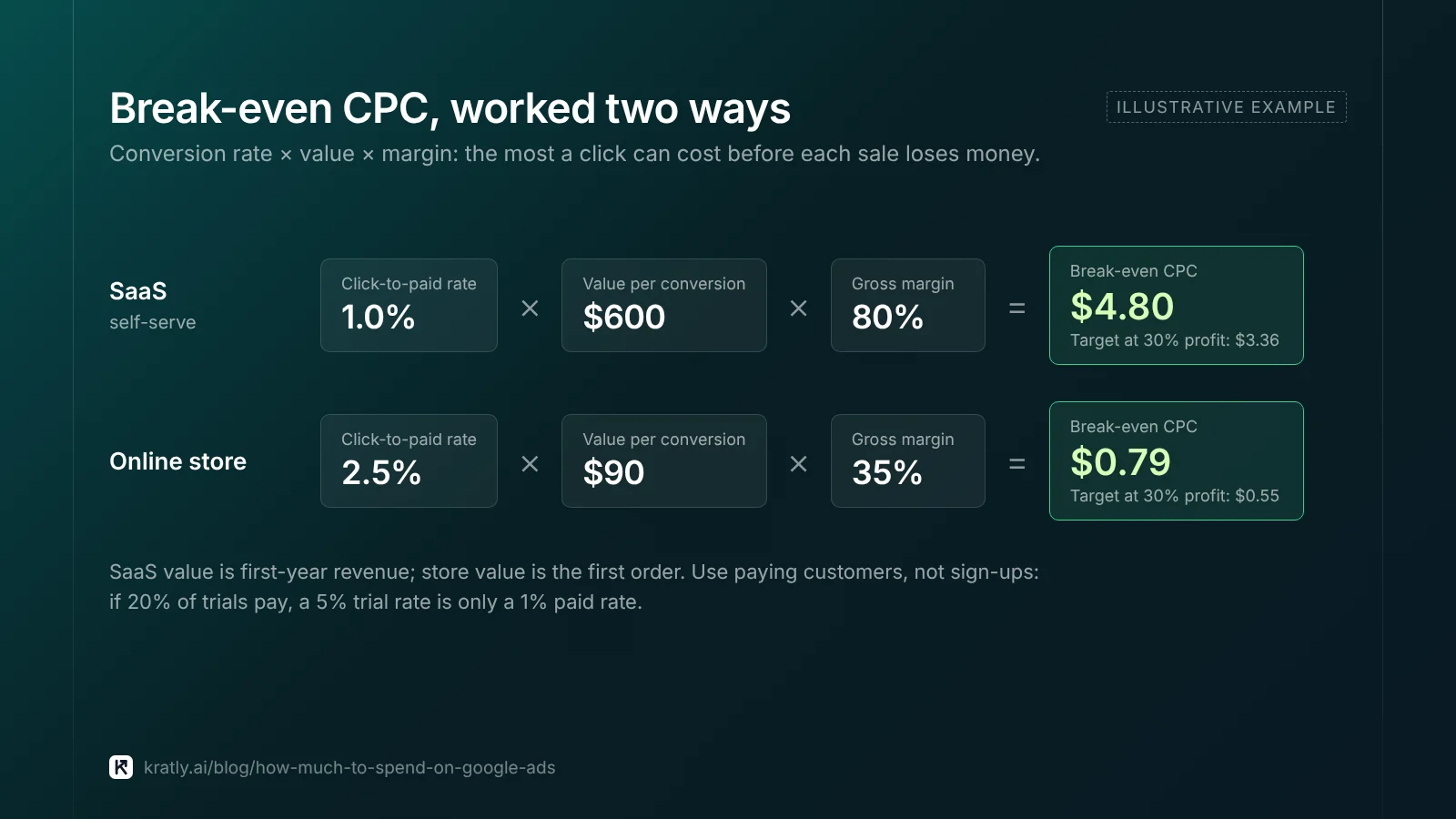
A worked example (illustrative numbers)#
These numbers are made up to show the math. They are not from a real company.
| Input | SaaS (self-serve) | Online store |
|---|---|---|
| Click-to-paid conversion rate | 1.0% | 2.5% |
| Value per conversion | $600 (first-year revenue) | $90 (first order) |
| Gross margin | 80% | 35% |
| Break-even CPC | 0.01 × $600 × 0.80 = $4.80 | 0.025 × $90 × 0.35 = $0.79 |
| Target CPC (keep 30% as profit) | $3.36 | $0.55 |
Two choices change the answer a lot.
- Which conversion. Use paying customers, not sign-ups. If 20% of trials pay, a 5% trial rate is only a 1% paid rate.
- Which value. For subscriptions, use revenue over your payback window, not the first month. For stores, use first order unless repeat buying shows up in your own cohorts.
How much budget does Smart Bidding need?#
Your floor is set by data, not ambition. Automated bidding needs enough conversions to learn.
Google's target ROAS needs at least 15 conversions in the past 30 days for Search and Shopping (Google Ads Help). For Performance Max, Google's developer guide says: "Set an average daily budget of at least three times your target CPA or cost per conversion" (Google Ads API docs).
Turn that into a monthly number:
Minimum monthly budget = conversions needed ÷ conversion rate × CPC
Say you bid on a qualified trial, at a 4% click-to-trial rate and a $6 CPC (illustrative). Fifteen trials need 375 clicks, or $2,250 a month. That's about $74 a day.
If you bid on paying customers at 1%, the same 15 need 1,500 clicks, or $9,000 a month. That's why I'd bid on the most frequent conversion that still predicts payment. Then send real Stripe revenue back as the value, as in tracking Stripe conversions in Google Ads.
Can't afford that? Don't starve Smart Bidding. Use manual CPC or Maximize Clicks, capped at your target CPC, on a tight keyword list.
How Google spends a daily budget#
You set an average daily budget, not a hard daily cap. Google says a campaign "might spend up to twice your average daily budget" on a given day (Google Ads Help). Over a month, it holds total spend to about 30.4 times the daily figure. You'll never pay more than that limit.
So set budgets backward from the month:
Daily budget = monthly budget ÷ 30.4
A $3,000 month is about $99 a day. Expect some days near $198 and some well under $99.
Don't raise budget before fixing leaks, or more money flows into the same bad search terms. Check the nine places Google Ads budget leaks first.
Google Ads budget by stage#
This table is my opinion, not survey data. Each stage moves on when the data says so, not on a calendar.
| Stage | What you're proving | Bidding | Budget rule | Move on when |
|---|---|---|---|---|
| 1. Test | Some keywords bring paying customers | Manual CPC or Maximize Clicks, capped at target CPC | Enough for ~300 clicks a month on your best keyword set | At least 3 paying customers at or under break-even CPC |
| 2. Learn | Bidding can find more of them | Maximize Conversions, then target CPA | Clicks for 15+ conversions in 30 days | Cost per paying customer steady for 2 months |
| 3. Scale | More budget keeps cost per customer under target | Target CPA or target ROAS on real revenue | Raise in steps; wait out your conversion delay | Marginal cost per customer nears break-even |
| 4. Expand | New campaign types pay | Add PMax or new keyword themes | PMax daily budget ≥ 3× target CPA | Each campaign judged on its own paying customers |
In stage 3, watch marginal cost: the tenth $1,000 buys pricier clicks than the first. Judge each increase on the customers it added. Our guide on when to pause a Google Ads campaign covers how long to wait.
Google Ads budget allocation across campaigns#
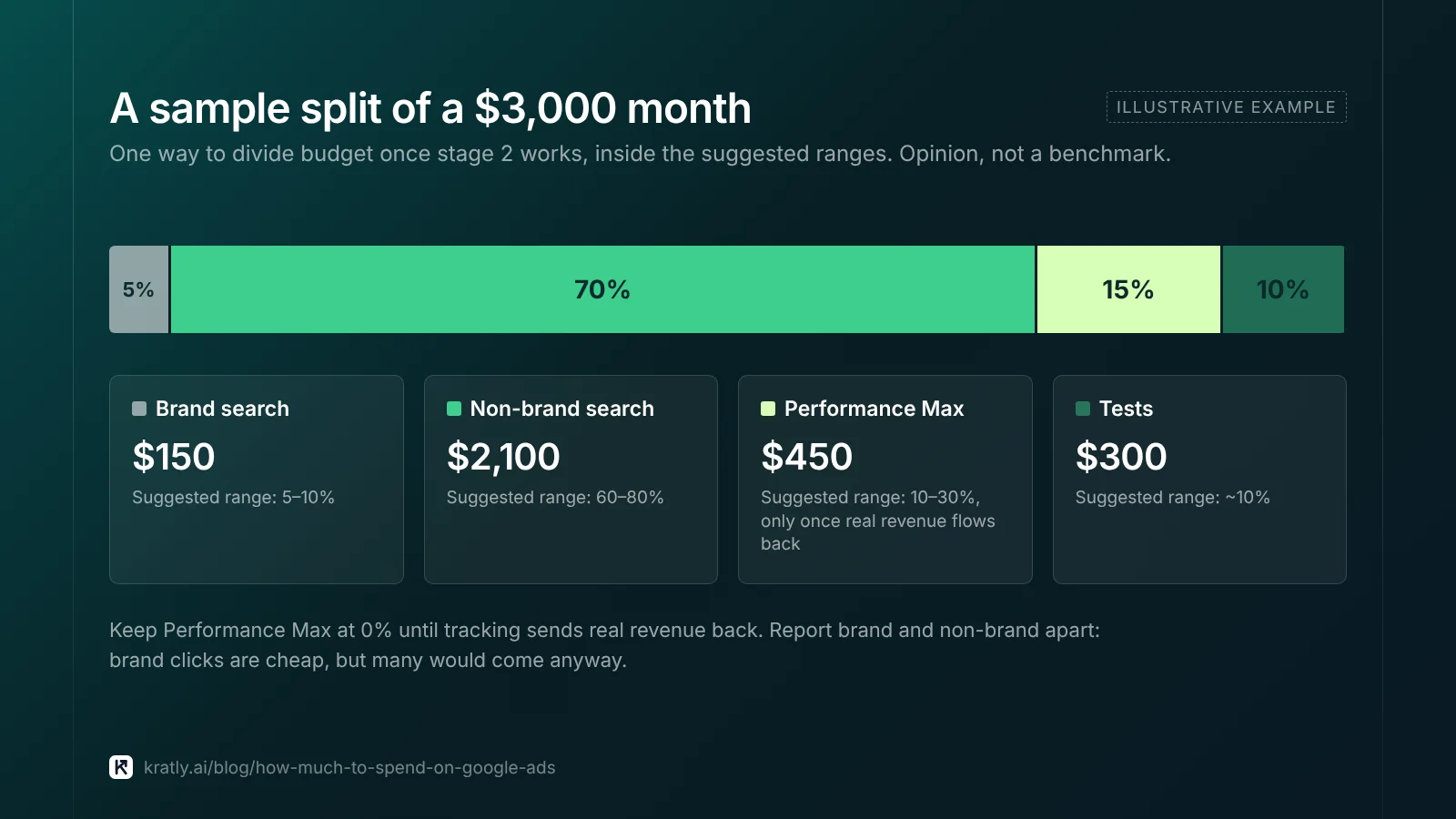
Most accounts end up with three or four campaign types. Here's how I'd split money once stage 2 works. Again, this is opinion.
| Campaign | Share of budget | Why | What to watch |
|---|---|---|---|
| Brand search | Small, often 5–10% | Cheap clicks, but many would come anyway | Test it before you pay: should you bid on your brand name? |
| Non-brand search | Most, 60–80% | Buying-intent searches; you control keywords | Cost per paying customer by keyword theme |
| Performance Max | 0% until tracking sends real revenue, then 10–30% | Reaches Shopping, YouTube and Display too | Channel and search term reports; Performance Max for SaaS |
| Tests | ~10% | New keyword themes or landing pages | One test at a time |
Brand campaigns inflate account results. When eBay paused brand search ads, 99.5% of lost paid clicks came back through organic search (NBER, Blake, Nosko and Tadelis). Report brand and non-brand apart.
What do Google Ads clicks cost on average?#
Use benchmarks as a sanity check, not a target. The most cited source is LocaliQ, which publishes them with WordStream.
Its 2026 search advertising benchmarks, last updated June 2026, report across all industries (LocaliQ):
- Average CPC: $5.42
- Average conversion rate: 8.18% (Google Ads)
- Average cost per lead: $66.69
- Business services: $5.87 CPC, 4.85% conversion rate, $93.69 cost per lead
That's agency client data, and it counts leads, not paying customers. A "conversion" there could be a form fill.
In the worked example, the SaaS break-even CPC of $4.80 sits under the $5.42 average. More budget won't fix that. A better conversion rate, higher value or cheaper keywords will.
Google Ads cost in India#
Teams in India face two auctions. Price depends on where your ads show, not where you sit.
Selling to buyers in India#
Don't assume India clicks are cheap; check your own keywords. We ran our own Keyword Planner forecast on October 24, 2026, for Kratly's keyword list. It forecast about ₹154 per click. That's Kratly's internal forecast for one set of B2B software keywords, not a market benchmark.
Treat any forecast with care. For new advertisers, Google says forecasts rely on "historical average data for all advertisers" (Google Ads Help).
Add tax to the budget. Google India bills Indian Ads accounts with GST at 18% IGST, or 9% CGST plus 9% SGST in the same state. Without a GSTIN, you may not be able to claim credit for it (Google Payments Help). Confirm the details with your tax adviser.
Selling to US buyers from India#
If you target the US, you're in the auction for US searches, so run a separate Keyword Planner forecast with US location targeting. Your break-even CPC math is the same. Use US pricing, US conversion rates and the revenue that lands in your account after fees. More on that market in selling SaaS from India to US buyers.
What I'd do: run separate India and US campaigns, each with its own budget and CPC cap. A blended campaign hides which market pays back.
How to do this in Kratly#
A note on bias: Kratly sells software that measures ad revenue. The math above works in a spreadsheet. For what an AI tool should and shouldn't do with your budget, see AI marketing agent: what it can do, what it can't, how to choose.
- Run the free wasted-spend checker before you set a new budget. Upload your search terms report; it runs in your browser and flags searches that spend without converting.
- Connect Google Ads with Stripe or Shopify. Kratly ties each campaign to the payments it brought, so your conversion rate and value come from real money.
- Compare cost per paying customer with your break-even for each campaign.
- Approve suggested budget changes. You approve each move; every change is logged and reversible.
Questions, answered
How much should I spend on Google Ads per month?
Enough to buy about 15 conversions a month at a CPC below your break-even. Work it out as conversions needed ÷ conversion rate × CPC. At a 4% conversion rate and a $6 CPC, that's $2,250. If you can't afford that, run manual bidding on a tight keyword list until you can. Then raise budget only while cost per paying customer stays under target.
How do I calculate break-even CPC?
Multiply your click-to-sale conversion rate by the value of a conversion and your gross margin. At a 1% paid rate, $600 of first-year revenue and 80% margin, break-even CPC is $4.80. Bid below it to keep a profit. Use paying customers and real revenue, not sign-ups, or the number will be far too high.
How much does Google Ads cost in India?
It depends on the keyword and the targeted location, so run your own Keyword Planner forecast. Kratly's own forecast for its B2B software keywords (October 24, 2026) came to about ₹154 per click, not a market benchmark. Indian accounts billed by Google India also pay 18% GST. If you target US buyers, forecast US prices separately.
How should I split budget between brand, search and Performance Max?
My suggestion: put most of it, about 60–80%, on non-brand search. Keep brand small and test whether it adds sales. Add Performance Max only once real revenue flows back, with a daily budget of at least three times your target CPA. Keep about 10% for tests. Judge each campaign on its own paying customers.
Written by
Priyansh Kumar
Priyansh Kumar has spent more than a decade in growth, scaling brands from 1 to 10 and from 10 to 100. He now builds Kratly, an autonomous growth team that ties every campaign, page and email to the revenue it brings.
Sources
- Google Ads Help: Why daily costs might exceed your average daily budget · About target ROAS bidding · About Keyword Planner forecasts
- Google Ads API docs: Create a Performance Max campaign budget
- Google Payments Help: GST on purchases (India)
- LocaliQ: Search advertising benchmarks (updated June 2026, agency client data)
- Amazon Ads: Ads math and break-even ROAS
- NBER: Blake, Nosko and Tadelis, Consumer heterogeneity and paid search effectiveness (w20171)
Was this article useful?