Short answer
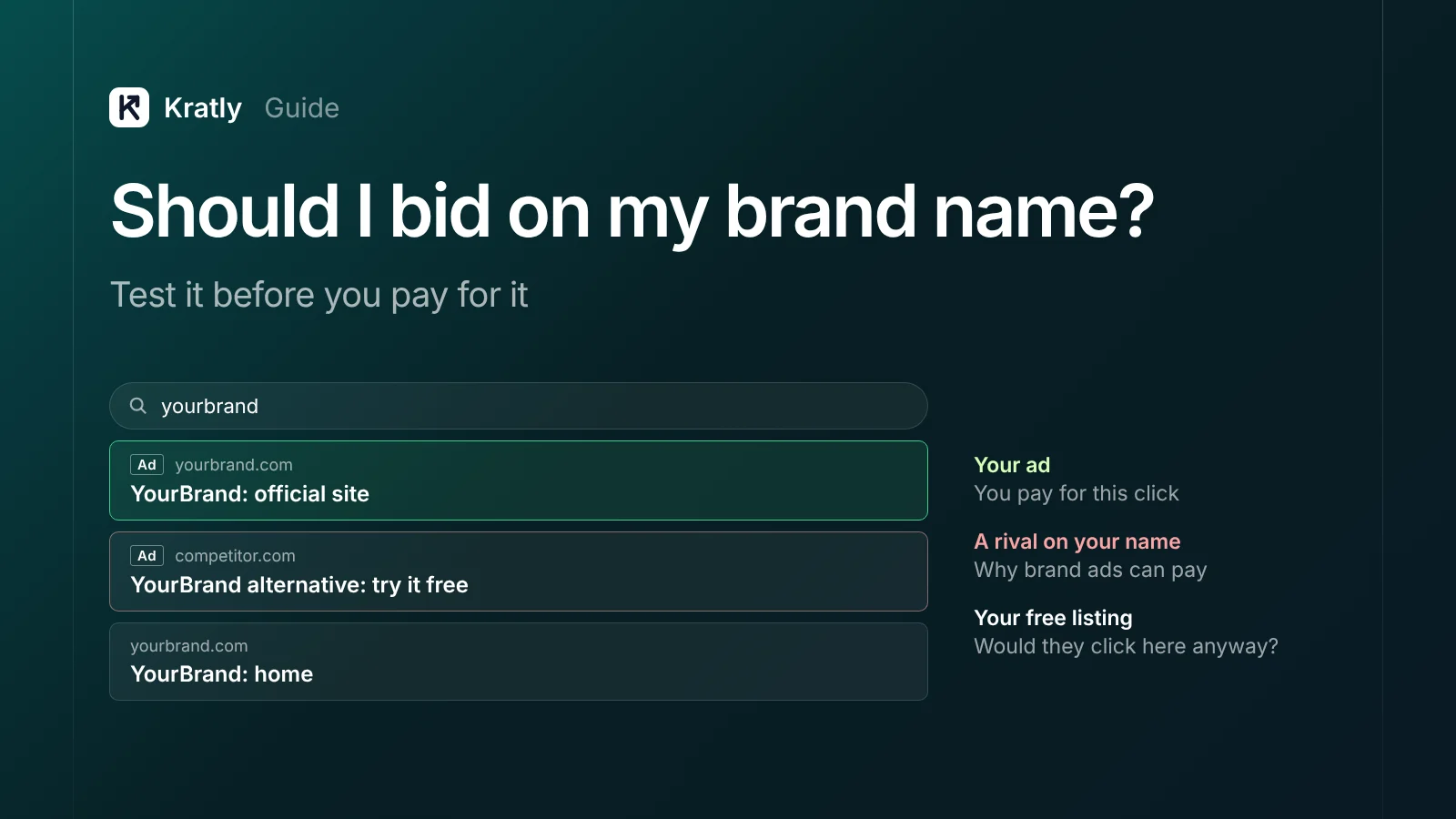
Should I bid on my brand name? Only if a test shows it adds paying customers. If competitors bid on your name, a brand campaign usually protects real sales. If nobody does and you rank first, many brand clicks would come through organic anyway. Run a geo or time holdout for four weeks and judge on paid customers.
In 2019, Basecamp's co-founder Jason Fried searched for "Basecamp" and found competitors' ads sitting above his company. His view of paying to appear on your own name: "It's a shakedown. It's ransom" (Jason Fried on X, collected by Michael Tsai). Shopify CEO Tobi Lütke called it "charging what's basically protection money on your own brand name."
On the other side sits eBay. In a controlled test, eBay stopped its brand ads. Organic results brought back 99.5% of the lost paid clicks (NBER, Blake, Nosko and Tadelis).
Both are right, for different accounts. The question isn't whether brand bidding is good. It's whether your brand ads add customers you wouldn't get anyway. You can find that out in a month.
Should I bid on my brand name? The case for and against#
Brand ads look great in reports. They have high click rates, cheap clicks and a low cost per conversion. That's the trap. The people who search your name already chose you. The ad gets credit for a decision made earlier.
| Reasons to bid on your brand | Reasons not to |
|---|---|
| Competitors bid on your name and appear above you | Nobody else bids, and you rank first organically |
| You control the message, offer and landing page | Most brand clicks would arrive through organic anyway |
| Resellers, review sites or affiliates take the top spot | Brand ROAS inflates the whole account and hides weak campaigns |
| You can show sitelinks to pricing, login, demo | Smart Bidding and PMax drift toward cheap brand conversions |
| A launch or press spike brings new searchers | It costs real money every month, and the bill grows with your brand |
My default: if Auction insights shows competitors on your brand terms, keep a small, tight brand campaign and test it. If nobody else is there, test switching it off.
The case where I'd do the opposite: during a launch, a funding announcement or a big press week. Search demand jumps, competitors notice, and you want full control of the page. Don't test then; test after.
What the studies say#
Two well-known studies point in different directions. Both are useful.
eBay (2015). Economists ran controlled experiments on eBay's paid search. For brand keywords, they found ads "have no measurable short-term benefits" (NBER). When brand ads stopped, organic clicks replaced 99.5% of the lost paid clicks. But eBay is a household name with no real rival on its own brand terms. Your brand probably isn't.
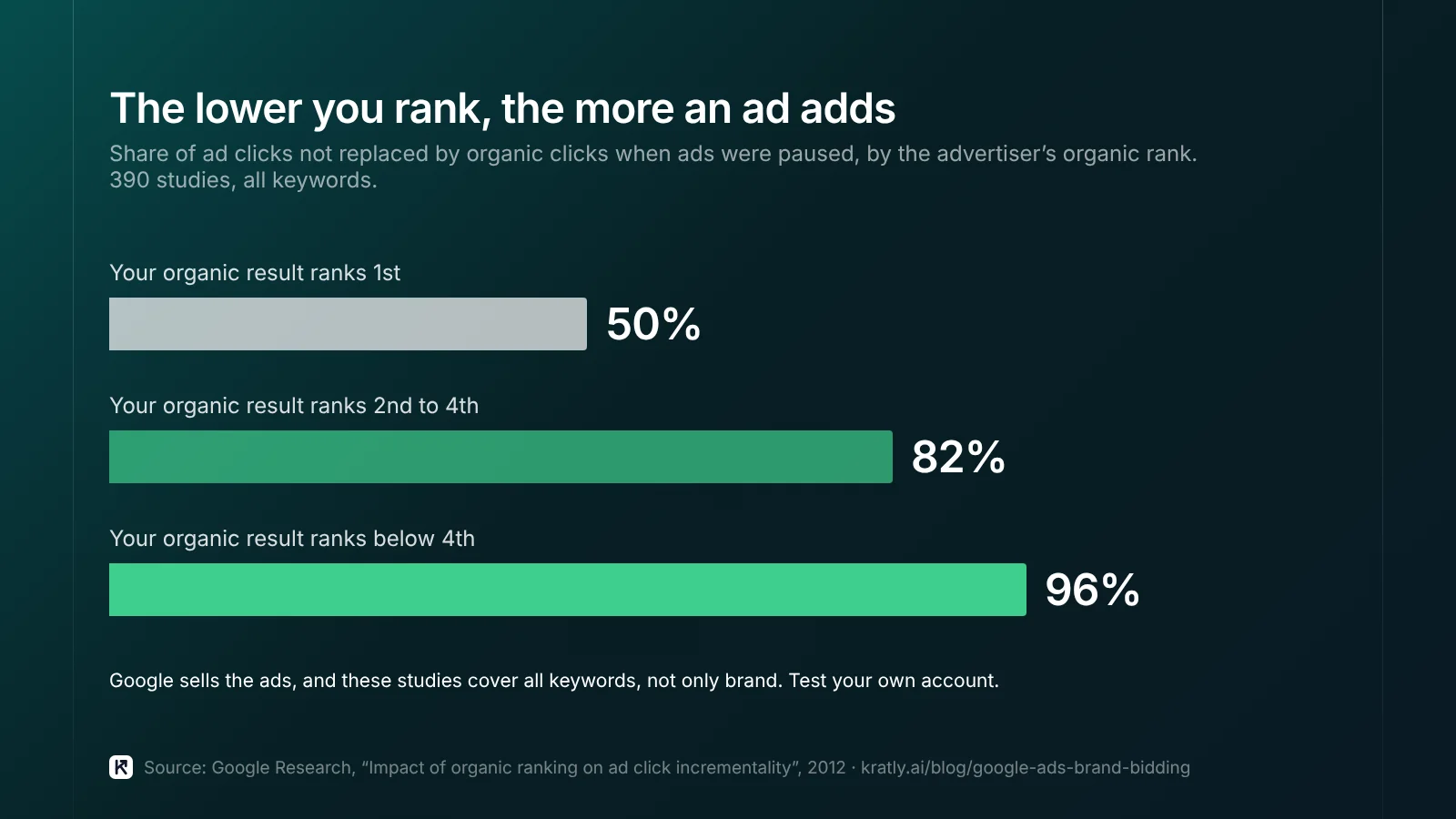
Google (2012). Google analyzed 390 "search ads pause" studies. When the advertiser's organic result ranked first, 50% of ad clicks were incremental. At organic ranks 2–4, it was 82%. Below rank 4, it was 96% (Google Research). These studies covered all keywords, not just brand, and Google sells the ads. Still, the pattern is clear: the weaker your organic spot, the more the ad adds.
What this means for you: the answer depends on who else is on your results page. A small SaaS with a common-word name and three competitors bidding is closer to Google's numbers. A well-known brand with a clean results page is closer to eBay's.
Who bids on your brand? Check Auction insights#
Before you test, see who you're up against.
Open Campaigns, select your brand campaign or brand keywords, then choose Auction insights. For Search, it shows impression share, overlap rate and position above rate. It also shows top of page rate, absolute top of page rate and outranking share (Google Ads Help). It "doesn't show insights when impression share is less than 10%," so very small campaigns may show nothing.
What I'd check first: position above rate. If a competitor ranks above you on your own name often, they're taking clicks you paid to earn.
Can competitors do this? Yes. Google's trademark policy says it will not restrict "using trademarks as keywords" (Google Ads policy). It can restrict a direct competitor using your trademark in the ad text, if you file a complaint and hold trademark rights in that country. So you can stop "Basecamp alternative" headlines from a rival, in many cases. You can't stop them bidding on the keyword.
How to run a branded search test#
A branded search test switches brand ads off for part of your traffic and compares results with the part that kept them. You measure total customers, not ad clicks. Here's how I'd set it up.
Step 1: Pick your method.
| Method | How it works | Good for | Cost and risk |
|---|---|---|---|
| Geo holdout | Exclude brand ads in some US states or regions; keep them in matched regions | Most accounts with national traffic | 4–6 weeks; some lost clicks in the holdout area |
| Time on/off | Brand ads off for 2 weeks, on for 2 weeks, repeat | Small accounts, one market | Easy, but seasonality and launches muddy it |
| Conversion Lift | Google runs a randomized holdout | Budgets of $5,000+ for the test | Least effort; Google measures Google |
Conversion Lift has a $5,000 minimum budget (Google Ads Help). Google made it self-serve for Search and PMax in October 2026 (Search Engine Land).
Step 2: Choose what you'll measure. Use total brand clicks (paid plus organic, from Search Console), new sign-ups and new paying customers in the test and control areas. Paying customers come from Stripe or your CRM, not Google Ads.
Step 3: Check for brand leakage elsewhere. If PMax or broad match keeps bidding on your name, the test is broken. Add brand exclusions to PMax first (Google Ads Help). That's covered in Performance Max for SaaS.
Step 4: Run it long enough. Cover at least two full trial cycles. For a 14-day trial, that's four weeks or more. Don't start during a launch or a sale.
Step 5: Compare. Take the change in paying customers in the holdout versus control. Divide brand spend by the customers it truly added. That's your real cost per incremental customer.
For the statistics and test design in more detail, see marketing incrementality test: did your change really work?
Reading the result: keep, cut or pause#
| What the test shows | Do this |
|---|---|
| Paid customers fell clearly in the holdout | Keep brand ads; they're adding customers |
| Organic clicks rose to cover the gap, customers flat | Pause, then recheck Auction insights monthly |
| Competitors took the top spot once you stopped | Keep, with a lower bid cap, and file a trademark complaint if they use your name in ad text |
| Small loss, high cost | Cut: bid only on brand + "pricing", "login", "vs" terms |
A pause isn't forever. If a competitor turns up later, switch back on.
If you keep a brand campaign in Google Ads#
A good brand campaign in Google Ads is small, separate and easy to read.
- Separate it. Put brand in its own Search campaign and budget. Then exclude brand from non-brand and PMax campaigns, so they can't hide behind cheap brand conversions. This is a classic case of brand keyword cannibalization.
- Use brand settings. In Search, brand restrictions limit broad match "to only serve on searches that include the brands you select" (Google Ads Help). Since May 27, 2025, new brand lists for Search sit in the AI Max settings panel (Google Ads Help). Exact and phrase match on your name work too.
- Don't chase Quality Score. Brand keywords usually score well. Google itself calls Quality Score "a diagnostic tool" and says it "is not an input in the ad auction" (Google Ads Help).
- Report it apart. Never mix brand and non-brand in one ROAS number. Brand will make a weak account look healthy. More on that in Google Ads wasted spend: the 9 places your budget leaks.
How to do this in Kratly#
- Connect Google Ads, your site and Stripe. Kratly shows revenue and cost per paying customer for brand and non-brand campaigns separately.
- See brand spend inside other campaigns. Kratly flags brand terms in PMax and broad match spend.
- Plan the holdout. Kratly suggests a brand test; you approve it before anything changes.
- Review the result. Compare paying customers in test and control, then keep, cut or pause. Every change is logged and reversible.
Questions, answered
Should I bid on my brand name if I already rank first?
Not by default. If no competitor shows on your name, many brand ad clicks would arrive through organic anyway. Google's own study found only 50% of ad clicks were incremental when the advertiser ranked first. Run a geo or time holdout first. If paid customers hold steady with ads off, pause them and recheck Auction insights monthly.
Can a competitor bid on my brand name in Google Ads?
Yes. Google doesn't restrict trademarks used as keywords, so a rival can bid on your name. Google can restrict a direct competitor using your trademark in the ad text. You need to file a complaint and hold trademark rights in that country. Check Auction insights to see who is bidding on your brand terms.
How long should a branded search test run?
At least four weeks, or two full trial-to-paid cycles, whichever is longer. For a 14-day trial, that means four weeks or more. Avoid launches, sales and big press weeks, since they change search demand. Judge the result on paying customers from Stripe or your CRM, plus organic clicks from Search Console.
Why are brand keywords so cheap?
Because your ad is the most relevant answer for someone searching your name, so it gets a high click rate. Brand keywords also tend to have a high Quality Score. But cheap clicks still cost money if they'd have come through organic anyway. Report brand separately so it doesn't make a weak account look healthy.
Does PMax bid on my brand?
Yes, it can. PMax may bid on people already searching your name, which makes the campaign look cheaper than it is. Add your brand as a brand exclusion in PMax. It covers Search, Shopping and YouTube search inventory. Then keep brand in its own Search campaign, so you can see and control what it costs.
Written by
Priyansh Kumar
Priyansh Kumar has spent more than a decade in growth, scaling brands from 1 to 10 and from 10 to 100. He now builds Kratly, an autonomous growth team that ties every campaign, page and email to the revenue it brings.
Sources
- Blake, Nosko and Tadelis: Consumer Heterogeneity and Paid Search Effectiveness (NBER w20171)
- Google Research: Impact of organic ranking on ad click incrementality (2012)
- Google Ads policy: Trademarks
- Google Ads Help: Auction insights · Brand settings · Brand exclusions · Quality Score · Conversion Lift
- Search Engine Land: Conversion Lift for Search and PMax (Oct 2026)
- Michael Tsai: Search ads for competing products (2019 roundup) · Jason Fried on X · Tobi Lütke on X
Was this article useful?