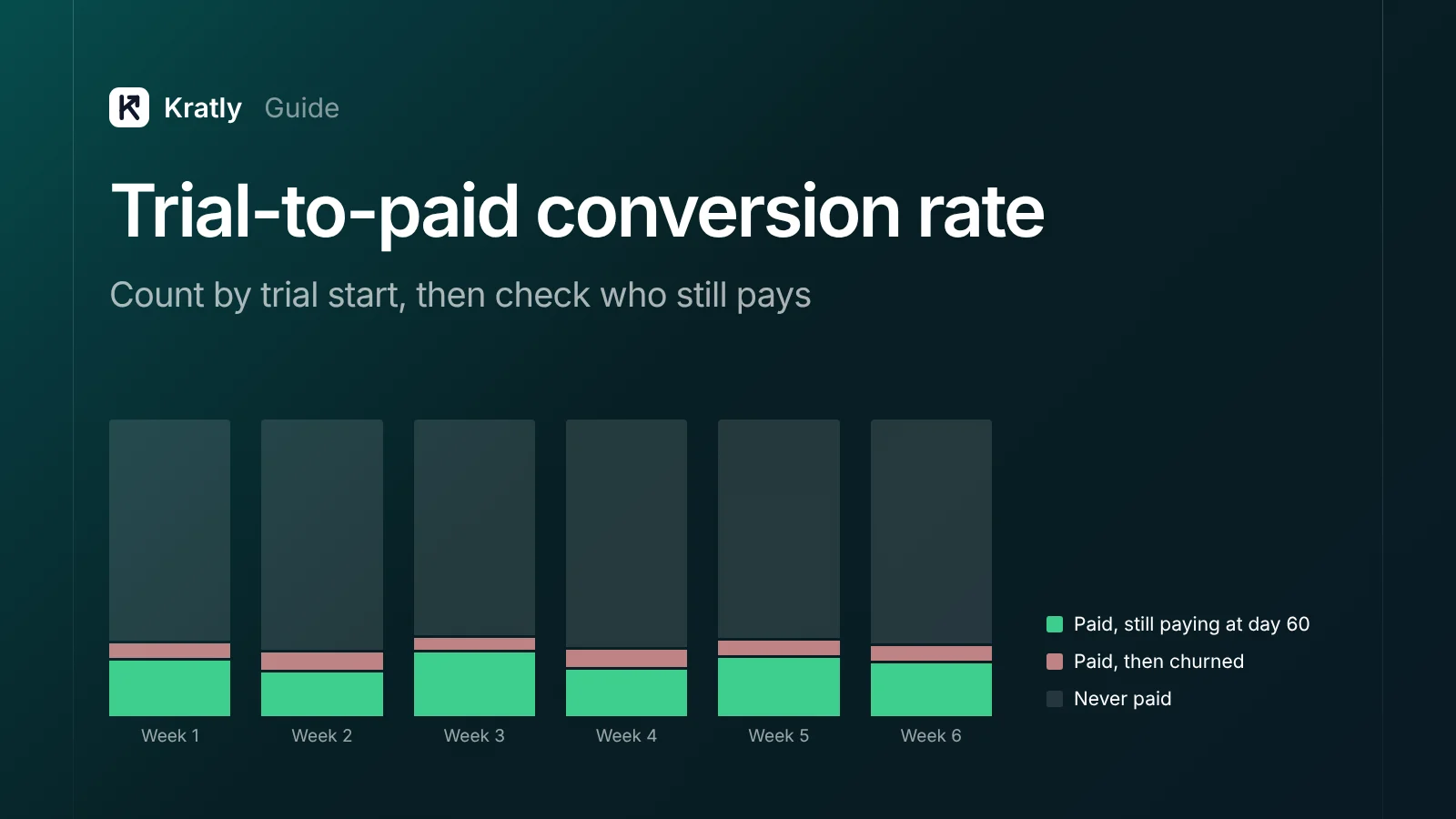
Short answer
Your trial to paid conversion rate is paying customers divided by trials started, grouped by the week or month the trial began. Set a fixed window, such as trial length plus 30 days. Report card and no-card trials apart. Then track how many converts still pay 60 days later, because early churn hides weak conversions.
Composite example: a founder sees "trial-to-paid: 41%" on her dashboard and plans to double ad spend. Then she recounts. The tool divided this month's payments by this month's trials, and counted extended trials twice. By trial-start cohort, the rate is 24%. A fifth of those payers cancel within two months. (Made-up example, not a real company or Kratly customer.)
The trial to paid conversion rate is easy to get wrong. This guide covers counting rules, benchmarks by segment and early churn. It ends with seven fixes and how to measure each.
What is trial-to-paid conversion rate?#
Trial-to-paid conversion rate is the share of trials started in a period that become paying customers within a set window.
Three words carry the weight. Started means the cohort is fixed when trials begin. Paying means a successful charge in Stripe, not a plan picked in the app. Window means you stop counting at a set day, so periods compare fairly.
Free trial conversion isn't the same as free-to-paid. Free-to-paid usually covers freemium sign-ups too. If you run both models, the trade-offs are in free trial vs freemium: which brings more paying customers?.
How do you calculate it correctly?#
ChartMogul's help center describes the method I'd copy. It counts trials started in an interval that later subscribe, divided by all trials started in that interval. Late conversions are credited back to the trial's start date (ChartMogul). It also says the rate is most accurate for periods older than your average sales cycle.
Here are the rules I'd write down once and keep.
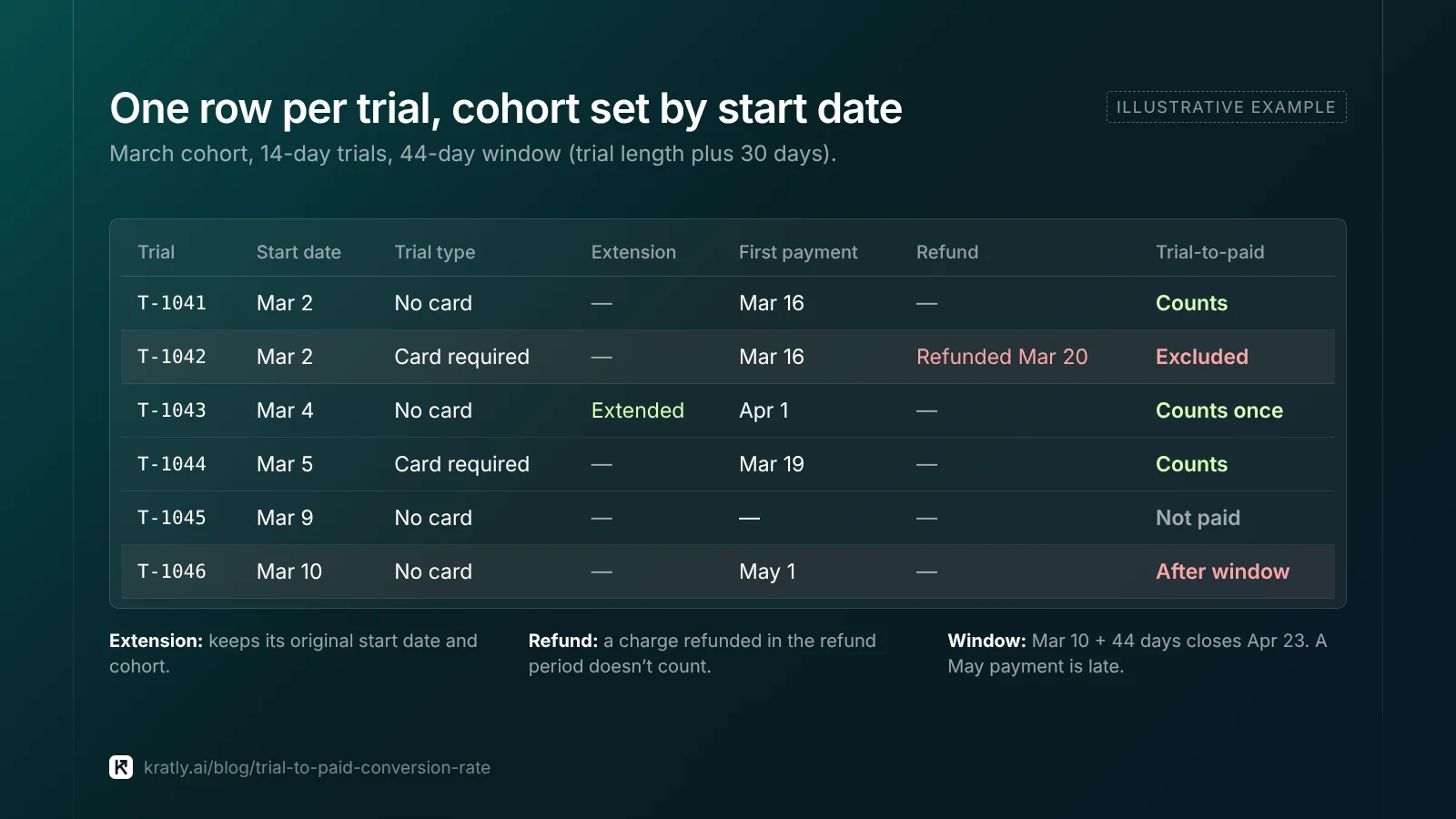
- Cohort by trial start. Never divide this month's payments by this month's trials. A spike in trials makes the rate fall on paper, then jump next month.
- Fix the window. I'd use trial length plus 30 days. A 14-day trial gets a 44-day window. Report the cohort only once the window closes.
- Count extensions once. An extended trial is still one trial. Keep its original start date, and tag it so you can report extended trials apart.
- Split card-required from no-card. A card-required rate counts auto-charges that may be refunded. Count a conversion only after the refund period passes.
- Exclude the noise. Remove test accounts, staff, existing customers re-trialing and duplicate sign-ups from one company.
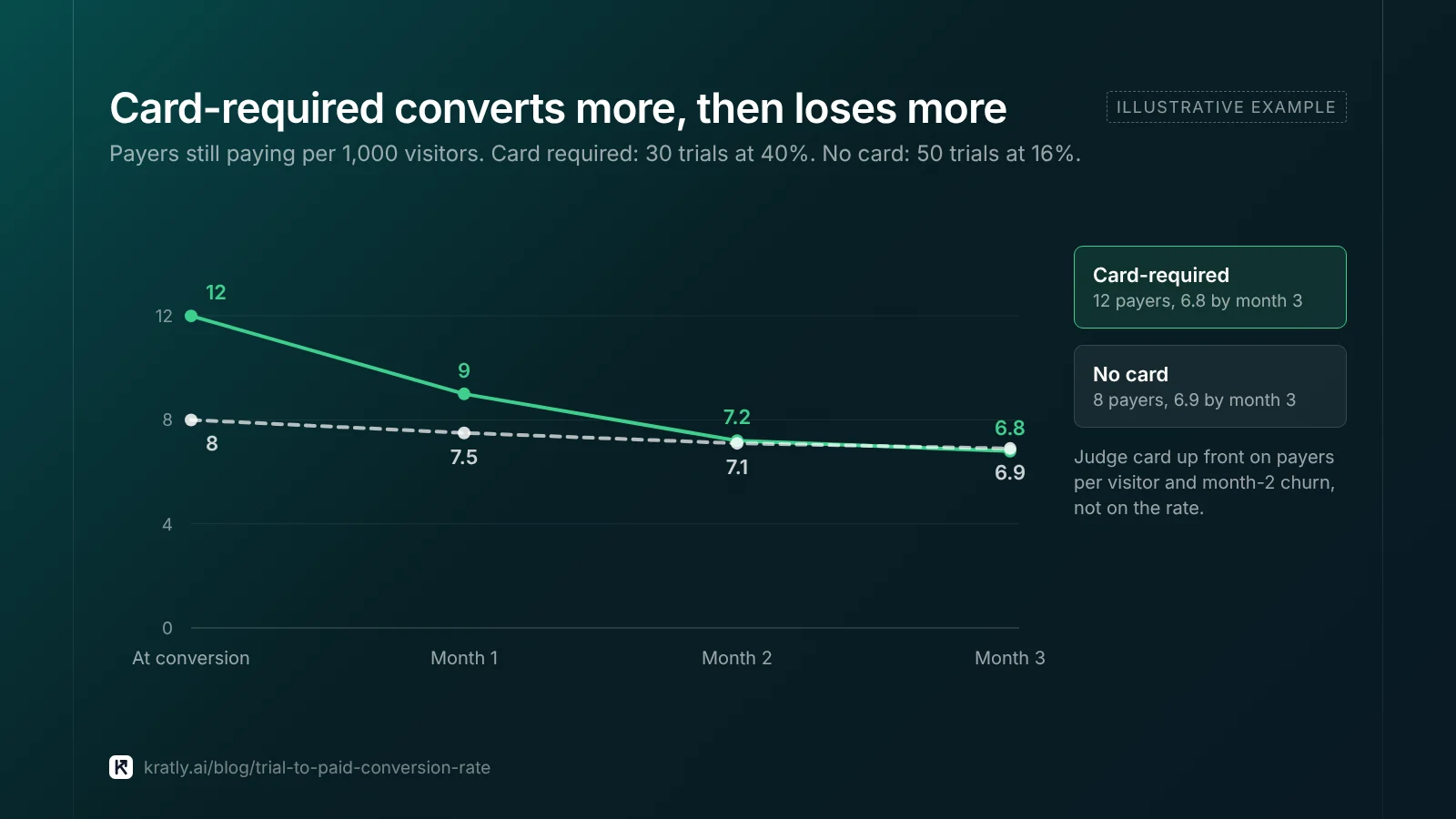
- Add the step before. For card-required trials, also report visitors to trial starts. A higher rate on fewer starts can mean fewer payers.
| Cohort (illustrative) | Trials started | Paid within window | Refunded or charged back | Trial-to-paid | Still paying at day 60 |
|---|---|---|---|---|---|
| No-card, March | 400 | 64 | 0 | 16.0% | 52 (13.0%) |
| Card-required, March | 120 | 54 | 6 | 40.0% | 41 (34.2%) |
These numbers are made up to show the method. The card-required rate is (54 − 6) ÷ 120. Day-60 figures divide by trials started, which makes them your "kept-paid" rate.
Stripe sends a customer.subscription.trial_will_end event three days before a trial ends (Stripe Docs). Log it with each trial. It gives you a clean timestamp for the end-of-trial step.
What is a good trial to paid conversion rate by segment?#
Our trial follow-up emails guide covers the headline 2026 figures: about 17% for no-card trials and about 49% for card-required, in one agency's client data. Here are other cuts, by segment.
| Source (date, type) | Segment | What it found |
|---|---|---|
| Growth Unhinged, ChartMogul and ProductLed survey (Jan 2026; 200 B2B products), bands as summarized by Userpilot (vendor, Aug 2026) | No-card trial | Median band 4–6%; 75th percentile 10–15% |
| Same | Card-required trial | Median band 25–35%; 75th percentile 50–60% |
| Same | Payers per 1,000 visitors | Card-required 10.5; standard trial 3.6 |
| ProductLed survey via Userpilot (secondary; 600+ B2B SaaS, date not stated) | Conversion driven by product-qualified leads | About 25%, roughly three times the 9% average |
| RevenueCat State of Subscription Apps 2026 (vendor; 115,000+ apps) | Subscription apps, North America | Trial-to-paid 34.2% |
| RevenueCat 2026 | Apps by trial length | 17–32 days: 42.5% median; under 4 days: 25.5% |
Sources: Userpilot, Growth Unhinged, RevenueCat report, RevenueCat summary.
Userpilot describes the survey's definition as a free sign-up that pays within six months. Your 44-day window will read lower. The spread is also wide. The report found "a 10x conversion difference" between the top and bottom fifth of self-serve products, as quoted by Userpilot.
So I'd use benchmarks for one thing: spotting a gap of 2x or more. Inside that range, your own rate last quarter is the only benchmark that matters.
Do converted trials stay? Early churn after the first payment#
A trial that pays once and leaves in month two isn't a win. I'd track month-1 and month-2 churn for every cohort, beside trial-to-paid.
The public SaaS churn rate benchmarks point the same way. Churn is front-loaded.
- ChartMogul (2023 report, 2,100+ SaaS businesses): retention falls fastest in the first months. Top-quartile companies selling under $10 a month kept 87% of new customers at month 3. Those over $500 a month kept 98%. The report says low 3-month retention "signals issues with onboarding or acquisition" (ChartMogul).
- RevenueCat (2026, apps): month 1 accounted for 35% of all first-year cancellations by annual subscribers (RevenueCat).
- SaaS Capital (2025, private B2B): median gross revenue retention was 91% (SaaS Capital).
Those ChartMogul figures are top quartile, not the middle.
Two checks I'd run. First, compare month-2 churn for card-required and no-card converts. Auto-charged users who never activated tend to leave at the first renewal. Second, split involuntary churn out. Failed cards are a billing fix, covered in Stripe dunning emails.
Seven fixes, with effort and how to measure each#
Measure every fix the same way: kept-paid rate at day 60, by trial-start cohort, against a holdout or the prior cohort. Effort is my estimate for a small team.
1. Define one activation milestone#
Pick the first action that predicts payment, and judge every other fix by whether more trials reach it. The method is in SaaS activation metric. Effort: two to three days of data work. Measure: activation rate by cohort, and trial-to-paid for activated versus not.
2. Cut onboarding to that milestone#
Remove every step that doesn't lead there. Templates, sample data and one-click imports usually beat tours. Effort: one to three weeks of product work. Measure: median time to activation, then kept-paid rate.
3. Test trial length#
RevenueCat's app data favors longer trials. A 2023 field test at a SaaS company found 7 days beat 30 (Management Science study, detail in our free trial vs freemium guide). Evidence conflicts, so test it. Effort: a billing setting plus copy. Measure: randomize new trials by length; compare kept-paid per trial started.
4. Test card up front#
Card-required lifts the rate and cuts starts. Judge it on payers per 1,000 visitors and month-2 churn, not on the rate. Effort: one to two days. Measure: visitor-to-payer rate and day-60 kept-paid, run for at least two full cohorts.
5. Fix the pricing page#
Trials often stall at "which plan?" Show prices, name the plan for each buyer type, and answer billing questions on the page. Tests are in SaaS pricing page best practices. Effort: a week. Measure: pricing-page visitors who start checkout, then pay.
6. Send trial-ending emails by behavior#
Activated users get the upgrade ask. Stuck users get help reaching the milestone. The sequence is in trial follow-up emails. Effort: two to four days. Measure: a 10–20% random holdout that gets only required notices.
7. Add sales assist for high-intent trials#
Route trials from large companies, or those that hit usage limits, to a short call. Growth Unhinged found 80% of free-trial products had a human touchpoint for enterprise trials (Growth Unhinged). Effort: a few hours a week of founder or sales time. Measure: kept-paid and first-year revenue for assisted versus matched unassisted trials.
What I'd do first: fixes 1 and 6. They're cheap, and they make every later test easier to read.
How to do this in Kratly#
Kratly sells in this space, so weigh this section accordingly. Everything above works in a spreadsheet.
- Connect Google Ads, Meta Ads, your website and Stripe. Kratly ties each trial and each paying customer to the campaign, page or email that brought them.
- Compare campaigns by paying customers, not trials. Two campaigns with equal trial costs can differ widely in who pays.
- Check pages and emails by revenue. See which pricing pages and trial emails come before payment.
- Approve suggested changes. Kratly suggests budget moves toward campaigns whose trials pay. You approve them, and every change is logged and reversible.
This is the measurement loop an AI marketing agent can run for you, and the reason autonomous growth starts from revenue.
Questions, answered
What is a good trial to paid conversion rate?
It depends on whether you ask for a card. In 2026 survey bands summarized by Userpilot, no-card trials sat around 4–6% at the median and card-required trials around 25–35%. Top-quartile products reached 10–15% and 50–60%. Subscription apps in North America converted 34.2% of trials in RevenueCat's 2026 data. Compare against your own past cohorts first.
How do you calculate trial-to-paid conversion rate?
Divide trials that became paying customers by all trials started in the same period. Group by trial start date, not payment date. Stop counting at a fixed window, such as trial length plus 30 days. Count extended trials once, remove refunds and test accounts, and report card-required trials apart from no-card ones.
Should extended trials count as new trials?
No. An extension continues the same trial, so keep its original start date and cohort. Counting it twice inflates the denominator and makes your rate look lower. Tag extended trials, though. Reporting them apart shows whether extensions convert or just delay a no. If extended trials rarely pay, stop offering them by default.
What churn rate should I expect right after a trial converts?
Churn is highest in the first months. In ChartMogul's 2023 report, top-quartile companies selling under $10 a month kept 87% of new customers at month 3. Those above $500 a month kept 98%. Track month-1 and month-2 churn for every trial cohort, and split failed payments from active cancellations.
Written by
Priyansh Kumar
Priyansh Kumar has spent more than a decade in growth, scaling brands from 1 to 10 and from 10 to 100. He now builds Kratly, an autonomous growth team that ties every campaign, page and email to the revenue it brings.
Sources
- ChartMogul Help Center: Chart: Trial-to-Paid Conversion Rate (updated Oct 2026)
- ChartMogul: SaaS Retention Report 2023 (vendor, PDF)
- Userpilot: Free trial conversion rate (vendor, updated Aug 2026)
- Growth Unhinged (Kyle Poyar): Free-to-paid conversion report (2026)
- RevenueCat: State of Subscription Apps 2026 (vendor) · 2026 benchmarks summary (Mar 2026)
- SaaS Capital: 2025 B2B SaaS Retention Benchmarks (PDF)
- Stripe Docs: Using trial periods on subscriptions
- Yoganarasimhan, Barzegary and Pani: Design and evaluation of optimal free trials (Management Science, 2023)
Was this article useful?