Short answer
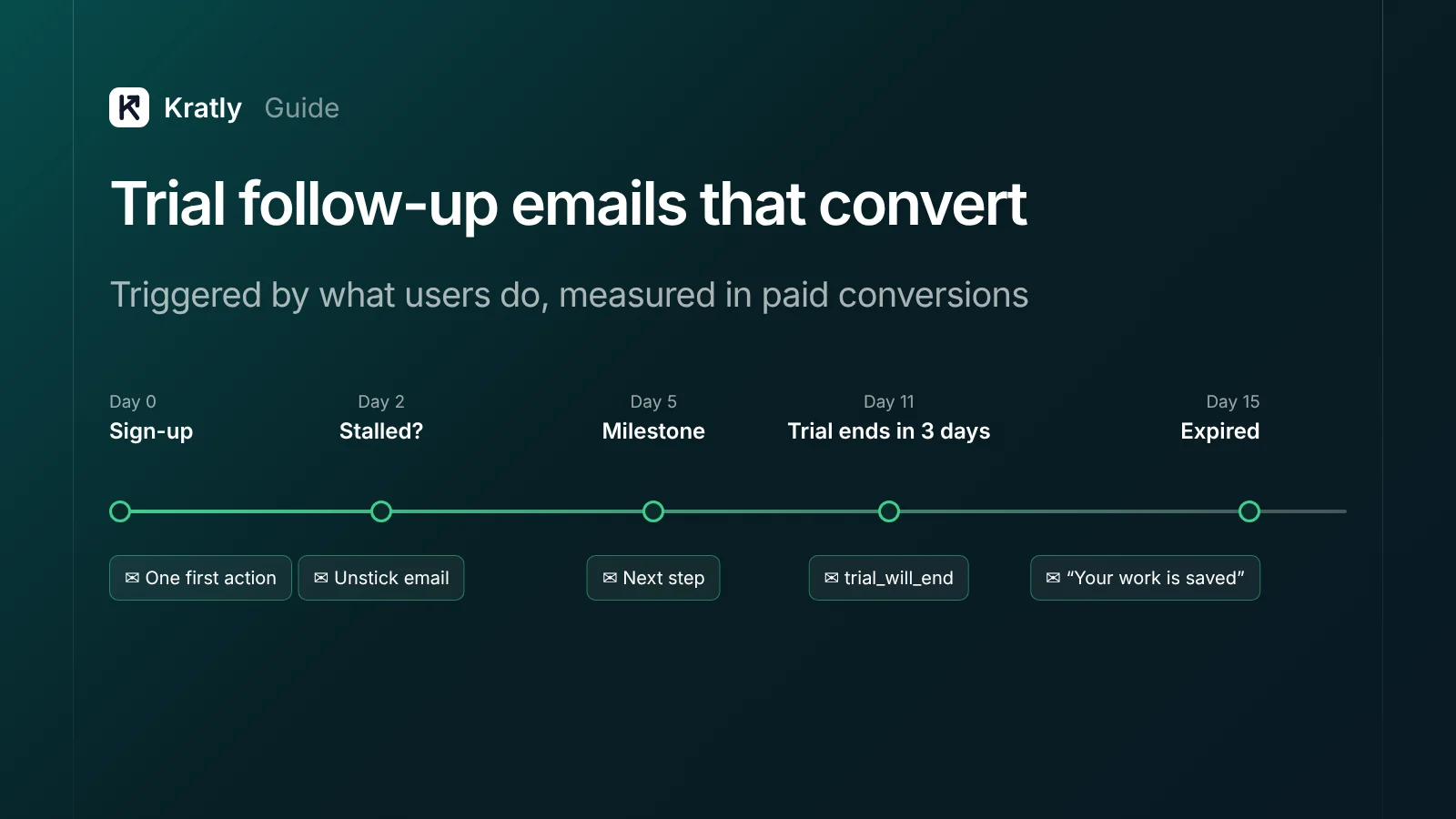
The best trial follow-up emails are triggered by what users do, not by the calendar. Send one email pointing to the first valuable action, nudge users who stall, celebrate milestones, remind them before the trial ends and recover abandoned checkouts. Judge the sequence by paid conversions against a holdout group, not by open rates.
Most trial users never get far enough to pay. One founder on Indie Hackers admitted: "My trial activation rate is 35%… That means 65% of people who sign up for a free trial never actually use the product" (Indie Hackers).
A generic welcome email and a "your trial ends tomorrow" note won't fix that. This guide shows the sequence that does, and how to prove it works.
What is a good trial-to-paid conversion rate?#
It depends heavily on whether you ask for a card up front.
| Source | No card required | Card required |
|---|---|---|
| First Page Sage, 86 SaaS companies (Oct 2026) | 17.3% of trials pay | 49.1% of trials pay |
| Growth Unhinged / ChartMogul, 200 B2B products (Feb 2026) | Median free-to-paid across models: 8% | About 30% |
Sources: First Page Sage, Growth Unhinged. First Page Sage's data comes from its own clients.
Here's the interesting part. First Page Sage found card-required trials get far fewer sign-ups, so paying customers per 1,000 visitors came out almost the same: 13.1 without a card, 13.3 with one.
So the trial model matters less than what happens inside the trial. That's where emails come in.
The trial follow-up email sequence: 7 emails#
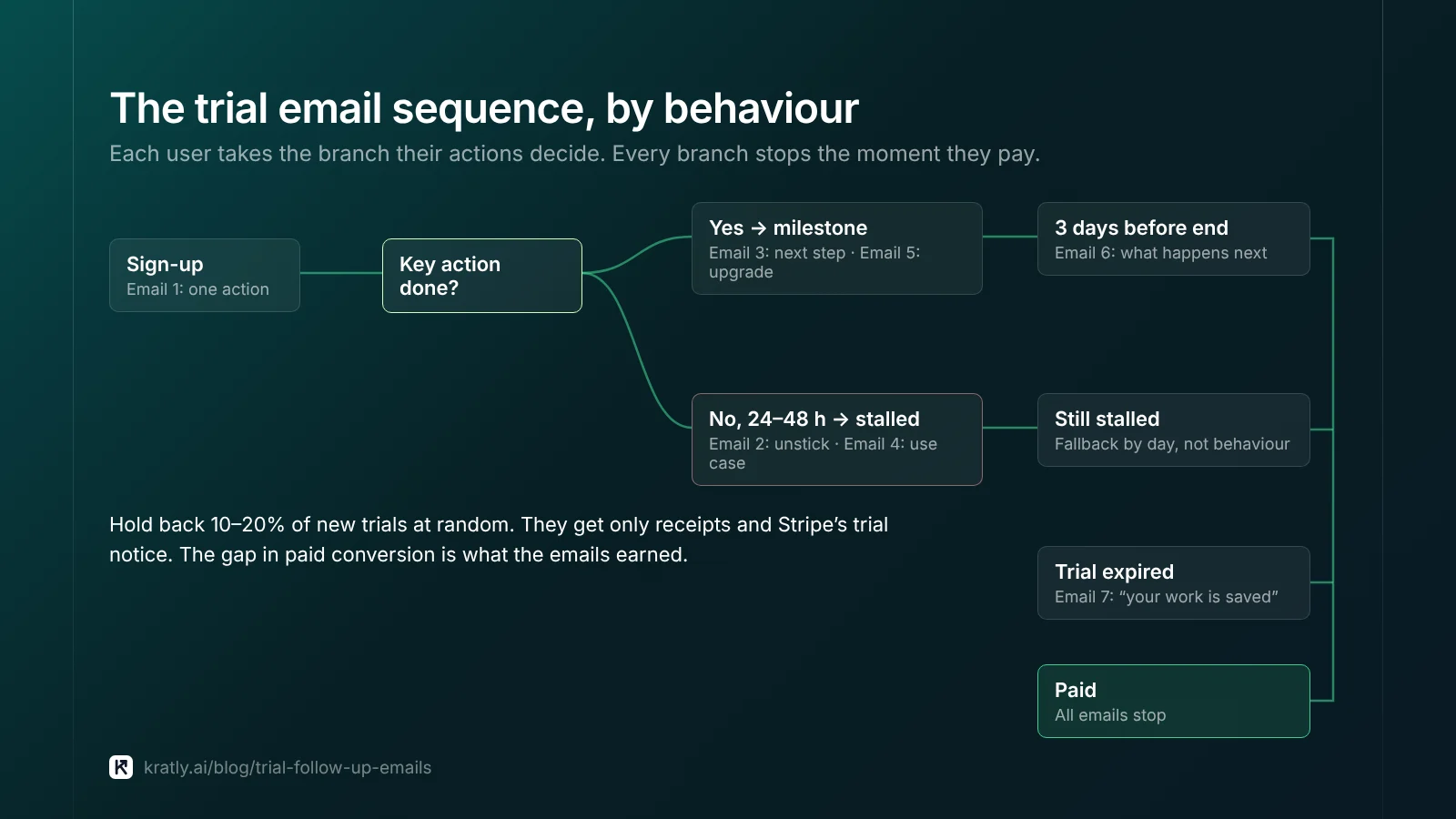
Every email below stops the moment the user pays. Triggers come from product events, with a day-based fallback for users who never log back in.
| # | Trigger | Goal | What it says |
|---|---|---|---|
| 1 | Sign-up | First value | One action to do now, with a direct link to it |
| 2 | No key action after 24–48 hours | Unstick | "Here's where most people get stuck," plus a fix |
| 3 | Reached first milestone | Momentum | "You did X. Next, try Y," the next most valuable step |
| 4 | Halfway, no activity (fallback) | Re-engage | One short use case from a customer like them |
| 5 | Heavy use, hasn't seen pricing | Upgrade | What they've built, and what keeps it working |
| 6 | 3 days before trial end | Decide | What happens when the trial ends, and the plan that fits them |
| 7 | 1 and 7 days after expiry | Recover | "Your work is saved," with an option to extend for active users |
Email 1: one action, not a tour#
The first email should point to the one action that best predicts payment in your product. Not a feature list. Not five links. Find that action by comparing users who paid with users who didn't.
Subject: Your first [report/project/campaign] takes 3 minutes Body: One sentence on why it matters, one button that opens the exact screen.
Email 2: the stall email#
This is the email most sequences miss. If a user hasn't completed the key action in 24 to 48 hours, something blocked them. Name the common blockers: a missing integration, an empty workspace, a confusing setting. Offer the fix or a 10-minute call.
Email 3: celebrate, then point forward#
When a user hits a milestone, tell them, and suggest the next step. Progress emails feel like help, not marketing.
Email 5: the upgrade email for power users#
Users who use the product heavily but haven't looked at pricing are your best prospects. Show them what they've done ("you've connected 3 accounts and run 12 reports") and what they keep by upgrading.
Emails 6 and 7: the deadline and the second chance#
Be clear and specific about what happens when the trial ends. After it ends, a short "your data is saved" email brings back people who meant to pay and forgot. For users who were active but didn't finish, offering a few more days often works better than a discount.
Trial-ending emails and what Stripe already sends#
If you bill with Stripe, some trial emails already exist. Know what they are, so yours fit around them.
- Trial reminder: Stripe can send a hosted email 7 days before a free trial ends, or at the start if the trial is shorter than 7 days. It exists to meet card-network rules for trials and includes a cancellation link (Stripe Docs).
- Webhook for your own email:
customer.subscription.trial_will_endfires 3 days before the trial ends by default (Stripe Docs). Use it to trigger email 6. - Failed payments: Smart Retries retry failed charges, with a recommended default of 8 tries within 2 weeks (Stripe Docs). Stripe can also email customers about failed payments and expiring cards (Stripe Docs).
Your trial-ending email should add what Stripe's doesn't: what this user has built, and which plan fits their usage.
Abandoned checkout emails#
Some users click "Upgrade", reach checkout and leave. They're your warmest leads.
Stripe Cart Recovery Emails are in invite-only beta for US businesses. Stripe emails the customer when a Checkout session expires, but only if they ticked a consent box for promotional email, enabled with consent_collection[promotions]=auto (Stripe Docs).
If you send your own, keep it to one or two emails. Remind them what they chose, link straight back to checkout, and answer the likely objection: price, security or "will I lose my data?".
Ecommerce data shows what these emails can do. Klaviyo's 2026 benchmarks put the average abandoned-cart click rate at 6.0% (Klaviyo). SaaS checkouts differ, so treat that as a rough guide.
Rules your trial emails must follow#
CAN-SPAM. Commercial email needs honest headers and subject lines, a valid postal address and a working opt-out honoured within 10 business days. Penalties reach $53,088 per email (FTC).
Purely transactional emails, such as receipts, are mostly exempt. But an upgrade pitch is commercial, even to a trial user. The FTC judges by the email's "primary purpose."
Gmail and Yahoo rules for bulk senders. If you send 5,000 or more emails a day to Gmail users, you need SPF, DKIM and DMARC, one-click unsubscribe on marketing email, and a spam complaint rate below 0.3% (Google). Google's guidance is to keep it under 0.1%.
Even below that volume, authenticated domains and easy unsubscribes protect your deliverability.
How to measure whether your emails work#
Open rates don't pay the bills. For context, MailerLite's 2025 benchmarks for software and web apps show an average open rate of 39.31% and click rate of 1.15% (MailerLite). Neither tells you whether anyone paid because of an email.
Plenty of public claims skip this step. One widely shared post claimed a "22% boost" from three emails, with no baseline or control group (Indie Hackers).
A better way:
- Hold out 10–20% of new trials at random. They get only required emails: receipts and Stripe's trial notice.
- Pick one metric: paid conversion within a fixed window, for example 30 days after the trial ends.
- Compare the two groups using payments in Stripe.
- Report the lift in percentage points, with a range, not a single number.
- Watch guardrails: unsubscribes, spam complaints and first-month refunds.
Our guide to the marketing incrementality test explains holdout sizing and timing.
How to do this in Kratly#
- Connect your product events and Stripe. Kratly sees which trial users reach each step and which of them pay.
- See where trials stall. Kratly shows how many trial users reach each step, and how many pay.
- Send the right follow-up. Kratly drafts follow-ups for users who stall or are ready to upgrade, and sends them from your own SendGrid account once you approve.
- Measure with a holdout. Kratly holds back a share of users from each rule and compares purchases in Stripe for emailed and held-out users.
Trial emails are one loop an AI growth agent can run end to end. See autonomous growth for how the loop works. If your users move between website and app, read website and app as one funnel.
Go deeper: Trial-to-paid conversion rate: benchmarks and seven fixes
Questions, answered
How many emails should a free trial sequence have?
There's no fixed number. Most users should get three to five, decided by what they do: a first-action email, a stall nudge if needed, a milestone or upgrade email, and a trial-ending reminder. Add one or two after expiry. Stop every sequence the moment someone pays.
When should you send the trial-ending email?
Three days before the trial ends works well, and Stripe's trial_will_end webhook fires then by default. If you use Stripe's hosted reminder, it goes out seven days before. Send a final reminder a day before for trials without a card on file.
What is a good trial-to-paid conversion rate?
It depends on the model. First Page Sage's 2026 data shows about 17% for trials without a card and about 49% with one. A ChartMogul-based study found a median of 8% free-to-paid across models. Compare yourself with businesses using the same model.
Should a SaaS free trial require a credit card?
Card-required trials convert a much higher share of sign-ups but attract fewer of them. First Page Sage found paying customers per 1,000 visitors were almost the same either way. Test it on your own funnel and judge by paying customers, not trial conversion rate.
Are trial emails transactional or marketing emails?
It depends on the main purpose. A receipt or account notice is transactional. An email pitching an upgrade is commercial under CAN-SPAM, even to a trial user, so it needs an unsubscribe link and a postal address.
Written by
Priyansh Kumar
Priyansh Kumar has spent more than a decade in growth, scaling brands from 1 to 10 and from 10 to 100. He now builds Kratly, an autonomous growth team that ties every campaign, page and email to the revenue it brings.
Sources
- First Page Sage: SaaS free trial conversion rate benchmarks (2026) · Growth Unhinged: Free-to-paid conversion report (2026)
- Stripe: Trial compliance and reminders · Trials · Smart Retries · Customer emails · Cart recovery emails
- Klaviyo: Abandoned cart benchmarks · MailerLite: Email benchmarks
- FTC: CAN-SPAM Act compliance guide · Google: Email sender guidelines FAQ
Was this article useful?