Short answer
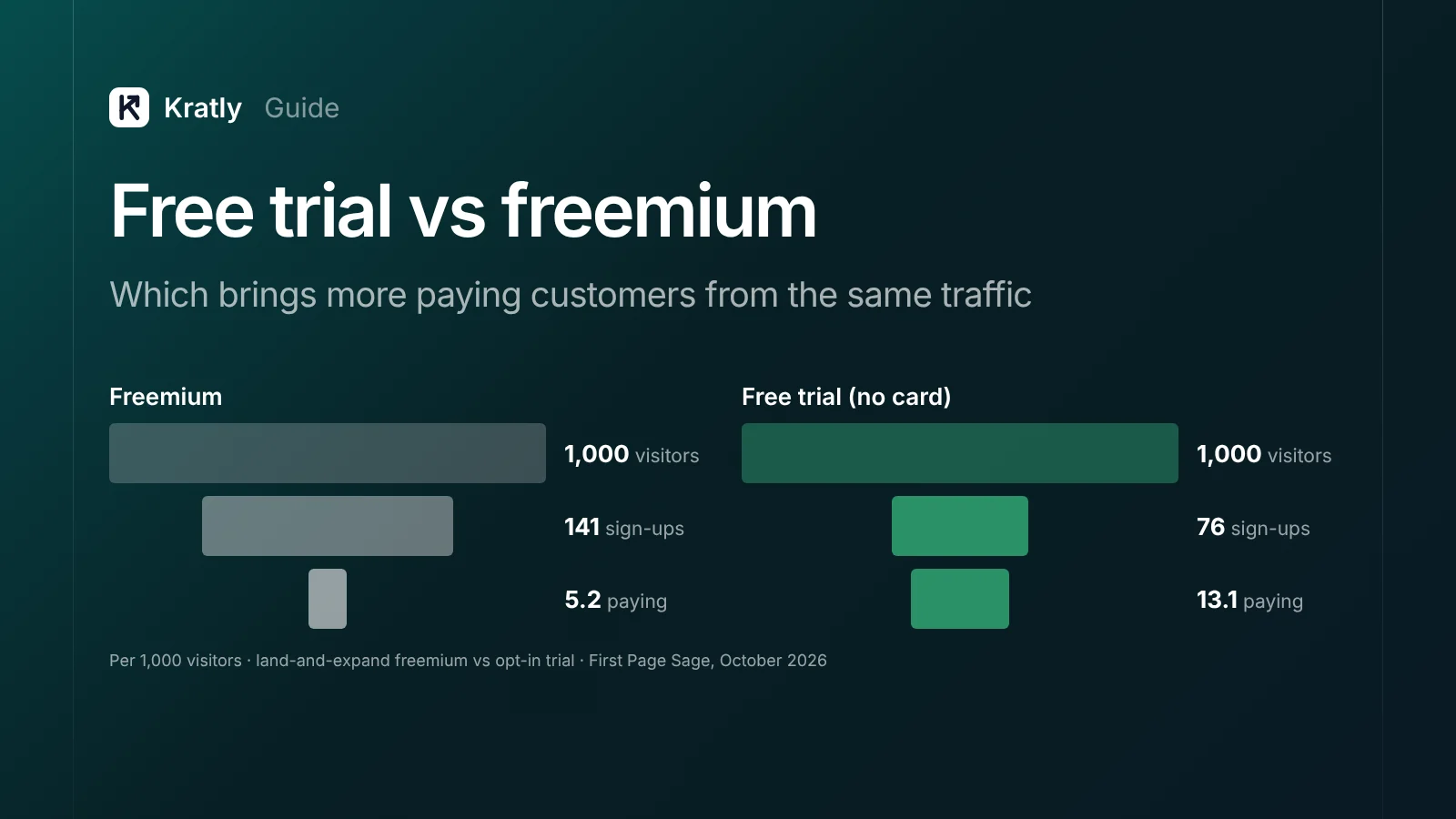
In the free trial vs freemium choice, a free trial brings more paying customers for most B2B SaaS. Freemium converts only about 3–5% of free users. It wins when free users bring in other users and cost almost nothing to serve. A reverse trial, full features first and then a free plan, is the middle path.
Richard O'Dwyer, founder of sheet2api, dropped his free plan. "I experimented by removing the 'free' plan, this caused MRR to go up, so this change will stay," he wrote (Indie Hackers). Another founder had $0 MRR on a free plan: "Guess what, nobody upgraded." After switching to a 15-day trial, he landed his first paying customers within days (Indie Hackers).
Free trial vs freemium isn't a matter of taste. It decides how many visitors become payers and what your free users cost you. Here's what the data says, and how to choose.
Free trial, freemium and reverse trial defined#
| Model | What the user gets | What happens at the end |
|---|---|---|
| Opt-in free trial (no card) | Paid features for a set time | Access stops unless they pay |
| Opt-out free trial (card required) | Paid features for a set time | Card is charged unless they cancel |
| Freemium | A limited plan, free forever | Nothing; they upgrade when they hit a limit |
| Reverse trial | Paid features for a set time, no card | They drop to the free plan unless they pay |
Elena Verna has led growth at Amplitude and Miro. She calls it a model that "gives customers access to paid features and puts them on a freemium plan when the trial ends" (Amplitude).
Free trial vs freemium: what the conversion data says#
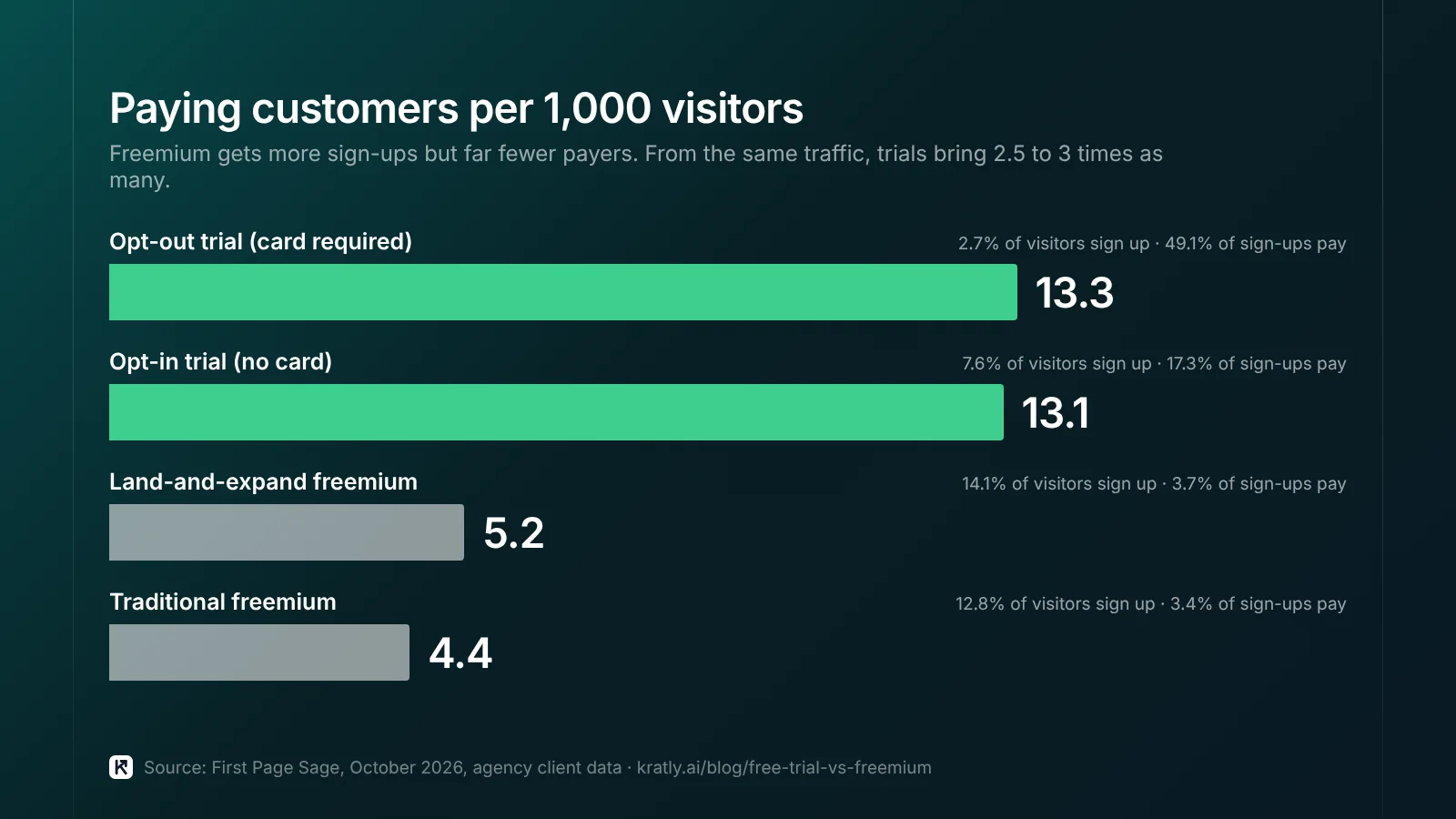
Don't compare conversion per sign-up. Compare paying customers per 1,000 visitors. Freemium gets far more sign-ups, so its low rate per sign-up is only half the story.
First Page Sage published this split in October 2026 from its own SaaS clients (First Page Sage):
| Model | Visitor to sign-up | Sign-up to paid | Payers per 1,000 visitors |
|---|---|---|---|
| Opt-out trial (card) | 2.7% | 49.1% | 13.3 |
| Opt-in trial (no card) | 7.6% | 17.3% | 13.1 |
| Land-and-expand freemium | 14.1% | 3.7% | 5.2 |
| Traditional freemium | 12.8% | 3.4% | 4.4 |
Two things stand out. Card and no-card trials end up nearly level per 1,000 visitors. And freemium brings roughly a third as many payers from the same traffic.
Kyle Poyar's 2026 survey of 200 B2B products, with ChartMogul and ProductLed, found a median free-to-paid rate of 8% across all models. Trials converted slightly better, but "that advantage disappears after adjusting for signup rates." Card-required trials converted at about 30% (Growth Unhinged). So the gap is smaller in his data than in First Page Sage's.
Subscription apps show the same direction, more sharply. RevenueCat's 2026 report found apps with a hard paywall converted 10.7% of downloads to paid, against 2.1% for freemium apps (RevenueCat).
My read: for most B2B SaaS, a trial brings more payers from the same traffic. Freemium has to earn its place some other way.
When freemium works and when it fails#
Freemium earns its place when free users create value beyond their own upgrade.
It works when:
- Free users bring new users. Every shared doc, design or invite exposes the product to someone new. Verna uses LinkedIn as the example: free members are what paying recruiters pay to reach.
- Serving a free user costs almost nothing. No human support, little compute, no storage that grows forever.
- The market is huge. A 3% upgrade rate on millions of users is a business. On 5,000 users, it isn't.
- The product explains itself. People get value alone, without a setup call.
It fails when:
- Free users need support. Every ticket from a free user is paid for by your paying ones.
- Each use costs you money. AI products with a model call per action are the obvious case.
- The value needs setup. If it takes an integration or a week of data to see value, free users never get there.
- The free plan is too good. If it solves the whole problem, nobody upgrades. That's what the "nobody upgraded" founder above ran into.
Do the money math before you choose. Illustrative numbers only: 10,000 free users at $1.50 a month each in hosting and support is $15,000 a month. At a 3.5% upgrade rate and $50 a month, those 350 payers bring $17,500. Your margin on the whole free tier is $2,500, before any acquisition cost.
The reverse trial: the middle option#
A reverse trial gives every new user the paid features, usually with no card. When the trial ends, users who haven't paid drop to the free plan instead of losing access.
You get trial urgency, because people feel the features they're about to lose. You also keep freemium reach, because non-payers stay and can invite others.
Verna lists Canva, Asana, Notion and Airtable as running versions of it. Airtable tells users: "At the end of your trial, we'll automatically move you to the Free plans unless you choose to upgrade" (Elena Verna).
It's still rare. In Poyar's 2026 survey, only 7% of products used a reverse trial as the main entry point. Free trials led at 57%, and freemium had 26%. Neither source publishes reverse-trial conversion rates, so treat any number you see with care.
I'd consider a reverse trial if you already have a free plan that converts poorly. It's a smaller change than killing the free plan, and easier to roll back.
SaaS trial length: 7, 14 or 30 days?#
Most products pick 14 days. In Poyar's survey, 62% of free trials ran 14 days, 14% ran 7 and 14% ran 30.
The best evidence on length comes from a field experiment published in Management Science in 2023. A large SaaS company randomly gave 337,724 new users a 7-, 14- or 30-day trial. The 7-day trial converted 15.44%, against 14.63% for 30 days, and lifted revenue by about 8%. The 14-day gain was not statistically significant (Yoganarasimhan, Barzegary and Pani).
The reason matters more than the winner. Longer trials led to more use overall but long idle stretches at the end. Average dormancy was about 4.6 days on the 7-day trial and over 21 days on the 30-day trial. People who went quiet before the trial ended rarely paid.
So set the length by time-to-value. If users see value in one session, 7 days is enough. If they need to connect data or bring in a team, 14 days is safer. I'd only go to 30 days when setup alone takes over a week.
A decision table#
| Your situation | Pick |
|---|---|
| B2B tool, value needs setup, average plan over $50/month | Opt-in free trial, 14 days |
| High-intent traffic, buyers already compared options | Opt-out trial (card required) |
| Product spreads through sharing or invites, near-zero cost per user | Freemium |
| Existing free plan with weak upgrades | Reverse trial on the free plan |
| AI product with real cost per action | Trial, or freemium with tight usage caps |
| Subscription app | Hard paywall with a trial, then test freemium |
| Price over $20k a year, sales-led | Demo, with prices on the page |
The case where I'd break the table: a crowded category where every rival is free. There, a free plan may be the cost of being considered at all.
How to test a switch without guessing#
- Pick the right metric. Paying customers per 1,000 visitors, and revenue per visitor after 60–90 days. Not sign-ups.
- Compare by cohort. Group users by sign-up week, so a switch date doesn't blur the numbers.
- Count cost, not just revenue. Add the support and compute cost of free users, and check CAC payback period benchmarks for both models.
- Fix the trial path. Stripe sends a
trial_will_endevent three days before a trial ends (Stripe Docs). Pair it with trial follow-up emails that turn sign-ups into paying customers. - Change the pricing page with it. The button and plan cards should match the model; see SaaS pricing page best practices.
How to do this in Kratly#
We built Kratly to answer questions like this one with revenue, not sign-up counts.
- Connect your site, ad accounts and Stripe. Kratly links each sign-up to the payments that follow.
- See paying customers by sign-up type. Compare trial, free-plan and demo sign-ups by revenue and cost per paying customer.
- Review cohorts by week. Kratly shows how each week's sign-ups turned into paying customers over time.
- Approve changes. Kratly suggests changes; you approve them, and each one is logged and reversible.
For the bigger picture, read how autonomous growth ties every campaign and page to paying customers.
Go deeper: Trial-to-paid conversion rate: benchmarks and seven fixes
Questions, answered
What is a good freemium conversion rate?
Around 3–5% of free users upgrading is typical. First Page Sage reports 3.4–3.7% across freemium types, and Verna cites roughly 5% even for strong freemium products. Judge it per 1,000 visitors, since freemium also brings many more sign-ups. On that measure, First Page Sage found freemium brings about 5 payers per 1,000 visitors, against about 13 for trials.
What is a reverse trial?
A reverse trial gives new users the paid features for a set time, usually without a card. If they don't pay, they move to a free plan instead of losing access. Canva, Asana, Notion and Airtable run versions of it. It's a good fit if you already have a free plan that converts poorly.
Is a 7-day or 14-day free trial better?
In a large randomized study, a 7-day trial beat a 30-day trial on conversion and revenue, while 14 days showed no significant gain. Pick by time-to-value: 7 days if value comes in one session, 14 if setup takes days. Long trials lead to idle stretches, and users who go quiet rarely pay.
Should a free trial require a credit card?
Card-required trials convert far more sign-ups, about 30–49% in 2026 reports, but get far fewer sign-ups. Per 1,000 visitors, First Page Sage found card and no-card trials nearly level, at about 13 payers each. Test it on your traffic. Card-required fits high-intent visitors who already compared options.
Can you offer both a free trial and a freemium plan?
Yes. That's essentially a reverse trial, or a free plan with an optional trial of paid features. It adds complexity to your pricing page, so keep the choice obvious for visitors. Users get trial urgency, because they feel the features they're about to lose. You also keep freemium reach, since non-payers stay on and can invite others.
Written by
Priyansh Kumar
Priyansh Kumar has spent more than a decade in growth, scaling brands from 1 to 10 and from 10 to 100. He now builds Kratly, an autonomous growth team that ties every campaign, page and email to the revenue it brings.
Sources
- First Page Sage: Conversion rate benchmarks for 2026 (October 2026)
- Growth Unhinged (Kyle Poyar, with ChartMogul and ProductLed): Free-to-paid conversion report (February 2026)
- RevenueCat: State of Subscription Apps 2026
- Elena Verna: Reverse trial (Amplitude, 2022) · Reverse trials examples (2024)
- Yoganarasimhan, Barzegary and Pani: Design and evaluation of optimal free trials, Management Science 69(6), 2023
- Stripe Docs: Trials
- Indie Hackers: sheet2api free plan removed · Switched to trial
Was this article useful?