Short answer
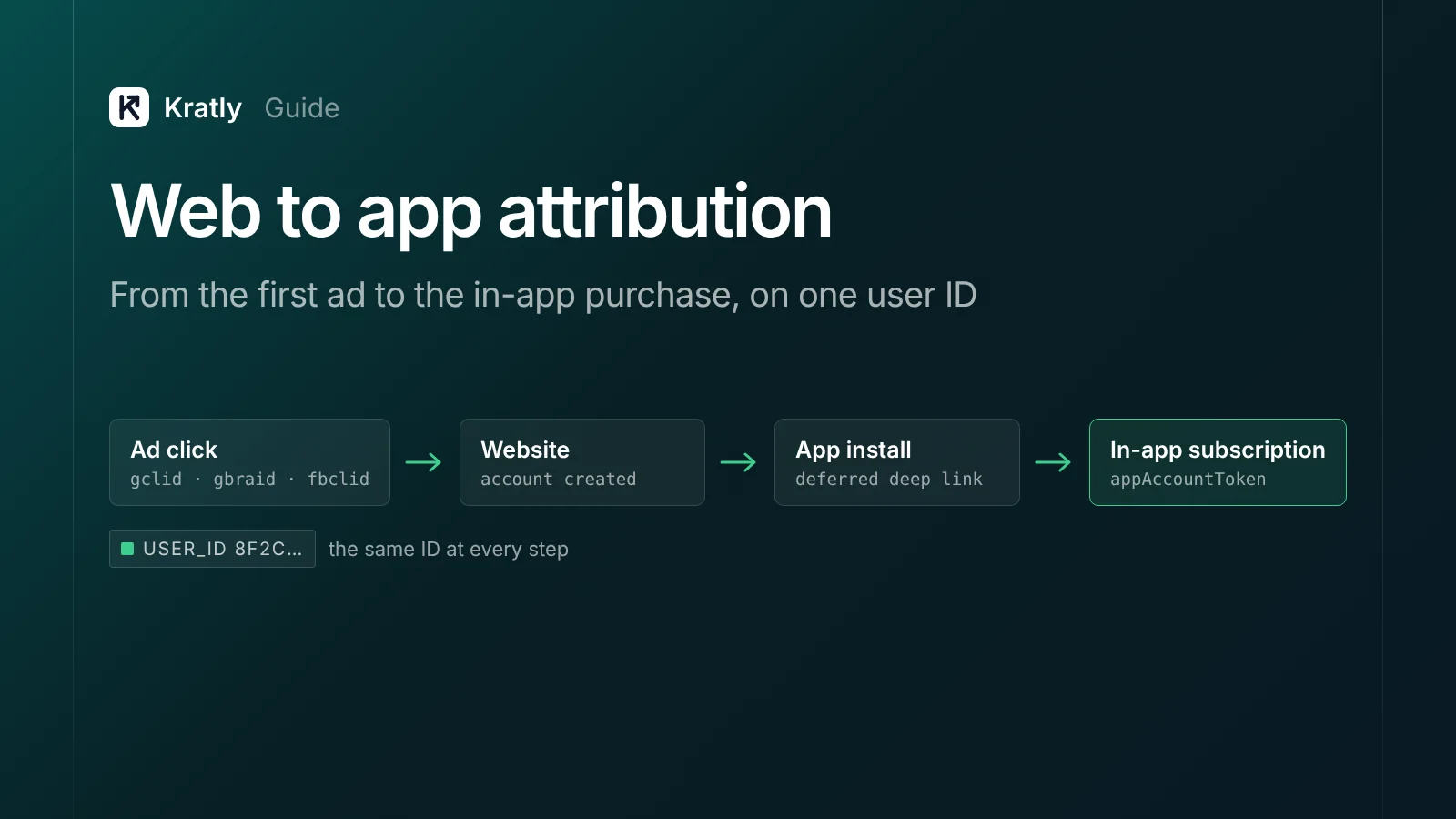
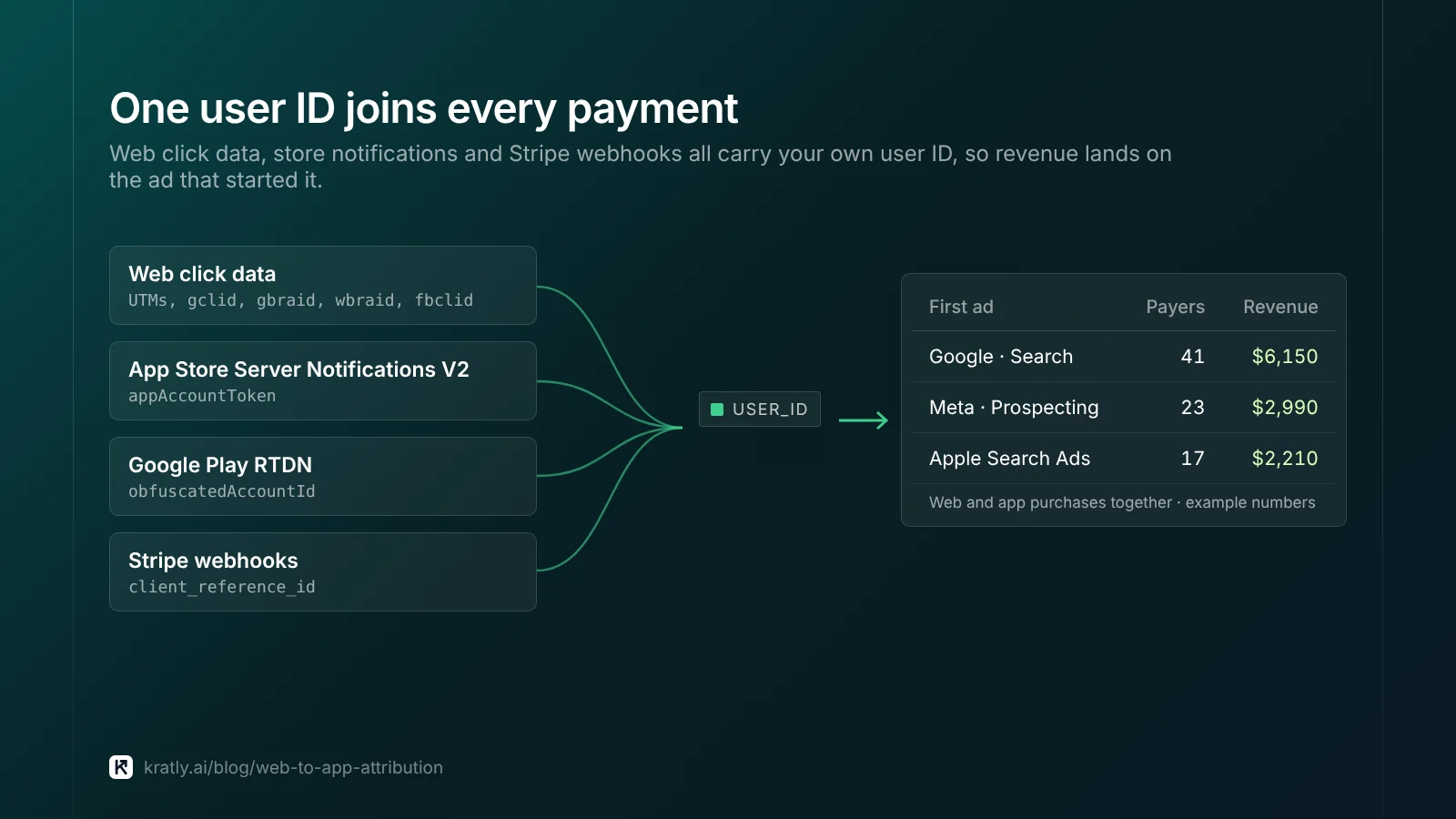
Web to app attribution links an ad click on the web to what the same person later buys in your app. Give every user one ID on web and in the app, carry click data through the install with deferred deep links, and tag each store and Stripe purchase with that ID. Report revenue by the first ad.
You run ads to your website. People install the app, start a trial and subscribe inside it. The ad platform reports installs. The App Store reports revenue. Nothing connects them.
One app founder compared the numbers: "Google's own conversion numbers were far from what I saw in RevenueCat." Google reported 53 conversions; RevenueCat showed 9 new customers (Indie Hackers). A commenter's advice: "judge ads on cost per paying customer, not cost per install."
This guide shows how to build that view.
Why web-to-app funnels are hard to measure#
Four gaps break the trail between ad and purchase.
1. The app store sits in the middle. A visitor clicks your ad, lands on your site, then goes to the App Store or Google Play. The store doesn't pass your campaign data to the app.
2. iOS limits tracking. Since iOS 14.5, apps need permission through Apple's App Tracking Transparency prompt to track users across apps (Apple). Opt-in rates vary by source: Adjust reported 35% in Q2 2025 (Adjust), AppsFlyer 50% (AppsFlyer).
3. Apple's privacy reports are slow and coarse. SKAdNetwork 4 sends up to three reports covering days 0–2, 3–7 and 8–35, each after a random delay of up to several days (Adjust). They don't identify users.
4. Revenue lives in different systems. In-app purchases sit with Apple and Google. Web purchases sit in Stripe. Renewals happen with no app open at all.
The building blocks of mobile app attribution#
| Building block | What it does | Note |
|---|---|---|
| Your own user ID | Links the same person on web and in the app, after login | The most reliable link you control |
| Deferred deep links | Carry the click data through the install to the first app open | Firebase Dynamic Links shut down on August 25, 2025 (Firebase); use another provider |
| Universal Links / App Links | Open the app directly when it's already installed | Don't handle the not-yet-installed case on their own (Airbridge) |
| Play Install Referrer | Passes referrer data to the app on Android | Returns referrer URL and click and install times (Android Developers) |
gbraid / wbraid | Google Ads click IDs for iOS app and web conversions | Used where gclid isn't passed on iOS (Google Ads Help) |
| SKAdNetwork / AdAttributionKit | Apple's privacy-preserving install attribution | AdAttributionKit launched in iOS 17.4 and added re-engagement in iOS 18 (Apple WWDC25) |
| Store server notifications | Tell your server about purchases, renewals and refunds | App Store Server Notifications V2; Google Play real-time developer notifications |
One change worth knowing: Google retired its Privacy Sandbox technologies, including on Android, in October 2025, citing low adoption (Android Authority). Don't build plans around them.
How to connect web and app: 6 steps#
Step 1: Create the account on the web when you can#
The strongest link between web and app is a login. If the visitor creates an account on your website before installing, you can tie the ad click to a user ID immediately. When they log in to the app, it's the same person. No guessing.
For many apps that means a short web onboarding flow: a few questions, an account, then "download the app."
Step 2: Capture click data on landing#
Store UTMs, gclid, gbraid, wbraid and fbclid on your server when the visitor lands, against an anonymous ID. Move them onto the user ID at sign-up. This is the same first step as our SaaS marketing attribution setup.
Step 3: Carry the click through the install#
For visitors who install before creating an account:
- Use a deferred deep link from a deep-linking or attribution provider, so the first app open receives the campaign data.
- On Android, also add your parameters to the Play Install Referrer.
- Use Universal Links and App Links for people who already have the app.
Step 4: Tag every purchase with your user ID#
Both stores let you attach your own ID to a purchase:
- Apple:
appAccountToken, "a UUID that associates the transaction with a user on your own service" (Apple) - Google Play:
setObfuscatedAccountId()(Android Developers) - Stripe (web purchases):
client_reference_idor customer metadata
Step 5: Count revenue on your server#
Don't rely on the app to report purchases. Use:
- App Store Server Notifications V2 for purchases, renewals and refunds (Apple)
- Google Play real-time developer notifications for subscription changes (Android Developers)
- Stripe webhooks for web payments
Each event carries your user ID from step 4, so you know who paid, how much and when.
Step 6: Report revenue by the first ad#
Join all revenue to each user's first and last ad click. Report cost per paying customer and revenue per campaign across web and app together.
Then use SKAdNetwork, AdAttributionKit and the ad platforms as a cross-check, not the source of truth. Send paid events back to the ad platforms so their bidding learns from payers.
Web checkout vs in-app purchase in 2026#
Court rulings have changed what US apps can do, and the rules are still moving. Check current terms before you change your checkout.
Apple (US storefront). After the April 30, 2025 order in Epic v. Apple, Apple's guidelines allow US apps to include buttons and links to outside purchases (512 Pixels). In December 2025 an appeals court allowed Apple to seek a reasonable commission on those purchases. Apple proposed rates in August 2026, and the Supreme Court agreed to hear Apple's appeal (iClarified; IPWatchdog). Whether a fee applies is unsettled as of October 2026.
Google Play (US). Google opened external links and alternative billing for US developers, with service fees for apps in those programs starting October 1, 2026 (Google Play Console Help).
Does web checkout earn more? Not automatically. In one test by the app Dipsea, published by RevenueCat, in-app checkout converted 27.0% of US iOS users against 18.1% for web-only checkout. Even after Apple's 30% fee, web-only earned about 6% less per customer (RevenueCat). That's one app. Test it on yours.
Context from RevenueCat's 2026 report of about 115,000 apps: web purchases were 4.9% of subscription revenue in North America, and median download-to-paid conversion by day 35 was 2.0% (RevenueCat).
Whatever you choose, the attribution setup above works for both. Stripe and store purchases join on the same user ID.
Getting found in the stores matters as much as measuring. See our app store optimization checklist for 2026.
How to do this in Kratly#
- Connect your ads, website, apps and Stripe. The Kratly SDK and verified Google Play and App Store purchases join clicks, installs and payments on one user ID.
- See one funnel. From first ad to install, trial and paid subscription, across web and app.
- See cost per paying customer by campaign. Not cost per install.
- Act on it. Kratly suggests budget shifts toward campaigns that bring paying users, wherever they pay.
This is one of the loops an AI growth agent can run end to end. See autonomous growth for how it works.
Go deeper: Server-side tracking explained: first-party data after cookies
Questions, answered
What is web to app attribution?
It's linking a person's ad click and website visit to what they later do in your app, such as installing, starting a trial or subscribing. The most reliable method uses one user ID on web and in the app, plus deep links that carry campaign data through the install.
How does deferred deep linking work?
A deferred deep link remembers where a user was going and which campaign brought them, even if they have to install the app first. When they open the app for the first time, the app receives that data and can take them to the right screen and record the source.
Can I see which ad led to an in-app subscription on iOS?
Yes, if you connect the purchase to your own user ID. Attach appAccountToken to the purchase, receive App Store Server Notifications on your server, and join them to the click data you stored when the user signed up. Apple's privacy reports alone won't identify users.
Can US iOS apps link to web checkout?
As of October 2026, Apple's guidelines allow US apps to include links and buttons to outside purchases, following Epic v. Apple. Whether Apple can charge a commission is still being decided in court. Check current App Review guidelines before changing your checkout.
What replaced Firebase Dynamic Links?
Firebase Dynamic Links shut down on August 25, 2025, and Firebase recommends third-party providers for deferred deep linking. Many attribution and deep-linking platforms offer this. Universal Links and App Links still handle users who already have the app.
Written by
Priyansh Kumar
Priyansh Kumar has spent more than a decade in growth, scaling brands from 1 to 10 and from 10 to 100. He now builds Kratly, an autonomous growth team that ties every campaign, page and email to the revenue it brings.
Sources
- Apple: User privacy and data use · appAccountToken · App Store Server Notifications · WWDC25: AdAttributionKit
- Android Developers: Play Install Referrer · Obfuscated account ID · Subscription lifecycle and RTDN
- Google: gbraid and wbraid · Play US external links and billing · Firebase: Dynamic Links FAQ
- Adjust: ATT opt-in rates 2025 · How SKAdNetwork 4 works · AppsFlyer: Post-ATT growth
- RevenueCat: State of Subscription Apps 2026 · IAP vs web purchases test
Was this article useful?