Short answer
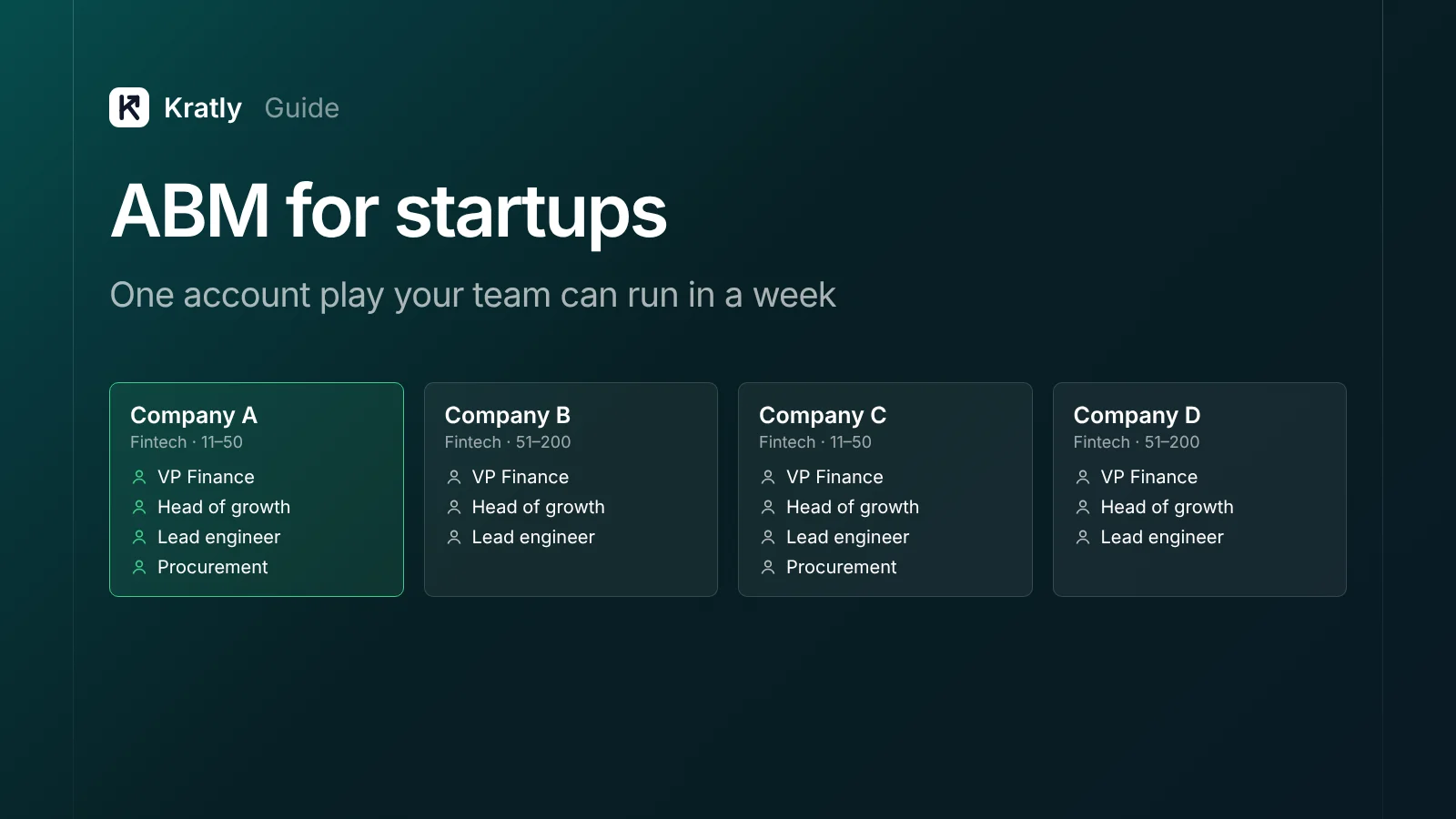
ABM for startups means picking 20 to 50 companies you want as customers and marketing to the people at each one. You don't need enterprise software. A sheet, LinkedIn, email and website retargeting are enough. Run one five-day play, then judge it on meetings, pipeline and paid revenue, not clicks.
Delainey Kirkwood of Gartner put it plainly: "Buying groups are more diverse than ever, ranging from five to 16 people across as many as four functions" (Gartner, May 2025). The same survey of 632 buyers found 74% of buyer teams showed "unhealthy conflict" while deciding.
So one cold email to one person often isn't enough. ABM for startups is how a small team reaches the whole room without an enterprise budget. Here is one play you can run in a week.
What is ABM for startups?#
Account-based marketing (ABM) is a B2B approach where you pick a short list of companies first. Then you market to the people inside each one as a group.
Lead gen casts a wide net and sorts form fills later. ABM starts with the list. Momentum ITSMA says it "invented the concept of Account-Based Marketing (ABM) in 2003" (Momentum ITSMA). Back then it was a program for big vendors selling to big clients.
For a startup, the idea shrinks well. You make sure each person who matters at a few dozen companies hears from you, in a way that fits their job.
Still finding your first customers? Read our B2B SaaS growth strategy guide first. ABM works best once you know who buys.
Do you need enterprise ABM tools?#
No. Enterprise ABM platforms bundle intent data, ad buying and account scoring. At 20 to 50 accounts, tools you already pay for can do each job.
| Job | Enterprise tool does it | Small-team way |
|---|---|---|
| Account list | Intent and fit scoring | Your closed-won customers in Stripe plus a sheet |
| Contacts | Contact database | LinkedIn search and company pages |
| Ads to the accounts | ABM ad platform | LinkedIn company list targeting |
| Retargeting | Platform audiences | Website visitor audiences on LinkedIn and Google |
| Reporting | Account dashboards | A sheet with one row per account |
As of November 2026, LinkedIn lets advertisers upload "a CSV list of companies or email addresses." Those lists are for "targeting specific accounts" (LinkedIn Marketing API docs). That is account targeting without a separate ABM platform. Our guide to LinkedIn ads for SaaS covers cost and tracking.
How do you pick 20 to 50 target accounts?#
The 20 to 50 range is my opinion, not a benchmark. Below 20, a week gives little signal. Above 50, "personal" turns generic. Here's how I'd build the list:
- Start from who already pays. Pull your paying customers from Stripe. Group them by industry, size and the problem they bought for.
- Pick one segment. Choose the group with the best retention or fastest sale. One segment means one message.
- Find look-alike companies. Search LinkedIn for similar companies and add each to a sheet.
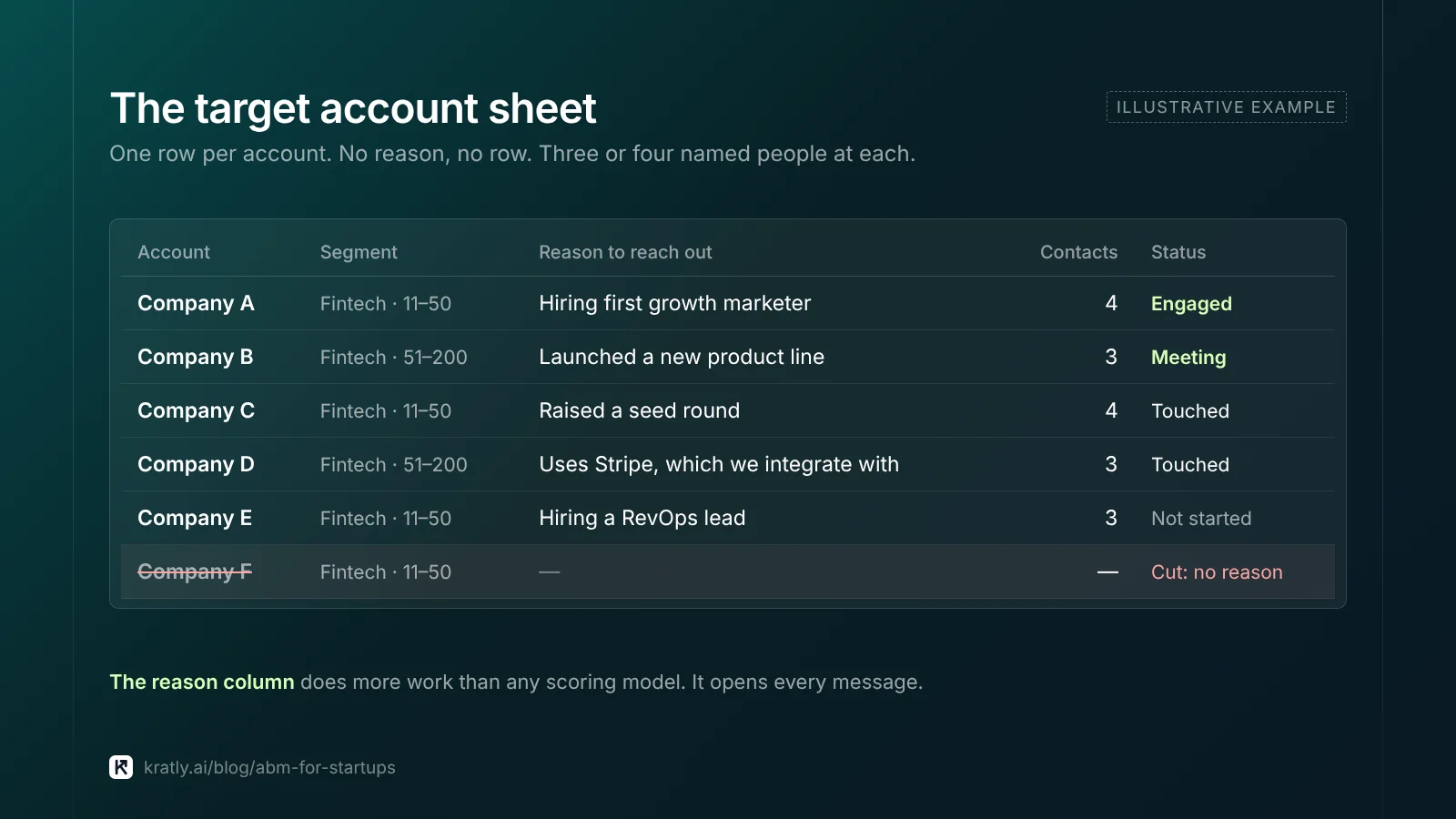
- Write one reason per account. A hiring post, a new product, a funding round, a tool you integrate with. No reason, no row.
- Cut to the list you can handle. Keep the accounts with the strongest reason.
Who is in the buying committee?#
Gartner's five to 16 people is a range across all deals. Map the roles you can name at each account. I'd aim for three or four people, not all 16.
| Role | What they care about | What to send them |
|---|---|---|
| Economic buyer (often a VP or founder) | Cost, payback, risk | A one-page business case |
| Champion (the person with the problem) | Saving time, looking good | A specific example in their workflow |
| Technical evaluator | Setup, security, integrations | Docs, a short setup note |
| Finance or procurement | Price, terms | Pricing page, contract basics |
Write one line per person: name, role, and what they'd care about. That line opens every message.
The one-week ABM playbook, day by day#
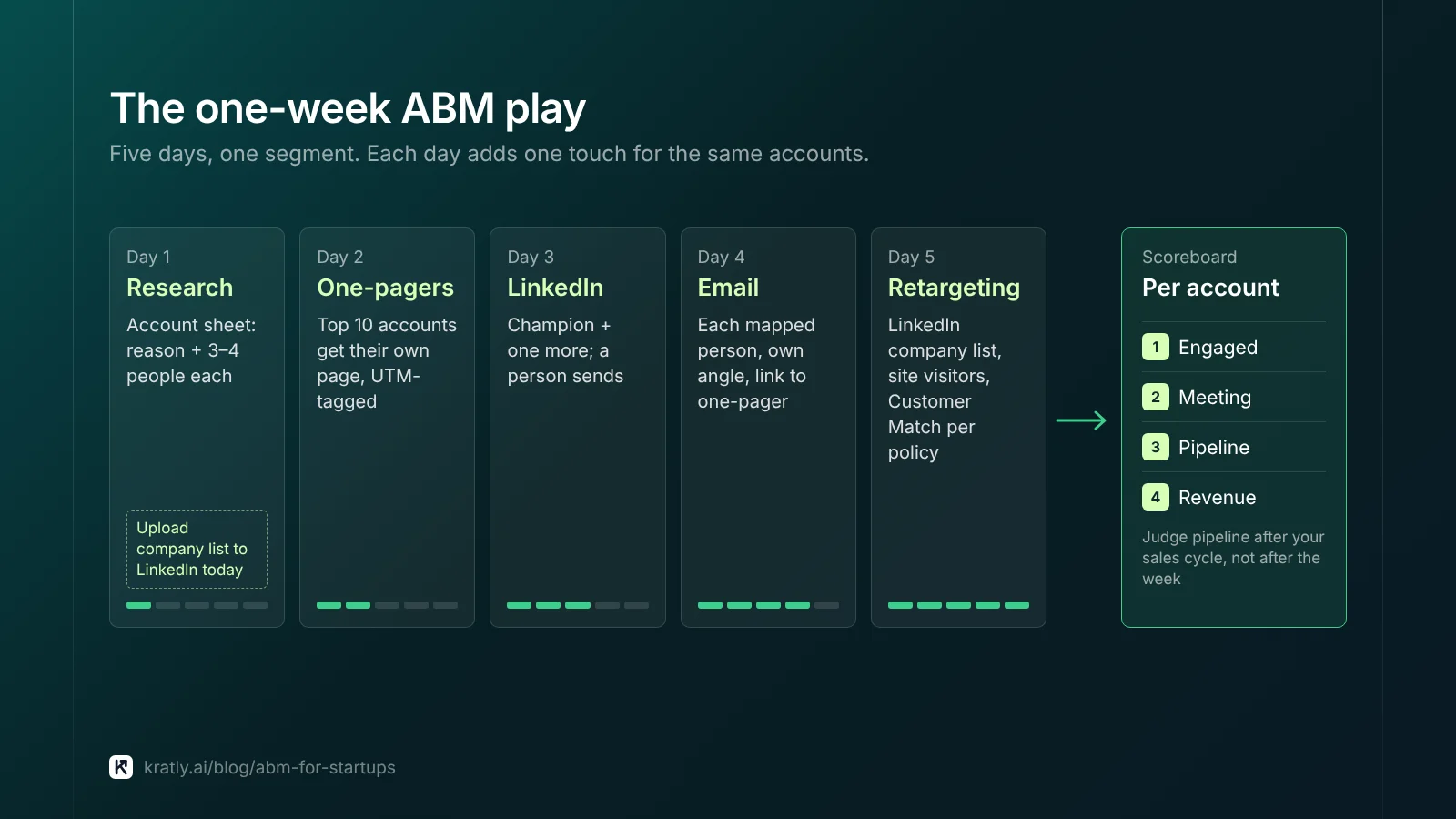
This ABM playbook runs Monday to Friday for one segment. It's sized for an account based marketing small team of one or two people.
Day 1: research and the account sheet#
Fill the sheet: accounts, reason, three or four people each. Let AI summarize each company's site and news, then check every summary. A wrong fact costs more than no opener.
Day 2: one-pagers per account#
Write a one-page note for each of your top 10 accounts: their situation, the problem you see, and one result you can show. The rest get a segment page with one line changed. Host each page on your site with a UTM-tagged link, so later visits tie back to the account.
Day 3: assisted LinkedIn touches#
Connect with the champion and one other person at each account. Software drafts the note. A person edits it and clicks send inside LinkedIn. Our guide to LinkedIn outreach without automation explains why the clicks stay human.
Day 4: email to the committee#
Send a short email to each mapped person. Lead with their line from the sheet and link to the one-pager. Give each person a different angle on the same problem. For send volumes and capacity, see how many cold emails per meeting.
Day 5: retargeting the accounts#
Show ads only to accounts you've touched:
- LinkedIn company list. Upload your account list as a CSV. LinkedIn says the first match can take "up to 48 hours" (LinkedIn Marketing API docs). Upload on Day 1, not Day 5.
- Website visitors. LinkedIn's Insight Tag lets you "retarget visitors of their website," per the same docs. Google Ads offers similar website audiences.
- Google Customer Match. You upload emails you collected yourself. As of November 2026, Google's policy limits full "Targeting." You need "90 days of Google Ads history and more than USD $50,000 total lifetime spend." Smaller accounts can use lists for "Observation" and "Exclusions" (Google Ads policy).
If you upload lists through code, Google now points developers to the Data Manager API. Since April 1, 2026, some Google Ads API tokens can't send Customer Match uploads. Those are tokens that sent no Customer Match requests from October 1, 2025 to March 31, 2026. Google's page adds: "Use the Data Manager API for Customer Match workflows instead" (Google Ads API). Our guide, Customer Match and the Data Manager API: what to do now, covers the move.
Time and money for a small team#
This budget is my opinion, not a benchmark. Replace it with your own hours after two weeks.
| Item | Time (my estimate) | Money |
|---|---|---|
| Account list and committee map | 4 to 6 hours | Your existing LinkedIn plan; check Sales Navigator plans if you need more search |
| One-pagers | 4 to 8 hours | None if you write them |
| LinkedIn touches | About an hour a day | None |
| Emails | 2 to 3 hours | Your existing email tool |
| Retargeting | 1 to 2 hours setup | A test budget you can afford to lose; check LinkedIn and Google minimums in each account |
| Weekly review | 30 minutes | None |
The real cost is founder time. If that time could close a deal already in the pipeline, do that first. Our startup marketing budget guide shows how to set a cash limit.
How do you measure ABM in revenue?#
Count accounts, not leads, and follow each account to money.
| Stage | What counts | Where it comes from |
|---|---|---|
| Engaged | Two or more people replied, accepted or visited | Your sheet, LinkedIn, site visits by UTM |
| Meeting | A call with at least one committee member | Calendar or CRM |
| Pipeline | A real opportunity with an amount | CRM |
| Revenue | First payment from the account | Stripe or your billing tool |
The "two or more people" rule is my own threshold. Set yours before you start.
Work out the rates between stages from your first two or three plays. Until then, plan with a stated assumption. Assumption: one meeting for every five engaged accounts, replaced with your real rate after the second play.
Judge pipeline after your normal sales cycle, not after the week. Our guide to B2B lead generation strategy: measure pipeline, not form fills explains how to carry the source to the deal. Tag every link you share so a payment can trace back to its account, as in our Stripe UTM tracking guide.
Where Kratly fits#
Kratly's account plays are built and being tested on our own accounts first: a weekly ranked list of accounts, one play across email, LinkedIn-assisted touches, ad audiences and an account page, and results per account. Every touch waits for a person's approval. Live today: Kratly connects your website tracking and Stripe or Shopify revenue and shows revenue by campaign, page and email, so a UTM-tagged one-pager shows up as paid revenue.
Questions, answered
Is ABM worth it for a startup?
Yes, once you know which kind of company buys from you. If you sell to teams where several people sign off, reaching only one person leaves deals stuck. A short, focused account list lets a small team reach the whole group. If you don't yet know your best customer type, find that first with founder-led sales, then run ABM on it.
How many accounts should a small ABM program target?
In my opinion, 20 to 50 for a first play. That's enough to see which touches get replies within a week, and small enough to write a real reason for each company. Start with fewer if one person runs it. Add accounts only after your first play shows which segment and message work.
What tools do I need for ABM on a small team?
A spreadsheet, LinkedIn, your email tool and an ad account. LinkedIn lets you upload a CSV company list to target specific accounts. Website visitor audiences on LinkedIn and Google cover retargeting. Add Stripe or your billing tool so you can see which accounts paid. Enterprise ABM platforms can wait until your lists run into the hundreds.
Can a startup use Google Customer Match for ABM?
Partly. Google's policy gives full targeting only to accounts with 90 days of history and more than $50,000 in lifetime spend. Smaller accounts can still use Customer Match lists for observation and exclusions. You can only upload customer data you collected yourself. If you upload through code, Google now directs developers to the Data Manager API.
How do you measure account-based marketing?
Track each account through four stages: engaged, meeting, pipeline and revenue. Decide your "engaged" rule before you start, such as two people replying or visiting. Judge pipeline after your usual sales cycle, not after the week. The final score is paid revenue from target accounts, traced through tagged links and your CRM.
Written by
Priyansh Kumar
Priyansh Kumar has spent more than a decade in growth, scaling brands from 1 to 10 and from 10 to 100. He now builds Kratly, an autonomous growth team that ties every campaign, page and email to the revenue it brings.
Sources
- Gartner: Sales survey finds 74% of B2B buyer teams demonstrate unhealthy conflict (May 7, 2025)
- Momentum ITSMA: Account Based Marketing
- LinkedIn Marketing API (Microsoft Learn): Matched Audiences overview
- LinkedIn Sales Solutions: Compare Sales Navigator plans
- Google Ads policy: Customer Match policy
- Google Ads API: Feature deprecations and unversioned changes
Was this article useful?