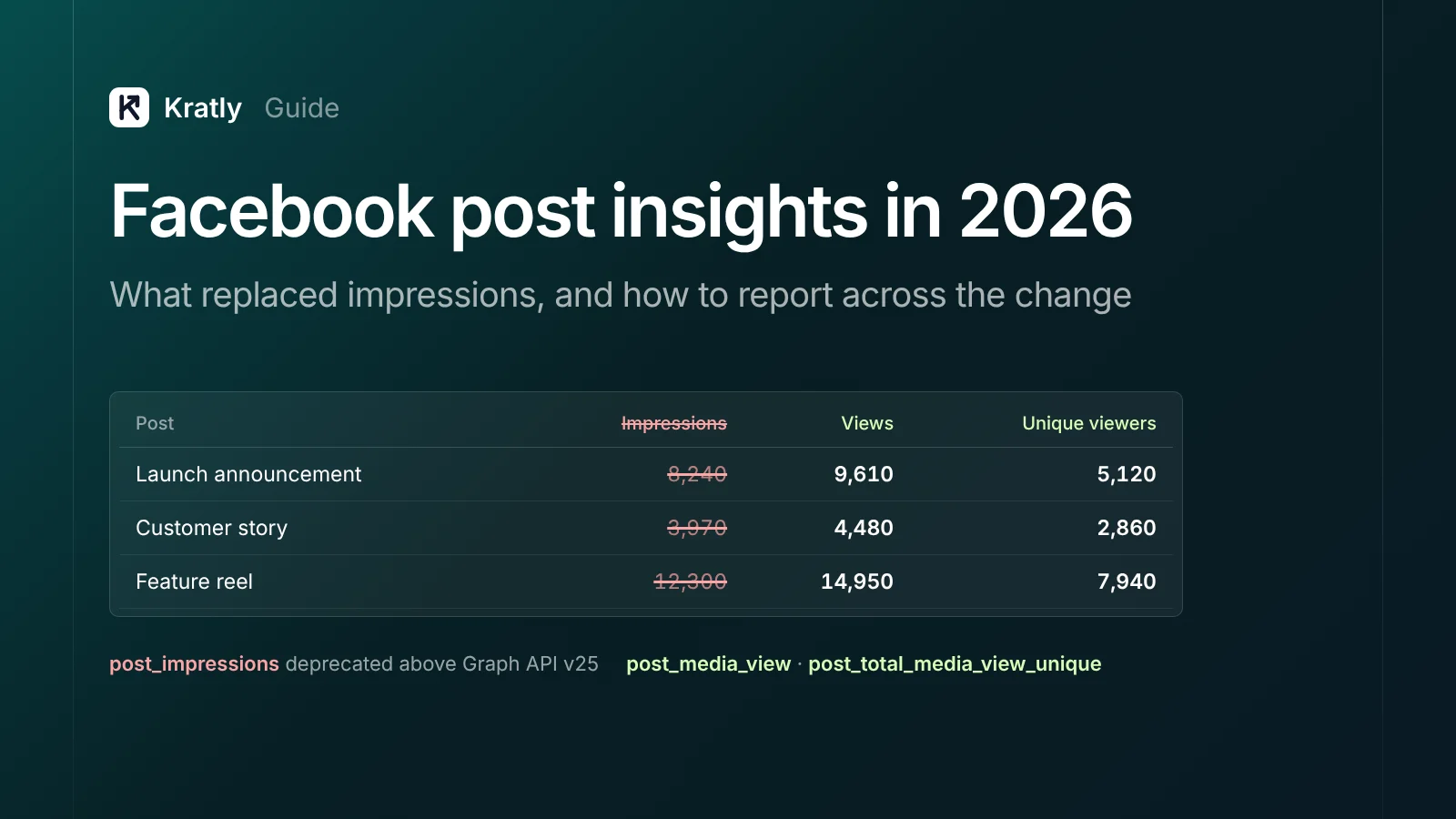
Short answer
Facebook post insights metrics now count views, not impressions. post_media_view counts each time a post was shown. post_total_media_view_unique counts unique viewers, like old reach. Instagram replaced impressions with views. Treat the switch as a break in trend, and judge posts on tagged revenue.
Meta's Graph API reference now labels post_impressions with five words: "Deprecated above Graph API v25" (Meta for Developers). The same note sits on post_impressions_unique, the old reach number.
If your social report still has an impressions column, Meta is retiring its source. This guide maps old Facebook post insights metrics to new ones, as of November 2026, and shows how to report across the change.
What changed in Facebook post insights metrics?#
Meta moved from impressions to views in three steps, per its own pages, as of November 2026.
- November 14, 2024: views in the app. Views became "the primary metric on Facebook for reels, videos, posts and stories" (Meta for Creators). Facebook and Instagram count them the same way.
- April 21, 2025: Instagram's API. Instagram's
impressionsandplaysstopped working on all API versions (Meta for Developers). - 2025 to 2026: Facebook Page and post insights. Meta said it would replace
impressionswithviews"on all API versions," starting November 15, 2025 (Meta for Developers blog). The Graph API v25 post, dated February 18, 2026, added reach. Meta planned to retire "Post/Page Reach" in June 2026 (Meta for Developers blog).
Meta's Pages docs add a warning. Some Page Insights metrics go away "for all API versions" by June 15, 2026 (Meta for Developers).
This guide covers organic content insights. For paid ads, see Facebook ads for SaaS: measure the sign-ups that actually pay.
Old metric to new metric#
Meta's deprecated metrics page lists a replacement for most of the old names (Meta for Developers). Here is the map, as of November 2026.
| Old metric | Use instead | Notes |
|---|---|---|
post_impressions | post_media_view | Counts repeat views |
post_impressions_unique (post reach) | post_total_media_view_unique | Unique viewers |
post_impressions_paid | post_media_view with is_from_ads | Paid share of views |
post_impressions_organic | post_media_view with is_from_ads | Organic share of views |
post_impressions_fan | post_media_view with is_from_followers | Views from followers |
post_impressions_viral, post_impressions_nonviral | No replacement listed | Drop from reports |
page_impressions | page_media_view | Page-level views |
page_impressions_unique (Page reach) | page_total_media_view_unique | Page-level viewers |
page_fans | page_follows | Followers, not likes |
Instagram impressions | views | Media and account level |
Instagram plays | views | Reels |
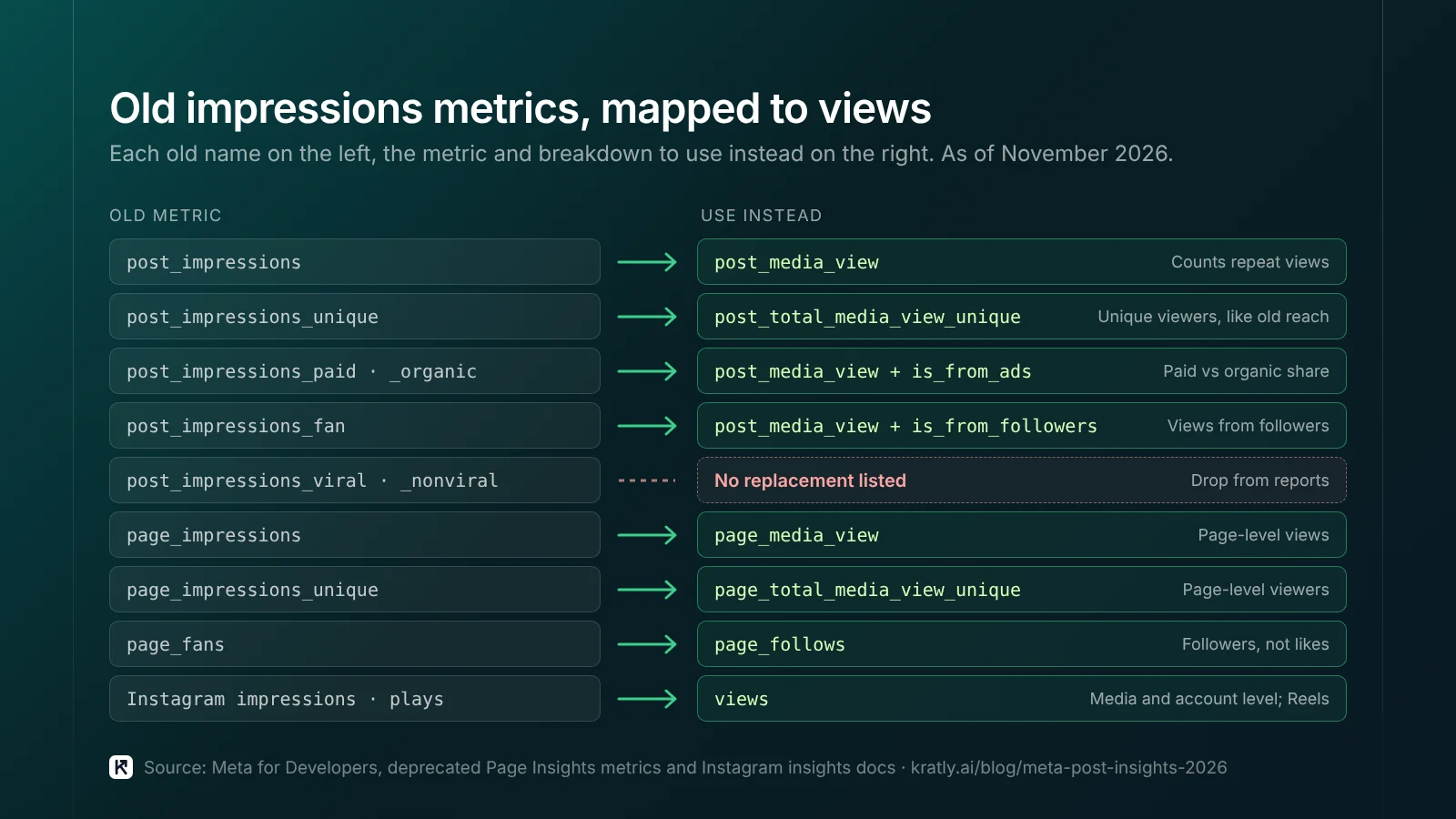
One warning: Meta's pages give different dates for the same metrics. The deprecated metrics page dates post_impressions to November 15, 2025. The insights reference says "deprecated above Graph API v25." Either way, don't build new reports on the old names.
What do the new metrics mean?#
post_media_view: how often the post was shown#
post_media_view is the number of times a post was played or displayed. Meta's words: "The number of times your content was played or displayed. Content includes videos, posts, stories and ads" (Meta for Developers).
- Repeats count. Meta's example: one person who sees a photo three times in a day gives three views, not one impression. So "Views may look higher" than old impressions (Meta for Creators).
- Ads count too. The definition includes ads. Use the
is_from_adsbreakdown to split paid from organic. Useis_from_followersto split followers from everyone else.
post_total_media_view_unique: how many people saw it#
Meta describes it as "The number of total unique media viewers for FB post." It is a lifetime metric. The Page version is page_total_media_view_unique, with day, week and 28-day periods (Meta for Developers).
Meta's v25 post calls this family "Media Viewers." Viewers are "intended to replace the legacy reach metric" (Meta for Developers blog).
So the plain-English version:
| You want to know | Use |
|---|---|
| How often was it shown? | post_media_view |
| How many people saw it? | post_total_media_view_unique |
| How much came from ads? | post_media_view split by is_from_ads |
| Did it reach beyond followers? | post_media_view split by is_from_followers |
Views divided by viewers gives rough "views per person." I'd watch it, not report it.
Instagram views vs impressions#
Instagram switched first. "Instagram introduced Views as the primary consumption metric," Meta says. Then views reached the API on all versions (Meta for Developers blog).
Here's Instagram views vs impressions in practice, as of November 2026:
views(account level): "The number of times your content was played or displayed. Content includes reels, posts, stories" (Meta for Developers).views(one post): "Total number of times IG Media has been played on Instagram." Meta still marks it "in development."reach: still there. At account level it counts "unique accounts that have seen your content," including in ads. Meta notes it is estimated.impressions: gone for all versions since April 21, 2025. Old media is an exception. Posts created on or before July 1, 2024 still return impressions in v21.0 and older (Meta for Developers).
How to report across the break in trend#
A break in trend is a point where a metric's definition changes, so the line before and after can't be compared. Impressions to views is one. Views count repeats in places impressions did not, and the cutover dates differ by API version and tool.
What I'd do:
- Mark the switch date on every chart. Use the date your own export began showing views.
- Stop the old line. Start a new one. Don't stitch impressions and views into one series. Label each.
- Compare like with like. Compare viewers with old reach, not views with old impressions. Unique people is the closer match.
- Reset the baseline. Use the first full month of views as the new baseline. Skip year-over-year growth until you have 12 months of views.
- Use ratios across the gap. Engagement per viewer and clicks per viewer survive the change better than raw counts.
- Add a note: "Views count repeats; not comparable to impressions before [date]."
A worked example (made-up numbers). Assumption: 40,000 monthly impressions before the switch, then 52,000 views. That is not 30% growth. It may only be the new counting rule. Compare viewers with old reach instead.
What to report to your team instead#
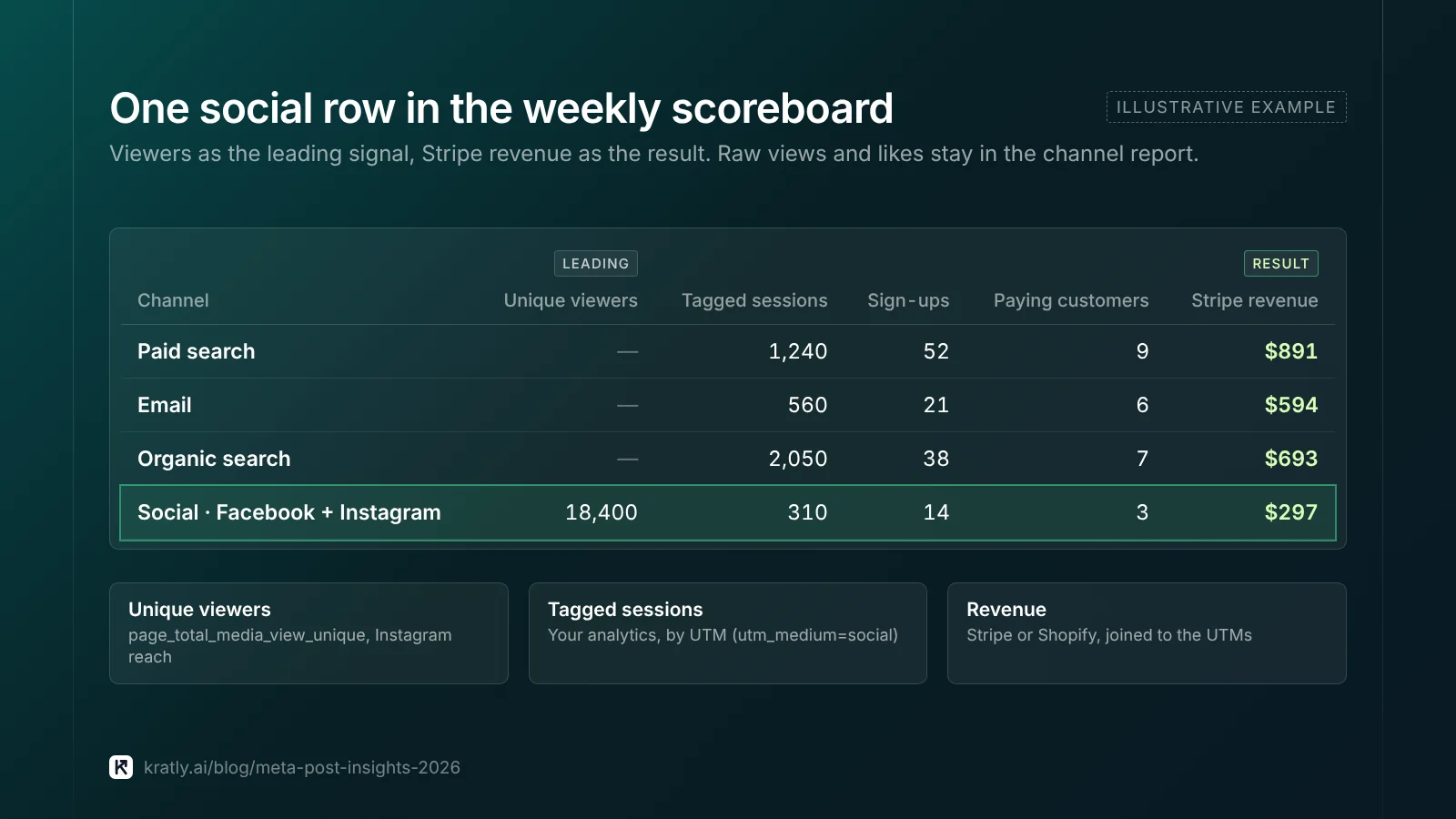
Post views help whoever runs social. They aren't a business result. In a weekly growth review meeting, I'd show only a few social lines, and mark them as leading.
| Line | Where it comes from | Why it's there |
|---|---|---|
| Unique viewers this week | page_total_media_view_unique, Instagram reach | Are more people seeing you? |
| Share of views from non-followers | post_media_view by is_from_followers | Is content reaching new people? |
| Sessions from tagged social links | Your analytics, by UTM | Did anyone come to the site? |
| Sign-ups and paying customers from social | Stripe or Shopify, joined to UTMs | Did it bring money? |
Leave raw views and likes in the channel report. In the review they start debates about activity, not revenue.
Why views are not revenue#
A view means a post was on a screen. It doesn't mean anyone clicked, signed up or paid. Viewers are not customers either.
To tie posts to money, you need the click to carry its source into your payment system:
- Tag every link you post. Use one pattern, such as
utm_source=facebookorutm_source=instagramwithutm_medium=social. Our UTM naming convention has the rules and a tracking sheet. - Tag the link in bio and Page buttons once.
- Carry the UTMs into Stripe or Shopify. Save them at sign-up and copy them onto the customer. The Stripe UTM tracking guide shows how.
- Report revenue by source, next to hours spent on content.
If you boost posts or run Meta ads, send real purchases back to Meta. Our guide to the Meta Conversions API setup and purchase check covers that.
Where Kratly fits#
Kratly's Facebook and Instagram post results, using the new views and viewers metrics and read at 1, 7, 14 and 28 days, are built and switch on once Meta approves the insights permissions. Live today: Kratly connects website tracking and Stripe or Shopify revenue, so UTM-tagged social clicks show up next to the payments they led to.
Questions, answered
What replaced post impressions on Facebook?
post_media_view replaced post_impressions. It counts every time a post was played or displayed, including repeat views by the same person. For unique people, use post_total_media_view_unique, which replaces the old reach metric. Paid, organic and follower splits now come from the is_from_ads and is_from_followers breakdowns on post_media_view.
What is the difference between Instagram views and impressions?
Impressions counted how often content appeared on screen, with older rules for reels. Views count every time content is played or displayed, and Meta calculates them the same way on Facebook and Instagram. Because repeats count, views can look higher than old impressions. Instagram's API stopped returning impressions for all versions on April 21, 2025.
Is reach still available in Facebook post insights?
Not under the old name for long. Meta's Graph API reference marks post_impressions_unique as deprecated above v25. Its replacement is post_total_media_view_unique, which Meta calls a count of unique media viewers. Instagram still offers a reach metric. Meta describes it as estimated and says it includes ads.
Can I compare views with last year's impressions?
Not directly. Views count repeat displays in places impressions did not, so a rise may come from the new rule, not from growth. Mark the switch date, start a new baseline, and compare viewers with old reach. Use ratios such as clicks per viewer across the gap.
Do Facebook post views show revenue?
No. A view means the post was on screen, not that anyone clicked or paid. To link posts to money, tag every posted link with UTMs and carry them into Stripe or Shopify at sign-up. Then report revenue by source.
Written by
Priyansh Kumar
Priyansh Kumar has spent more than a decade in growth, scaling brands from 1 to 10 and from 10 to 100. He now builds Kratly, an autonomous growth team that ties every campaign, page and email to the revenue it brings.
Sources
- Meta for Developers: Graph API Insights reference · Pages API Insights · Deprecated Page Insights metrics · Instagram Media Insights · Instagram User Insights
- Meta for Developers blog: Making it easier to build integrations across the Instagram API and Marketing API (Jan 21, 2025) · Page Insights API updates (Aug 15, 2025) · Introducing Graph API v25.0 and Marketing API v25.0 (Feb 18, 2026)
- Meta for Creators: Introducing views to simplify content (Nov 14, 2024)
Was this article useful?