Short answer
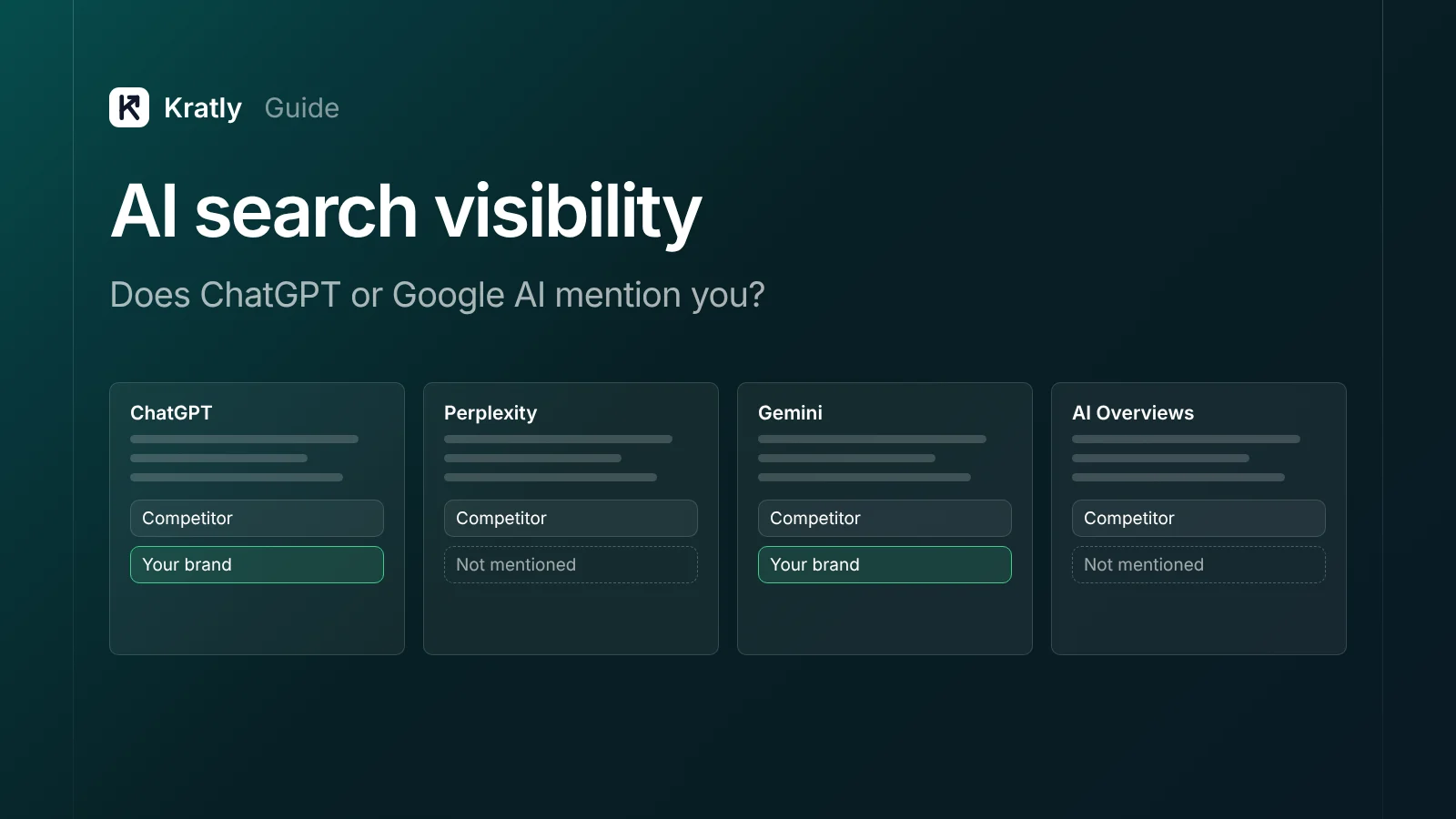
AI search visibility is how often AI assistants such as ChatGPT, Perplexity and Google's AI Overviews mention or cite your brand when buyers ask about your category. To check it, run a fixed set of buyer prompts several times each, log mentions, citations and accuracy, compare against competitors, and repeat monthly.
You rank on Google. You ask ChatGPT for the best tool in your category, and it names three competitors. One founder ran the test properly: "My product got mentioned 3 times across 47 prompts. One competitor got mentioned 31 times" (Indie Hackers).
That's the problem this guide solves: how to measure it reliably, and what to do about it.
What is AI search visibility?#
AI search visibility, also called LLM visibility, measures how present your brand is in answers from AI assistants. It has five parts:
| Metric | What it measures |
|---|---|
| Mention rate | % of runs where the AI names your brand |
| Citation rate | % of runs where it links to your site |
| Share of voice | Your mentions ÷ all brand mentions across your prompts |
| Accuracy | Whether what it says about your pricing, features and positioning is right |
| Mention gap | Prompts where competitors are named and you aren't |
Mentions and citations are different. ChatGPT can recommend you without linking, or link to your blog without recommending you. Track both.
Ahrefs uses similar metrics, including share of voice and mention and citation gaps (Ahrefs).
Why it matters now#
The audience is large. OpenAI reported 1.2 billion weekly ChatGPT users in September 2026 (OpenAI). Google said AI Mode passed 1 billion monthly users in July 2026 (Alphabet).
AI referral traffic is still small but tends to convert well:
| Source | Finding |
|---|---|
| Conductor, 13,770 domains (Nov 2025) | AI referrals were 1.08% of site traffic; ChatGPT sent 87.4% of them (Business Wire) |
| Ahrefs | ChatGPT at about 0.21% of traffic in its sample (Ahrefs) |
| Adobe, 2025 holiday season | AI referrals to retail sites converted 31% better than other traffic (Adobe) |
The traffic share varies by sample, so treat it as a range. And clicks undercount the effect. Many buyers read the AI answer, then search your brand name or type your URL. That shows up as branded search or direct traffic, not as an AI referral.
Why one check tells you nothing#
Asking ChatGPT once and screenshotting the answer is the most common mistake.
In a January 2026 study by SparkToro and Gumshoe, about 600 volunteers ran nearly 3,000 prompts across ChatGPT, Claude and Google AI. There was less than a 1 in 100 chance of getting the same list of brands twice, and about 1 in 1,000 of getting them in the same order (Search Engine Land).
Two lessons:
- Run each prompt many times. Visibility is a percentage across runs, not a yes or no.
- Ignore rank position. Being "#1 in ChatGPT" is mostly noise. Mention rate is the stable number.
How to check if ChatGPT mentions your brand: 6 steps#
Step 1: Write 20 to 30 buyer prompts#
Cover four intents, with three to five phrasings each:
| Intent | Example prompts |
|---|---|
| Category | "best revenue attribution tool for SaaS", "top Google Ads audit tools" |
| Problem | "how do I stop wasting money on Google Ads", "why doesn't Stripe revenue match Google Ads" |
| Comparison | "[your brand] vs [competitor]", "alternatives to [competitor]" |
| Brand | "what is [your brand]", "[your brand] pricing", "is [your brand] good" |
Write them the way buyers talk, not the way you'd write a keyword.
Step 2: Set up clean sessions#
Log out or use a private window, so past chats don't shape the answer. In ChatGPT, run prompts with web search both on and off. The answers differ (Ahrefs).
Cover the assistants your buyers use: ChatGPT, Google AI Overviews and AI Mode, Perplexity, Gemini, and Copilot if you sell to Microsoft-heavy teams.
Step 3: Run each prompt 5 to 10 times#
Yes, it's slow. That's why teams use tools for it. But a small manual panel run properly beats a big one run once.
Step 4: Log the results#
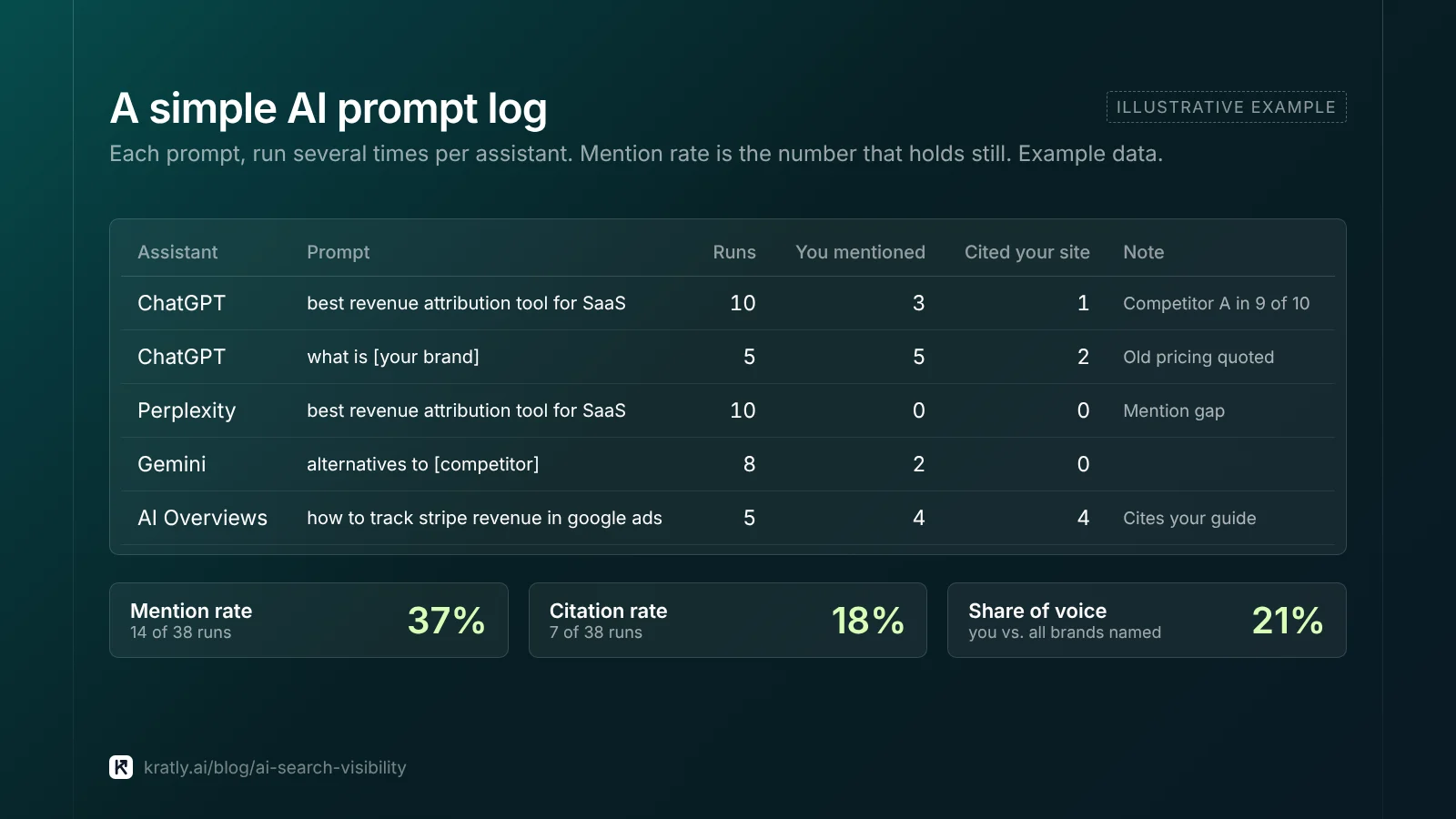
For each run, record: assistant, prompt, date, brands mentioned, whether you're mentioned, whether your site is cited, which URLs are cited, and anything inaccurate about you.
Step 5: Calculate your numbers#
Work out mention rate, citation rate and share of voice per assistant and per intent. Then list your mention gaps: prompts where competitors appear and you don't. Those are your priorities.
Pay special attention to accuracy on brand prompts. Wrong pricing or a feature you dropped two years ago costs you buyers who never reach your site.
Step 6: Track AI referrals in GA4 and repeat monthly#
In GA4, create a custom channel or an exploration filter on session source matching:
chatgpt|openai|perplexity|claude|copilot|gemini
That pattern is a common setup, not an official list (SEO Works). Expect undercounting. Some apps and in-app browsers strip the referrer. ChatGPT has added utm_source to some links, but reports in October 2026 suggest some visits now arrive with neither a UTM nor a referrer (Relevant Audience; not confirmed by OpenAI). Watch direct traffic to deep pages as a signal too.
Re-run the prompt panel monthly. Without a baseline, as one founder put it, "you can't tell whether anything you did moved it" (Product Hunt).
Make sure AI crawlers can reach you#
Before working on content, check you aren't blocking the bots that decide what appears in AI answers.
| Bot | What it does | Block it and… |
|---|---|---|
| OAI-SearchBot | Decides what appears in ChatGPT search | Your pages won't appear in ChatGPT search answers (OpenAI) |
| GPTBot | Collects content for OpenAI model training | Doesn't affect ChatGPT search |
| ChatGPT-User | Fetches a page when a user asks | Not used to decide what appears in search |
| PerplexityBot | Surfaces sites in Perplexity results; not for training | You can drop out of Perplexity results (Perplexity) |
| Googlebot | Google Search, including AI Overviews and AI Mode | Out of Google entirely |
| Google-Extended | Gemini training and grounding | Doesn't affect Google Search inclusion (Google) |
The practical rule: you can block training bots if you want to, but allow the search bots. OpenAI says robots.txt changes take about 24 hours to apply.
For Google's AI features, there's nothing extra to allow. A page must be indexed and eligible for a snippet (Google Search Central). If key pages aren't indexed, start with why Google isn't indexing your pages.
How to get more AI brand mentions#
AI assistants mostly repeat what the web already says about you. So the work happens on the web, not in a prompt.
1. Get mentioned on other sites. In Ahrefs' study of 75,000 brands, branded web mentions had the strongest correlation with appearing in AI Overviews (0.664). Backlinks were much weaker (0.218) (Ahrefs). That's correlation, not proof, but the direction is clear: "best of" lists, reviews, comparisons, podcasts and press matter.
2. Rank for the searches AI runs behind the scenes. AI assistants search the web for sub-questions before answering. Seer found page-one Google rankings correlated strongly with brand mentions in its sample (Seer). Our pillar guide on how to get cited in Google AI Overviews covers how.
3. Fix what AI gets wrong at the source. If ChatGPT quotes old pricing, find where it came from: your own old page, a review site, a directory. Update those pages. Keep your pricing and feature pages clear, current and dated.
4. Be useful where buyers ask. Communities like Reddit are cited often in AI answers. Answer real questions honestly and disclose who you are. Fake reviews and sock-puppet posts break platform rules and backfire.
5. Skip the shortcuts. There's no evidence that an llms.txt file or special AI markup improves mentions. Google says no special optimization is needed for its AI features.
How to do this in Kratly#
Kratly's AI search audit covers Google today: AI Overviews, the answer most buyers see first. Use the manual method above for ChatGPT, Perplexity and Gemini.
- Enter your site and the searches that bring you customers. Start with 10 to 20 buyer searches, not your whole keyword list.
- See who Google's AI cites. For each search, the audit shows whether an AI Overview appears, which sites it cites and whether you're one of them.
- Find the gaps. Searches where you rank but a competitor is cited are the fastest wins. Rewrite the section the AI should quote.
- Re-check. Run the audit again about four weeks after each change and compare.
Go deeper: How to rank in ChatGPT: generative engine optimization for SaaS
Questions, answered
How do I check if ChatGPT mentions my brand?
Write 20 to 30 prompts your buyers would ask, log out, and run each one 5 to 10 times with web search on and off. Record whether you're named, whether your site is linked and what's said about you. Compare with competitors and repeat monthly.
Why doesn't ChatGPT mention my company?
Usually because the web doesn't mention you much in the places AI draws from: reviews, comparisons, lists and communities. Other causes are blocking OAI-SearchBot, weak rankings for the sub-questions AI searches, or unclear pages about what you do. A newer brand simply has less written about it.
What is a good AI share of voice?
It depends on your category and number of competitors. Compare yourself against the brands buyers consider alongside you, and watch the trend. Rising mention rate and share of voice month on month matters more than any single number.
Does blocking GPTBot remove me from ChatGPT?
No. GPTBot collects data for model training. OAI-SearchBot decides what appears in ChatGPT search. You can block GPTBot and still appear in ChatGPT search, as long as OAI-SearchBot is allowed.
Can I see AI traffic in Google Analytics?
Partly. Filter GA4 sessions by source matching chatgpt, perplexity, claude, copilot and gemini. Some AI visits arrive without a referrer and show as direct, so AI traffic is undercounted. Watch branded search and direct traffic too.
Written by
Priyansh Kumar
Priyansh Kumar has spent more than a decade in growth, scaling brands from 1 to 10 and from 10 to 100. He now builds Kratly, an autonomous growth team that ties every campaign, page and email to the revenue it brings.
Sources
- OpenAI: DevDay 2026 recap · Crawlers and user agents
- Perplexity: Perplexity crawlers
- Google: Common crawlers · AI features and your website · Alphabet Q2 2026 earnings
- Search Engine Land: AI recommendation lists rarely repeat (SparkToro/Gumshoe, 2026)
- Ahrefs: AI visibility · Monitor brand mentions in ChatGPT · AI Overview brand correlation
- Seer Interactive: What drives brand mentions in AI answers
- Conductor via Business Wire: 2026 AEO/GEO benchmarks
- Adobe: AI-driven traffic surges across industries
Was this article useful?