Short answer
Last non-direct click attribution gives all credit to the last marketing channel before a sale, ignoring direct visits. First touch credits the channel that brought someone in. Last touch credits the final click, even direct. Trust each for a different question: first touch for discovery, last non-direct for paid-ad decisions, and none of them for proving cause.
You check three reports and get three answers. Google Ads says it drove the sale. GA4 says organic search. Shopify says direct. One store owner noticed exactly this: "Shopify backend shows a organic search source, but GA4 shows a direct source" (Shopify Community).
Nobody is lying. They're answering different questions. This guide shows which question each model answers, so you can pick the right one.
What is last non-direct click attribution?#
Last non-direct click attribution gives 100% of the credit for a conversion to the last marketing channel the person came through. Direct visits, such as typing your URL or using a bookmark, are skipped.
In Google's old Universal Analytics, this was the default model in standard reports. Google described it as one that "ignores direct traffic and attributes 100% of the conversion value to the last channel" the customer used (Google Analytics Help).
Why ignore direct? Because "direct" usually means "came back on their own after marketing brought them." Someone clicks an ad on Monday, then types your URL on Friday to buy. Last click credits "direct". Last non-direct credits the ad.
In GA4, the closest equivalent is the paid and organic last click model. Direct gets credit only when there's no other touch in the lookback window. Session-based reports, like Traffic acquisition, use this logic whatever model you select (Cardinal Path).
Attribution models compared#
| Model | Gives credit to | Answers | Weakness |
|---|---|---|---|
| First touch | The first known channel | What brings people to us? | Ignores everything that closed the sale |
| Last touch (last click) | The final click or visit, including direct | What happened right before they bought? | Over-credits direct, brand search and retargeting |
| Last non-direct click | The last marketing channel, skipping direct | Which marketing brought them back to buy? | Still ignores earlier touches |
| Linear | Every touch equally | Which channels show up along the way? | Treats a banner view like a demo request |
| U-shaped / W-shaped | First touch, lead creation (and opportunity), most credit; the rest shared | Which touches create leads and deals? | Weights are set by hand |
| Data-driven | Touches weighted by a model trained on your data | How should the platform share credit? | A black box, run by the company selling the ads |
None of these proves the marketing caused the sale. They divide credit for sales that happened. To measure cause, you need a control group. See our guide to the marketing incrementality test.
First touch vs last touch attribution: a worked example#
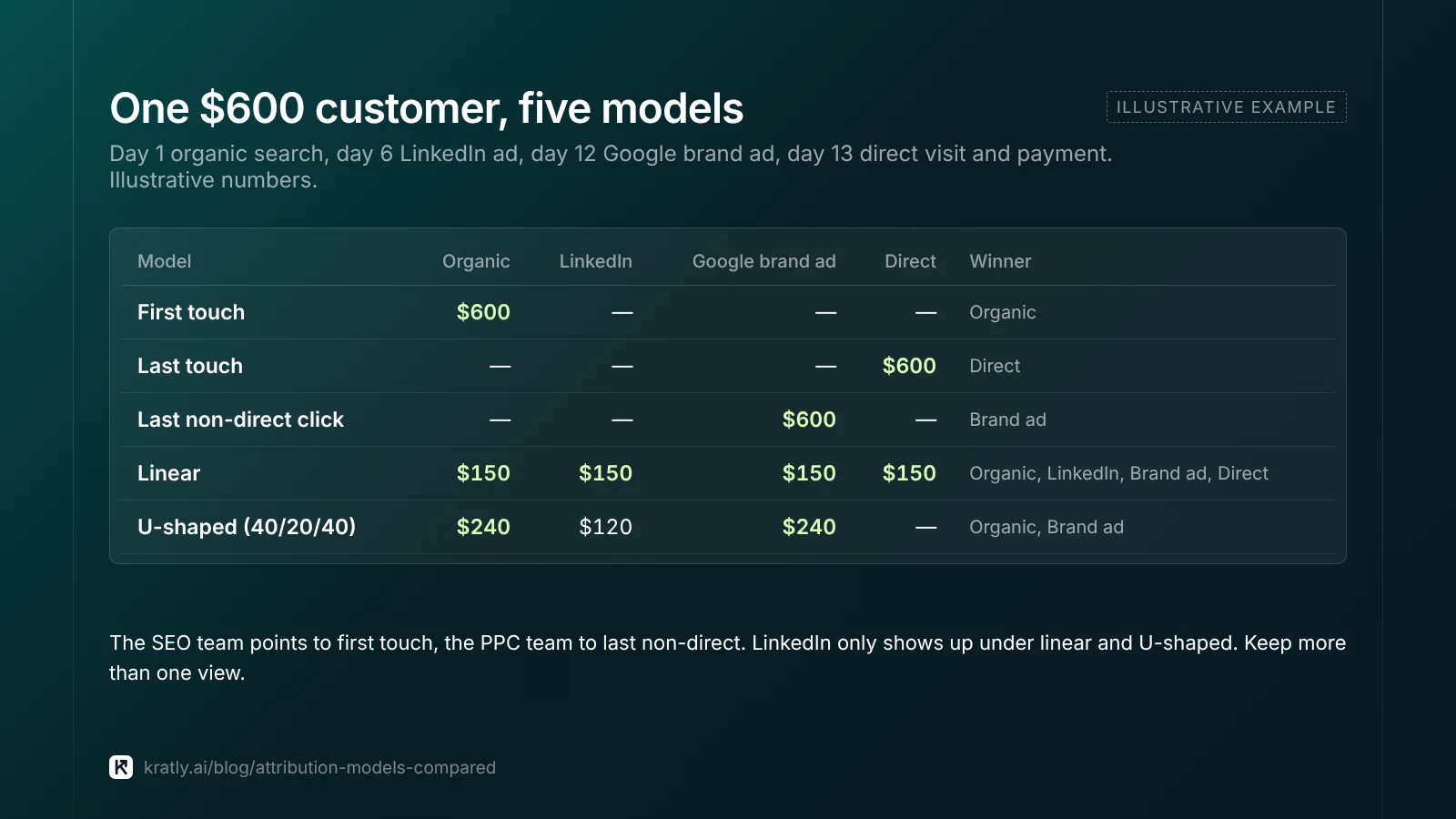
Take one customer's journey. The numbers are illustrative.
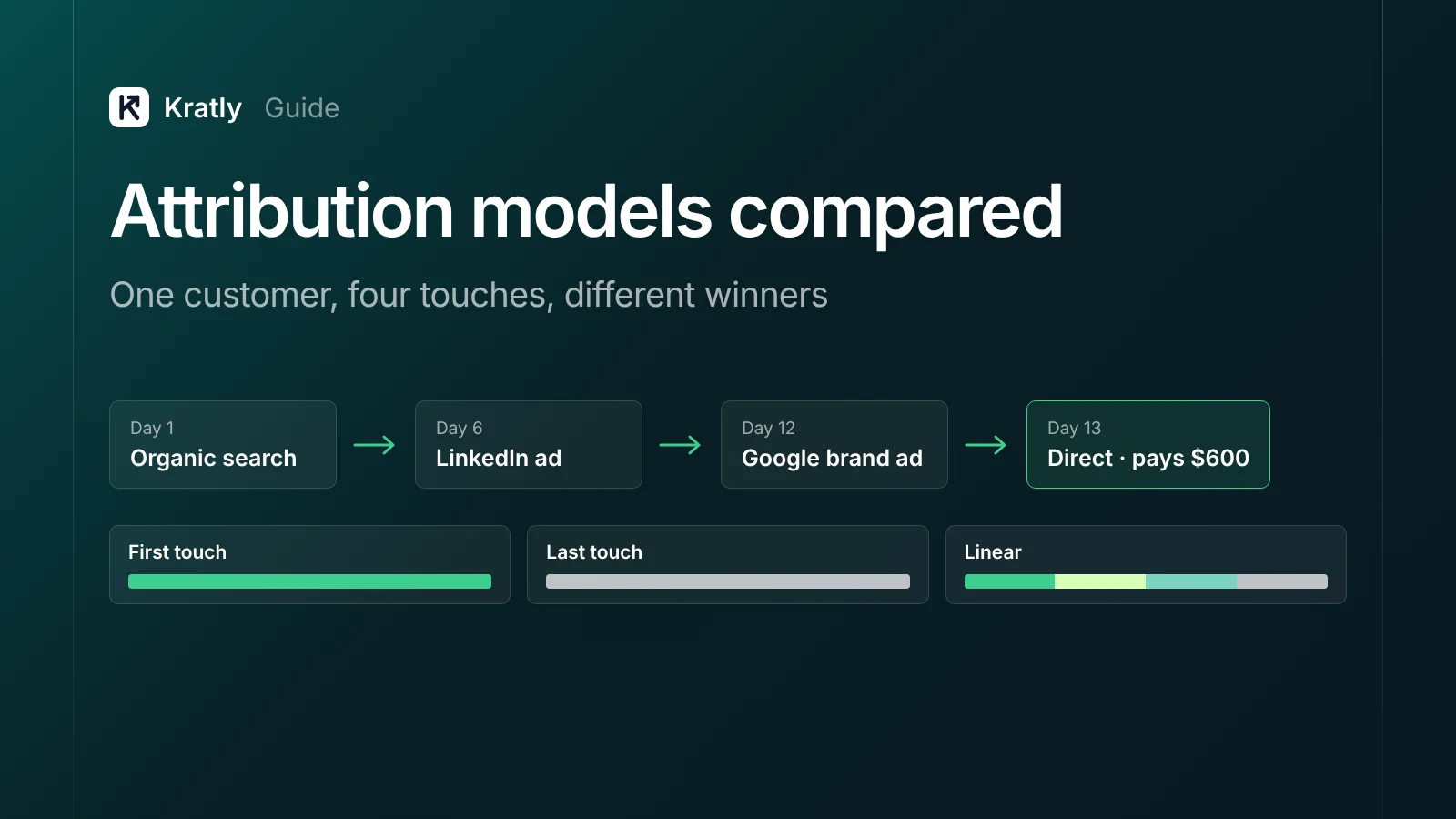
- Day 1: finds a blog post through Google organic search
- Day 6: clicks a LinkedIn ad
- Day 12: clicks a Google brand search ad
- Day 13: types the URL (direct) and pays $600
| Model | Organic | Google brand ad | Direct | |
|---|---|---|---|---|
| First touch | $600 | — | — | — |
| Last touch | — | — | — | $600 |
| Last non-direct click | — | — | $600 | — |
| Linear | $150 | $150 | $150 | $150 |
| U-shaped (40/20/40 example) | $240 | $120 | $240 | — |
The U-shaped row treats the brand ad as the last touch and skips direct. Tools vary in how they treat direct visits.
Same customer, five stories. The SEO team points to first touch. The PPC team points to last non-direct. LinkedIn looks useless unless you use linear. That's why teams fight over attribution.
The practical fix is to keep more than one view. Our SaaS marketing attribution guide shows how to store first touch, last non-direct touch and a self-reported source on every customer.
Which attribution models still exist in GA4 and Google Ads?#
Fewer than most guides suggest.
GA4 offers three (Cardinal Path):
- Data-driven
- Paid and organic last click (last non-direct, in effect)
- Google paid channels last click
First click, linear, time decay and position-based were "no longer available as of November 2023" (Google Analytics Help). Properties using them were switched to data-driven.
For a first-touch view in GA4, use the "First user source / medium" dimension in user acquisition reports. It records how a user first arrived.
Google Ads offers only data-driven and last click. Data-driven is the default for most conversion actions (Google Ads Help).
CRMs still offer more. HubSpot includes first interaction, last interaction, linear, U-shaped, W-shaped, full path and time decay, depending on your plan (HubSpot). Salesforce's campaign influence offers first touch, last touch and even distribution (Salesforce Ben).
Data-driven attribution: when to trust it#
Data-driven attribution (DDA) uses your account's conversion paths to estimate how much each touch contributed.
Since 2021, Google Ads has no minimum data requirement for DDA: all conversion actions are eligible "regardless of conversion or interaction volume" (Google Ads Help). Google still recommends at least 200 conversions and 2,000 ad interactions in 30 days for best results (Google Ads Help).
Three things to keep in mind:
- It only sees what it can track. Touches outside Google, such as podcasts, word of mouth and some social, are invisible to it.
- It's run by the seller. In an r/PPC thread about GA4 attribution changes, one advertiser asked whether it was "just a way for google to make google ads look better" (r/PPC). That's not proof of bias, but it's a fair reason to check DDA against your own data.
- Use it for bidding, not for proof. DDA is a reasonable way to let Smart Bidding share credit across keywords. It isn't evidence that Google Ads caused your growth.
Which attribution model to trust: by question#
| Your question | Use | Watch out for |
|---|---|---|
| Which channels bring new people to us? | First touch (GA4 first user source; CRM first interaction) | Over-credits top of funnel |
| Which marketing should get budget this week? | Last non-direct click on paid revenue | Under-credits early touches |
| How should Google Ads bid? | Google Ads data-driven | Only sees Google's touches |
| Which touches create B2B pipeline? | W-shaped or full path in your CRM | Weights are hand-set |
| What did customers say brought them? | Self-reported ("How did you hear about us?") | Memory is imperfect |
| Did this spend actually cause sales? | None. Run a holdout or lift test | Needs a control group |
Windows matter as much as the model#
Your lookback window often changes results more than your choice of model. In GA4, acquisition key events default to a 30-day window and other key events to 90 days, the maximum (Google Analytics Help). If your buyers take 45 days to pay, a 30-day window hands the credit to direct.
Reporting identity matters too. GA4's default "Blended" identity uses your User ID first, then device ID, then modelled data (Cardinal Path). Sending a User ID at login makes cross-device journeys more accurate.
How to do this in Kratly#
- Connect your ad accounts, site and Stripe. Kratly records the channels each paying customer came through.
- Switch models in one click. See Stripe revenue by channel under first touch, last touch or linear.
- See where models disagree. Compare a channel across the three views; big swings tell you where credit is contested.
- Test the big calls. Run a holdout on any channel where the models disagree most.
Go deeper: Self-reported attribution: ask 'How did you hear about us?' right
Questions, answered
What is the difference between last click and last non-direct click?
Last click gives all credit to the final visit, even if it was direct. Last non-direct click skips direct visits and credits the last marketing channel, such as an ad or organic search. Last non-direct usually gives a fairer view of what marketing did.
Which attribution model is best?
No single model is best. Use first touch to judge what brings people in, last non-direct click for weekly paid budget decisions, and data-driven for Google Ads bidding. To prove a channel causes sales, run an incrementality test.
Does GA4 still have first-click attribution?
Not as a selectable model. Google removed first click, linear, time decay and position-based in November 2023. You can still see how users first arrived with the "First user source / medium" dimension in GA4's user acquisition reports.
Is data-driven attribution accurate?
It's a reasonable way to share credit among the touches Google can see, and it suits Smart Bidding. It can't see touches outside Google's tracking, and it doesn't measure whether ads caused the sale. Check it against Stripe revenue and holdout tests.
Why does GA4 show so much direct traffic?
Direct appears when GA4 can't see a source: typed URLs, bookmarks, some apps, privacy tools and expired cookies. A short lookback window also hands credit to direct. Use paid and organic last click, longer windows and a User ID to reduce it.
Written by
Priyansh Kumar
Priyansh Kumar has spent more than a decade in growth, scaling brands from 1 to 10 and from 10 to 100. He now builds Kratly, an autonomous growth team that ties every campaign, page and email to the revenue it brings.
Sources
- Google Analytics Help: Universal Analytics attribution models · Retired attribution models · Attribution settings
- Google Ads Help: About attribution models · Data-driven attribution
- Cardinal Path: Attribution in GA4 · Reporting identity in GA4
- HubSpot: Attribution reporting · Salesforce Ben: Campaign influence
Was this article useful?