Short answer
For YouTube marketing, B2B SaaS teams get the most sign-ups from plain screen-recorded videos. The best are product demos, how-tos for a problem your buyer searches, and honest comparisons. Add chapters and corrected captions so YouTube and Google understand each part. Put tagged links in the description and ask new users where they found you.
Kapwing's co-founder Julia Enthoven looked back at the company's first year on YouTube. "These basic screencast tutorials … represent more than 80% of our total Youtube views," she wrote. And: "Less than one percent of our total YouTube views come from what are arguably our most entertaining videos" (Kapwing).
Boring, useful videos win. In 2026 they win twice: on YouTube, and again when Google's AI answers cite them.
Why YouTube now shows up in AI answers#
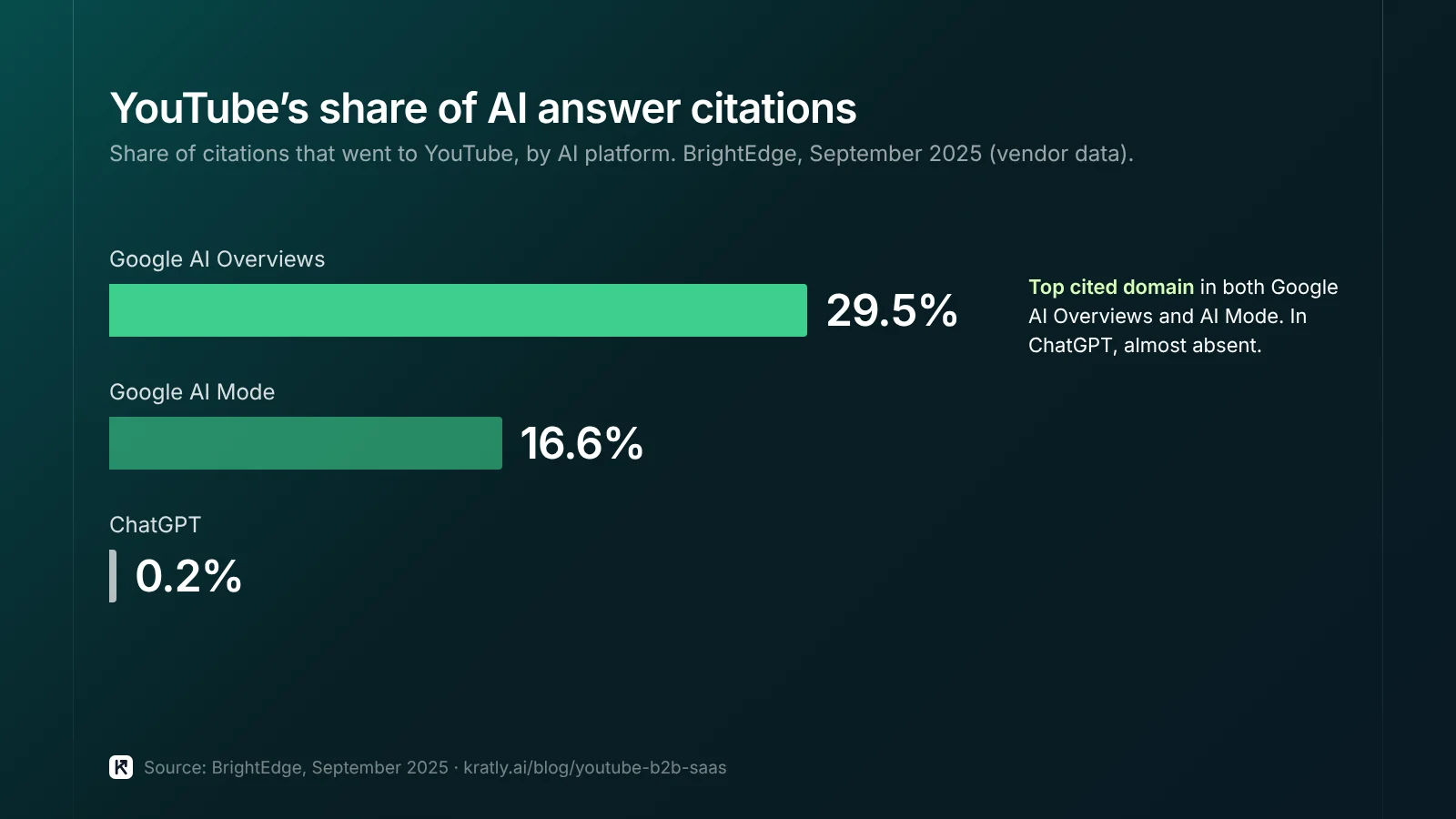
YouTube is the domain Google's AI answers cite most often. Two studies agree on that, even if their numbers differ.
- BrightEdge (September 2025, vendor data): YouTube held 29.5% of citation share in Google AI Overviews and 16.6% in AI Mode. It was the top cited domain in both. In ChatGPT it held only 0.2% (BrightEdge).
- Ahrefs (March 2026): YouTube is "the most cited domain in AI Overviews." It made up 5.6% of all cited URLs in their sample. Among cited pages that didn't rank in Google's top 100 for the same query, 18.2% were YouTube videos (Ahrefs).
That last number matters for a small SaaS. A clear video can be cited even when your blog post never reaches page one.
BrightEdge also lists what gets cited: tutorials, tool demonstrations, reviews and comparisons. Abstract content "without a visual benefit" isn't. For B2B software, that means: show the screen.
A 0.2% share in ChatGPT is tiny, so I'd treat YouTube as a Google play first. For the wider picture of where buyers ask AI tools about software, see AI search visibility: does ChatGPT or Google AI mention you?. Then read the pillar guide on how to get cited in Google AI Overviews.
YouTube marketing: B2B SaaS videos that bring sign-ups#
Not every video brings buyers. Here's how I'd rank formats for a B2B product, from most to least likely to bring a paying sign-up.
| Video type | Who searches for it | What it brings | Example title |
|---|---|---|---|
| How-to for a buyer's problem | People with the problem, not yet a tool | Sign-ups, if your product is the natural fix | "How to reconcile Stripe payouts in 10 minutes" |
| Product demo / walkthrough | People already comparing tools | Trials from high-intent viewers | "[Product] demo: set up your first report" |
| Comparison or alternatives | People choosing between tools | Sign-ups and AI citations | "[Product] vs [Competitor]: honest walkthrough" |
| Integration setup | Users of a tool you connect to | Sign-ups from a ready-made audience | "Connect HubSpot to [Product] step by step" |
| Founder story / vlog | Fans, other founders | Followers, rarely buyers | "Year one building [Product]" |
Start with the problem, not the product. Marcus Jones says his SaaS, Velio, reached 1,000 paying users in about 60 days with two videos (Profitable Founder podcast). His point: most founders make "solution aware videos, not problem-aware videos." His launch video opened with a viewer problem, then a method, then the product.
One caveat. Jones already ran a YouTube channel with close to 500,000 subscribers. You probably don't. Treat his result as proof of the format, not of the speed.
Comparisons are worth the discomfort. Be fair to the competitor and show where they win. The same rules apply as for written pages, covered in how to write a competitor alternatives page.
Pair YouTube with Reddit. Both are third-party sources that AI answers lean on. A short video you can link in a helpful Reddit reply is worth more than either alone. See Reddit marketing for SaaS for how to do that without getting banned.
How YouTube search ranks your videos#
YouTube explains its search ranking in plain terms. It uses three main factors (YouTube Help):
- Relevance: "how well the title, tags, description, and video content match your search query."
- Engagement: "the watch time of a particular video for a particular query."
- Quality: which channels "demonstrate expertise, authoritativeness, and trustworthiness" on a topic.
So, for YouTube SEO in SaaS, the job is simple to say and slow to do:
- Title it the way people search. "How to track Stripe revenue by campaign" beats "Revenue visibility, reimagined."
- Answer fast. Watch time for that query is the signal. A 60-second intro about your company costs you.
- Stay on one topic. Tutorials on one problem build topical trust. A mix of memes and webinars doesn't.
What I'd check first: the search terms report. YouTube says it "shows you what terms viewers searched when they found your content," on the Reach tab (YouTube Help). After ten videos, it tells you which problems your buyers name, in their words. Those words are also your next blog titles.
Chapters, captions and key moments#
Chapters help viewers jump ahead and give Google labeled segments to show.
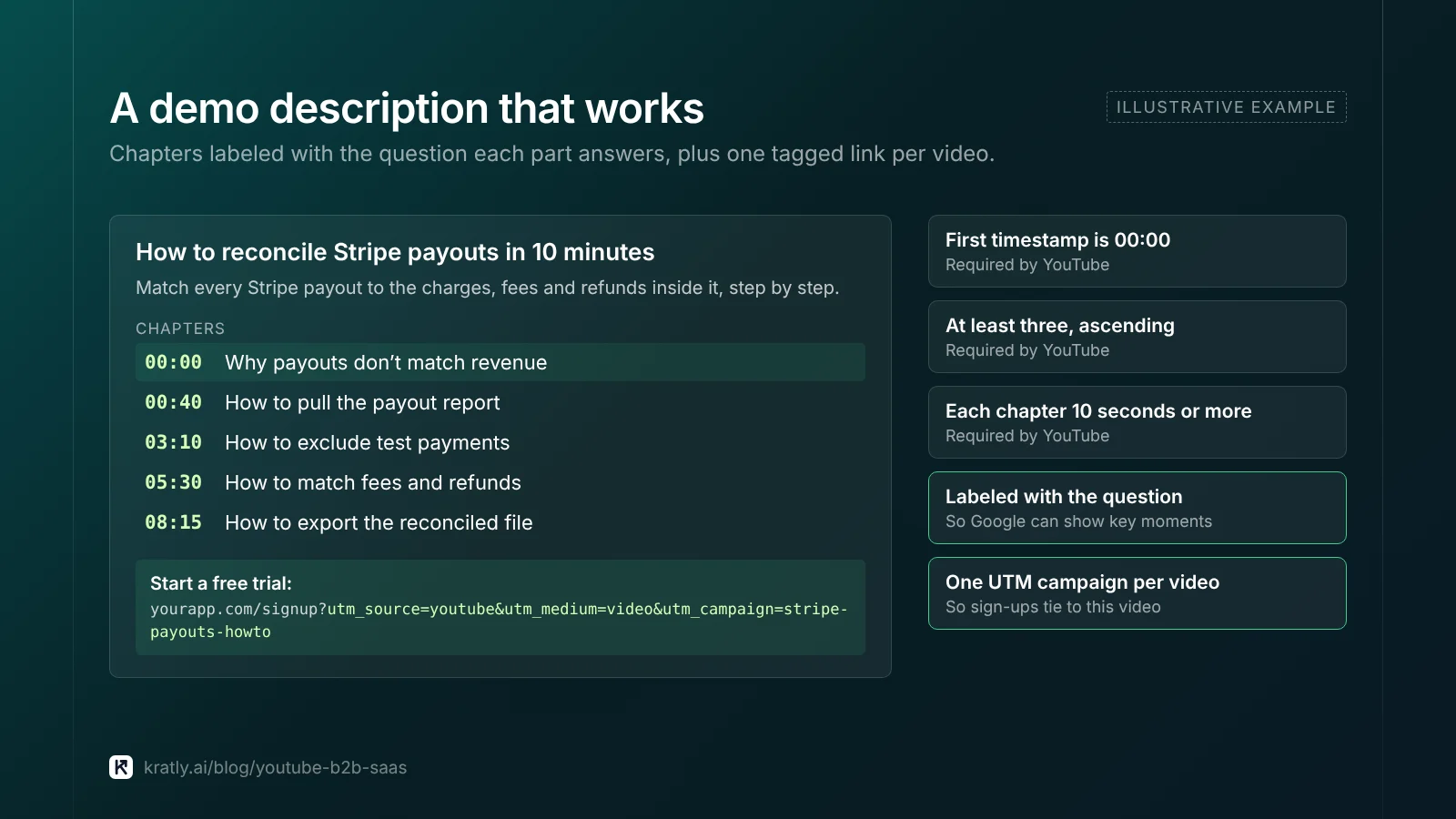
Adding chapters by hand. YouTube's rules (YouTube Help):
- The first timestamp in the description must start at 00:00.
- You need at least three timestamps, in ascending order.
- Each chapter must be at least 10 seconds long.
- Manual timestamps override automatic chapters.
Key moments in Google Search. Google says it will "prioritize key moments set by you, either through structured data or the YouTube description" (Google Search Central). For YouTube videos, the description timestamps are the simple route. Label each chapter with the question it answers: "03:10 How to exclude test payments."
Captions. Neither YouTube nor Google promises a ranking boost from captions. I'd still upload a corrected transcript. Automatic captions often garble product names and jargon, so the words in your video stop matching the words people search. Fixing that costs about the length of the video in editing time.
Embed on your site too. Google recommends a dedicated watch page for each video, with a unique title and description (Google Search Central). Embed your best demo on the matching product or comparison page, with a short summary. That gives you two chances to be found and cited.
How to track sign-ups and revenue from YouTube#
Many viewers watch on a phone, then type your name into a laptop days later. That visit shows up as direct or branded search. So use three layers, and expect each to be incomplete.
| Method | What it catches | What it misses |
|---|---|---|
| UTM links in descriptions and pinned comments | Clicks straight from the video | Anyone who searches your name later |
| "How did you hear about us?" on sign-up | People who remember the video | People who don't answer or forget |
| Branded search and direct trends | The overall lift after a run of videos | Which video did it |
Tag every link. Use one campaign per video, for example utm_source=youtube&utm_medium=video&utm_campaign=stripe-payouts-howto. A simple scheme is in UTM naming convention.
Ask, in a free-text box. A dropdown with "YouTube" in it gets clicked by default. A free-text answer like "your video on Stripe payouts" tells you the exact video.
Judge on payments, not views. Join the UTM source and the self-reported answer to the customer record, then to their Stripe payments. A video with 800 views and four paying customers beats one with 40,000 views and none. The wider method is in SaaS marketing attribution.
What it costs, and when to skip YouTube#
Here's the trade-off in hours. My rough estimate for a plain screen-recorded tutorial: about an hour to outline and an hour to record. Editing, adding chapters and fixing captions take two to three hours more. Call it four to five hours per video. Ten videos is a working week.
I'd invest in YouTube when:
- Buyers search for how to solve the problem your product solves.
- Your product is visual, so watching it work is persuasive.
- You can commit to one video a week for three months before judging.
I'd skip it, or wait, when:
- Nobody searches for your problem yet. Category creation is slow on YouTube.
- You sell a few large contracts a year. A personal demo per prospect works better.
- You can't track sign-ups to payments yet. Fix tracking first, or you'll judge on views.
Judge after three months on paying customers who named a video and on branded search. Not subscribers.
How to do this in Kratly#
- Run the free AI search audit. See whether Google's AI answers mention you for your buyers' questions, and which sources they cite instead.
- Connect your website and Stripe. Kratly ties sign-ups with a YouTube UTM source to the payments they make.
- Compare videos by revenue. See paying customers and revenue per video campaign next to your other channels.
- Approve next steps. Kratly suggests which topics to cover next; you decide, and every change is logged.
Questions, answered
Does YouTube work for B2B SaaS?
Yes, when buyers search for the problem you solve and your product is easy to show on screen. Plain tutorials and demos tend to beat polished brand videos. Commit to one video a week for three months. Then judge it on paying customers who named a video and on branded search, not on views.
What kind of videos get cited in Google AI Overviews?
Tutorials, tool demonstrations, and product reviews and comparisons get cited most, per BrightEdge. Abstract strategy content without a visual element gets cited less. Ahrefs found YouTube is the most cited domain in AI Overviews overall. A clear video can even be cited when your blog post never reaches page one, so for B2B software, show the screen.
Do YouTube chapters help SEO?
Yes. Chapters help viewers find answers and let Google show labeled key moments in search. Google says it prioritizes key moments set in the YouTube description. Start at 00:00, use at least three timestamps, and keep each chapter at least 10 seconds long. Label each chapter with the question it answers.
How do I track sign-ups from YouTube?
Add UTM-tagged links to each video description, with one campaign per video. Ask "How did you hear about us?" as a free-text field on sign-up. Then connect both to payments in Stripe. Expect some YouTube influence to show up as direct or branded search.
Written by
Priyansh Kumar
Priyansh Kumar has spent more than a decade in growth, scaling brands from 1 to 10 and from 10 to 100. He now builds Kratly, an autonomous growth team that ties every campaign, page and email to the revenue it brings.
Sources
- BrightEdge: YouTube presence in AI search (Sept 2025)
- Ahrefs: AI Overview citations and top-10 rankings (March 2026)
- YouTube Help: How YouTube search works · Video chapters · Understand your video reach
- Google Search Central: Video SEO best practices
- Kapwing (Julia Enthoven): How to grow a SaaS startup on YouTube
- Profitable Founder podcast: Marcus Jones on 1,000 paying users from two videos (March 2026)
Was this article useful?