Short answer
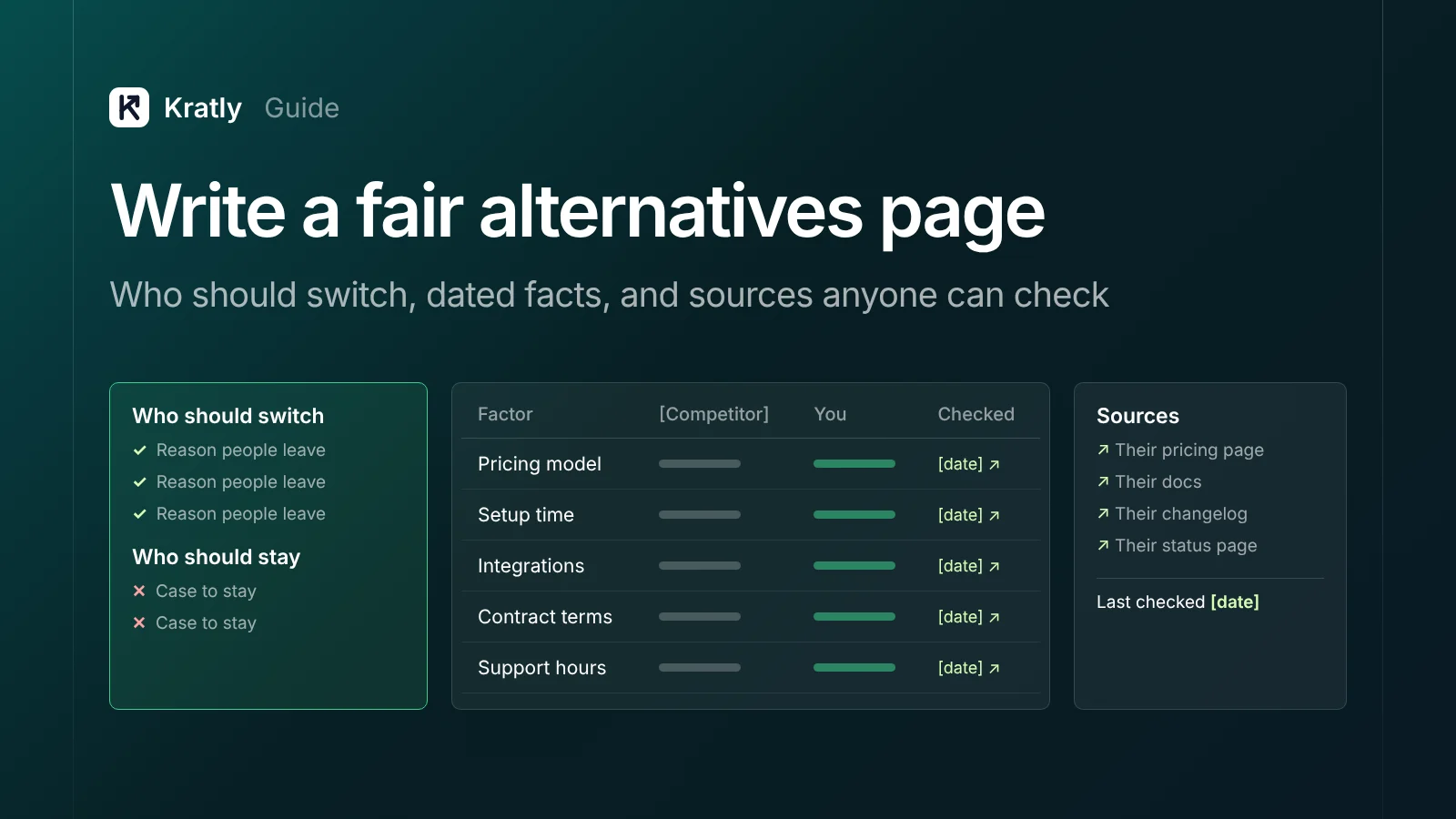
To write an alternatives page, target "[competitor] alternatives" and open with who should and shouldn't switch. Compare on the few factors buyers decide on, and date every claim with a source. Show where the competitor is better. Add migration steps and proof. Fair, checkable pages rank, convert and get quoted by AI answers.
One agency tracked conversion rates by keyword type across its clients. Pages targeting "[competitor] alternatives" converted at 8.43%. "X vs Y" pages converted at 5.45%. A top-of-funnel example converted at 0.6% (Grow and Convert, agency client data).
That gap is why every SaaS team wants these pages, and why so many are bad. The fix is restraint: fewer claims, each dated and sourced, and an honest line about who should stay put.
Buyers also check your page against an AI answer. G2 reported in 2026 that 51% of software buyers start their research in an AI chatbot (Demand Gen Report). A one-sided page loses to a fair summary from a model that has read your competitor's docs.
Alternatives page or vs page: which to write first#
- "[Competitor] alternatives" is searched by someone using or rejecting that competitor. They want a short list.
- "[You] vs [competitor]" is searched by someone who already knows both names. They're close to a decision.
- "[Competitor A] vs [competitor B]" is searched by someone choosing between two others. You can win it only if you're a credible third option.
I'd start with the alternatives page for the competitor you meet most in sales calls. It has the highest conversion rate in the Grow and Convert data.
If people already search "[you] vs [competitor]", write that page first. Those searchers are further along, and one rival is cheaper to cover than five.
What I'd check first: ask sales which tool new customers left, and the main reason why. That reason becomes your headline. See how these pages fit with use-case, integration and pricing pages in the bottom-of-funnel SaaS pages that bring revenue.
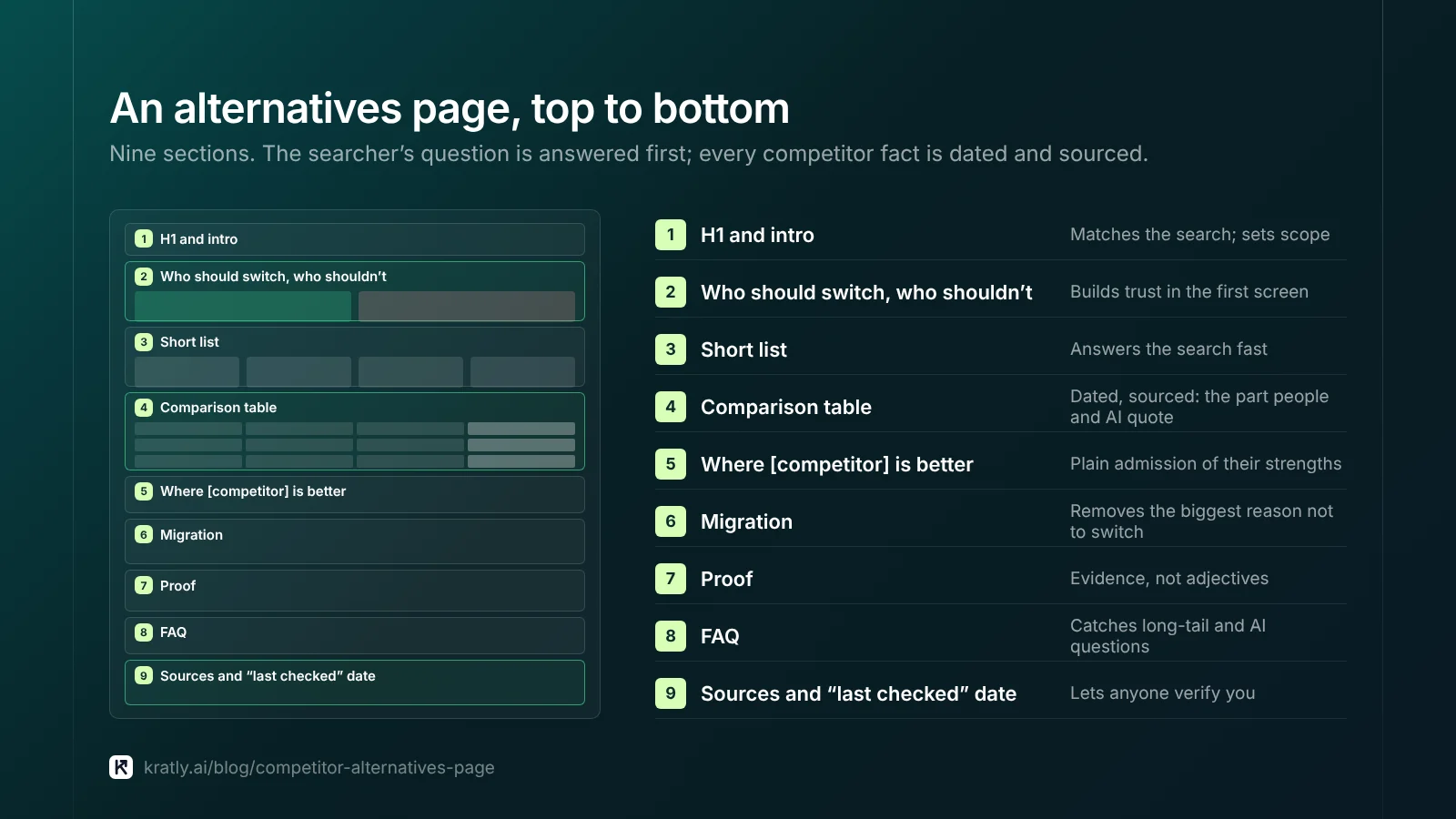
How to write an alternatives page: section by section#
| Section | What goes in it | Why it's there |
|---|---|---|
| H1 and intro | "[Competitor] alternatives" plus the year, and one line on who this page is for | Matches the search; sets scope |
| Who should switch, who shouldn't | 3 reasons people leave; 2 cases where they should stay | Builds trust in the first screen |
| Short list | Each option with "best for", starting price and one drawback | Answers the search fast |
| Comparison table | 5–8 decision factors, each cell dated and sourced | The part people and AI tools quote |
| Where [competitor] is better | Plain admission of their strengths | Google's review guidance asks for drawbacks |
| Migration | Steps, import tools, time it takes, what doesn't carry over | Removes the biggest reason not to switch |
| Proof | Named customer quotes, review-site links, screenshots of your own product | Evidence, not adjectives |
| FAQ | Pricing, contracts, data export, support | Catches long-tail and AI questions |
| Sources and "last checked" date | Links to competitor pricing, docs and changelogs | Lets anyone verify you |
Lead with the reason to leave, not with you. The searcher came for options. A first screen with only your logo and a demo button loses them.
Pick decision factors buyers use. Pricing model, setup time, integrations, data limits, support hours, contract terms. Skip vanity rows like "modern UI" that you can't measure.
Say who should stay. Example: "If you need on-premise hosting, stay with [competitor]. We're cloud only." It costs a few sign-ups you'd have lost anyway, and buys trust from everyone else.
A vs page template you can copy#
A vs page covers one rival, side by side, with a clear verdict by type of buyer.
| Block | Template | Example wording |
|---|---|---|
| Verdict up top | "Choose [you] if… Choose [competitor] if…" | "Choose us if you sell subscriptions on Stripe. Choose them if you need a built-in CRM." |
| At a glance | 4–6 row table: price, best for, setup time, key limit | "Starts at $X/month (their pricing page, checked [date])" |
| Feature detail | Grouped by job, not by feature list | "Reporting", "Billing", "Integrations" |
| Pricing at 3 sizes | Same usage, both tools, cited | Small, mid and large team |
| Where they win | 2–4 honest points | "Larger template library" |
| Switching | Steps and time | "Most teams import in a day" (only if you can back it up) |
| FAQ and sources | Dated links | "Last checked [date]" |
The verdict goes first because many visitors read only that. Make it useful even to those who pick the other tool.
The trade-off: expect a few hours of research per competitor, plus a quarterly recheck.
Fair comparisons: FTC, false advertising and trademarks#
This is general information, not legal advice. Have a lawyer review strong claims about a named competitor.
The FTC encourages comparisons, with conditions. Its policy statement on comparative advertising "encourages the naming of, or reference to competitors, but requires clarity" (FTC, 1979). Comparative advertising, "when truthful and non-deceptive, is a source of important information to consumers," it says. Comparisons face the same test as any ad: could they mislead?
False advertising claims come from competitors. Section 43(a) of the Lanham Act lets a business sue over false or misleading statements about goods in commercial advertising (15 U.S.C. §1125). The riskiest lines are numbers about the rival: their price, limits, uptime and security. If it's wrong or stale, that's your exposure.
Using their name is usually allowed, within limits. US courts call it nominative use. The Ninth Circuit's test, per the American Bar Association, asks three things. Is the product hard to identify without the name? Do you use only as much of the mark "as is reasonably necessary"? Do you avoid anything that would "suggest sponsorship or endorsement by the trademark holder" (ABA Landslide, 2022)? Circuits apply this differently.
What that means on the page:
- Use the competitor's name in plain text. Don't use their logo or brand colors.
- Don't imply a partnership, endorsement or "official" status.
- Don't say "the only", "the best" or "X times faster" unless you can prove it today.
Make every claim checkable#
A claim is checkable when a reader can click and see what you saw. That protects you legally and helps in search.
Google's guidance on reviews asks writers to do three things (Google Search Central):
- "explain what sets something apart from its competitors"
- "discuss the benefits and drawbacks of something, based on your own original research"
- show "evidence such as visuals, audio, or other links of your own experience"
It's written for product reviews, but fits software comparisons.
How I'd put that into practice:
- Date every competitor fact. "Starts at $X/month (pricing page, checked [date])."
- Link the source. Their pricing page, docs, changelog or status page.
- Separate tested from claimed. "In our test" versus "according to their docs."
- Add a "last checked" line near the table, and a way to report errors.
- Recheck every quarter, and whenever a competitor ships a pricing change.
Put one named owner on each page, or the table goes stale.
Alternatives page SEO and AI answers#
Alternatives page SEO follows the search. Put "[competitor] alternatives" in the title, H1 and URL. Cover "[competitor] competitors" and "tools like [competitor]". Link to the page from pricing, integration and problem-focused blog pages.
AI answers read these pages differently. Google says there's no special optimization for AI features. A page must be indexed and eligible for a snippet (Google Search Central). But AI Overviews appear less on commercial searches. Ahrefs found they triggered on 4.3% of commercial keywords against 21.4% of informational ones (Ahrefs, Nov 2025).
Ask ChatGPT for "[competitor] alternatives" and it pulls from pages like yours, review sites and forums. Its answers shift a lot: SparkToro and Gumshoe found less than a 1 in 100 chance of getting the same brand list twice (Search Engine Land, Jan 2026). A clear table with dated facts is easy to quote. A page full of "best-in-class" is not.
For the wider playbook, read how to get cited in Google AI Overviews. Want to know if ChatGPT and Google already mention you for competitor searches? Use the checks in AI search visibility: does ChatGPT or Google AI mention you?
A real example worth studying#
PostHog's "PostHog vs Mixpanel" page is a useful model (PostHog, Jan 2026). It's written by PostHog, so read it as a vendor page. Three things stand out:
- Feature tables grouped by job: product analytics, session replay, feature flags, experiments and more.
- Pricing at several usage levels, not a single headline price.
- A plain case for the competitor. Its FAQ lists reasons to stay with Mixpanel. It also calls Mixpanel "a solid choice" for teams that want "a polished UI optimized for product managers and growth teams."
Copy the moves, not the wording.
How to do this in Kratly#
- Run the free AI search audit. See whether Google's AI Overviews cite you when buyers search for alternatives to your main competitors.
- Connect your site and Stripe. Kratly shows sign-ups, paying customers and revenue for each page, including your alternatives and vs pages.
- Compare pages on revenue. See which competitor pages bring paying customers and which only bring visits.
- Approve suggested updates. Kratly flags pages with stale or missing facts and suggests changes. You approve each one, and every change is logged and reversible.
Questions, answered
How long should an alternatives page be?
Long enough to answer the decision. A short page with dated facts, a clear verdict and migration steps beats a long one padded with feature lists. Cover who should switch and who shouldn't, 5–8 decision factors, where the competitor is better, migration and proof.
Should I list other competitors besides my own product?
Yes, if you can describe them fairly. Three to six real options match what searchers want. For each one, give a "best for" line, a starting price and one drawback. Searchers came to compare options, not to read a sales pitch.
Is it legal to use a competitor's name on my site?
In the US, naming a competitor to identify their product is generally allowed if claims are true and you don't imply endorsement. Use their name in plain text and avoid their logo. Make no "the best" claims you can't prove today. This isn't legal advice.
How often should I update comparison pages?
Every quarter, and whenever a competitor changes pricing or ships a major feature. Show a "last checked" date on the page. Put one named owner on each page, or the table goes stale. Link each competitor fact to its own source.
Do alternatives pages show up in AI answers?
They can. Chatbots answer "alternatives" questions from pages, review sites and forums. Clear tables with dated, sourced facts are the easiest content to quote. Answers shift a lot, though. SparkToro and Gumshoe found less than a 1 in 100 chance of getting the same brand list twice.
Written by
Priyansh Kumar
Priyansh Kumar has spent more than a decade in growth, scaling brands from 1 to 10 and from 10 to 100. He now builds Kratly, an autonomous growth team that ties every campaign, page and email to the revenue it brings.
Sources
- Grow and Convert: SEO conversion rates by keyword type (agency client data)
- Demand Gen Report: G2 on buyers starting research in AI chatbots (2026)
- FTC: Statement of policy regarding comparative advertising
- 15 U.S.C. §1125 (Lanham Act §43(a)): text via University of Iowa Pressbooks
- American Bar Association, Landslide: Nominative trademark use
- Google Search Central: Write high-quality reviews · AI features and your website
- Ahrefs: What triggers AI Overviews
- Search Engine Land: AI recommendation lists rarely repeat
- PostHog: PostHog vs Mixpanel
Was this article useful?