Short answer
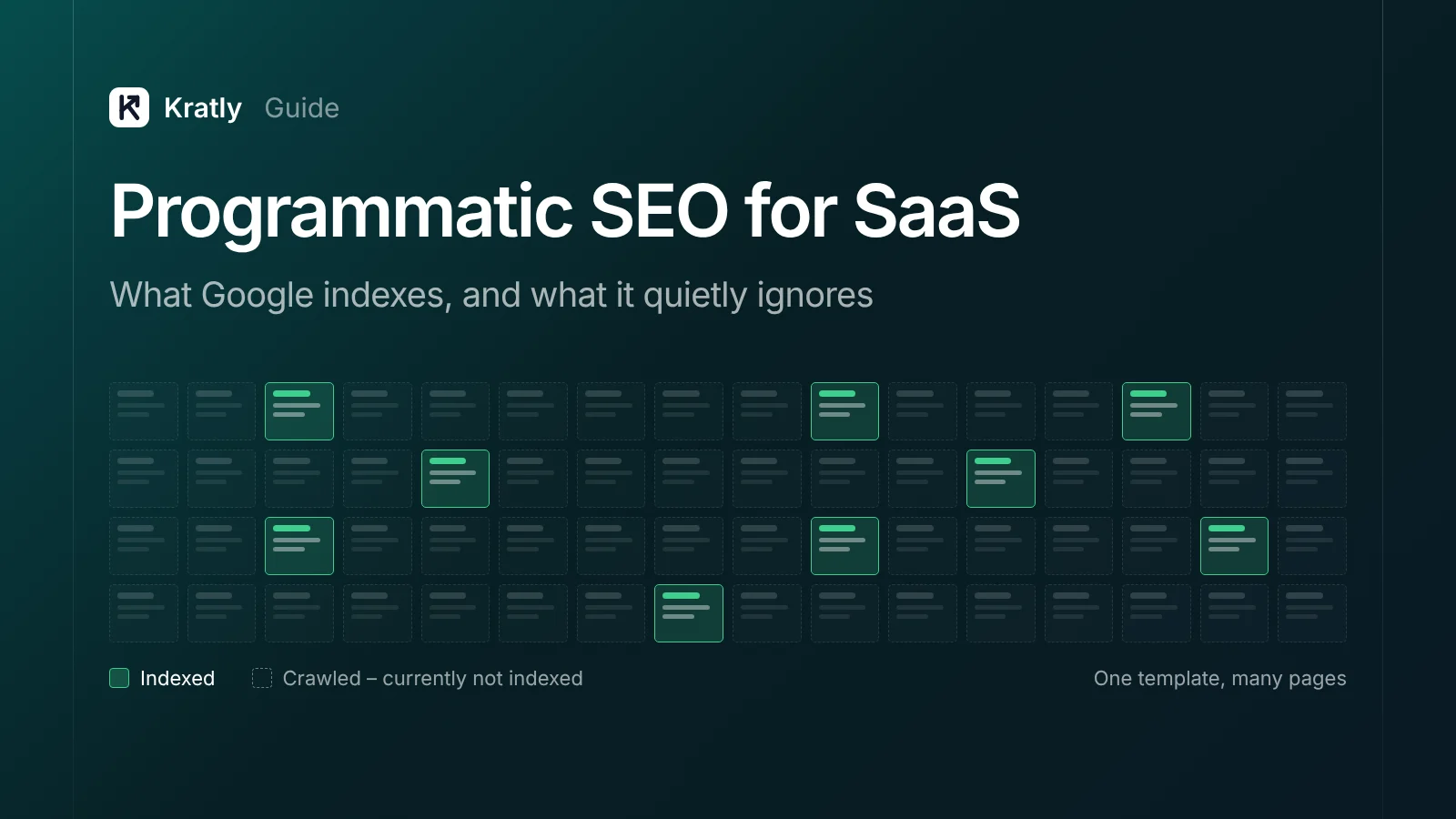
A programmatic SEO SaaS project works when each page answers a real search and carries data no other page has, like Zapier's app integration pages. Google ignores pages that only swap a keyword into a template. Pilot 20–50 pages, measure how many get indexed and what revenue each brings, then scale.
"Our original plan was to push toward 500+ agent pages fast." That's Jakub, writing on Indie Hackers in June 2026. His team's generic pages "got crawled but sat in 'discovered, currently not indexed' limbo for weeks." His conclusion: "Fewer pages that actually index beat a large sitemap that Google ignores" (Indie Hackers).
He's not alone. Another founder reported in 2022 that "+4k pages are excluded" from Google's index after a programmatic launch (Indie Hackers). Google's John Mueller has called programmatic SEO "often a fancy banner for spam" (Ahrefs).
Yet some famous SaaS growth stories are programmatic. Here's what separates them, and how to test cheaply.
What programmatic SEO means for a SaaS company#
Programmatic SEO is building many pages from one template and a dataset. Each page targets a variation of the same search pattern: "[app A] + [app B] integration", "[role] job description template", "[currency] to [currency]".
For SaaS, the usual sources are:
- Your integrations list. One page per partner app.
- Your template or asset library. One page per template category.
- Your product's own data. Benchmarks, public stats, outputs your tool already creates.
- Use cases by industry or role. The riskiest, because the data is often thin.
The template is cheap. The data is the hard part. Without something unique for each page, you have a page generator, not a project.
When it works: three tests every page must pass#
1. Real search demand per page. Demand for this exact page, not the pattern. Zapier is the classic proof. Its app pages drove about 16% of its organic traffic, but its three-app combination pages got close to zero (Ahrefs, 2022 data).
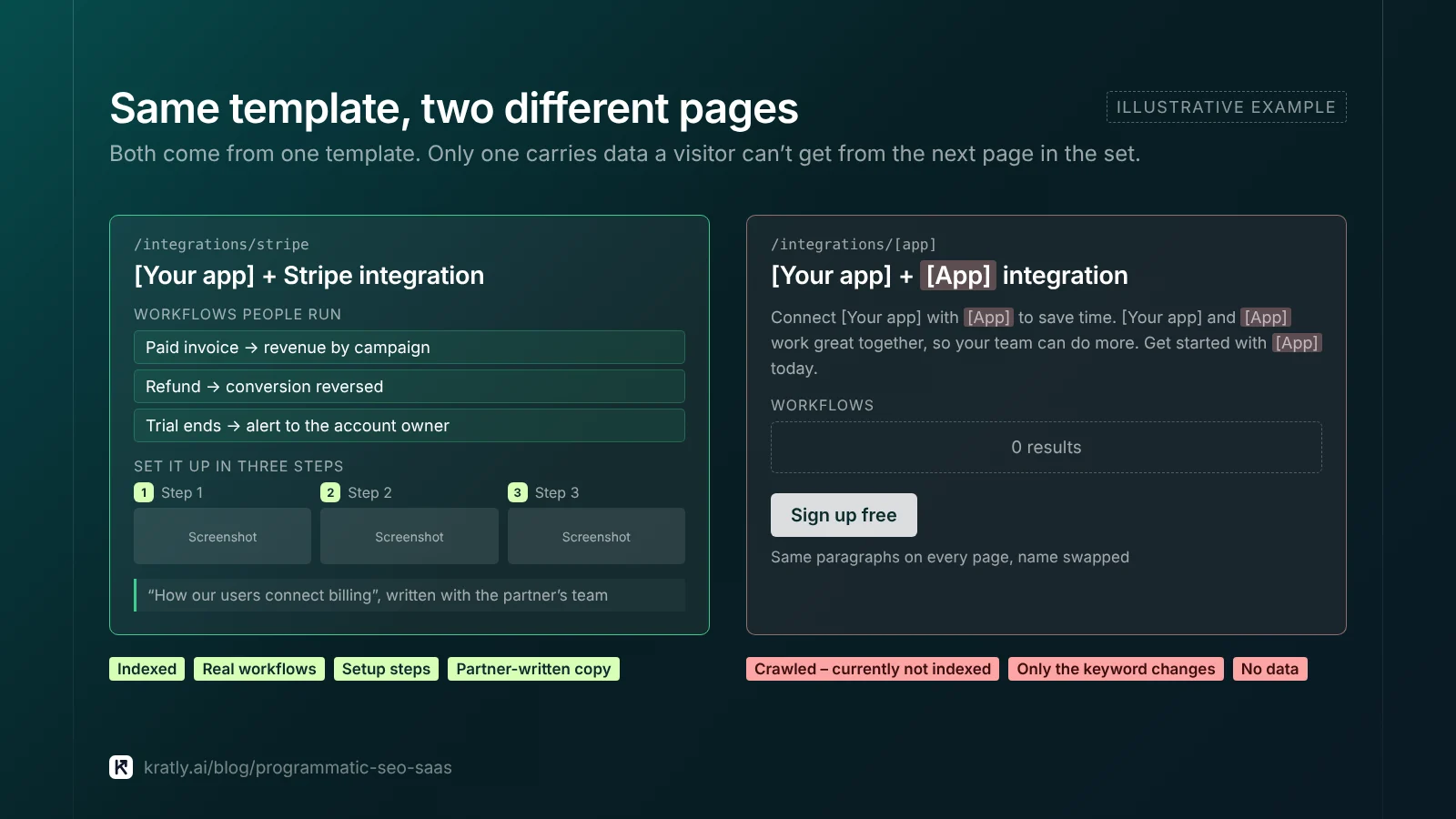
2. Unique data per page. Something a visitor can't get by reading the next page in the set. Zapier's partners wrote copy for their own app pages. Notion's template category pages show real templates. Canva's feature pages lead into a working tool. Ahrefs estimated about 600 Notion template pages bring roughly 204,000 monthly organic visits. About 310 Canva feature pages bring roughly 13 million (Ahrefs, updated Sept 2026; third-party estimates).
3. Useful without Google. Would you link to this page from your product or help center? If the only visitor you imagine is Googlebot, stop.
The trade-off: 200 pages that pass all three tests beat 5,000 that pass one, but cost far more per page.
One Indie Hackers founder built "200+ pages tailored to more complex use cases" in 2023. The pages "started ranking well for many keywords, and we secured a bunch of demos," he wrote. But he added: "Now the article generates more visits than all the programmatic SEO pages together" (Indie Hackers, 2023).
When Google ignores it: scaled content, doorways and thin templates#
Google's spam policies name the patterns directly (Google Search Central).
Scaled content abuse is "when many pages are generated for the primary purpose of manipulating search rankings." Google's examples include:
- "using generative AI tools or other similar tools to generate many pages without adding value for users"
- "scraping feeds, search results, or other content to generate many pages"
Doorway abuse is "when sites or pages are created to rank for specific, similar search queries." Examples include:
- "pages targeted at specific regions or cities that funnel users to one page"
- "substantially similar pages that are closer to search results than a clearly defined, browseable hierarchy"
Google's March 2024 core update targeted this kind of content. Google said it expected 45% less low-quality, unoriginal content in results (Google).
What about AI-written pages? Google's February 2023 guidance says it rewards helpful content however it's made. It also says using automation, AI included, mainly to manipulate rankings breaks its spam policies (Google Search Central). AI isn't the problem. Empty pages are.
Most thin sets never get a manual penalty. They fail quietly: Google crawls a sample, sees near-duplicates and leaves the rest unindexed.
Warning signs to look for before publishing:
- Pages differ only by the keyword in the H1 and title.
- Body copy is the same paragraphs with names swapped.
- Many pages have no data at all, or "0 results".
- The page exists only to send people to a sign-up form.
- You can't name a person who would bookmark it.
Read the indexing report before you scale#
Google Search Console's Page indexing report tells you how Google judged your set. Google says not to expect 100%: "Don't expect every URL on your site to be indexed" (Search Console Help).
| Status | Google's description | What it usually means for template pages | What I'd do |
|---|---|---|---|
| Crawled – currently not indexed | "The page was crawled by Google but not indexed." | Google looked and saw little new | Add unique data, or merge and remove pages |
| Discovered – currently not indexed | "The page was found by Google, but not crawled yet." | Google doesn't think the set is worth crawling yet | Fewer pages, stronger internal links |
| Duplicate without user-selected canonical | "This page is a duplicate of another page" without a preferred canonical | Pages too similar to each other | Merge, or set a canonical |
| Indexed | Page is in Google's index | Passed the first test | Now check clicks and revenue |
Each status is covered in Google not indexing my pages: causes and fixes by status.
What I'd check first: the share of the set that's indexed, not the raw count. Five hundred indexed out of 10,000 is a 5% rate. Google is sampling and rejecting most of it.
The programmatic SEO SaaS pilot: 20–50 pages first#
I'd never launch a full set on day one. A pilot costs a few weeks and saves you removing thin pages later.
- Pick the 20–50 pages with the most search demand and the richest data. Include a few weaker ones on purpose, so you learn where the line is.
- Build them to the standard you'd ship at scale. Same template, same data depth, server-rendered HTML. Jakub's team found a rendering bug served "Loading..." as the title to Googlebot, and indexing "dropped to single digits."
- Link them from real pages. Your integrations directory, help docs and related pages. Orphan pages in a sitemap are easy to ignore.
- Wait six to eight weeks. Then pull the Page indexing report for the pilot URLs.
- Measure three numbers: indexing rate, clicks per indexed page, and revenue per page from paying customers. Tie sign-ups to Stripe, not to form fills.
- Decide. Scale, fix, or stop.
My rule of thumb, not a Google threshold:
- Most pages indexed and some bring sign-ups that pay: scale in batches of 50–100, and keep measuring.
- Under half indexed: don't add pages. Add data to the ones you have, or cut the weak half.
- Indexed but no revenue after three months: the searches are real but the intent is wrong. Change the page's offer, or stop.
A pilot is mostly data work: collecting, cleaning and checking it. Put a number on your team's hours, then compare it with revenue per page. If a page earns $20 a month and costs four hours to build and maintain, that's a slow payback at most salaries.
For upkeep, see how to refresh old content to win back traffic and AI citations.
Programmatic SEO examples by page type#
| Page type | Search pattern | Unique data that earns indexing | Risk |
|---|---|---|---|
| Integration pages | "[you] + [app] integration" | Real workflows, setup steps, partner-written copy | Low if each integration exists |
| Template library | "[document] template" | The working template itself | Low to medium |
| Free tool outputs | "[thing] calculator", "[domain] checker" | A result the visitor can use | Low |
| Public data pages | "[metric] by [industry]" | Your own aggregated product data | Medium; needs enough data per page |
| Use case by industry | "[category] for [industry]" | Industry workflows, examples, proof | High; often swap-a-word pages |
| Location pages | "[service] in [city]" | Local facts, local customers | High; Google's doorway example |
| Combination pages | "[app A] + [app B] + [app C]" | Rarely any | High; Zapier's got near zero traffic |
Programmatic sets also feed AI answers. Google says pages need to be indexed and snippet-eligible to appear in its AI features (Google Search Central). An unindexed page can't be cited. Read our guide to getting cited in Google AI Overviews before scaling. And if your set targets buying-intent searches, start from the bottom-of-funnel SaaS SEO pages that bring revenue.
How to do this in Kratly#
- Run the free indexing checker on your pilot URLs to see which are indexed and which are stuck.
- Connect your site and Stripe. Kratly shows sign-ups, paying customers and revenue for each page in the set.
- Compare the pilot against your other pages. See revenue per page for programmatic pages next to your hand-written ones.
- Approve the next step. Kratly suggests which pages to improve, merge or scale. You approve each change, and changes are logged and reversible.
Questions, answered
Is programmatic SEO still worth it for SaaS in 2026?
Yes, when each page has real demand and unique data, like integration pages or template libraries. It's rarely worth it for swap-a-word pages by industry or city. Pilot 20–50 pages and measure indexing and revenue before you scale. Zapier's app pages are the classic proof.
Does Google penalize programmatic SEO?
No, not the method itself. Google targets scaled content abuse and doorway pages, which describe many pages made to rank without adding value. Most thin programmatic pages aren't penalized at all. Google crawls a sample, sees near-duplicates and leaves the rest unindexed.
Can I use AI to write programmatic pages?
Google says it rewards helpful content however it's produced, but using automation mainly to manipulate rankings breaks its spam policies. Its examples include AI-made pages that add no value for users. AI can format your data. It can't replace having data worth showing.
How many programmatic pages should I start with?
Start with 20–50. That's enough to see an indexing pattern and a few conversions, and small enough to fix or remove cheaply. Include a few weaker pages on purpose, so you learn where the line is. Wait six to eight weeks.
Why are my programmatic pages "crawled – currently not indexed"?
Google crawled them and chose not to index them. For template pages, that usually means they look too similar or add too little. Add unique data, merge near-duplicates and link the best pages from real navigation. Check the indexed share, not the raw count.
Written by
Priyansh Kumar
Priyansh Kumar has spent more than a decade in growth, scaling brands from 1 to 10 and from 10 to 100. He now builds Kratly, an autonomous growth team that ties every campaign, page and email to the revenue it brings.
Sources
- Indie Hackers: Jakub on which AI-built pages Google indexed (June 2026) · Panoramata programmatic SEO update (2022) · Momcilo Popov on programmatic SEO (2023)
- Ahrefs: Programmatic SEO · Zapier SEO case study
- Google Search Central: Spam policies · Guidance about AI-generated content (Feb 2023) · AI features and your website
- Google: March 2024 core update and spam policies
- Search Console Help: Page indexing report
Was this article useful?